Minimum Bipartite Groups (original) (raw)
Last Updated : 12 Jul, 2025
Given Adjacency List representation of graph of N vertices from 1 to N, the task is to count the minimum bipartite groups of the given graph.
Examples:
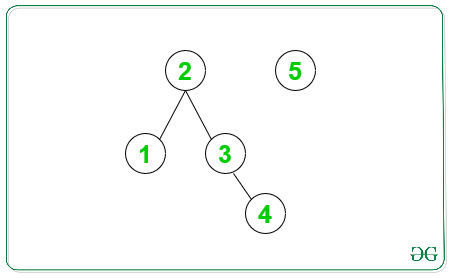
Input: N = 5
Below is the given graph with number of nodes is 5:
Output: 3
Explanation:
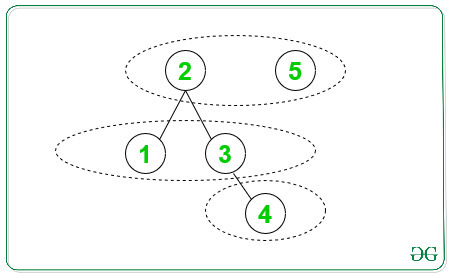
Possible groups satisfying the Bipartite property: [2, 5], [1, 3], [4]
Below is the number of bipartite groups can be formed:
Approach:
The idea is to find the maximum height of all the Connected Components in the given graph of N nodes to find the minimum bipartite groups. Below are the steps:
- For all the non-visited vertex in the given graph, find the height of the current Connected Components starting from the current vertex.
- Start DFS Traversal to find the height of all the Connected Components.
- The maximum of the heights calculated for all the Connected Components gives the minimum bipartite groups required.
Below is the implementation of the above approach:
C++ `
#include <bits/stdc++.h> using namespace std;
// Function to find the height sizeof // the current component with vertex s int height(int s, vector adj[], int* visited) { // Visit the current Node visited[s] = 1; int h = 0;
// Call DFS recursively to find the
// maximum height of current CC
for (auto& child : adj[s]) {

    // If the node is not visited
    // then the height recursively
    // for next element
    if (visited[child] == 0) {
        h = max(h, 1 + height(child, adj,
                              visited));
    }
}
return h;
}
// Function to find the minimum Groups int minimumGroups(vector adj[], int N) { // Initialise with visited array int visited[N + 1] = { 0 };
// To find the minimum groups
int groups = INT_MIN;

// Traverse all the non visited Node
// and calculate the height of the
// tree with current node as a head
for (int i = 1; i <= N; i++) {

    // If the current is not visited
    // therefore, we get another CC
    if (visited[i] == 0) {
        int comHeight;
        comHeight = height(i, adj, visited);
        groups = max(groups, comHeight);
    }
}

// Return the minimum bipartite matching
return groups;
}
// Function that adds the current edges // in the given graph void addEdge(vector adj[], int u, int v) { adj[u].push_back(v); adj[v].push_back(u); }
// Drivers Code int main() { int N = 5;
// Adjacency List
vector<int> adj[N + 1];

// Adding edges to List
addEdge(adj, 1, 2);
addEdge(adj, 3, 2);
addEdge(adj, 4, 3);

cout << minimumGroups(adj, N);
}
Java
import java.util.*;
class GFG{
// Function to find the height sizeof // the current component with vertex s static int height(int s, Vector adj[], int []visited) { // Visit the current Node visited[s] = 1; int h = 0;
// Call DFS recursively to find the
// maximum height of current CC
for (int  child : adj[s]) {

    // If the node is not visited
    // then the height recursively
    // for next element
    if (visited[child] == 0) {
        h = Math.max(h, 1 + height(child, adj,
                              visited));
    }
}
return h;
}
// Function to find the minimum Groups static int minimumGroups(Vector adj[], int N) { // Initialise with visited array int []visited= new int[N + 1];
// To find the minimum groups
int groups = Integer.MIN_VALUE;

// Traverse all the non visited Node
// and calculate the height of the
// tree with current node as a head
for (int i = 1; i <= N; i++) {

    // If the current is not visited
    // therefore, we get another CC
    if (visited[i] == 0) {
        int comHeight;
        comHeight = height(i, adj, visited);
        groups = Math.max(groups, comHeight);
    }
}

// Return the minimum bipartite matching
return groups;
}
// Function that adds the current edges // in the given graph static void addEdge(Vector adj[], int u, int v) { adj[u].add(v); adj[v].add(u); }
// Drivers Code public static void main(String[] args) { int N = 5;
// Adjacency List
Vector<Integer> []adj = new Vector[N + 1];
for (int i = 0 ; i < N + 1; i++)
    adj[i] = new Vector<Integer>();

// Adding edges to List
addEdge(adj, 1, 2);
addEdge(adj, 3, 2);
addEdge(adj, 4, 3);

System.out.print(minimumGroups(adj, N));
} }
// This code is contributed by 29AjayKumar
Python3
import sys
Function to find the height sizeof
the current component with vertex s
def height(s, adj, visited):
# Visit the current Node
visited[s] = 1
h = 0

# Call DFS recursively to find the
# maximum height of current CC
for child in adj[s]:

    # If the node is not visited
    # then the height recursively
    # for next element
    if (visited[child] == 0):
        h = max(h, 1 + height(child, adj,
                              visited))

return h
Function to find the minimum Groups
def minimumGroups(adj, N):
# Initialise with visited array
visited = [0 for i in range(N + 1)]

# To find the minimum groups
groups = -sys.maxsize

# Traverse all the non visited Node
# and calculate the height of the
# tree with current node as a head
for i in range(1, N + 1):

    # If the current is not visited
    # therefore, we get another CC
    if (visited[i] == 0):
        comHeight = height(i, adj, visited)
        groups = max(groups, comHeight)

# Return the minimum bipartite matching
return groups
Function that adds the current edges
in the given graph
def addEdge(adj, u, v):
adj[u].append(v)
adj[v].append(u)
Driver code
if name=="main":
N = 5

# Adjacency List
adj = [[] for i in range(N + 1)]

# Adding edges to List
addEdge(adj, 1, 2)
addEdge(adj, 3, 2)
addEdge(adj, 4, 3)

print(minimumGroups(adj, N))
This code is contributed by rutvik_56
C#
using System; using System.Collections.Generic;
class GFG{
// Function to find the height sizeof // the current component with vertex s static int height(int s, List []adj, int []visited) { // Visit the current Node visited[s] = 1; int h = 0;
// Call DFS recursively to find the
// maximum height of current CC
foreach (int  child in adj[s]) {

    // If the node is not visited
    // then the height recursively
    // for next element
    if (visited[child] == 0) {
        h = Math.Max(h, 1 + height(child, adj,
                              visited));
    }
}
return h;
}
// Function to find the minimum Groups static int minimumGroups(List []adj, int N) { // Initialise with visited array int []visited= new int[N + 1];
// To find the minimum groups
int groups = int.MinValue;

// Traverse all the non visited Node
// and calculate the height of the
// tree with current node as a head
for (int i = 1; i <= N; i++) {

    // If the current is not visited
    // therefore, we get another CC
    if (visited[i] == 0) {
        int comHeight;
        comHeight = height(i, adj, visited);
        groups = Math.Max(groups, comHeight);
    }
}

// Return the minimum bipartite matching
return groups;
}
// Function that adds the current edges // in the given graph static void addEdge(List []adj, int u, int v) { adj[u].Add(v); adj[v].Add(u); }
// Drivers Code public static void Main(String[] args) { int N = 5;
// Adjacency List
List<int> []adj = new List<int>[N + 1];
for (int i = 0 ; i < N + 1; i++)
    adj[i] = new List<int>();

// Adding edges to List
addEdge(adj, 1, 2);
addEdge(adj, 3, 2);
addEdge(adj, 4, 3);

Console.Write(minimumGroups(adj, N));
} }
// This code is contributed by Rajput-Ji
JavaScript
`
Time Complexity: O(V+E), where V is the number of vertices and E is the set of edges.
Auxiliary Space: O(V).