Minimum cost to provide water (original) (raw)
Last Updated : 23 Jul, 2025
Given an integer **N, where **N denotes the number of villages numbered **1 to **N, an array **wells[] where **wells[i] denotes the cost to build a water well in the *i'th city, a 2D array pipes in form of [X Y C*] which denotes that the cost to connect village **X and **Y with water pipes is **C. Your task is to provide water to each and every village either by building a well in the village or connecting it to some other village having water. Find the minimum cost to do so.
**Examples:
**Input: N=3, wells=[1, 2, 2], pipes=[[1 2 1], [2 3 1]]
**Output: 3
**Explanation: Build well in village1 to provide water with cost=1
connect village2 and village1 with cost =1 , now village1 and village2 have water.
Finally connect village3 with village2 with cost=1 , now all the villages have water with total cost=3.**Input: N=4, wells[1, 1, 1, 1], pipes=[[1 2 100], [2 3 100], [2 4 50]]
**Output: 4
**Explanation: Clearly its better to construct well at each village rather than building costly roads. Hence total cost=1+1+1+1=4.
**Minimum Cost to provide water using Kruskal’s Minimum Spanning Tree (MST) Algorithm & Disjoint Set Union:
We can create a graph with villages as vertices and use pipes array to form edges between these villages, also we need to construct a pseudo vertex that is connected to each and every village ****'i'** with an edges weight of wells[i] , in this way we can take care of cost of building the pipes and wells simultaneously. The **MST cost of this graph will give us our answer i.e. the minimum cost to provide water to each village.
**Illustration:
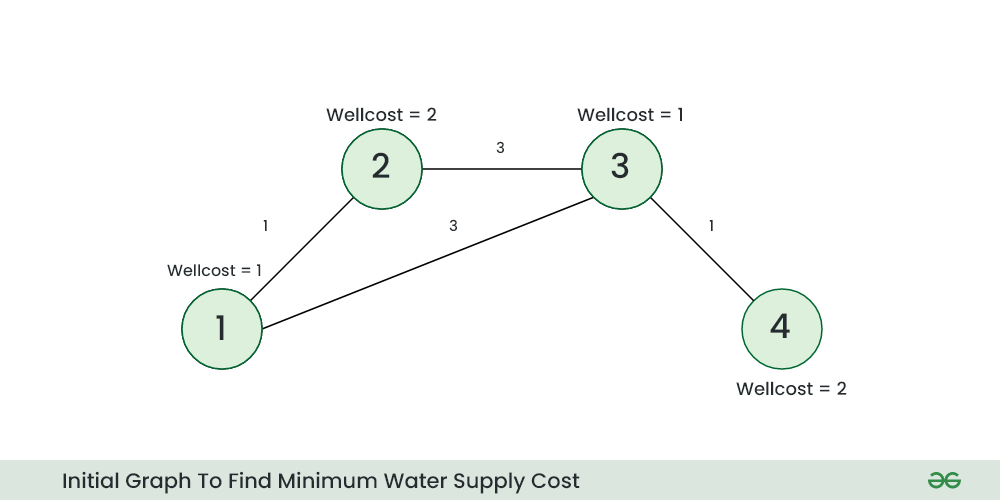
Suppose, N=4, wells[1, 2, 1, 2], pipes=[[1 2 1], [1 3 3],[2 3 3], [3 4 1]]
**Step 1: We construct the graph with villages as the vertex and use **pipes array to form edges as shown in **fig-1
fig-1
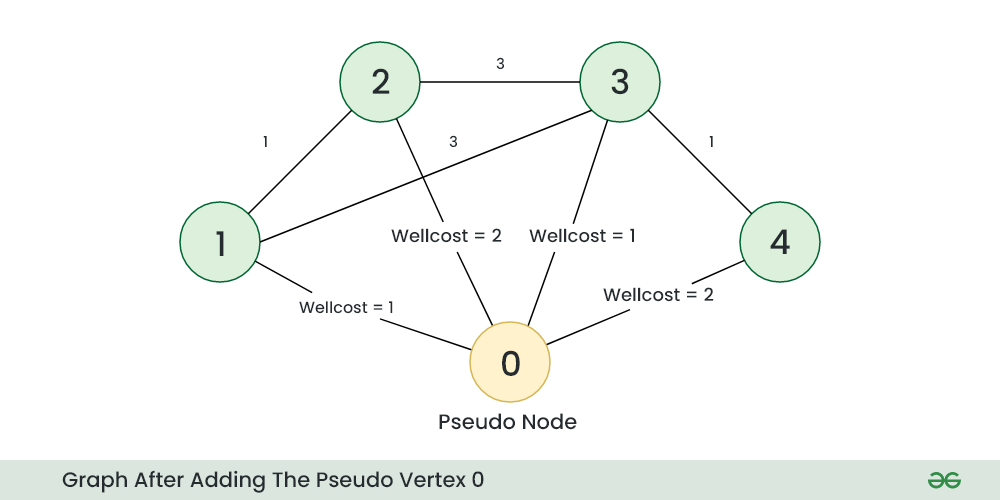
**Step 2: Create a **pseudo node (**0) and add edges from **0 to all other vertices from **1 to **N , assign edge weight as wells[i] , for each '**i' 1 to N.
fig-2
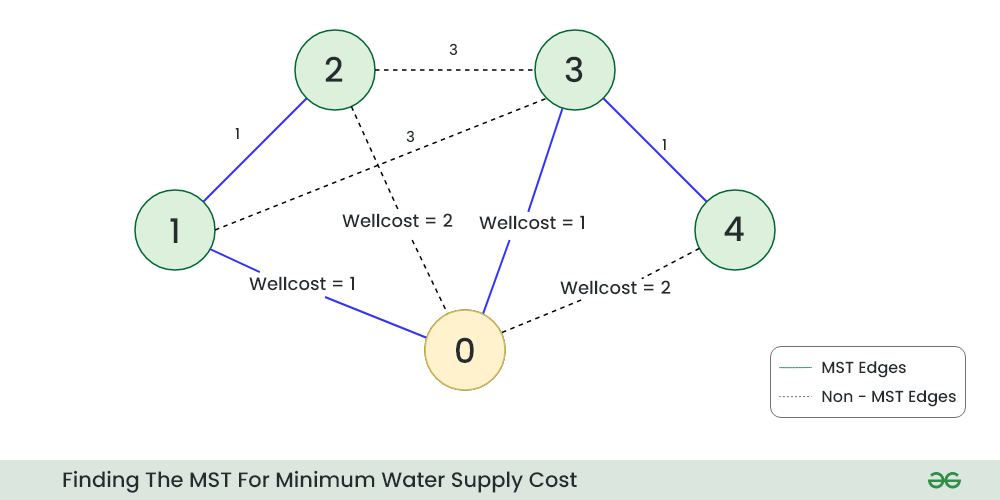
**Step 3: Find the MST of the above graph and return the MST cost= 1+1+1+1= 4 as the answer.
fig-3
Step-by-step algorithm:
- Firstly initialize the DSU data structure i.e. **make(), **find(), **Union(), and **parent array.
- Create a set ****'st'** to store the edges sorted in ascending order on the basis of edge weight.
- Insert the edges in ****'st'** using the pipes array.
- Edges between villages(**1 to N) and pseudo vertex(**0) have to be inserted with **edge weight=wells[i] for each village ****'i'**.
- Apply Kruskal's MST algorithm on the set '**st'.
- return the MST cost as the answer.
Below is the implementation of the above algorithm:
C++ `
// C++ code for the above approach: #include <bits/stdc++.h> using namespace std;
// Parent array to store parent of // each component of DSU. int parent[1001];
// sizez array to apply DSU by size. int sizez[1001];
// This function is used to initialize // the DSU. void make(int i) { parent[i] = i; sizez[i] = 1; }
// This function is used to find the // parent of each component of DSU int find(int v) { if (v == parent[v]) return v; return parent[v] = find(parent[v]); }
// This function is used to merge two // components of DSU. void Union(int a, int b) {
// Finding the parents of vertex
// a and b
a = find(a);
b = find(b);

// If parents are not equal
if (a != b) {
    if (sizez[a] < sizez[b])
        swap(a, b);
    parent[b] = a;

    // Apply DSU by size
    sizez[a] += sizez[b];
}
}
// Funtion to solve the problem int minCostToProvideWater(int n, vector& wells, vector<vector >& pipes) {
// set to store the edges sorted on
// the basis of weights.
set<vector<int> > st;

// Inserting the edges into the set
for (auto e : pipes) {
    int u = e[0];
    int v = e[1];
    int wt = e[2];
    st.insert({ wt, u, v });
}

// Inserting the edges created by the
// pseudo vertex i.e. 0
for (int i = 0; i < n; i++) {
    st.insert({ wells[i], 0, i + 1 });
}

// Initializing the DSU
for (int i = 0; i <= n; i++) {
    make(i);
}

int answer = 0;

// Applying Krushkal's MST algorithm
while (st.size()) {
    auto it = st.begin();
    int wt = (*it)[0];
    int u = (*it)[1];
    int v = (*it)[2];
    if (find(u) != find(v)) {
        answer += wt;
        Union(u, v);
    }
    st.erase(st.begin());
}
return answer;
}
// Driver Function int main() { int N = 3; vector wells = { 1, 2, 2 }; vector<vector > pipes = { { 1, 2, 1 }, { 2, 3, 1 } };
// Function call
cout << minCostToProvideWater(N, wells, pipes);
return 0;
}
Java
// Java program for the above approach
import java.util.*;
public class Main {
// Parent array to store parent of
// each component of DSU.
static int[] parent = new int[1001];

// sizez array to apply DSU by size.
static int[] sizez = new int[1001];

// This function is used to initialize
// the DSU.
static void make(int i) {
    parent[i] = i;
    sizez[i] = 1;
}

// This function is used to find the
// parent of each component of DSU
static int find(int v) {
    if (v == parent[v])
        return v;
    return parent[v] = find(parent[v]);
}

// This function is used to merge two
// components of DSU.
static void Union(int a, int b) {

    // Finding the parents of vertex
    // a and b
    a = find(a);
    b = find(b);

    // If parents are not equal
    if (a != b) {
        if (sizez[a] < sizez[b]){
            int temp = a;
            a = b;
            b = temp;
        }
        parent[b] = a;

        // Apply DSU by size
        sizez[a] += sizez[b];
    }
}

// Function to solve the problem
static int minCostToProvideWater(int n,
                                 List<Integer> wells,
                                 List<List<Integer>> pipes) {

    // set to store the edges sorted on
    // the basis of weights.
    TreeSet<List<Integer>> st = new TreeSet<>(new Comparator<List<Integer>>() {
        @Override
        public int compare(List<Integer> a, List<Integer> b) {
            return a.get(0).compareTo(b.get(0));
        }
    });

    // Inserting the edges into the set
    for (List<Integer> e : pipes) {
        int u = e.get(0);
        int v = e.get(1);
        int wt = e.get(2);
        st.add(Arrays.asList(wt, u, v));
    }

    // Inserting the edges created by the
    // pseudo vertex i.e. 0
    for (int i = 0; i < n; i++) {
        st.add(Arrays.asList(wells.get(i), 0, i + 1));
    }

    // Initializing the DSU
    for (int i = 0; i <= n; i++) {
        make(i);
    }

    int answer = 0;

    // Applying Kruskal's MST algorithm
    while (!st.isEmpty()) {
        List<Integer> it = st.pollFirst();
        int wt = it.get(0);
        int u = it.get(1);
        int v = it.get(2);
        if (find(u) != find(v)) {
            answer += wt;
            Union(u, v);
        }
    }
    return answer;
}

// Driver Function
public static void main(String[] args) {
    int N = 3;
    List<Integer> wells = Arrays.asList(1, 2, 2);
    List<List<Integer>> pipes = Arrays.asList(
            Arrays.asList(1, 2, 1),
            Arrays.asList(2, 3, 1)
    );

    // Function call
    System.out.println(minCostToProvideWater(N, wells, pipes));
}
}
// This code is contributed by Abhinav Mahajan (abhinav_m22).
Python
import heapq
This function is used to initialize the DSU.
def make(i, parent, sizez): parent[i] = i sizez[i] = 1
This function is used to find the parent of each component of DSU
def find(v, parent): if v == parent[v]: return v parent[v] = find(parent[v], parent) return parent[v]
This function is used to merge two components of DSU
def union(a, b, parent, sizez): a = find(a, parent) b = find(b, parent) if a != b: if sizez[a] < sizez[b]: a, b = b, a parent[b] = a sizez[a] += sizez[b]
Function to solve the problem
def min_cost_to_provide_water(n, wells, pipes): edges = []
# Inserting the edges into the heap sorted by weights
for pipe in pipes:
    u, v, wt = pipe
    edges.append((wt, u, v))

# Inserting the edges created by the pseudo-vertex i.e., 0
for i in range(n):
    edges.append((wells[i], 0, i + 1))

# Initializing DSU
parent = [0] * (n + 1)
sizez = [0] * (n + 1)
for i in range(n + 1):
    make(i, parent, sizez)

answer = 0

# Applying Kruskal's MST algorithm
edges.sort()
for edge in edges:
    wt, u, v = edge
    if find(u, parent) != find(v, parent):
        answer += wt
        union(u, v, parent, sizez)

return answer
Driver Function
if name == "main": N = 3 wells = [1, 2, 2] pipes = [ (1, 2, 1), (2, 3, 1) ]
# Function call
print(min_cost_to_provide_water(N, wells, pipes))
C#
using System; using System.Collections.Generic;
class GFG { // Parent array to store parent of // each component of DSU. static int[] parent = new int[1001]; // Size array to apply DSU by size. static int[] sizez = new int[1001]; // This function is used to initialize the DSU. static void Make(int i) { parent[i] = i; sizez[i] = 1; } // This function is used to find the parent of // each component of DSU. static int Find(int v) { if (v == parent[v]) return v; return parent[v] = Find(parent[v]); } // This function is used to merge // two components of DSU. static void Union(int a, int b) { // Finding the parents of vertex a and b a = Find(a); b = Find(b); // If parents are not equal if (a != b) { if (sizez[a] < sizez[b]) (a, b) = (b, a); parent[b] = a; // Apply DSU by size sizez[a] += sizez[b]; } } // Function to solve the problem static int MinCostToProvideWater(int n, List wells, List<List> pipes) { // Using SortedSet to store the // edges sorted on the basis of weights. SortedSet<List> st = new SortedSet<List>(new Geek()); // Inserting the edges into the set foreach (var e in pipes) { int u = e[0]; int v = e[1]; int wt = e[2]; st.Add(new List() { wt, u, v }); } // Inserting the edges created by the pseudo vertex i.e. 0 for (int i = 0; i < n; i++) { st.Add(new List() { wells[i], 0, i + 1 }); } // Initializing the DSU for (int i = 0; i <= n; i++) { Make(i); } int answer = 0; // Applying Kruskal's MST algorithm while (st.Count > 0) { var it = st.Min; int wt = it[0]; int u = it[1]; int v = it[2]; if (Find(u) != Find(v)) { answer += wt; Union(u, v); } st.Remove(it); }
    return answer;
}
// Custom comparer to sort
// the edges based on weights
public class Geek : IComparer<List<int>>
{
    public int Compare(List<int> a, List<int> b)
    {
        return a[0].CompareTo(b[0]);
    }
}
// Driver Function
static void Main()
{
    int N = 3;
    List<int> wells = new List<int>() { 1, 2, 2 };
    List<List<int>> pipes = new List<List<int>> { new List<int> { 1, 2, 1 }, new List<int> { 2, 3, 1 } };
    // Function call
    Console.WriteLine(MinCostToProvideWater(N, wells, pipes));
}
}
JavaScript
// JavaScript code for the above approach:
// Parent array to store parent of // each component of DSU. let parent = new Array(1001); // sizez array to apply DSU by size. let sizez = new Array(1001); // This function is used to initialize // the DSU. function make(i) { parent[i] = i; sizez[i] = 1; } // This function is used to find the // parent of each component of DSU function find(v) { if (v == parent[v]) return v; return parent[v] = find(parent[v]); }
// This function is used to merge two // components of DSU. function Union(a, b) {
// Finding the parents of vertex // a and b a = find(a); b = find(b);
// If parents are not equal if (a != b) { if (sizez[a] < sizez[b]) [a, b] = [b, a]; parent[b] = a;
// Apply DSU by size
sizez[a] += sizez[b];
} }
// Funtion to solve the problem function minCostToProvideWater(n, wells, pipes) {
// set to store the edges sorted on // the basis of weights. let st = new Set();
// Inserting the edges into the set for (let e of pipes) { let u = e[0]; let v = e[1]; let wt = e[2]; st.add([wt, u, v]); }
// Inserting the edges created by the // pseudo vertex i.e. 0 for (let i = 0; i < n; i++) { st.add([wells[i], 0, i + 1]); }
// Initializing the DSU for (let i = 0; i <= n; i++) { make(i); } let answer = 0;
// Applying Krushkal's MST algorithm while (st.size) { let it = st.values().next().value; let wt = it[0]; let u = it[1]; let v = it[2]; if (find(u) != find(v)) { answer += wt; Union(u, v); } st.delete(it); } return answer; } let N = 3; let wells = [1, 2, 2]; let pipes = [[1, 2, 1], [2, 3, 1]]; console.log(minCostToProvideWater(N, wells, pipes));
`
**Time Complexity: O(E*log(N)), where **E is the number of edges and **N is the number of vertices in the formed graph.
**Auxiliary Space: O(N)