Minimum Product Spanning Tree (original) (raw)
Last Updated : 20 Feb, 2023
Given a connected and undirected graph, a spanning tree of that graph is a subgraph that is a tree and connects all the vertices together. A single graph can have many different spanning trees. A minimum product spanning tree for a weighted, connected, and undirected graph is a spanning tree with a weight product less than or equal to the weight product of every other spanning tree. The weight product of a spanning tree is the product of weights corresponding to each edge of the spanning tree. All weights of the given graph will be positive for simplicity.
Examples:
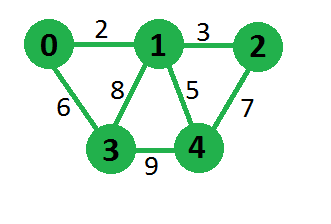
Minimum Product that we can obtain is 180 for above graph by choosing edges 0-1, 1-2, 0-3 and 1-4
This problem can be solved using standard minimum spanning tree algorithms like Kruskal (https://www.geeksforgeeks.org/dsa/kruskals-minimum-spanning-tree-algorithm-greedy-algo-2/)and prim’s algorithm, but we need to modify our graph to use these algorithms. Minimum spanning tree algorithms tries to minimize the total sum of weights, here we need to minimize the total product of weights. We can use the property of logarithms to overcome this problem.
As we know,
log(w1* w2 * w3 * …. * wN) = log(w1) + log(w2) + log(w3) ….. + log(wN)
We can replace each weight of the graph by its log value, then we apply any minimum spanning tree algorithm which will try to minimize the sum of log(wi) which in turn minimizes the weight product.
For example graph, the steps are shown below diagram,
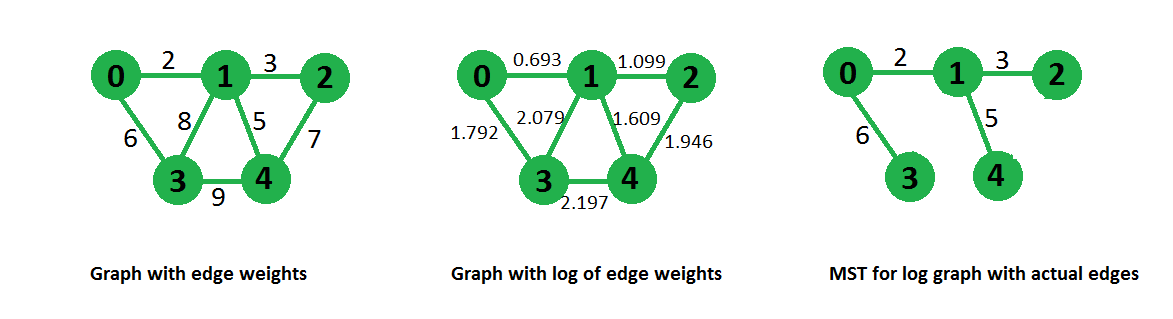
In the below code first, we have constructed the log graph from the given input graph, then that graph is given as input to prim’s MST algorithm, which will minimize the total sum of weights of the tree. Since weights of the modified graph are logarithms of the actual input graph, we actually minimize the product of weights of the spanning tree.
C++ `
// A C++ program for getting minimum product // spanning tree The program is for adjacency matrix // representation of the graph #include <bits/stdc++.h>
// Number of vertices in the graph #define V 5
// A utility function to find the vertex with minimum // key value, from the set of vertices not yet included // in MST int minKey(int key[], bool mstSet[]) { // Initialize min value int min = INT_MAX, min_index;
for (int v = 0; v < V; v++)
    if (mstSet[v] == false && key[v] < min)
        min = key[v], min_index = v;

return min_index;
}
// A utility function to print the constructed MST // stored in parent[] and print Minimum Obtainable // product int printMST(int parent[], int n, int graph[V][V]) { printf("Edge Weight\n"); int minProduct = 1; for (int i = 1; i < V; i++) { printf("%d - %d %d \n", parent[i], i, graph[i][parent[i]]);
    minProduct *= graph[i][parent[i]];
}
printf("Minimum Obtainable product is %d\n",
       minProduct);
}
// Function to construct and print MST for a graph // represented using adjacency matrix representation // inputGraph is sent for printing actual edges and // logGraph is sent for actual MST operations void primMST(int inputGraph[V][V], double logGraph[V][V]) { int parent[V]; // Array to store constructed MST int key[V]; // Key values used to pick minimum // weight edge in cut bool mstSet[V]; // To represent set of vertices not // yet included in MST
// Initialize all keys as INFINITE
for (int i = 0; i < V; i++)
    key[i] = INT_MAX, mstSet[i] = false;

// Always include first 1st vertex in MST.
key[0] = 0; // Make key 0 so that this vertex is
// picked as first vertex
parent[0] = -1; // First node is always root of MST

// The MST will have V vertices
for (int count = 0; count < V - 1; count++) {
    // Pick the minimum key vertex from the set of
    // vertices not yet included in MST
    int u = minKey(key, mstSet);

    // Add the picked vertex to the MST Set
    mstSet[u] = true;

    // Update key value and parent index of the
    // adjacent vertices of the picked vertex.
    // Consider only those vertices which are not yet
    // included in MST
    for (int v = 0; v < V; v++)

        // logGraph[u][v] is non zero only for
        // adjacent vertices of m mstSet[v] is false
        // for vertices not yet included in MST
        // Update the key only if logGraph[u][v] is
        // smaller than key[v]
        if (logGraph[u][v] > 0 && mstSet[v] == false && logGraph[u][v] < key[v])

            parent[v] = u, key[v] = logGraph[u][v];
}

// print the constructed MST
printMST(parent, V, inputGraph);
}
// Method to get minimum product spanning tree void minimumProductMST(int graph[V][V]) { double logGraph[V][V];
// Constructing logGraph from original graph
for (int i = 0; i < V; i++) {
    for (int j = 0; j < V; j++) {
        if (graph[i][j] > 0)
            logGraph[i][j] = log(graph[i][j]);
        else
            logGraph[i][j] = 0;
    }
}

// Applying standard Prim's MST algorithm on
// Log graph.
primMST(graph, logGraph);
}
// driver program to test above function int main() { /* Let us create the following graph 2 3 (0)--(1)--(2) | / \ | 6| 8/ \5 |7 | / \ | (3)-------(4) 9 */ int graph[V][V] = { { 0, 2, 0, 6, 0 }, { 2, 0, 3, 8, 5 }, { 0, 3, 0, 0, 7 }, { 6, 8, 0, 0, 9 }, { 0, 5, 7, 9, 0 }, };
// Print the solution
minimumProductMST(graph);

return 0;
}
Java
// A Java program for getting minimum product // spanning tree The program is for adjacency matrix // representation of the graph import java.util.*;
class GFG {
// Number of vertices in the graph
static int V = 5;

// A utility function to find the vertex with minimum
// key value, from the set of vertices not yet included
// in MST
static int minKey(int key[], boolean[] mstSet)
{
    // Initialize min value
    int min = Integer.MAX_VALUE, min_index = 0;

    for (int v = 0; v < V; v++) {
        if (mstSet[v] == false && key[v] < min) {
            min = key[v];
            min_index = v;
        }
    }
    return min_index;
}

// A utility function to print the constructed MST
// stored in parent[] and print Minimum Obtainable
// product
static void printMST(int parent[], int n, int graph[][])
{
    System.out.printf("Edge Weight\n");
    int minProduct = 1;
    for (int i = 1; i < V; i++) {
        System.out.printf("%d - %d %d \n",
                          parent[i], i, graph[i][parent[i]]);

        minProduct *= graph[i][parent[i]];
    }
    System.out.printf("Minimum Obtainable product is %d\n",
                      minProduct);
}

// Function to construct and print MST for a graph
// represented using adjacency matrix representation
// inputGraph is sent for printing actual edges and
// logGraph is sent for actual MST operations
static void primMST(int inputGraph[][], double logGraph[][])
{
    int[] parent = new int[V]; // Array to store constructed MST
    int[] key = new int[V]; // Key values used to pick minimum
    // weight edge in cut
    boolean[] mstSet = new boolean[V]; // To represent set of vertices not
    // yet included in MST

    // Initialize all keys as INFINITE
    for (int i = 0; i < V; i++) {
        key[i] = Integer.MAX_VALUE;
        mstSet[i] = false;
    }
    // Always include first 1st vertex in MST.
    key[0] = 0; // Make key 0 so that this vertex is
    // picked as first vertex
    parent[0] = -1; // First node is always root of MST

    // The MST will have V vertices
    for (int count = 0; count < V - 1; count++) {
        // Pick the minimum key vertex from the set of
        // vertices not yet included in MST
        int u = minKey(key, mstSet);

        // Add the picked vertex to the MST Set
        mstSet[u] = true;

        // Update key value and parent index of the
        // adjacent vertices of the picked vertex.
        // Consider only those vertices which are not yet
        // included in MST
        for (int v = 0; v < V; v++) // logGraph[u][v] is non zero only for
        // adjacent vertices of m mstSet[v] is false
        // for vertices not yet included in MST
        // Update the key only if logGraph[u][v] is
        // smaller than key[v]
        {
            if (logGraph[u][v] > 0
                && mstSet[v] == false
                && logGraph[u][v] < key[v]) {

                parent[v] = u;
                key[v] = (int)logGraph[u][v];
            }
        }
    }

    // print the constructed MST
    printMST(parent, V, inputGraph);
}

// Method to get minimum product spanning tree
static void minimumProductMST(int graph[][])
{
    double[][] logGraph = new double[V][V];

    // Constructing logGraph from original graph
    for (int i = 0; i < V; i++) {
        for (int j = 0; j < V; j++) {
            if (graph[i][j] > 0) {
                logGraph[i][j] = Math.log(graph[i][j]);
            }
            else {
                logGraph[i][j] = 0;
            }
        }
    }

    // Applying standard Prim's MST algorithm on
    // Log graph.
    primMST(graph, logGraph);
}

// Driver code
public static void main(String[] args)
{
    /* Let us create the following graph
    2 3
(0)--(1)--(2)
    | / \ |
6| 8/ \5 |7
    | /     \ |
(3)-------(4)
        9         */
    int graph[][] = {
        { 0, 2, 0, 6, 0 },
        { 2, 0, 3, 8, 5 },
        { 0, 3, 0, 0, 7 },
        { 6, 8, 0, 0, 9 },
        { 0, 5, 7, 9, 0 },
    };

    // Print the solution
    minimumProductMST(graph);
}
}
// This code has been contributed by 29AjayKumar
Python3
A Python3 program for getting minimum
product spanning tree The program is
for adjacency matrix representation
of the graph
import math
Number of vertices in the graph
V = 5
A utility function to find the vertex
with minimum key value, from the set
of vertices not yet included in MST
def minKey(key, mstSet):
# Initialize min value
min = 10000000
min_index = 0

for v in range(V):

    if (mstSet[v] == False and
           key[v] < min):
        min = key[v]
        min_index = v

return min_index
A utility function to print the constructed
MST stored in parent[] and print Minimum
Obtainable product
def printMST(parent, n, graph):
print("Edge Weight")
minProduct = 1

for i in range(1, V):
    print("{} - {}   {} ".format(parent[i], i,
                        graph[i][parent[i]]))
    minProduct *= graph[i][parent[i]]

print("Minimum Obtainable product is {}".format(
      minProduct))
Function to construct and print MST for
a graph represented using adjacency
matrix representation inputGraph is
sent for printing actual edges and
logGraph is sent for actual MST
operations
def primMST(inputGraph, logGraph):
# Array to store constructed MST
parent = [0 for i in range(V)]

# Key values used to pick minimum
key = [10000000 for i in range(V)]

# weight edge in cut
# To represent set of vertices not
mstSet = [False for i in range(V)]

# Yet included in MST
# Always include first 1st vertex in MST

# Make key 0 so that this vertex is
key[0] = 0

# Picked as first vertex

# First node is always root of MST
parent[0] = -1

# The MST will have V vertices
for count in range(0, V - 1):

    # Pick the minimum key vertex from
    # the set of vertices not yet
    # included in MST
    u = minKey(key, mstSet)

    # Add the picked vertex to the MST Set
    mstSet[u] = True

    # Update key value and parent index
    # of the adjacent vertices of the
    # picked vertex. Consider only those
    # vertices which are not yet
    # included in MST
    for v in range(V):

        # logGraph[u][v] is non zero only
        # for adjacent vertices of m
        # mstSet[v] is false for vertices
        # not yet included in MST. Update
        # the key only if logGraph[u][v] is
        # smaller than key[v]
        if (logGraph[u][v] > 0 and
            mstSet[v] == False and
            logGraph[u][v] < key[v]):
            parent[v] = u
            key[v] = logGraph[u][v]

# Print the constructed MST
printMST(parent, V, inputGraph)
Method to get minimum product spanning tree
def minimumProductMST(graph):
logGraph = [[0 for j in range(V)]
               for i in range(V)]

# Constructing logGraph from
# original graph
for i in range(V):
    for j in range(V):
        if (graph[i][j] > 0):
            logGraph[i][j] = math.log(graph[i][j])
        else:
            logGraph[i][j] = 0

# Applying standard Prim's MST algorithm
# on Log graph.
primMST(graph, logGraph)
Driver code
if name=='main':
''' Let us create the following graph
    2 3
(0)--(1)--(2)
    | / \ |
6| 8/ \5 |7
    | /     \ |
(3)-------(4)
        9         '''
graph = [ [ 0, 2, 0, 6, 0 ],
          [ 2, 0, 3, 8, 5 ],
          [ 0, 3, 0, 0, 7 ],
          [ 6, 8, 0, 0, 9 ],
          [ 0, 5, 7, 9, 0 ], ]

# Print the solution
minimumProductMST(graph)
This code is contributed by rutvik_56
C#
// C# program for getting minimum product // spanning tree The program is for adjacency matrix // representation of the graph using System;
class GFG {
// Number of vertices in the graph
static int V = 5;

// A utility function to find the vertex with minimum
// key value, from the set of vertices not yet included
// in MST
static int minKey(int[] key, Boolean[] mstSet)
{
    // Initialize min value
    int min = int.MaxValue, min_index = 0;

    for (int v = 0; v < V; v++) {
        if (mstSet[v] == false && key[v] < min) {
            min = key[v];
            min_index = v;
        }
    }
    return min_index;
}

// A utility function to print the constructed MST
// stored in parent[] and print Minimum Obtainable
// product
static void printMST(int[] parent, int n, int[, ] graph)
{
    Console.Write("Edge Weight\n");
    int minProduct = 1;
    for (int i = 1; i < V; i++) {
        Console.Write("{0} - {1} {2} \n",
                      parent[i], i, graph[i, parent[i]]);

        minProduct *= graph[i, parent[i]];
    }
    Console.Write("Minimum Obtainable product is {0}\n",
                  minProduct);
}

// Function to construct and print MST for a graph
// represented using adjacency matrix representation
// inputGraph is sent for printing actual edges and
// logGraph is sent for actual MST operations
static void primMST(int[, ] inputGraph, double[, ] logGraph)
{
    int[] parent = new int[V]; // Array to store constructed MST
    int[] key = new int[V]; // Key values used to pick minimum
    // weight edge in cut
    Boolean[] mstSet = new Boolean[V]; // To represent set of vertices not
    // yet included in MST

    // Initialize all keys as INFINITE
    for (int i = 0; i < V; i++) {
        key[i] = int.MaxValue;
        mstSet[i] = false;
    }
    // Always include first 1st vertex in MST.
    key[0] = 0; // Make key 0 so that this vertex is
    // picked as first vertex
    parent[0] = -1; // First node is always root of MST

    // The MST will have V vertices
    for (int count = 0; count < V - 1; count++) {
        // Pick the minimum key vertex from the set of
        // vertices not yet included in MST
        int u = minKey(key, mstSet);

        // Add the picked vertex to the MST Set
        mstSet[u] = true;

        // Update key value and parent index of the
        // adjacent vertices of the picked vertex.
        // Consider only those vertices which are not yet
        // included in MST
        for (int v = 0; v < V; v++) // logGraph[u, v] is non zero only for
        // adjacent vertices of m mstSet[v] is false
        // for vertices not yet included in MST
        // Update the key only if logGraph[u, v] is
        // smaller than key[v]
        {
            if (logGraph[u, v] > 0
                && mstSet[v] == false
                && logGraph[u, v] < key[v]) {

                parent[v] = u;
                key[v] = (int)logGraph[u, v];
            }
        }
    }

    // print the constructed MST
    printMST(parent, V, inputGraph);
}

// Method to get minimum product spanning tree
static void minimumProductMST(int[, ] graph)
{
    double[, ] logGraph = new double[V, V];

    // Constructing logGraph from original graph
    for (int i = 0; i < V; i++) {
        for (int j = 0; j < V; j++) {
            if (graph[i, j] > 0) {
                logGraph[i, j] = Math.Log(graph[i, j]);
            }
            else {
                logGraph[i, j] = 0;
            }
        }
    }

    // Applying standard Prim's MST algorithm on
    // Log graph.
    primMST(graph, logGraph);
}

// Driver code
public static void Main(String[] args)
{
    /* Let us create the following graph
    2 3
(0)--(1)--(2)
    | / \ |
6| 8/ \5 |7
    | /     \ |
(3)-------(4)
        9         */
    int[, ] graph = {
        { 0, 2, 0, 6, 0 },
        { 2, 0, 3, 8, 5 },
        { 0, 3, 0, 0, 7 },
        { 6, 8, 0, 0, 9 },
        { 0, 5, 7, 9, 0 },
    };

    // Print the solution
    minimumProductMST(graph);
}
} /* This code contributed by PrinciRaj1992 */
JavaScript
`
Output:
Edge Weight 0 - 1 2 1 - 2 3 0 - 3 6 1 - 4 5 Minimum Obtainable product is 180
The time complexity of this algorithm is O(V2) as there are two nested for loops which iterate over all the vertices.
The space complexity of this algorithm is O(V2), as we are using a 2-D array of size V x V to store the input graph.