Minimum spanning tree cost of given Graphs (original) (raw)
Last Updated : 11 Jul, 2025
Given an undirected graph of V nodes (V > 2) named V1, V2, V3, ..., Vn. Two nodes Vi and Vj are connected to each other if and only if 0 < | i - j | ? 2. Each edge between any vertex pair (Vi, Vj) is assigned a weight i + j. The task is to find the cost of the minimum spanning tree of such graph with V nodes.
Examples:
Input: V = 4
Output: 13
Input: V = 5
Output: 21
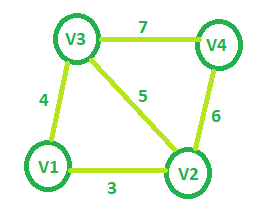
Approach:
Starting with a graph with minimum nodes (i.e. 3 nodes), the cost of the minimum spanning tree will be 7. Now for every node i starting from the fourth node which can be added to this graph, ith node can only be connected to (i - 1)th and (i - 2)th node and the minimum spanning tree will only include the node with the minimum weight so the newly added edge will have the weight i + (i - 2).
So addition of fourth node will increase the overall weight as 7 + (4 + 2) = 13
Similarly adding fifth node, weight = 13 + (5 + 3) = 21
...
For nth node, weight = weight + (n + (n - 2)).
This can be generalized as weight = V2 - V + 1 where V is the total nodes in the graph.
Below is the implementation of the above approach:
C++ `
// C++ implementation of the approach #include <bits/stdc++.h> using namespace std;
// Function that returns the minimum cost // of the spanning tree for the required graph int getMinCost(int Vertices) { int cost = 0;
// Calculating cost of MST
cost = (Vertices * Vertices) - Vertices + 1;

return cost;
}
// Driver code int main() { int V = 5; cout << getMinCost(V);
return 0;}
Java
// Java implementation of the approach class GfG {
// Function that returns the minimum cost // of the spanning tree for the required graph static int getMinCost(int Vertices) { int cost = 0;
// Calculating cost of MST
cost = (Vertices * Vertices) - Vertices + 1;

return cost;
}
// Driver code public static void main(String[] args) { int V = 5; System.out.println(getMinCost(V)); } }
// This code is contributed by // Prerna Saini.
C#
// C# implementation of the above approach using System;
class GfG {
// Function that returns the minimum cost
// of the spanning tree for the required graph
static int getMinCost(int Vertices)
{
    int cost = 0;

    // Calculating cost of MST
    cost = (Vertices * Vertices) - Vertices + 1;

    return cost;
}

// Driver code
public static void Main()
{
    int V = 5;
    Console.WriteLine(getMinCost(V));
}
}
// This code is contributed by Ryuga
Python3
python3 implementation of the approach
Function that returns the minimum cost
of the spanning tree for the required graph
def getMinCost( Vertices): cost = 0
# Calculating cost of MST
cost = (Vertices * Vertices) - Vertices + 1

return cost
Driver code
if name == "main":
V = 5
print (getMinCost(V))
PHP
JavaScript
`
Complexity Analysis:
- Time Complexity: O(1)
- Auxiliary Space: O(1)