Most Commonly Asked Data Structure Interview Questions on Queue (original) (raw)
Last Updated : 7 Sep, 2025
Queues are a fundamental data structure in computer science, widely used for task scheduling, resource management, and handling requests in real-world systems.
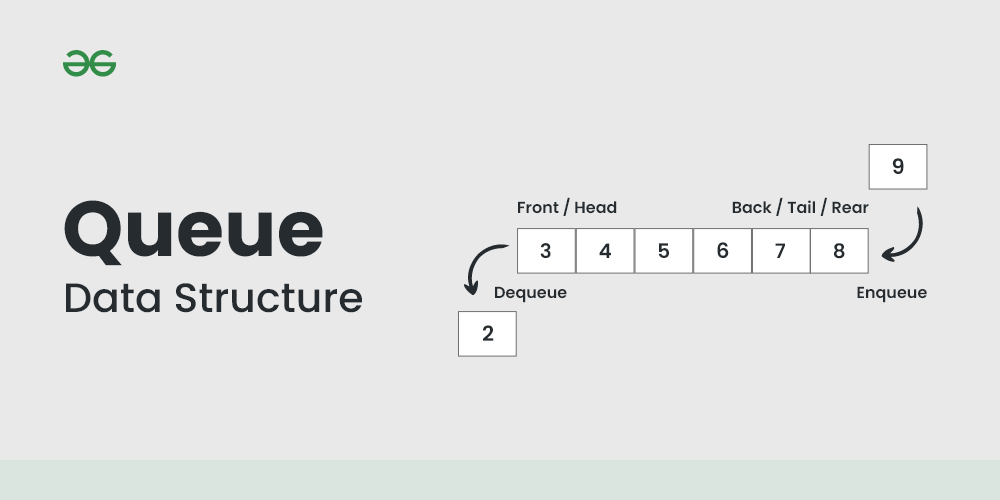
Queues
1. How would you find the size of a queue?
The size of a queue can be tracked by maintaining a counter variable, which is incremented during an enqueue operation and decremented during a dequeue operation. Most programming languages offer a method to directly retrieve the size of a queue.
2. How do you declare a Queue?
The way a queue is declared varies depending on the programming language:
- **C/C++: You can use arrays or a linked list implementation for queues or simply use queue class to implement Queue data structure.
- **Java: You can use
Queueinterface orLinkedListclass for queues or use ArrayDeque module available in Java collections framework. - **Python: You can use the
queuemodule or list for simple queue operations or create a queue using the deque module in the collections framework. - **JavaScript: You can implement a queue using an array.
- **C#: You can use Queue from the System.Collections namespace. C++ `
#include #include using namespace std;
int main() { queue q;
// Insert elements into the queue
q.push(10);
q.push(20);
q.push(30);

// Print and remove elements from the queue
while (!q.empty()) {
    cout << q.front() << " ";
    q.pop();
}

return 0;
}
Java
import java.util.LinkedList; import java.util.Queue;
public class Main { public static void main(String[] args) { Queue q = new LinkedList<>();
    // Insert elements into the queue
    q.add(10);
    q.add(20);
    q.add(30);

    // Print and remove elements from the queue
    while (!q.isEmpty()) {
        System.out.print(q.peek() + " ");
        q.poll();
    }
}
}
Python
from collections import deque
Create a queue
q = deque()
Insert elements into the queue
q.append(10) q.append(20) q.append(30)
Print and remove elements from the queue
while q: print(q[0], end=' ') q.popleft()
C#
using System; using System.Collections.Generic;
public class Program { public static void Main() { Queue q = new Queue();
    // Insert elements into the queue
    q.Enqueue(10);
    q.Enqueue(20);
    q.Enqueue(30);

    // Print and remove elements from the queue
    while (q.Count > 0) {
        Console.Write(q.Peek() + " ");
        q.Dequeue();
    }
}
}
JavaScript
// Create a queue let q = [];
// Insert elements into the queue q.push(10); q.push(20); q.push(30);
// Print and remove elements from the queue while (q.length > 0) { console.log(q[0]); q.shift(); }
`
3. What are the main operations of a queue?
The primary operations on a queue are:
- **Enqueue: Add an element to the back of the queue.
- **Dequeue: Remove an element from the front of the queue.
- **Peek: View the front element without removing it.
- **isEmpty: Check if the queue is empty.
- **Size: Get the number of elements in the queue.
4. Can a queue be resized at runtime?
Whether a queue can be resized at runtime depends on the underlying data structure used to implement it.
- **Array-based Queue: In an array-based queue, the size is usually fixed when the queue is created, as arrays have a predefined size.
- **Linked List-based Queue: Can grow and shrink dynamically since nodes are allocated as needed.
- **Library-based Queues: In languages like C++ (STL queue) or Java (ArrayDeque, LinkedList), resizing is handled internally by the underlying container, which grows dynamically.
5. How is the memory representation of a queue handled?
- **Array-based Queue: Elements are stored in contiguous memory locations. A naive implementation may shift elements on dequeue (O(n)), but an optimized implementation uses front and rear pointers (or circular arrays) to avoid shifting (O(1)).
- **Linked List-based Queue: Each element is stored in a node that points to the next element, enabling dynamic growth without contiguous memory.
- **LIbrary Based: In frameworks like C++ STL or Java Collections, the memory representation depends on the underlying dynamic container (like deque or LinkedList).
6. What is the time complexity for enqueue and dequeue operations?
**i. Enqueue: O(1) for array (with circular indexing) and linked list implementations.
**ii. Dequeue:
- Naive array queue: O(n) due to shifting.
- Optimized array/circular queue and linked list queue: O(1).
7. What is the difference between a queue and a stack?
A queue follows the First-In-First-Out (FIFO) principle, while a stack follows the Last-In-First-Out (LIFO) principle. In a stack, the last element added is the first one to be removed. The operations in a stack are push and pop, while in a queue, they are enqueue and dequeue.
8. What problem does a circular queue solve compared to a simple linear queue?
- In a linear queue, once the rear reaches the end of the array, even if there are free spaces in front (due to dequeued elements), we cannot insert new elements.
- A circular queue connects the end back to the front, allowing efficient use of space by reusing empty spots, solving the "false full" condition in linear queues.
9. What is a circular queue?
A circular queue is a type of queue in which the last element is connected back to the first element, forming a circle. This helps in utilizing the available space more efficiently. When the queue is full and an element is dequeued, it frees up space for new elements at the front, effectively reusing space.
10. What are the applications of a queue?
Queues have a wide range of applications in computer science, including:
- **Task Scheduling: Operating systems use queues to manage processes and tasks.
- **Network Buffers: Queues manage the data packets in networks to ensure proper order of delivery.
- **Breadth-First Search (BFS): In graph traversal, a queue is used to explore nodes level by level.
- **Print Queue: Managing print jobs in a printer is a typical example of using a queue.
- **Real-Time Systems: Handling data in streaming applications such as media players.
11. What is priority queue, and how is it different from a normal queue?
A priority queue is a special type of queue where each element is assigned a priority. Elements with higher priority are dequeued before elements with lower priority, even if they were added later. This is different from a normal queue, where elements are processed strictly in the order they are added (FIFO).
12. How would you implement a priority queue?
Priority queues are typically implemented using a heap data structure (min-heap or max-heap). Some languages provide built-in support for priority queues, like Java’s PriorityQueue class.
13. What is a deque and how is it different from a queue?
A deque (double-ended queue) allows insertion and removal of elements from both ends, unlike a regular queue, which only allows insertion at the rear and removal from the front. This gives a deque more flexibility for certain operations.
14. What is the time complexity for searching in a queue?
Searching for an element in a queue typically requires O(n) time, where n is the number of elements in the queue, as it may involve a linear scan of all elements.
15. How would you reverse a queue?
You can reverse a queue by using a stack or by recursively dequeuing elements and enqueuing them back in the reverse order.
16. What is a blocking queue?
A blocking queue is a type of queue where operations like enqueue and dequeue block the caller until the operation can be completed. It is commonly used in multi-threaded environments where one thread may be waiting for another thread to provide data.
17. How would you implement a queue using two stacks?
Queue overflow occurs when no more elements can be added. Handling depends on the type of queue:
- **Fixed-size Array Queue: Resize the array to a larger capacity or handle the overflow as an error.
- **Circular Queue: Utilizes available space efficiently by wrapping around, but overflow still occurs if the queue is full.
- **Dynamic Queues (linked list or library-based): Generally do not overflow unless system memory is exhausted.
18. How can you handle overflow in a queue?
Queue Overflow occurs when the queue has no space for additional elements. This can be handled by resizing the queue or switching to a dynamic queue. In a circular queue, overflow is avoided by efficiently utilizing the available space.
19. How would you implement a queue using a linked list?
A queue can be implemented using a linked list where the front of the queue is the head of the linked list, and the rear is the tail. Enqueue involves adding an element at the tail, and dequeue involves removing an element from the head.
20. What is the difference between a queue and a deque?
While a queue follows the FIFO principle, a deque (double-ended queue) allows both enqueue and dequeue operations at both ends. This provides greater flexibility in certain applications, such as implementing sliding windows or undo operations in applications.