Number of Unique BST with N Keys (original) (raw)
Last Updated : 11 Jul, 2025
Given an **integer n, the task is to find the total number of **unique BSTs that can be made using values from **1 to n.
**Examples:
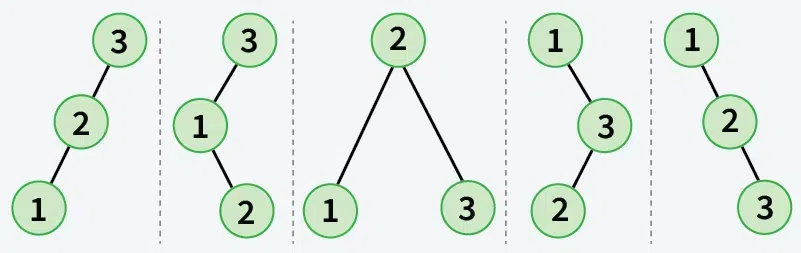
**Input: n = 3
**Output: 5
**Explanation: For n = 3, preorder traversal of Unique BSTs are:
1 2 3
1 3 2
2 1 3
3 1 2
3 2 1
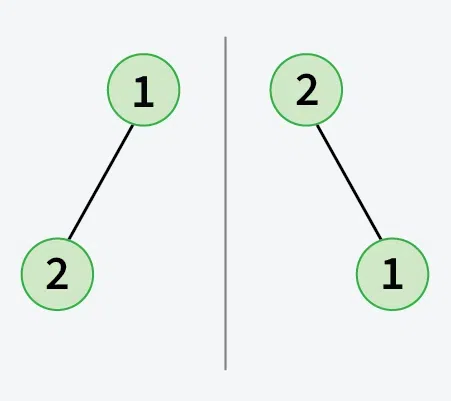
**Input: n = 2
**Output: 2
**Explanation: For n = 2, preorder traversal of Unique BSTs are:
_1 2
_2 1

**Approach:
A binary search tree (BST) maintains the property that elements are arranged based on their relative order. Let’s define C(n) as the number of **unique BSTs that can be constructed with
nnodes.When considering all possible BSTs, each of the
nnodes can serve as the root. For any selected root, the remaining **n-1 nodes must be divided into two groups:
- Nodes with keys **smaller than the root’s key
- Nodes with keys **larger than the root’s key.
Assume we choose the node with the i-th key as the root. In this scenario, there will be i-1 nodes that are smaller and **n-i nodes that are larger than the chosen root. This leads to dividing the problem of counting the total BSTs with the i-th key as the root into two subproblems:
- Calculating the number of **unique BSTs for the left subtree containing **i-1 nodes, represented as C(i-1).
- Calculating the number of **unique BSTs for the right subtree containing **n-i nodes, represented as **C(n-i).
Since the **left and **right subtrees are constructed independently, we **multiply these counts to get the total number of BSTs for the current configuration: **C(i-1) * C(n-i).
To find the total number of **BSTs with n nodes, we sum this product across all possible roots (i.e., from i = 1 to n). Therefore,
**C(n) = Σ(i = 1 to n) C(i-1) * C(n-i).
This formula corresponds to the recurrence relation for the nth **Catalan number. So this is how it is a **classic application of Catalan number. We just need to find **nth catalan number. First few catalan numbers are 1 1 2 5 14 42 132 429 1430 4862, … (considered from **0th number).
Formula of catalan number is ****(1 / n+1) * (** **2*n Cn). Please refer to Applications of Catalan Numbers.
C++ `
// C++ code of finding Number of Unique // BST with N Keys
#include using namespace std;
// Function to calculate the binomial // coefficient C(n, k) int binomialCoeff(int n, int k) {
  // C(n, k) is the same as C(n, n-k)
if (k > n - k) {
    k = n - k;
}

int res = 1;

// Calculate the value of n! / (k! * (n-k)!)
for (int i = 0; i < k; ++i) {
    res *= (n - i);
    res /= (i + 1);
}

return res;
}
// Function to find the nth Catalan number int numTrees(int n) {
// Calculate C(2n, n)
int c = binomialCoeff(2 * n, n);

  // Return the nth Catalan number
return c / (n + 1);
}
int main() {
int n = 5;
cout << numTrees(n) << endl;
return 0;
}
Java
// Java program to find the number of unique // BSTs with N keys
class GfG {
// Function to calculate the binomial
  // coefficient C(n, k)
static int binomialCoeff(int n, int k) {

    // C(n, k) is the same as C(n, n-k)
    if (k > n - k) {
        k = n - k;
    }

    int res = 1;

    // Calculate the value of n! / (k! * (n-k)!)
    for (int i = 0; i < k; ++i) {
        res *= (n - i);
        res /= (i + 1);
    }

    return res;
}

// Function to find the nth Catalan number
static int numTrees(int n) {

    // Calculate C(2n, n)
    int c = binomialCoeff(2 * n, n);

    // Return the nth Catalan number
    return c / (n + 1);
}

public static void main(String[] args) {
    int n = 5;
    System.out.println(numTrees(n));
}
}
Python
Python program to find the number of unique
BSTs with N keys
Function to calculate the binomial coefficient C(n, k)
def binomial_coeff(n, k):
# C(n, k) is the same as C(n, n-k)
if k > n - k:
    k = n - k

res = 1

# Calculate the value of n! / (k! * (n-k)!)
for i in range(k):
    res *= (n - i)
    res //= (i + 1)

return res
Function to find the nth Catalan number
def numTrees(n):
# Calculate C(2n, n)
c = binomial_coeff(2 * n, n)

# Return the nth Catalan number
return c // (n + 1)
n = 5 print(numTrees(n))
C#
// C# program to find the number of unique // BSTs with N keys
using System;
class GfG {
// Function to calculate the binomial
  // coefficient C(n, k)
static int BinomialCoeff(int n, int k) {

    // C(n, k) is the same as C(n, n-k)
    if (k > n - k) {
        k = n - k;
    }

    int res = 1;

    // Calculate the value of n! / (k! * (n-k)!)
    for (int i = 0; i < k; ++i) {
        res *= (n - i);
        res /= (i + 1);
    }

    return res;
}

// Function to find the nth Catalan
  // number
static int numTrees(int n) {

    // Calculate C(2n, n)
    int c = BinomialCoeff(2 * n, n);

    // Return the nth Catalan number
    return c / (n + 1);
}

static void Main() {
    int n = 5;
    Console.WriteLine(numTrees(n));
}
}
JavaScript
// JavaScript program to find the number of unique BSTs with // n keys
// Function to calculate the binomial coefficient C(n, k) function binomialCoeff(n, k) {
// C(n, k) is the same as C(n, n-k)
if (k > n - k) {
    k = n - k;
}

let res = 1;

// Calculate the value of n! / (k! * (n-k)!)
for (let i = 0; i < k; i++) {
    res *= (n - i);
    res /= (i + 1);
}

return res;
}
// Function to find the nth Catalan number function numTrees(n) {
// Calculate C(2n, n)
let c = binomialCoeff(2 * n, n);

// Return the nth Catalan number
return c / (n + 1);
}
const n = 5; console.log(numTrees(n));
`
**Time Complexity: O(n), where n is nth catalan number.
**Auxiliary Space: O(1)