Optimal File Merge Patterns (original) (raw)
Last Updated : 11 Jul, 2025
Given n number of sorted files, the task is to find the minimum computations done to reach the Optimal Merge Pattern.
When two or more sorted files are to be merged altogether to form a single file, the minimum computations are done to reach this file are known as Optimal Merge Pattern.
If more than 2 files need to be merged then it can be done in pairs. For example, if need to merge 4 files A, B, C, D. First Merge A with B to get X1, merge X1 with C to get X2, merge X2 with D to get X3 as the output file.
If we have two files of sizes m and n, the total computation time will be m+n. Here, we use the greedy strategy by merging the two smallest size files among all the files present.
Examples:
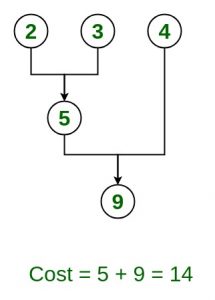
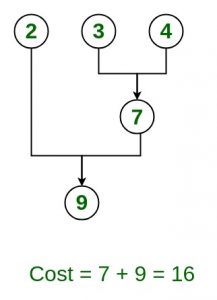
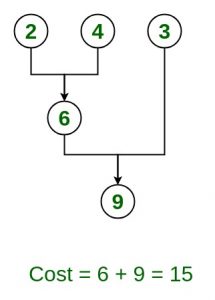
Given 3 files with sizes 2, 3, 4 units. Find an optimal way to combine these files
Input: n = 3, size = {2, 3, 4}
Output: 14
Explanation: There are different ways to combine these files:
Method 1: Optimal method
Method 2:
Method 3:
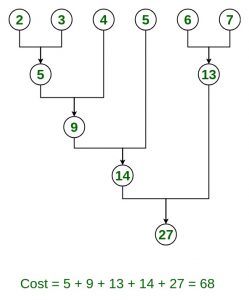
Input: n = 6, size = {2, 3, 4, 5, 6, 7}
Output: 68
Explanation: Optimal way to combine these files
Input: n = 5, size = {5,10,20,30,30}
Output: 205Input: n = 5, size = {8,8,8,8,8}
Output: 96

Observations:
From the above results, we may conclude that for finding the minimum cost of computation we need to have our array always sorted, i.e., add the minimum possible computation cost and remove the files from the array. We can achieve this optimally using a min-heap(priority-queue) data structure.
Approach:
Node represents a file with a given size also given nodes are greater than 2
- Add all the nodes in a priority queue (Min Heap).{pq.poll = file size}
- Initialize count = 0 // variable to store file computations.
- Repeat while (size of priority Queue is greater than 1)
- int weight = pq.poll(); pq.pop;//pq denotes priority queue, remove 1st smallest and pop(remove) it out
- weight+=pq.poll() && pq.pop(); // add the second element and then pop(remove) it out
- count +=weight;
- pq.add(weight) // add this combined cost to priority queue;
- count is the final answer
Below is the implementation of the above approach:
C++ `
// C++ program to implement // Optimal File Merge Pattern #include <bits/stdc++.h> using namespace std;
// Function to find minimum computation int minComputation(int size, int files[]) {
// Create a min heap
priority_queue<int, vector<int>, greater<int> > pq;

for (int i = 0; i < size; i++) {

    // Add sizes to priorityQueue
    pq.push(files[i]);
}

// Variable to count total Computation
int count = 0;

while (pq.size() > 1) {

    // pop two smallest size element
    // from the min heap
    int first_smallest = pq.top();
    pq.pop();
    int second_smallest = pq.top();
    pq.pop();

    int temp = first_smallest + second_smallest;

    // Add the current computations
    // with the previous one's
    count += temp;

    // Add new combined file size
    // to priority queue or min heap
    pq.push(temp);
}
return count;
}
// Driver code int main() {
// No of files
int n = 6;

// 6 files with their sizes
int files[] = { 2, 3, 4, 5, 6, 7 };

// Total no of computations
// do be done final answer
cout << "Minimum Computations = "
     << minComputation(n, files);

return 0;
}
// This code is contributed by jaigoyal1328
Java
// Java program to implement // Optimal File Merge Pattern
import java.util.PriorityQueue; import java.util.Scanner;
public class OptimalMergePatterns {
// Function to find minimum computation
static int minComputation(int size, int files[])
{

    // create a min heap
    PriorityQueue<Integer> pq = new PriorityQueue<>();

    for (int i = 0; i < size; i++) {

        // add sizes to priorityQueue
        pq.add(files[i]);
    }

    // variable to count total computations
    int count = 0;

    while (pq.size() > 1) {

        // pop two smallest size element
        // from the min heap
        int temp = pq.poll() + pq.poll();

        // add the current computations
        // with the previous one's
        count += temp;

        // add new combined file size
        // to priority queue or min heap
        pq.add(temp);
    }

    return count;
}

public static void main(String[] args)
{

    // no of files
    int size = 6;

    // 6 files with their sizes
    int files[] = new int[] { 2, 3, 4, 5, 6, 7 };

    // total no of computations
    // do be done final answer
    System.out.println("Minimum Computations = "
                       + minComputation(size, files));
}
}
Python3
Python Program to implement
Optimal File Merge Pattern
class Heap(): # Building own implementation of Min Heap def init(self):
    self.h = []

def parent(self, index):
    # Returns parent index for given index

    if index > 0:
        return (index - 1) // 2

def lchild(self, index):
    # Returns left child index for given index

    return (2 * index) + 1

def rchild(self, index):
    # Returns right child index for given index

    return (2 * index) + 2

def addItem(self, item):

    # Function to add an item to heap
    self.h.append(item)

    if len(self.h) == 1:

        # If heap has only one item no need to heapify
        return

    index = len(self.h) - 1
    parent = self.parent(index)

    # Moves the item up if it is smaller than the parent
    while index > 0 and item < self.h[parent]:
        self.h[index], self.h[parent] = self.h[parent], self.h[parent]
        index = parent
        parent = self.parent(index)

def deleteItem(self):

    # Function to add an item to heap
    length = len(self.h)
    self.h[0], self.h[length-1] = self.h[length-1], self.h[0]
    deleted = self.h.pop()

    # Since root will be violating heap property
    # Call moveDownHeapify() to restore heap property
    self.moveDownHeapify(0)

    return deleted

def moveDownHeapify(self, index):

    # Function to make the items follow Heap property
    # Compares the value with the children and moves item down

    lc, rc = self.lchild(index), self.rchild(index)
    length, smallest = len(self.h), index

    if lc < length and self.h[lc] <= self.h[smallest]:
        smallest = lc

    if rc < length and self.h[rc] <= self.h[smallest]:
        smallest = rc

    if smallest != index:
        # Swaps the parent node with the smaller child
        self.h[smallest], self.h[index] = self.h[index], self.h[smallest]

        # Recursive call to compare next subtree
        self.moveDownHeapify(smallest)

def increaseItem(self, index, value):
    # Increase the value of 'index' to 'value'

    if value <= self.h[index]:
        return

    self.h[index] = value
    self.moveDownHeapify(index)
class OptimalMergePattern(): def init(self, n, items):
    self.n = n
    self.items = items
    self.heap = Heap()

def optimalMerge(self):

    # Corner cases if list has no more than 1 item
    if self.n <= 0:
        return 0

    if self.n == 1:
        return self.items[0]

    # Insert items into min heap
    for _ in self.items:
        self.heap.addItem(_)

    count = 0
    while len(self.heap.h) != 1:
        tmp = self.heap.deleteItem()
        count += (tmp + self.heap.h[0])
        self.heap.increaseItem(0, tmp + self.heap.h[0])

    return count
Driver Code
if name == 'main': OMP = OptimalMergePattern(6, [2, 3, 4, 5, 6, 7]) ans = OMP.optimalMerge() print(ans)
This code is contributed by Rajat Gupta
C#
using System; using System.Collections.Generic;
public class OptimalMergePatterns {
// Function to find minimum computation static int MinComputation(int size, int[] files) {
// create a list to store file sizes
List<int> fileList = new List<int>(files);

// variable to count total computations
int count = 0;

while (fileList.Count > 1) {
  // sort the file sizes in ascending order
  fileList.Sort();

  // get the two smallest file sizes
  int file1 = fileList[0];
  int file2 = fileList[1];

  // calculate the combined file size
  int combinedFileSize = file1 + file2;

  // add the current computations
  // with the previous one's
  count += combinedFileSize;

  // remove the two smallest file sizes
  fileList.RemoveAt(0);
  fileList.RemoveAt(0);

  // add new combined file size
  // to the list of file sizes
  fileList.Add(combinedFileSize);
}

return count;
}
public static void Main(string[] args) { // no of files int size = 6;
// 6 files with their sizes
int[] files = new int[] { 2, 3, 4, 5, 6, 7 };

// total no of computations
// do be done final answer
Console.WriteLine("Minimum Computations = "
                  + MinComputation(size, files));
} }
// This code is contributed by phasing17.
JavaScript
// JavaScript program to implement // Optimal File Merge Pattern class Heap { // Building own implementation of Min Heap constructor() { this.h = []; }
parent(index) {
    // Returns parent index for given index
    if (index > 0) {
        return Math.floor((index - 1) / 2);
    }
}

lchild(index) {
    // Returns left child index for given index
    return 2 * index + 1;
}

rchild(index) {
    // Returns right child index for given index
    return 2 * index + 2;
}

addItem(item) {
    // Function to add an item to heap
    this.h.push(item);

    if (this.h.length === 1) {
        // If heap has only one item no need to heapify
        return;
    }

    let index = this.h.length - 1;
    let parent = this.parent(index);

    // Moves the item up if it is smaller than the parent
    while (index > 0 && item < this.h[parent]) {
        [this.h[index], this.h[parent]] = [this.h[parent], this.h[index]];
        index = parent;
        parent = this.parent(index);
    }
}

deleteItem() {
    // Function to add an item to heap
    const length = this.h.length;
    [this.h[0], this.h[length - 1]] = [this.h[length - 1], this.h[0]];
    const deleted = this.h.pop();

    // Since root will be violating heap property
    // Call moveDownHeapify() to restore heap property
    this.moveDownHeapify(0);

    return deleted;
}

moveDownHeapify(index) {
    // Function to make the items follow Heap property
    // Compares the value with the children and moves item down

    const lc = this.lchild(index);
    const rc = this.rchild(index);
    const length = this.h.length;
    let smallest = index;

    if (lc < length && this.h[lc] <= this.h[smallest]) {
        smallest = lc;
    }

    if (rc < length && this.h[rc] <= this.h[smallest]) {
        smallest = rc;
    }

    if (smallest !== index) {
        // Swaps the parent node with the smaller child
        [this.h[smallest], this.h[index]] = [this.h[index], this.h[smallest]];

        // Recursive call to compare next subtree
        this.moveDownHeapify(smallest);
    }
}

increaseItem(index, value) {
    // Increase the value of 'index' to 'value'

    if (value <= this.h[index]) {
        return;
    }

    this.h[index] = value;
    this.moveDownHeapify(index);
}
}
class OptimalMergePattern { constructor(n, items) { this.n = n; this.items = items; this.heap = new Heap(); }
optimalMerge() {
    // Corner cases if list has no more than 1 item
    if (this.n <= 0) {
        return 0;
    }

    if (this.n === 1) {
        return this.items[0];
    }

    // Insert items into min heap
    for (const item of this.items) {
        this.heap.addItem(item);
    }

    let count = 0;
    while (this.heap.h.length !== 1) {
        const tmp = this.heap.deleteItem();
        count += tmp + this.heap.h[0];
        this.heap.increaseItem(0, tmp + this.heap.h[0])
    }

    return count
}
}
// Driver Code
let OMP = new OptimalMergePattern(6, [2, 3, 4, 5, 6, 7]) let ans = OMP.optimalMerge() console.log("Minimum Computations =", ans)
// This code is contributed by phasing17
`
Output
Minimum Computations = 68
Time Complexity: O(nlogn)
Auxiliary Space: O(n)