All subsequences of a string (original) (raw)
Given a string, we have to find out all its subsequences of it. A String is said to be a subsequence of another String, if it can be obtained by deleting 0 or more character without changing its order.
For example, sub-sequences of "**geeks" are
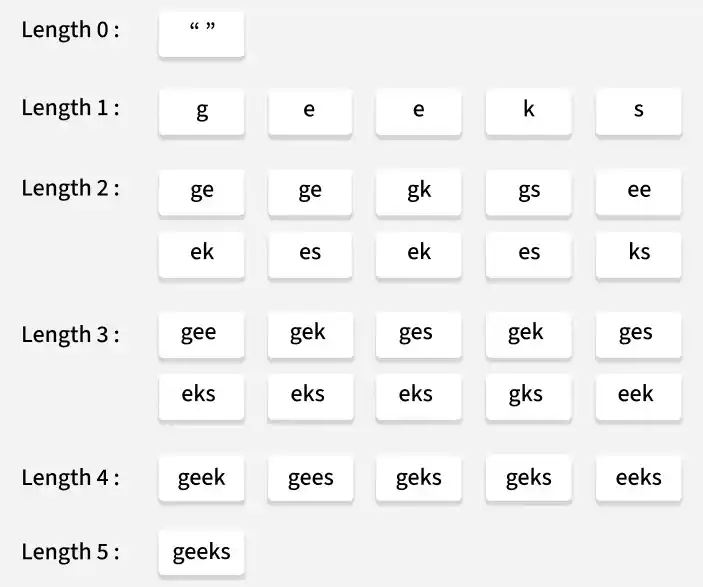
**Examples:
**Input : ab
****Output : "", "**a", "b", "ab"**Input : abc
**Output : "", "a", "b", "c", "ab", "ac", "bc", "abc"
Table of Content
- Pick and Don't Pick Recursive Approach
- Incremental Approach
- Using Binary Representation of Numbers from 0 to 2^n – 1
**Pick and Don't Pick Recursive Approach
We begin with the last character and for every character, we make two choices, we either pick it or do not pick it and make two recursive calls. This way generate all possible subsequences.
C++ `
#include <bits/stdc++.h> using namespace std;
// Find all subsequences recursively void printSubRec(string s, string curr) { // Base Case : s is empty, print // current subsequence if (s.empty()) { cout << curr << endl; return; }
// curr is passed with including
// the first character of the string
printSubRec(s.substr(1), curr + s[0]);

// curr is passed without including
// the first character of the string
printSubRec(s.substr(1), curr);
}
// Wrapper method for printSubRec void printSubs(string s) { string curr = ""; printSubRec(s, curr); }
// Driver code int main() { string s = "ab"; printSubs(s); return 0; }
Java
// Java program for the above approach import java.util.*; class GFG {
// Declare a global list
static List<String> al = new ArrayList<>();

// Creating a public static Arraylist such that
// we can store values
// IF there is any question of returning the
// we can directly return too// public static
// ArrayList<String> al = new ArrayList<String>();
public static void main(String[] args)
{
    String s = "abcd";
    findsubsequences(s, ""); // Calling a function
    System.out.println(al);
}

private static void findsubsequences(String s,
                                     String ans)
{
    if (s.length() == 0) {
        al.add(ans);
        return;
    }

    // We add adding 1st character in string
    findsubsequences(s.substring(1), ans + s.charAt(0));

    // Not adding first character of the string
    // because the concept of subsequence either
    // character will present or not
    findsubsequences(s.substring(1), ans);
}
}
Python
Below is the implementation of the above approach
def printSubsequence(input, output):
# Base Case
# if the input is empty print the output string
if len(input) == 0:
    print(output, end=' ')
    return

# output is passed with including the
# 1st character of input string
printSubsequence(input[1:], output+input[0])

# output is passed without including the
# 1st character of input string
printSubsequence(input[1:], output)
Driver code
output is set to null before passing in
as a parameter
output = "" input = "abcd"
printSubsequence(input, output)
This code is contributed by Tharun Reddy
C#
// C# program for the above approach using System; using System.Collections.Generic;
class GFG{
static void printSubsequence(string input, string output) {
// Base Case
// If the input is empty print the output string
if (input.Length == 0)
{
    Console.WriteLine(output);
    return;
}

// Output is passed with including
// the Ist character of
// Input string
printSubsequence(input.Substring(1),
                 output + input[0]);

// Output is passed without
// including the Ist character
// of Input string
printSubsequence(input.Substring(1),
                 output);
}
// Driver code static void Main() {
// output is set to null before passing
// in as a parameter
string output = "";
string input = "abcd";

printSubsequence(input, output);
} }
// This code is contributed by SoumikMondal
Javascript
`
**Time Complexity: O(n2^n) This is because, for a string of length n, we generate a total of 2^n sub-sequences.
**Auxiliary Space : O(n) The recursive function call stack requires O(n) space for the worst case, where n is the length of the given string.
**Further Optimization : Instead of generating a substring every-time, we can pass index as additional parameter and pass reference of the same string.
Incremental Approach
One by one fix characters and recursively generate all subsets starting from them. After every recursive call, we remove the last character so that the next permutation can be generated.
C++ `
#include <bits/stdc++.h> using namespace std;
// s : Stores input string // n : Length of s. // curr : Stores current permutation // index : Index in current permutation, curr void printSubSeqRec(string s, int n, int index = -1, string curr = "") { // base case if (index == n) return;
// Print the current subsequence (including empty)
cout << curr << "\n";

for (int i = index + 1; i < n; i++) {
    curr += s[i];
    printSubSeqRec(s, n, i, curr);

    // backtracking
    curr = curr.erase(curr.size() - 1);
}
return;
}
// Generates power set in lexicographic order. void printSubSeq(string s) { printSubSeqRec(s, s.size()); }
// Driver code int main() { string s = "ab"; printSubSeq(s); return 0; }
Java
// Java program to generate power set in // lexicographic order. class GFG {
// str : Stores input string
// n : Length of str.
// curr : Stores current permutation
// index : Index in current permutation, curr
static void printSubSeqRec(String str, int n, int index,
                           String curr)
{
    // base case
    if (index == n) {
        return;
    }
    if (curr != null && !curr.trim().isEmpty()) {
        System.out.println(curr);
    }
    for (int i = index + 1; i < n; i++) {
        curr += str.charAt(i);
        printSubSeqRec(str, n, i, curr);

        // backtracking
        curr = curr.substring(0, curr.length() - 1);
    }
}

// Generates power set in
// lexicographic order.
static void printSubSeq(String str)
{
    int index = -1;
    String curr = "";

    printSubSeqRec(str, str.length(), index, curr);
}

// Driver code
public static void main(String[] args)
{
    String str = "cab";
    printSubSeq(str);
}
}
// This code is contributed by PrinciRaj1992
Python
Python program to generate power set in lexicographic order.
str: Stores input string
n: Length of str.
curr: Stores current permutation
index: Index in current permutation, curr
def printSubSeqRec(str, n, index = -1, curr = ""):
base case
 if (index == n):
   return
 if (len(curr) > 0):
   print(curr)

 i = index + 1

 while(i < n):
    curr = curr + str[i]
    printSubSeqRec(str, n, i, curr)
    curr = curr[0:-1]
    i = i + 1
Generates power set in lexicographic order.
function
def printSubSeq(str): printSubSeqRec(str, len(str))
// Driver code
str = "cab" printSubSeq(str)
This code is contributed by shinjanpatra
C#
// Include namespace system using System;
// C# program to generate power set in // lexicographic order. public class GFG { // str : Stores input string // n : Length of str. // curr : Stores current permutation // index : Index in current permutation, curr public static void printSubSeqRec(String str, int n, int index, String curr) { // base case if (index == n) { return; } if (curr != null && !(curr.Trim().Length == 0)) { Console.WriteLine(curr); } for (int i = index + 1; i < n; i++) { curr += str[i]; GFG.printSubSeqRec(str, n, i, curr); // backtracking curr = curr.Substring(0,curr.Length - 1-0); } } // Generates power set in // lexicographic order. public static void printSubSeq(String str) { var index = -1; var curr = ""; GFG.printSubSeqRec(str, str.Length, index, curr); } // Driver code public static void Main(String[] args) { var str = "cab"; GFG.printSubSeq(str); } } // This code is contributed by mukulsomukesh
Javascript
`
**Time Complexity: O(n * 2n), where n is the size of the given string
**Auxiliary Space: O(n), due to recursive call stack
**Using Binary Representation of Numbers from 0 to 2^n – 1
**String = "abc"
_All combinations of abc can be represented by all binary representation from 0 to (2^n - 1) where n is the size of the string . The following representation clears things up.
**Note : We can also take zero into consideration which will eventually give us an empty set "", the only change in code will be starting loop from zero.
_001 -> "c"
_010 -> "b"
_011 -> "bc
_100 -> "a"
_101 -> "ac"
_110 -> "ab"
_111 -> "abc"**As you can observe we get unique sub-sequences for every set-bit and thus no 2 combinations can be same as 2 numbers cannot have same binary representation.
Below is the implementation of the above approach:
C++ `
#include <bits/stdc++.h> using namespace std;
// Function to print all the power set void printPowerSet(string &s) { int n = pow(2, s.size());
for (int counter = 0; counter < n; counter++) {
    for (int j = 0; j < s.size(); j++) {

        // Check if jth bit in the counter is set
        if (counter & (1 << j))
            cout << s[j];
    }
    cout << endl;
}
}
/* Driver code */ int main() { string s = "ab"; printPowerSet(s); return 0; }
Java
import java.util.*;
public class GFG {
//function to find where the bit is set
public static String print(String s , int i){

    int j = 0;
    String sub = "";

    //finding the bit is set
    while(i>0){
        if((i & 1) == 1){
            sub += s.charAt(j);
        }
        j++;
        i = i>>1;
    }
    return sub;
}

//function to create sub-sets
public static List<String> createsubsets(String s){

    List<String> res = new ArrayList<>();
    for(int i = 0 ; i < (1<<s.length()) ; i++){
        //each time we create a subsequence for corresponding binary representation
        res.add(print(s,i));
    }
    return res;
}

//main function to call
public static void main(String args[])
{
    String s = "abc";

    // vector of strings to store all sub-sequences
    List<String> print = createsubsets(s);

    // print the subsets
    for (int i = 0; i < print.size(); i++) {
        for (int j = 0; j < print.get(i).length(); j++) {
            System.out.print(print.get(i).charAt(j) + " ");
        }
        System.out.println();
    }
}
} // This code contributed by Srj_27
Python
def print_subset(s, i): j = 0 sub = "" #finding where the bit is set while i > 0: if i & 1: sub += s[j] #pushing only when bit is set j += 1 #always incrementing the index pointer i = i >> 1 return sub
def createsubsets(s): res = [] for i in range(1, (1 << len(s))): #each time we create a subsequence for corresponding binary representation res.append(print_subset(s, i)) return res
if name == "main": s = "abc" #vector of strings to store all sub-sequences subsets = createsubsets(s)
#print function
for subset in subsets:
    for c in subset:
        print(c, end=" ")
    print()
This code is contributed Shivam Tiwari
C#
using System; using System.Collections.Generic;
namespace GFG { class Program { //function to find where the bit is set public static string Print(string s, int i) { int j = 0; string sub = "";
        //finding the bit is set
        while (i > 0)
        {
            if ((i & 1) == 1)
            {
                sub += s[j];
            }
            j++;
            i = i >> 1;
        }
        return sub;
    }

    //function to create sub-sets
    public static List<string> CreateSubsets(string s)
    {
        List<string> res = new List<string>();
        for (int i = 0; i < (1 << s.Length); i++)
        {
            //each time we create a subsequence for corresponding binary representation
            res.Add(Print(s, i));
        }
        return res;
    }

    static void Main(string[] args)
    {
        string s = "abc";

        // list of strings to store all sub-sequences
        List<string> print = CreateSubsets(s);

        // print the subsets
        for (int i = 0; i < print.Count; i++)
        {
            for (int j = 0; j < print[i].Length; j++)
            {
                Console.Write(print[i][j] + " ");
            }
            Console.WriteLine();
        }
    }
}
} // This code contributed by Ajax
Javascript
// Function to extract a subsequence when the corresponding bit is set function printSubset(s, i) { let j = 0; // Index pointer to iterate through the string s let sub = ""; // Resultant subsequence
// Finding where the bit is set while (i > 0) { if (i & 1) { // Pushing only when the bit is set sub += s[j]; } j += 1; // Always incrementing the index pointer i = i >> 1; // Right shift the number to get the next bit } return sub; }
// Function to generate all possible sub-sequences function createSubsets(s) { let res = []; // Array to store all sub-sequences for (let i = 1; i < (1 << s.length); i++) { // Each iteration generates a sub-sequence for the corresponding binary representation res.push(printSubset(s, i)); } return res; }
// Driver Code const s = "abc"; // String input const subsets = createSubsets(s); // Array of all sub-sequences
// Printing the sub-sequences for (let subset of subsets) { for (let c of subset) { process.stdout.write(c + " "); } console.log(); }
`
**Time Complexity: O(n* 2^n)
**Auxiliary Space: O(n)