Count digits (original) (raw)
Last Updated : 23 Apr, 2026
Given a number **n, return the count of digits in this number.
**Example:
**Input: n = 1567
**Output: 4
**Explanation: There are 4 digits in 1567, which are 1, 5, 6 and 7.**Input: n = 255
**Output: 3
**Explanation: There are 3 digits in 255, which are 2, 5 and 5.

Table of Content
- Iterative Solution O(log10(n)) Time or O(Number of digits) and O(1) Space
- Using Recursion - O(log10(n)) or O(Number of digits) Time and O(Number of digits) Space
- Using log base 10 function - O(1) Time and O(1) Space
- Converting Number to String - O(Number of digits) Time and O(Number of digits) Space
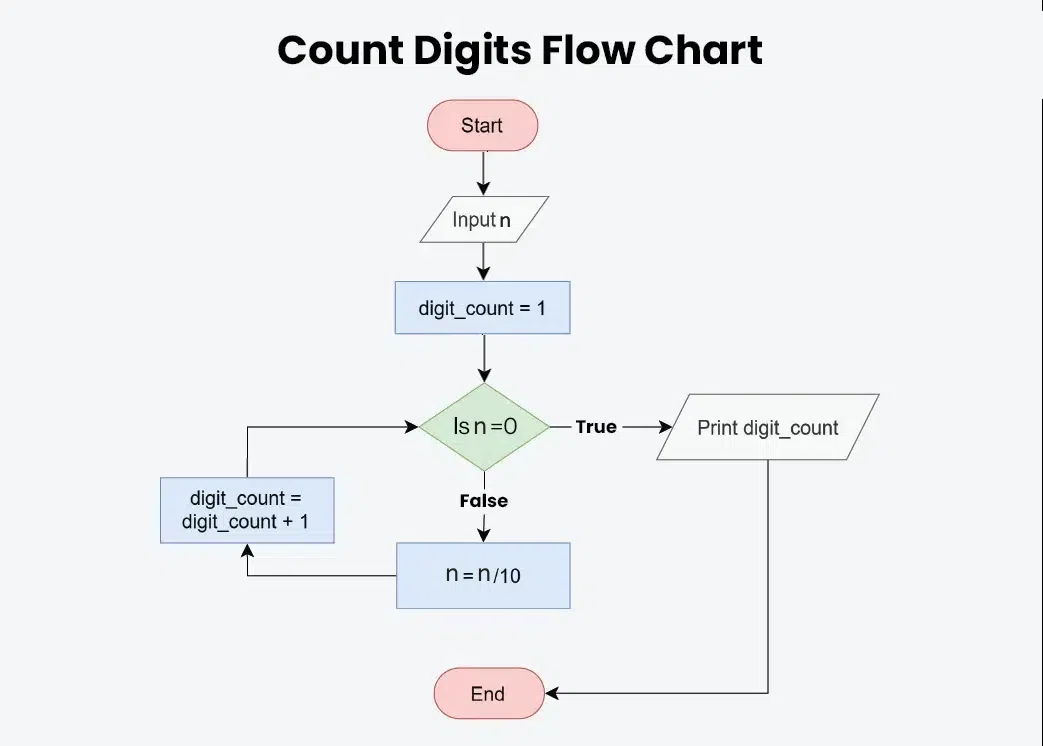
Iterative Solution O(log10(n)) Time or O(Number of digits) and O(1) Space
The idea is to count the digits by removing the digits from the input number starting from right(least significant digit) to left(most significant digit) till the number is reduced to 0. We are removing digits from the right because the rightmost digit can be removed simply by performing integer division by 10. For eg: n = 1567, then 1567 / 10 = 156.7 = 156(Integer Division).
C++ `
#include using namespace std;
int countDigit(int n) { // Base case if (n == 0) return 1;
int count = 0;

// Iterate till n has digits remaining
while (n != 0)
{

    // Remove rightmost digit
    n = n / 10;

    // Increment digit count by 1
    ++count;
}
return count;
}
int main() { int n = 58964; cout << countDigit(n); return 0; }
C
#include <stdio.h>
int countDigit(int n) {
// Base case
if (n == 0)
    return 1;

int count = 0;

// Iterate till n has digits remaining
while (n != 0)
{

    // Remove rightmost digit
    n = n / 10;

    // Increment digit count by 1
    ++count;
}
return count;
}
int main() { int n = 58964; printf("%d\n", countDigit(n)); return 0; }
Java
import java.io.*;
class GfG { static int countDigit(int n) { // Base case if (n == 0) return 1;
    int count = 0;

    // Iterate till n has digits remaining
    while (n != 0) {

        // Remove rightmost digit
        n = n / 10;

        // Increment digit count by 1
        ++count;
    }
    return count;
}

public static void main(String[] args)
{
    int n = 58964;
    System.out.println(countDigit(n));
}
}
Python
def countDigit(n):
# Base case
if n == 0:
    return 1

count = 0

# Iterate till n has digits remaining
while n != 0:

    # Remove rightmost digit
    n = n // 10

    # Increment digit count by 1
    count += 1

return count
if name == "main": n = 58964 print(countDigit(n))
C#
using System;
class GfG {
static int CountDigit(int n)
{

    // Base case
    if (n == 0)
        return 1;

    int count = 0;

    // Iterate till n has digits remaining
    while (n != 0) {

        // Remove rightmost digit
        n = n / 10;

        // Increment digit count by 1
        ++count;
    }
    return count;
}

static void Main()
{
    int n = 58964;
    Console.WriteLine(CountDigit(n));
}
}
JavaScript
function countDigit(n) {
// Base case
if (n === 0)
    return 1;

let count = 0;

// Iterate till n has digits remaining
while (n !== 0) {

    // Remove rightmost digit
    n = Math.floor(n / 10);

    // Increment digit count by 1
    ++count;
}
return count;
}
let n = 58964; console.log(countDigit(n));
`
Using Recursion - O(log10(n)) or O(Number of digits) Time and O(Number of digits) Space
The idea is to remove digits from right by calling a recursive function for each digit. The base condition of this recursive approach is when we divide the number by 10 and the number gets reduced to 0, so return 1 for this operation. Otherwise, Keep dividing the number by 10 this reduces the input number size by 1 and keeps track of the number of sizes reduced.
C++ `
#include using namespace std;
// Recursively count the number of digits in the integer 'n' int countDigit(int n) { // Base case: if 'n' is a single digit if (n / 10 == 0) return 1;
// Recursive case: strip one digit and count
return 1 + countDigit(n / 10);
}
int main() { int n = 58964; cout << countDigit(n); return 0; }
C
#include <stdio.h> // Recursively count the number of digits in the integer 'n' int countDigit(int n) { // Base case: if 'n' is a single digit if (n / 10 == 0) return 1; // Recursive case: strip one digit and count return 1 + countDigit(n / 10); }
int main() { int n = 58964; printf("%d", countDigit(n)); return 0; }
Java
import java.util.*;
class GfG {
// Recursively counts the number of digits in the number 'n'
static int countDigit(int n)
{
    // Base case: if 'n' is a single-digit number
    if (n / 10 == 0)
        return 1;

    // Recursive call: strip one digit and count
    return 1 + countDigit(n / 10);
}

public static void main(String[] args)
{
    int n = 58964;
    System.out.print(countDigit(n));
}
}
Python
def countDigit(n): # Base case: if 'n' is a single-digit number if n // 10 == 0: return 1 # Recursive case: strip one digit and count return 1 + countDigit(n // 10)
if name == "main": n = 58964 print(countDigit(n))
C#
using System;
class GfG {
// Recursively counts the number of digits in the number 'n'
static int countDigit(int n)
{
    // Base case: if 'n' is a single-digit number
    if (n / 10 == 0)
        return 1;

    // Recursive call: strip one digit and count
    return 1 + countDigit(n / 10);
}

public static void Main()
{
    int n = 58964;
    Console.WriteLine(countDigit(n));
}
}
JavaScript
function countDigit(n) { // Base case: if 'n' is a single-digit number if (parseInt(n / 10) === 0) return 1;
// Recursive case: strip one digit and count
return 1 + countDigit(parseInt(n / 10));
}
var n = 58964; console.log(countDigit(n));
`
Using log base 10 function - O(1) Time and O(1) Space
We can use log10(logarithm of base 10) to count the number of digits of positive numbers (logarithm is not defined for negative numbers). For negative numbers, first take the absolute value of
n, since logarithm is not defined for negative values.
Digit count of n = floor(log10(n) + 1)
C++ `
#include #include using namespace std;
int countDigit(int n) { // Handle zero separately if (n == 0) return 1;
// Convert negative to positive
n = abs(n);

return floor(log10(n)) + 1;
}
int main() { int n = -58964; cout << countDigit(n); return 0; }
Java
import java.lang.Math;
public class GfG { public static int countDigit(int n) { // Handle zero separately if (n == 0) return 1;
    // Convert negative to positive
    n = Math.abs(n);

    return (int)Math.floor(Math.log10(n)) + 1;
}

public static void main(String[] args) {
    int n = -58964;
    System.out.println(countDigit(n));
}
}
Python
import math
def countDigit(n): # Handle zero separately if n == 0: return 1
# Convert negative to positive
n = abs(n)

return math.floor(math.log10(n)) + 1
if name == "main": n = -58964 print(countDigit(n))
C#
using System;
class GfG{ static int CountDigit(int n) { // Handle zero separately if (n == 0) return 1;
    // Convert negative to positive
    n = Math.Abs(n);

    return (int)Math.Floor(Math.Log10(n)) + 1;
}

static void Main() {
    int n = -58964;
    Console.WriteLine(CountDigit(n));
}
}
JavaScript
function countDigit(n) { // Handle zero separately if (n === 0) return 1;
// Convert negative to positive
n = Math.abs(n);

return Math.floor(Math.log10(n)) + 1;
}
// driver code let n = -58964; console.log(countDigit(n));
`
Converting Number to String - O(Number of digits) Time and O(Number of digits) Space
We can convert the number into a string and then find the length of the string to get the number of digits in the original number. If the number is negative, the string will contain a
'-'sign, so subtract 1 from the length.
C++ `
#include using namespace std;
int countDigit(int n) { // Convert integer to string string num = to_string(n);
// If negative, exclude '-' sign
if (num[0] == '-')
    return num.length() - 1;

return num.length();
}
int main() { int n = -58964; cout << countDigit(n); return 0; }
Java
public class GfG { public static int countDigit(int n) { // Convert integer to string String num = Integer.toString(n);
    // If negative, exclude '-' sign
    if (num.charAt(0) == '-')
        return num.length() - 1;

    return num.length();
}

public static void main(String[] args) {
    int n = -58964;
    System.out.println(countDigit(n));
}
}
Python
def countDigit(n): # Convert integer to string num = str(n)
# If negative, exclude '-' sign
if num[0] == '-':
    return len(num) - 1

return len(num)
if name == 'main': n = -58964 print(countDigit(n))
C#
using System;
class GfG{ static int CountDigit(int n) { // Convert integer to string string num = n.ToString();
    // If negative, exclude '-' sign
    if (num[0] == '-')
        return num.Length - 1;

    return num.Length;
}

static void Main() {
    int n = -58964;
    Console.WriteLine(CountDigit(n));
}
}
JavaScript
function countDigit(n) { // Convert integer to string let num = n.toString();
// If negative, exclude '-' sign
if (num[0] === '-')
    return num.length - 1;

return num.length;
}
// driver code let n = -58964; console.log(countDigit(n));
`