Program for Shortest Job First (or SJF) CPU Scheduling | Set 1 (Non preemptive) (original) (raw)
Last Updated : 23 Jul, 2025
The shortest job first (SJF) or shortest job next, is a scheduling policy that selects the waiting process with the smallest execution time to execute next. SJN, also known as Shortest Job Next (SJN), can be preemptive or non-preemptive.
Characteristics of SJF Scheduling:
- Shortest Job first has the advantage of having a minimum average waiting time among all scheduling algorithms.
- It is a Greedy Algorithm.
- It may cause starvation if shorter processes keep coming. This problem can be solved using the concept of ageing.
- It is practically infeasible as Operating System may not know burst times and therefore may not sort them. While it is not possible to predict execution time, several methods can be used to estimate the execution time for a job, such as a weighted average of previous execution times.
- SJF can be used in specialized environments where accurate estimates of running time are available.
Algorithm:
- Sort all the processes according to the arrival time.
- Then select that process that has minimum arrival time and minimum Burst time.
- After completion of the process make a pool of processes that arrives afterward till the completion of the previous process and select that process among the pool which is having minimum Burst time.
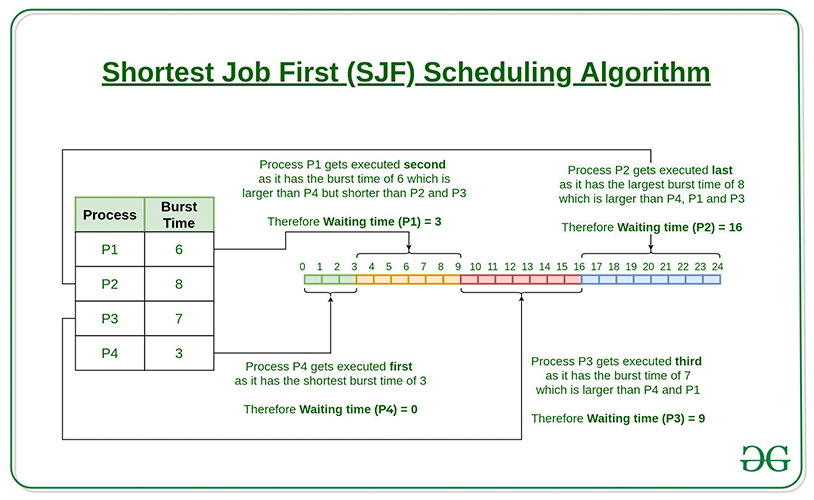
Shortest Job First Scheduling Algorithm
How to compute below times in SJF using a program?
- Completion Time: Time at which process completes its execution.
- Turn Around Time: Time Difference between completion time and arrival time.
Turn Around Time = Completion Time - Arrival Time - Waiting Time(W.T): Time Difference between turn around time and burst time.
Waiting Time = Turn Around Time - Burst Time
Program for Non-Preemptive Shortest Job First CPU Scheduling
Non-Preemptive Shortest Job First algorithm can be implemented using Segment Trees data structure. For detailed implementation of Non-Preemptive Shortest Job First scheduling algorithm, please refer: Program for Non-Preemptive Shortest Job First CPU Scheduling.
In this post, we have assumed arrival times as 0, so turn around and completion times are same.
Examples to show working of Non-Preemptive Shortest Job First CPU Scheduling Algorithm:
Example-1: Consider the following table of arrival time and burst time for five processes P1, P2, P3, P4 and P5.
| Process | Burst Time | Arrival Time |
|---|---|---|
| P1 | 6 ms | 2 ms |
| P2 | 2 ms | 5 ms |
| P3 | 8 ms | 1 ms |
| P4 | 3 ms | 0 ms |
| P5 | 4 ms | 4 ms |
The Shortest Job First CPU Scheduling Algorithm will work on the basis of steps as mentioned below:
At time = 0,
- Process P4 arrives and starts executing
| Time Instance | Process | Arrival Time | Waiting Table | Execution Time | Initial Burst Time | Remaining Burst Time |
|---|---|---|---|---|---|---|
| 0-1ms | P4 | 0ms | 1ms | 3ms | 2ms |
At time= 1,
- Process P3 arrives.
- But, as P4 still needs 2 execution units to complete.
- Thus, P3 will wait till P4 gets executed.
| Time Instance | Process | Arrival Time | Waiting Table | Execution Time | Initial Burst Time | Remaining Burst Time |
|---|---|---|---|---|---|---|
| 1-2ms | P4 | 0ms | 1ms | 2ms | 1ms | |
| P3 | 1ms | P3 | 0ms | 8ms | 8ms |
At time =2,
- Process P1 arrives and is added to the waiting table
- P4 will continue its execution.
| Time Instance | Process | Arrival Time | Waiting Table | Execution Time | Initial Burst Time | Remaining Burst Time |
|---|---|---|---|---|---|---|
| 2-3ms | ||||||
| P3 | 1ms | P3 | 0ms | 8ms | 8ms | |
| P1 | 2ms | P3, P1 | 0ms | 6ms | 6ms |
At time = 3,
- Process P4 will finish its execution.
- Then, the burst time of P3 and P1 is compared.
- Process P1 is executed because its burst time is less as compared to P3.
| Time Instance | Process | Arrival Time | Waiting Table | Execution Time | Initial Burst Time | Remaining Burst Time |
|---|---|---|---|---|---|---|
| 3-4ms | P3 | 1ms | P3 | 0ms | 8ms | 8ms |
| P1 | 2ms | P3 | 1ms | 6ms | 5ms |
At time = 4,
- Process P5 arrives and is added to the waiting Table.
- P1 will continue execution.
| Time Instance | Process | Arrival Time | Waiting Table | Execution Time | Initial Burst Time | Remaining Burst Time |
|---|---|---|---|---|---|---|
| 4-5ms | P3 | 1ms | P3 | 0ms | 8ms | 8ms |
| P1 | 2ms | P3 | 1ms | 5ms | 4ms | |
| P5 | 4ms | P3, P5 | 0ms | 4ms | 4ms |
At time = 5,
- Process P2 arrives and is added to the waiting Table.
- P1 will continue execution.
| Time Instance | Process | Arrival Time | Waiting Table | Execution Time | Initial Burst Time | Remaining Burst Time |
|---|---|---|---|---|---|---|
| 5-6ms | P3 | 1ms | P3 | 0ms | 8ms | 8ms |
| P1 | 2ms | P3 | 1ms | 4ms | 3ms | |
| P5 | 4ms | P3, P5 | 0ms | 4ms | 4ms | |
| P2 | 5ms | P3, P5, P2 | 0ms | 2ms | 2ms |
At time = 6,
- Process P1 will finish its execution.
- The burst time of P3, P5, and P2 is compared.
- Process P2 is executed because its burst time is the lowest among all.
| Time Instance | Process | Arrival Time | Waiting Table | Execution Time | Initial Burst Time | Remaining Burst Time |
|---|---|---|---|---|---|---|
| 6-9ms | P3 | 1ms | P3 | 0ms | 8ms | 8ms |
| P5 | 4ms | P3, P5 | 0ms | 4ms | 4ms | |
| P2 | 5ms | P3, P5, P2 | 0ms | 2ms | 2ms |
At time=9,
- Process P2 is executing and P3 and P5 are in the waiting Table.
| Time Instance | Process | Arrival Time | Waiting Table | Execution Time | Initial Burst Time | Remaining Burst Time |
|---|---|---|---|---|---|---|
| 9-11ms | P3 | 1ms | P3 | 0ms | 8ms | 8ms |
| P5 | 4ms | P3, P5 | 0ms | 4ms | 4ms | |
At time = 11,
- The execution of Process P2 will be done.
- The burst time of P3 and P5 is compared.
- Process P5 is executed because its burst time is lower than P3.
| Time Instance | Process | Arrival Time | Waiting Table | Execution Time | Initial Burst Time | Remaining Burst Time |
|---|---|---|---|---|---|---|
| 11-15ms | P3 | 1ms | P3 | 0ms | 8ms | 8ms |
At time = 15,
- Process P5 will finish its execution.
| Time Instance | Process | Arrival Time | Waiting Table | Execution Time | Initial Burst Time | Remaining Burst Time |
|---|---|---|---|---|---|---|
| 15-23ms |
At time = 23,
- Process P3 will finish its execution.
- The overall execution of the processes will be as shown below:
| Time Instance | Process | Arrival Time | Waiting Table | Execution Time | Initial Burst Time | Remaining Burst Time |
|---|---|---|---|---|---|---|
| 0-1ms | P4 | 0ms | 1ms | 3ms | 2ms | |
| 1-2ms | P4 | 0ms | 1ms | 2ms | 1ms | |
| P3 | 1ms | P3 | 0ms | 8ms | 8ms | |
| 2-3ms | ||||||
| P3 | 1ms | P3 | 0ms | 8ms | 8ms | |
| P1 | 2ms | P3, P1 | 0ms | 6ms | 6ms | |
| 3-4ms | P3 | 1ms | P3 | 0ms | 8ms | 8ms |
| P1 | 2ms | P3 | 1ms | 6ms | 5ms | |
| 4-5ms | P3 | 1ms | P3 | 0ms | 8ms | 8ms |
| P1 | 2ms | P3 | 1ms | 5ms | 4ms | |
| P5 | 4ms | P3, P5 | 0ms | 4ms | 4ms | |
| 5-6ms | P3 | 1ms | P3 | 0ms | 8ms | 8ms |
| P1 | 2ms | P3 | 1ms | 4ms | 3ms | |
| P5 | 4ms | P3, P5 | 0ms | 4ms | 4ms | |
| P2 | 5ms | P3, P5, P2 | 0ms | 2ms | 2ms | |
| 6-9ms | P3 | 1ms | P3 | 0ms | 8ms | 8ms |
| P5 | 4ms | P3, P5 | 0ms | 4ms | 4ms | |
| P2 | 5ms | P3, P5, P2 | 0ms | 2ms | 2ms | |
| 9-11ms | P3 | 1ms | P3 | 0ms | 8ms | 8ms |
| P5 | 4ms | P3, P5 | 0ms | 4ms | 4ms | |
| 11-15ms | P3 | 1ms | P3 | 0ms | 8ms | 8ms |
| 15-23ms |
Gantt chart for above execution:
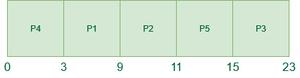
Gantt chart
Now, let’s calculate the average waiting time for above example:
P4 = 0 - 0 = 0
P1 = 3 - 2 = 1
P2 = 9 - 5 = 4
P5 = 11 - 4 = 7
P3 = 15 - 1 = 14
Average Waiting Time = 0 + 1 + 4 + 7 + 14/5 = 26/5 = 5.2

Advantages of SJF:
- SJF is better than the First come first serve(FCFS) algorithm as it reduces the average waiting time.
- SJF is generally used for long term scheduling
- It is suitable for the jobs running in batches, where run times are already known.
- SJF is probably optimal in terms of average turnaround time.
Disadvantages of SJF:
- SJF may cause very long turn-around times or starvation.
- In SJF job completion time must be known earlier, but sometimes it is hard to predict.
- Sometimes, it is complicated to predict the length of the upcoming CPU request.
- It leads to the starvation that does not reduce average turnaround time.
Implementation of SJF Algorithm in C
C++ `
#include using namespace std;
int main() {
// Matrix for storing Process Id, Burst
// Time, Average Waiting Time & Average
// Turn Around Time.
int A[100][4];
int i, j, n, total = 0, index, temp;
float avg_wt, avg_tat;

cout << "Enter number of process: ";
cin >> n;

cout << "Enter Burst Time:" << endl;

// User Input Burst Time and alloting Process Id.
for (i = 0; i < n; i++) {
    cout << "P" << i + 1 << ": ";
    cin >> A[i][1];
    A[i][0] = i + 1;
}

// Sorting process according to their Burst Time.
for (i = 0; i < n; i++) {
    index = i;
    for (j = i + 1; j < n; j++)
        if (A[j][1] < A[index][1])
            index = j;
    temp = A[i][1];
    A[i][1] = A[index][1];
    A[index][1] = temp;

    temp = A[i][0];
    A[i][0] = A[index][0];
    A[index][0] = temp;
}

A[0][2] = 0;
// Calculation of Waiting Times
for (i = 1; i < n; i++) {
    A[i][2] = 0;
    for (j = 0; j < i; j++)
        A[i][2] += A[j][1];
    total += A[i][2];
}

avg_wt = (float)total / n;
total = 0;
cout << "P     BT     WT     TAT" << endl;

// Calculation of Turn Around Time and printing the
// data.
for (i = 0; i < n; i++) {
    A[i][3] = A[i][1] + A[i][2];
    total += A[i][3];
    cout << "P" << A[i][0] << "     " << A[i][1] << "     " << A[i][2] << "      " << A[i][3] << endl;
}

avg_tat = (float)total / n;
cout << "Average Waiting Time= " << avg_wt << endl;
cout << "Average Turnaround Time= " << avg_tat << endl;
}
C
#include <stdio.h> int main() { // Matrix for storing Process Id, Burst // Time, Average Waiting Time & Average // Turn Around Time. int A[100][4]; int i, j, n, total = 0, index, temp; float avg_wt, avg_tat; printf("Enter number of process: "); scanf("%d", &n); printf("Enter Burst Time:\n"); // User Input Burst Time and alloting Process Id. for (i = 0; i < n; i++) { printf("P%d: ", i + 1); scanf("%d", &A[i][1]); A[i][0] = i + 1; } // Sorting process according to their Burst Time. for (i = 0; i < n; i++) { index = i; for (j = i + 1; j < n; j++) if (A[j][1] < A[index][1]) index = j; temp = A[i][1]; A[i][1] = A[index][1]; A[index][1] = temp;
    temp = A[i][0];
    A[i][0] = A[index][0];
    A[index][0] = temp;
}
A[0][2] = 0;
// Calculation of Waiting Times
for (i = 1; i < n; i++) {
    A[i][2] = 0;
    for (j = 0; j < i; j++)
        A[i][2] += A[j][1];
    total += A[i][2];
}
avg_wt = (float)total / n;
total = 0;
printf("P     BT     WT     TAT\n");
// Calculation of Turn Around Time and printing the
// data.
for (i = 0; i < n; i++) {
    A[i][3] = A[i][1] + A[i][2];
    total += A[i][3];
    printf("P%d     %d     %d      %d\n", A[i][0],
           A[i][1], A[i][2], A[i][3]);
}
avg_tat = (float)total / n;
printf("Average Waiting Time= %f", avg_wt);
printf("\nAverage Turnaround Time= %f", avg_tat);
}
Java
import java.io.* import java.util.*;
public class Main { public static void main(String[] args) { Scanner input = new Scanner(System.in); int n; // Matrix for storing Process Id, Burst // Time, Average Waiting Time & Average // Turn Around Time. int[][] A = new int[100][4]; int total = 0; float avg_wt, avg_tat; System.out.println("Enter number of process:"); n = input.nextInt(); System.out.println("Enter Burst Time:"); for (int i = 0; i < n; i++) { // User Input Burst Time and alloting // Process Id. System.out.print("P" + (i + 1) + ": "); A[i][1] = input.nextInt(); A[i][0] = i + 1; } for (int i = 0; i < n; i++) { // Sorting process according to their // Burst Time. int index = i; for (int j = i + 1; j < n; j++) { if (A[j][1] < A[index][1]) { index = j; } } int temp = A[i][1]; A[i][1] = A[index][1]; A[index][1] = temp; temp = A[i][0]; A[i][0] = A[index][0]; A[index][0] = temp; } A[0][2] = 0; // Calculation of Waiting Times for (int i = 1; i < n; i++) { A[i][2] = 0; for (int j = 0; j < i; j++) { A[i][2] += A[j][1]; } total += A[i][2]; } avg_wt = (float)total / n; total = 0; // Calculation of Turn Around Time and printing the // data. System.out.println("P\tBT\tWT\tTAT"); for (int i = 0; i < n; i++) { A[i][3] = A[i][1] + A[i][2]; total += A[i][3]; System.out.println("P" + A[i][0] + "\t" + A[i][1] + "\t" + A[i][2] + "\t" + A[i][3]); } avg_tat = (float)total / n; System.out.println("Average Waiting Time= " + avg_wt); System.out.println("Average Turnaround Time= " + avg_tat); } }
Python3
converting the code to python3
def main(): # Taking the number of processes n = int(input("Enter number of process: ")) # Matrix for storing Process Id, Burst Time, Average Waiting Time & Average Turn Around Time. A = [[0 for j in range(4)] for i in range(100)] total, avg_wt, avg_tat = 0, 0, 0 print("Enter Burst Time:") for i in range(n): # User Input Burst Time and alloting Process Id. A[i][1] = int(input(f"P{i+1}: ")) A[i][0] = i + 1 for i in range(n): # Sorting process according to their Burst Time. index = i for j in range(i + 1, n): if A[j][1] < A[index][1]: index = j temp = A[i][1] A[i][1] = A[index][1] A[index][1] = temp temp = A[i][0] A[i][0] = A[index][0] A[index][0] = temp A[0][2] = 0 # Calculation of Waiting Times for i in range(1, n): A[i][2] = 0 for j in range(i): A[i][2] += A[j][1] total += A[i][2] avg_wt = total / n total = 0 # Calculation of Turn Around Time and printing the data. print("P BT WT TAT") for i in range(n): A[i][3] = A[i][1] + A[i][2] total += A[i][3] print(f"P{A[i][0]} {A[i][1]} {A[i][2]} {A[i][3]}") avg_tat = total / n print(f"Average Waiting Time= {avg_wt}") print(f"Average Turnaround Time= {avg_tat}")
if name == "main": main()
C#
//C# equivalents
using System;
namespace Main { class Program { static void Main(string[] args) { // Matrix for storing Process Id, Burst // Time, Average Waiting Time & Average // Turn Around Time. int[,] A = new int[100, 4]; int n; int total = 0; float avg_wt, avg_tat; Console.WriteLine("Enter number of process:"); n = Convert.ToInt32(Console.ReadLine()); Console.WriteLine("Enter Burst Time:"); for (int i = 0; i < n; i++) { // User Input Burst Time and alloting // Process Id. Console.Write("P" + (i + 1) + ": "); A[i, 1] = Convert.ToInt32(Console.ReadLine()); A[i, 0] = i + 1; } for (int i = 0; i < n; i++) { // Sorting process according to their // Burst Time. int index = i; for (int j = i + 1; j < n; j++) { if (A[j, 1] < A[index, 1]) { index = j; } } int temp = A[i, 1]; A[i, 1] = A[index, 1]; A[index, 1] = temp; temp = A[i, 0]; A[i, 0] = A[index, 0]; A[index, 0] = temp; } A[0, 2] = 0; // Calculation of Waiting Times for (int i = 1; i < n; i++) { A[i, 2] = 0; for (int j = 0; j < i; j++) { A[i, 2] += A[j, 1]; } total += A[i, 2]; } avg_wt = (float)total / n; total = 0; // Calculation of Turn Around Time and printing the // data. Console.WriteLine("P\tBT\tWT\tTAT"); for (int i = 0; i < n; i++) { A[i, 3] = A[i, 1] + A[i, 2]; total += A[i, 3]; Console.WriteLine("P" + A[i, 0] + "\t" + A[i, 1] + "\t" + A[i, 2] + "\t" + A[i, 3]); } avg_tat = (float)total / n; Console.WriteLine("Average Waiting Time= " + avg_wt); Console.WriteLine("Average Turnaround Time= " + avg_tat); } } }
JavaScript
// Javascript code let A = []; let total = 0; let index, temp; let avg_wt, avg_tat; let n = prompt("Enter the number of process: ");
for (let i = 0; i < n; i++) { let input = prompt("P" + (i + 1) + ": "); A.push([i+1, parseInt(input)]); }
for (let i = 0; i < n; i++) { index = i; for (let j = i + 1; j < n; j++) { if (A[j][1] < A[index][1]) { index = j; } } temp = A[i][1]; A[i][1] = A[index][1]; A[index][1] = temp;
temp = A[i][0];
A[i][0] = A[index][0];
A[index][0] = temp;
}
A[0][2] = 0; for (let i = 1; i < n; i++) { A[i][2] = 0; for (let j = 0; j < i; j++) { A[i][2] += A[j][1]; } total += A[i][2]; }
avg_wt = total / n; total = 0; console.log("P BT WT TAT"); for (let i = 0; i < n; i++) { A[i][3] = A[i][1] + A[i][2]; total += A[i][3]; console.log("P" + A[i][0] + " " + A[i][1] + " " + A[i][2] + " " + A[i][3]); }
avg_tat = total / n; console.log("Average Waiting Time= " + avg_wt); console.log("Average Turnaround Time= " + avg_tat);
`
Time Complexity: O(n^2)
Auxiliary Space: O(n)
Note: In this post, we have assumed arrival times as 0, so turn around and completion times are same.
In Set-2 we will discuss the preemptive version of SJF i.e. Shortest Remaining Time First