Program for Worst Fit algorithm in Memory Management (original) (raw)
Last Updated : 13 Sep, 2023
Prerequisite : Partition allocation methods
Worst Fit allocates a process to the partition which is largest sufficient among the freely available partitions available in the main memory. If a large process comes at a later stage, then memory will not have space to accommodate it.
Example:
Input : blockSize[] = {100, 500, 200, 300, 600}; processSize[] = {212, 417, 112, 426}; Output: Process No. Process Size Block no. 1 212 5 2 417 2 3 112 5 4 426 Not Allocated
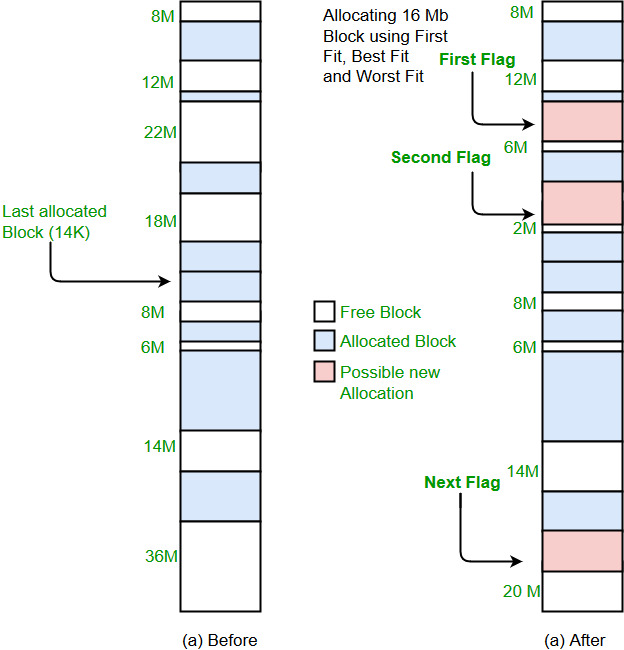
Implementation: 1- Input memory blocks and processes with sizes. 2- Initialize all memory blocks as free. 3- Start by picking each process and find the maximum block size that can be assigned to current process i.e., find max(bockSize[1], blockSize[2],.....blockSize[n]) > processSize[current], if found then assign it to the current process. 5- If not then leave that process and keep checking the further processes.
Below is implementation of above steps.
C++ `
// C++ implementation of worst - Fit algorithm #include<bits/stdc++.h> using namespace std;
// Function to allocate memory to blocks as per worst fit // algorithm void worstFit(int blockSize[], int m, int processSize[], int n) { // Stores block id of the block allocated to a // process int allocation[n];
// Initially no block is assigned to any process
memset(allocation, -1, sizeof(allocation));

// pick each process and find suitable blocks
// according to its size ad assign to it
for (int i=0; i<n; i++)
{
    // Find the best fit block for current process
    int wstIdx = -1;
    for (int j=0; j<m; j++)
    {
        if (blockSize[j] >= processSize[i])
        {
            if (wstIdx == -1)
                wstIdx = j;
            else if (blockSize[wstIdx] < blockSize[j])
                wstIdx = j;
        }
    }

    // If we could find a block for current process
    if (wstIdx != -1)
    {
        // allocate block j to p[i] process
        allocation[i] = wstIdx;

        // Reduce available memory in this block.
        blockSize[wstIdx] -= processSize[i];
    }
}

cout << "\nProcess No.\tProcess Size\tBlock no.\n";
for (int i = 0; i < n; i++)
{
    cout << "   " << i+1 << "\t\t" << processSize[i] << "\t\t";
    if (allocation[i] != -1)
        cout << allocation[i] + 1;
    else
        cout << "Not Allocated";
    cout << endl;
}
}
// Driver code int main() { int blockSize[] = {100, 500, 200, 300, 600}; int processSize[] = {212, 417, 112, 426}; int m = sizeof(blockSize)/sizeof(blockSize[0]); int n = sizeof(processSize)/sizeof(processSize[0]);
worstFit(blockSize, m, processSize, n);

return 0 ;
}
Java
// Java implementation of worst - Fit algorithm
public class GFG { // Method to allocate memory to blocks as per worst fit // algorithm static void worstFit(int blockSize[], int m, int processSize[], int n) { // Stores block id of the block allocated to a // process int allocation[] = new int[n];
    // Initially no block is assigned to any process
    for (int i = 0; i < allocation.length; i++)
        allocation[i] = -1;

    // pick each process and find suitable blocks
    // according to its size ad assign to it
    for (int i=0; i<n; i++)
    {
        // Find the best fit block for current process
        int wstIdx = -1;
        for (int j=0; j<m; j++)
        {
            if (blockSize[j] >= processSize[i])
            {
                if (wstIdx == -1)
                    wstIdx = j;
                else if (blockSize[wstIdx] < blockSize[j])
                    wstIdx = j;
            }
        }

        // If we could find a block for current process
        if (wstIdx != -1)
        {
            // allocate block j to p[i] process
            allocation[i] = wstIdx;

            // Reduce available memory in this block.
            blockSize[wstIdx] -= processSize[i];
        }
    }

    System.out.println("\nProcess No.\tProcess Size\tBlock no.");
    for (int i = 0; i < n; i++)
    {
        System.out.print("   " + (i+1) + "\t\t" + processSize[i] + "\t\t");
        if (allocation[i] != -1)
            System.out.print(allocation[i] + 1);
        else
            System.out.print("Not Allocated");
        System.out.println();
    }
}

// Driver Method
public static void main(String[] args)
{
     int blockSize[] = {100, 500, 200, 300, 600};
     int processSize[] = {212, 417, 112, 426};
     int m = blockSize.length;
     int n = processSize.length;

     worstFit(blockSize, m, processSize, n);
}
}
Python3
Python3 implementation of worst - Fit algorithm
Function to allocate memory to blocks as
per worst fit algorithm
def worstFit(blockSize, m, processSize, n):
# Stores block id of the block
# allocated to a process

# Initially no block is assigned
# to any process
allocation = [-1] * n

# pick each process and find suitable blocks
# according to its size ad assign to it
for i in range(n):

    # Find the best fit block for
    # current process
    wstIdx = -1
    for j in range(m):
        if blockSize[j] >= processSize[i]:
            if wstIdx == -1:
                wstIdx = j
            elif blockSize[wstIdx] < blockSize[j]:
                wstIdx = j

    # If we could find a block for
    # current process
    if wstIdx != -1:

        # allocate block j to p[i] process
        allocation[i] = wstIdx

        # Reduce available memory in this block.
        blockSize[wstIdx] -= processSize[i]

print("Process No. Process Size Block no.")
for i in range(n):
    print(i + 1, "         ",
          processSize[i], end = "     ")
    if allocation[i] != -1:
        print(allocation[i] + 1)
    else:
        print("Not Allocated")
Driver code
if name == 'main': blockSize = [100, 500, 200, 300, 600] processSize = [212, 417, 112, 426] m = len(blockSize) n = len(processSize)
worstFit(blockSize, m, processSize, n)This code is contributed by PranchalK
C#
// C# implementation of worst - Fit algorithm using System;
class GFG
{
// Method to allocate memory to blocks
// as per worst fit algorithm
static void worstFit(int []blockSize, int m,
int []processSize, int n)
{
// Stores block id of the block allocated to a
// process
int []allocation = new int[n];
    // Initially no block is assigned to any process
    for (int i = 0; i < allocation.Length; i++)
        allocation[i] = -1;

    // pick each process and find suitable blocks
    // according to its size ad assign to it
    for (int i = 0; i < n; i++)
    {
        // Find the best fit block for current process
        int wstIdx = -1;
        for (int j = 0; j < m; j++)
        {
            if (blockSize[j] >= processSize[i])
            {
                if (wstIdx == -1)
                    wstIdx = j;
                else if (blockSize[wstIdx] < blockSize[j])
                    wstIdx = j;
            }
        }

        // If we could find a block for current process
        if (wstIdx != -1)
        {
            // allocate block j to p[i] process
            allocation[i] = wstIdx;

            // Reduce available memory in this block.
            blockSize[wstIdx] -= processSize[i];
        }
    }

    Console.WriteLine("\nProcess No.\tProcess Size\tBlock no.");
    for (int i = 0; i < n; i++)
    {
        Console.Write(" " + (i+1) + "\t\t\t" + processSize[i] + "\t\t\t");
        if (allocation[i] != -1)
            Console.Write(allocation[i] + 1);
        else
            Console.Write("Not Allocated");
        Console.WriteLine();
    }
}

// Driver code
public static void Main(String[] args)
{
    int []blockSize = {100, 500, 200, 300, 600};
    int []processSize = {212, 417, 112, 426};
    int m = blockSize.Length;
    int n = processSize.Length;

    worstFit(blockSize, m, processSize, n);
}
}
// This code has been contributed by 29AjayKumar
JavaScript
`
Output
Process No. Process Size Block no. 1 212 5 2 417 2 3 112 5 4 426 Not Allocated
Time Complexity: O(N*M) where N is processSize length and M is blockSize length.
Auxiliary Space: O(N)