Radix Sort (original) (raw)
Last Updated : 30 Sep, 2025
**Radix Sort is a linear sorting algorithm (for fixed length digit counts) that sorts elements by processing them digit by digit. It is an efficient sorting algorithm for integers or strings with fixed-size keys.
- It repeatedly distributes the elements into buckets based on each digit's value. This is different from other algorithms like Merge Sort or Quick Sort where we compare elements directly.
- By repeatedly sorting the elements by their significant digits, from the least significant to the most significant, it achieves the final sorted order.
- We use a stable algorithm like Counting Sort to sort the individual digits so that the overall algorithm remains stable.
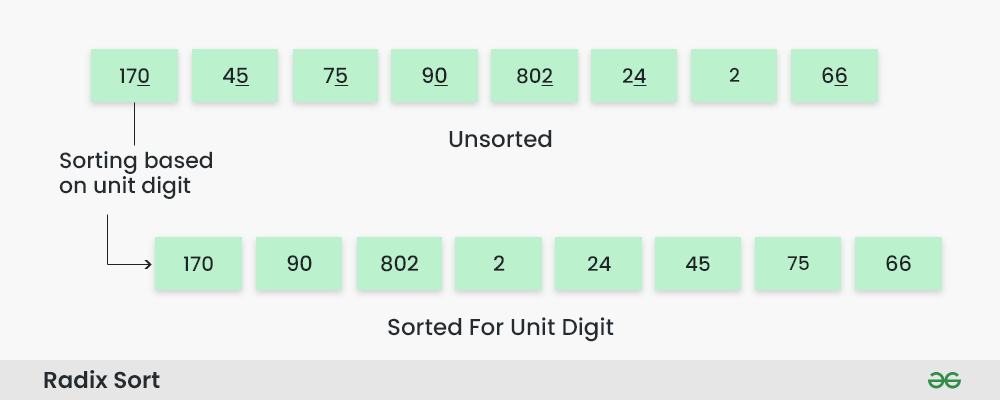
To perform radix sort on the array [170, 45, 75, 90, 802, 24, 2, 66], we follow these steps:
**Step 1: Find the largest element, which is 802. It has three digits, so we will iterate three times.
**Step 2: Sort the elements based on the **unit place digits (X=0).
How does Radix Sort Algorithm work | Step 2
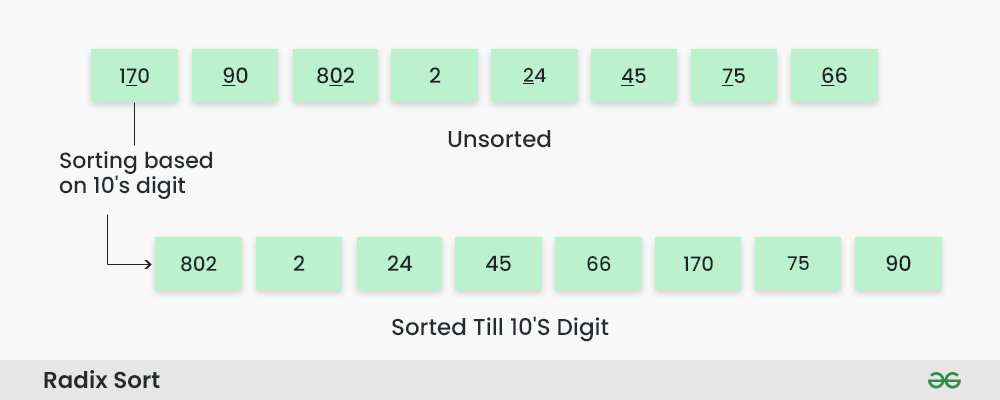
**Step 3: Sort the elements based on the **tens place digits.
How does Radix Sort Algorithm work | Step 3
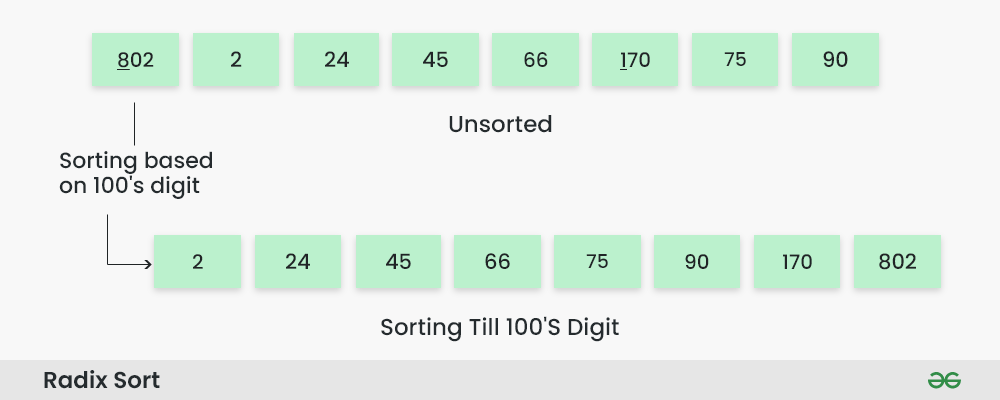
**Step 4: Sort the elements based on the hundreds place digits.
How does Radix Sort Algorithm work | Step 4
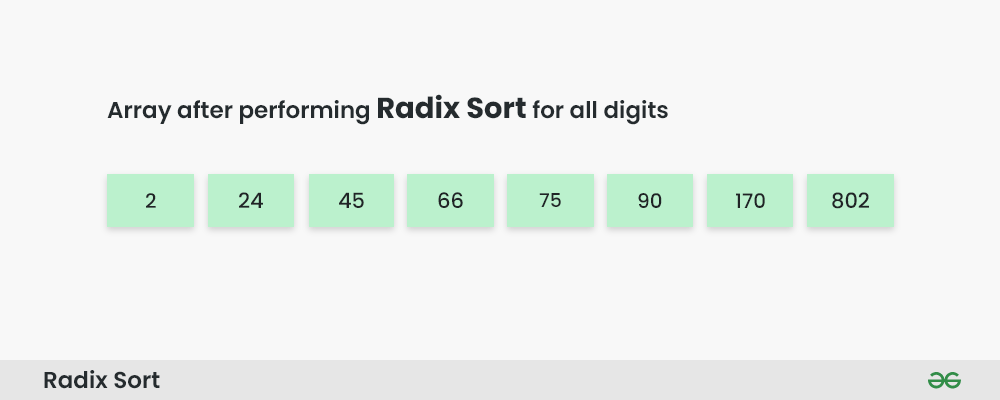
**Step 5: The array is now sorted in ascending order.
How does Radix Sort Algorithm work | Step 5

Below is the implementation for the above illustrations:
C++ `
// C++ implementation of Radix Sort
#include using namespace std;
// A utility function to get maximum // value in arr[] int getMax(int arr[], int n) { int mx = arr[0]; for (int i = 1; i < n; i++) if (arr[i] > mx) mx = arr[i]; return mx; }
// A function to do counting sort of arr[] // according to the digit // represented by exp. void countSort(int arr[], int n, int exp) {
// Output array
int output[n];
int i, count[10] = { 0 };

// Store count of occurrences
// in count[]
for (i = 0; i < n; i++)
    count[(arr[i] / exp) % 10]++;

// Change count[i] so that count[i]
// now contains actual position
// of this digit in output[]
for (i = 1; i < 10; i++)
    count[i] += count[i - 1];

// Build the output array
for (i = n - 1; i >= 0; i--) {
    output[count[(arr[i] / exp) % 10] - 1] = arr[i];
    count[(arr[i] / exp) % 10]--;
}

// Copy the output array to arr[],
// so that arr[] now contains sorted
// numbers according to current digit
for (i = 0; i < n; i++)
    arr[i] = output[i];
}
// The main function to that sorts arr[] // of size n using Radix Sort void radixsort(int arr[], int n) {
// Find the maximum number to
// know number of digits
int m = getMax(arr, n);

// Do counting sort for every digit.
// Note that instead of passing digit
// number, exp is passed. exp is 10^i
// where i is current digit number
for (int exp = 1; m / exp > 0; exp *= 10)
    countSort(arr, n, exp);
}
// A utility function to print an array void print(int arr[], int n) { for (int i = 0; i < n; i++) cout << arr[i] << " "; }
// Driver Code int main() { int arr[] = { 170, 45, 75, 90, 802, 24, 2, 66 }; int n = sizeof(arr) / sizeof(arr[0]);
// Function Call
radixsort(arr, n);
print(arr, n);
return 0;
}
C
#include <stdio.h>
// A utility function to get the maximum // value in arr[] int getMax(int arr[], int n) { int mx = arr[0]; for (int i = 1; i < n; i++) if (arr[i] > mx) mx = arr[i]; return mx; }
// A function to do counting sort of arr[] // according to the digit represented by exp void countSort(int arr[], int n, int exp) { int output[n]; // Output array int count[10] = {0}; // Initialize count array as 0
// Store count of occurrences in count[]
for (int i = 0; i < n; i++)
    count[(arr[i] / exp) % 10]++;

// Change count[i] so that count[i] now
// contains actual position of this digit
// in output[]
for (int i = 1; i < 10; i++)
    count[i] += count[i - 1];

// Build the output array
for (int i = n - 1; i >= 0; i--) {
    output[count[(arr[i] / exp) % 10] - 1] = arr[i];
    count[(arr[i] / exp) % 10]--;
}

// Copy the output array to arr[],
// so that arr[] now contains sorted
// numbers according to current digit
for (int i = 0; i < n; i++)
    arr[i] = output[i];
}
// The main function to sort arr[] of size // n using Radix Sort void radixSort(int arr[], int n) {
// Find the maximum number to know
// the number of digits
int m = getMax(arr, n);

// Do counting sort for every digit
// exp is 10^i where i is the current
// digit number
for (int exp = 1; m / exp > 0; exp *= 10)
    countSort(arr, n, exp);
}
// A utility function to print an array void printArray(int arr[], int n) { for (int i = 0; i < n; i++) printf("%d ", arr[i]); printf("\n"); }
// Driver code int main() { int arr[] = {170, 45, 75, 90, 802, 24, 2, 66}; int n = sizeof(arr) / sizeof(arr[0]);
// Function call
radixSort(arr, n);
printArray(arr, n);
return 0;
}
Java
// Radix sort Java implementation
import java.io.; import java.util.;
class Radix {
// A utility function to get maximum value in arr[]
static int getMax(int arr[], int n)
{
    int mx = arr[0];
    for (int i = 1; i < n; i++)
        if (arr[i] > mx)
            mx = arr[i];
    return mx;
}

// A function to do counting sort of arr[] according to
// the digit represented by exp.
static void countSort(int arr[], int n, int exp)
{
    int output[] = new int[n]; // output array
    int i;
    int count[] = new int[10];
    Arrays.fill(count, 0);

    // Store count of occurrences in count[]
    for (i = 0; i < n; i++)
        count[(arr[i] / exp) % 10]++;

    // Change count[i] so that count[i] now contains
    // actual position of this digit in output[]
    for (i = 1; i < 10; i++)
        count[i] += count[i - 1];

    // Build the output array
    for (i = n - 1; i >= 0; i--) {
        output[count[(arr[i] / exp) % 10] - 1] = arr[i];
        count[(arr[i] / exp) % 10]--;
    }

    // Copy the output array to arr[], so that arr[] now
    // contains sorted numbers according to current
    // digit
    for (i = 0; i < n; i++)
        arr[i] = output[i];
}

// The main function to that sorts arr[] of
// size n using Radix Sort
static void radixsort(int arr[], int n)
{
    // Find the maximum number to know number of digits
    int m = getMax(arr, n);

    // Do counting sort for every digit. Note that
    // instead of passing digit number, exp is passed.
    // exp is 10^i where i is current digit number
    for (int exp = 1; m / exp > 0; exp *= 10)
        countSort(arr, n, exp);
}

// A utility function to print an array
static void print(int arr[], int n)
{
    for (int i = 0; i < n; i++)
        System.out.print(arr[i] + " ");
}

// Main driver method
public static void main(String[] args)
{
    int arr[] = { 170, 45, 75, 90, 802, 24, 2, 66 };
    int n = arr.length;

    // Function Call
    radixsort(arr, n);
    print(arr, n);
}
}
Python
Python program for implementation of Radix Sort
A function to do counting sort of arr[] according to
the digit represented by exp.
def countingSort(arr, exp1):
n = len(arr)

# The output array elements that will have sorted arr
output = [0] * (n)

# initialize count array as 0
count = [0] * (10)

# Store count of occurrences in count[]
for i in range(0, n):
    index = arr[i] // exp1
    count[index % 10] += 1

# Change count[i] so that count[i] now contains actual
# position of this digit in output array
for i in range(1, 10):
    count[i] += count[i - 1]

# Build the output array
i = n - 1
while i >= 0:
    index = arr[i] // exp1
    output[count[index % 10] - 1] = arr[i]
    count[index % 10] -= 1
    i -= 1

# Copying the output array to arr[],
# so that arr now contains sorted numbers
i = 0
for i in range(0, len(arr)):
    arr[i] = output[i]
Method to do Radix Sort
def radixSort(arr):
# Find the maximum number to know number of digits
max1 = max(arr)

# Do counting sort for every digit. Note that instead
# of passing digit number, exp is passed. exp is 10^i
# where i is current digit number
exp = 1
while max1 / exp >= 1:
    countingSort(arr, exp)
    exp *= 10
Driver code
arr = [170, 45, 75, 90, 802, 24, 2, 66]
Function Call
radixSort(arr)
for i in range(len(arr)): print(arr[i], end=" ")
This code is contributed by Mohit Kumra
Edited by Patrick Gallagher
C#
// C# implementation of Radix Sort using System;
class GFG { public static int getMax(int[] arr, int n) { int mx = arr[0]; for (int i = 1; i < n; i++) if (arr[i] > mx) mx = arr[i]; return mx; }
// A function to do counting sort of arr[] according to
// the digit represented by exp.
public static void countSort(int[] arr, int n, int exp)
{
    int[] output = new int[n]; // output array
    int i;
    int[] count = new int[10];

    // initializing all elements of count to 0
    for (i = 0; i < 10; i++)
        count[i] = 0;

    // Store count of occurrences in count[]
    for (i = 0; i < n; i++)
        count[(arr[i] / exp) % 10]++;

    // Change count[i] so that count[i] now contains
    // actual
    //  position of this digit in output[]
    for (i = 1; i < 10; i++)
        count[i] += count[i - 1];

    // Build the output array
    for (i = n - 1; i >= 0; i--) {
        output[count[(arr[i] / exp) % 10] - 1] = arr[i];
        count[(arr[i] / exp) % 10]--;
    }

    // Copy the output array to arr[], so that arr[] now
    // contains sorted numbers according to current
    // digit
    for (i = 0; i < n; i++)
        arr[i] = output[i];
}

// The main function to that sorts arr[] of size n using
// Radix Sort
public static void radixsort(int[] arr, int n)
{
    // Find the maximum number to know number of digits
    int m = getMax(arr, n);

    // Do counting sort for every digit. Note that
    // instead of passing digit number, exp is passed.
    // exp is 10^i where i is current digit number
    for (int exp = 1; m / exp > 0; exp *= 10)
        countSort(arr, n, exp);
}

// A utility function to print an array
public static void print(int[] arr, int n)
{
    for (int i = 0; i < n; i++)
        Console.Write(arr[i] + " ");
}

// Driver Code
public static void Main()
{
    int[] arr = { 170, 45, 75, 90, 802, 24, 2, 66 };
    int n = arr.Length;

    // Function Call
    radixsort(arr, n);
    print(arr, n);
}

// This code is contributed by DrRoot_
}
JavaScript
// Radix sort JavaScript implementation
"use strict";
// A utility function to get maximum value in arr[] function getMax(arr) { const length = arr.length; let mx = arr[0]; for (let i = 1; i < length; i++) { if (arr[i] > mx) mx = arr[i]; } return mx; }
// A function to do counting sort of arr[] according to // the digit represented by exp. function countSort(arr, exp) { const length = arr.length; let output = Array(length); // output array let count = Array(10).fill(0, 0);
// Store count of occurrences in count[] for (let i = 0; i < length; i++) { const digit = Math.floor(arr[i] / exp) % 10; count[digit]++; }
// Change count[i] so that count[i] now contains // actual position of this digit in output[] for (let i = 1; i < 10; i++) { count[i] += count[i - 1]; }
// Build the output array for (let i = length - 1; i >= 0; i--) { const digit = Math.floor(arr[i] / exp) % 10; output[count[digit] - 1] = arr[i]; count[digit]--; }
return output; }
// The main function to that sorts arr[] using Radix Sort function radixSort(arr) { // Find the maximum number to know number of digits const maxNumber = getMax(arr); // Create a shallow copy where the sorted values will be kept let sortedArr = [...arr];
// Do counting sort for every digit. Note that // instead of passing digit number, exp is passed. // exp is 10^i where i is current digit number for (let exp = 1; Math.floor(maxNumber / exp) > 0; exp *= 10) { // Get the Count sort iteration const sortedIteration = countSort(sortedArr, exp); sortedArr = sortedIteration; }
return sortedArr; }
/Driver Code/ const arr = [170, 45, 75, 90, 802, 24, 2, 66];
// Function Call const sortedArr = radixSort(arr);
console.log(sortedArr.join(" "));
// This code is contributed by beeduhboodee
PHP
` Dart ``
// Radix sort Dart implementation
/// A utility function to get the maximum value of a List<int> [array]
int getMax(List array) {
int max = array[0];
for (final it in array) { if (it > max) { max = it; } }
return max; }
/// A function to do counting sort of List<int> [array] according to the
/// digit represented by [exp].
List countSort(List array, int exp) {
final length = array.length;
final outputArr = List.filled(length, 0);
// A list where index represents the digit and value represents the count of
// occurrences
final digitsCount = List.filled(10, 0);
// Store count of occurrences in digitsCount[] for (final item in array) { final digit = item ~/ exp % 10; digitsCount[digit]++; }
// Change digitsCount[i] so that digitsCount[i] now contains actual position // of this digit in outputArr[] for (int i = 1; i < 10; i++) { digitsCount[i] += digitsCount[i - 1]; }
// Build the output array for (int i = length - 1; i >= 0; i--) { final item = array[i]; final digit = item ~/ exp % 10; outputArr[digitsCount[digit] - 1] = item; digitsCount[digit]--; }
return outputArr; }
/// The main function to that sorts a List<int> [array] using Radix sort
List radixSort(List array) {
// Find the maximum number to know number of digits
final maxNumber = getMax(array);
// Shallow copy of the input array
final sortedArr = List.of(array);
// Do counting sort for every digit. Note that instead of passing digit // number, exp is passed. exp is 10^i, where i is current digit number for (int exp = 1; maxNumber ~/ exp > 0; exp *= 10) { final sortedIteration = countSort(sortedArr, exp); sortedArr.clear(); sortedArr.addAll(sortedIteration); }
return sortedArr; }
void main() { const array = [170, 45, 75, 90, 802, 24, 2, 66];
final sortedArray = radixSort(array);
print(sortedArray); }
// This code is contributed by beeduhboodee
``
Output
2 24 45 66 75 90 170 802
**Complexity Analysis of Radix Sort:
**Time Complexity:
- Radix sort is a non-comparative integer sorting algorithm that sorts data with integer keys by grouping the keys by the individual digits which share the same significant position and value. It has a time complexity of **O(d * (n + b)), where d is the number of digits, n is the number of elements, and b is the base of the number system being used.
- In practical implementations, radix sort is often faster than other comparison-based sorting algorithms, such as quicksort or merge sort, for large datasets, especially when the keys have many digits. However, its time complexity grows linearly with the number of digits, and so it is not as efficient for small datasets.
**Auxiliary Space:
- Radix sort also has a space complexity of **O(n + b), where n is the number of elements and b is the base of the number system. This space complexity comes from the need to create buckets for each digit value and to copy the elements back to the original array after each digit has been sorted.
Please refer Complexity Analysis of Radix Sort for more details