Reverse actual bits of the given number (original) (raw)
Last Updated : 14 Jan, 2026
Given a non-negative integer **n, the task is to **reverse the bits in its binary representation and return the resulting decimal number. The reversal should consider only the actual binary digits without any leading zeros.
**Examples :
**Input : 11
**Output : 13
**Explanation: (11)10 = (1011)2.
After reversing the bits we get: (1101)2 = (13)10.**Input : 10
**Output : 5
**Explanation : (10)10 = (1010)2.
After reversing the bits we get: (0101)2 = (101)2 = (5)10.

**Approach:
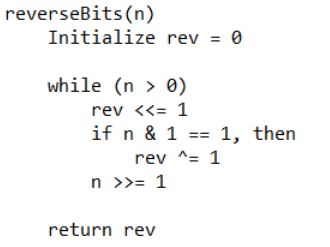
The idea is to build the reversed number by examining each bit of the input number from **right to left, while simultaneously constructing the result from **left to right using left shift and right shift operators.
Step by step approach:
- Traverse each bit of the input number using right shift operations (n >>= 1).
- Build the result by shifting it left (ans <<= 1) before each new bit is processed.
- When a '1' bit is encountered in the input (n & 1 == 1), set the rightmost bit of the result (ans |= 1).
- Continue this process until all bits in the input number have been processed (n > 0).
C++ `
// C++ program to reverse actual bits of a given number #include using namespace std;
int reverseBits(unsigned int n) { int ans = 0;
// traversing bits of 'n' from the right
while (n > 0) {

    // bitwise left shift
    // 'ans' by 1
    ans <<= 1;

    // if current bit is '1'
    if (n & 1 == 1)
        ans |= 1;

    // bitwise right shift
    // 'n' by 1
    n >>= 1;

}

// required number
return ans;
}
int main() { int n = 11; cout << reverseBits(n); return 0; }
Java
// Java program to reverse actual bits of a given number
class GfG {
static int reverseBits(int n) {
    int ans = 0;

    // traversing bits of 'n' from the right
    while (n > 0) {

        // bitwise left shift
        // 'ans' by 1
        ans <<= 1;

        // if current bit is '1'
        if ((n & 1) == 1)
            ans |= 1;

        // bitwise right shift
        // 'n' by 1
        n >>= 1;
    }

    // required number
    return ans;
}

public static void main(String[] args) {
    int n = 11;
    System.out.println(reverseBits(n));
}
}
Python
Python program to reverse actual bits of a given number
def reverseBits(n): ans = 0
# traversing bits of 'n' from the right
while n > 0:

    # bitwise left shift
    # 'ans' by 1
    ans <<= 1

    # if current bit is '1'
    if (n & 1) == 1:
        ans |= 1

    # bitwise right shift
    # 'n' by 1
    n >>= 1

# required number
return ans
if name == "main": n = 11 print(reverseBits(n))
C#
// C# program to reverse actual bits of a given number using System;
class GfG {
static uint reverseBits(uint n) {
    uint ans = 0;

    // traversing bits of 'n' from the right
    while (n > 0) {

        // bitwise left shift
        // 'ans' by 1
        ans <<= 1;

        // if current bit is '1'
        if ((n & 1) == 1)
            ans |= 1;

        // bitwise right shift
        // 'n' by 1
        n >>= 1;
    }

    // required number
    return ans;
}

static void Main() {
    uint n = 11;
    Console.WriteLine(reverseBits(n));
}
}
JavaScript
// JavaScript program to reverse actual bits of a given number
function reverseBits(n) { let ans = 0;
// traversing bits of 'n' from the right
while (n > 0) {

    // bitwise left shift
    // 'ans' by 1
    ans <<= 1;

    // if current bit is '1'
    if ((n & 1) === 1)
        ans |= 1;

    // bitwise right shift
    // 'n' by 1
    n >>= 1;
}

// required number
return ans;
}
let n = 11; console.log(reverseBits(n));
`
**Time Complexity: O(log n)
**Space Complexity: O(1)