Reverse tree path (original) (raw)
Last Updated : 11 Jul, 2025
Given a tree and node data, the task to reverse the path to that particular Node.
Examples:
Input:
7
/
6 5
/ \ /
4 3 2 1
Data = 4
Output: Inorder of tree
7 6 3 4 2 5 1
Input:
7
/
6 5
/ \ /
4 3 2 1
Data = 2
Output : Inorder of tree
4 6 3 2 7 5 1
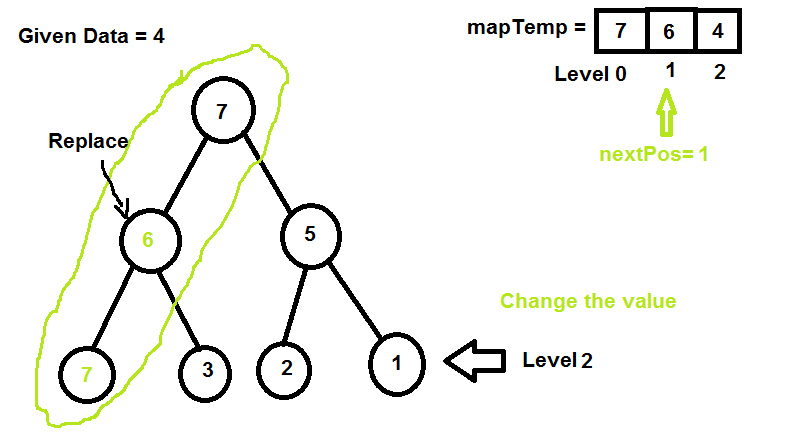
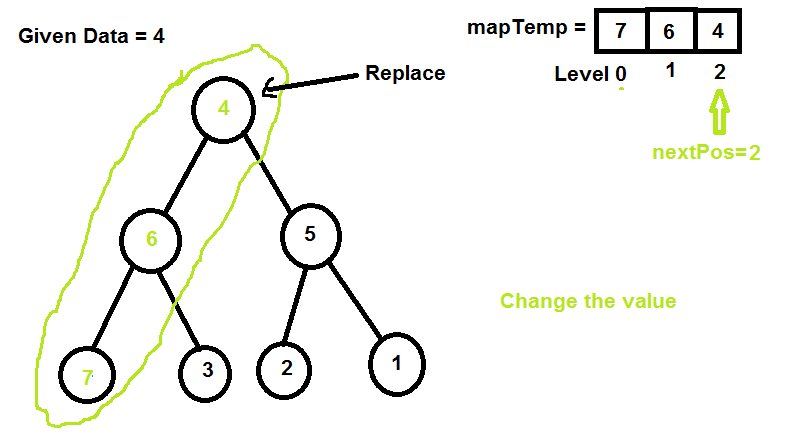
The idea is to use a map to store path level wise.
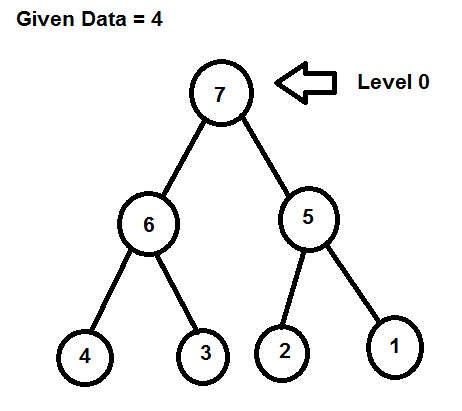
Find the Node path as well as store it in the map
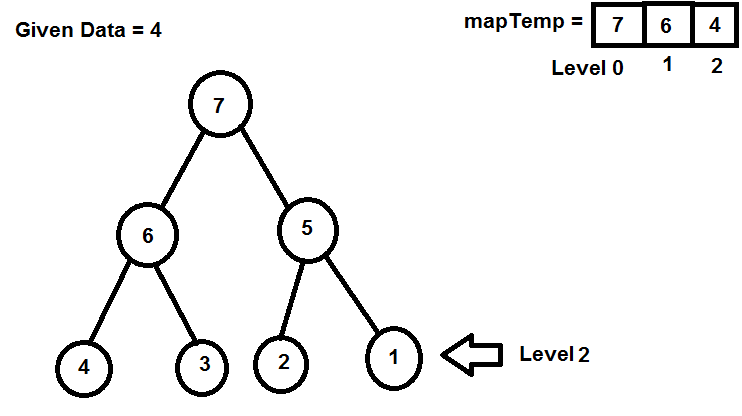
the path is
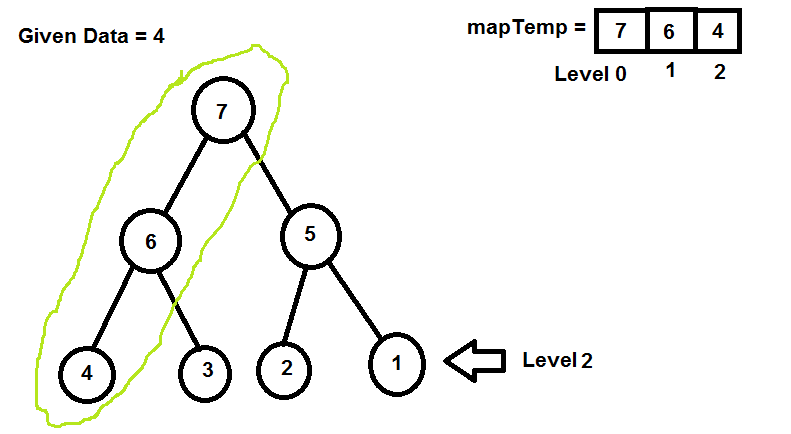
Replace the position with the map nextPos index value
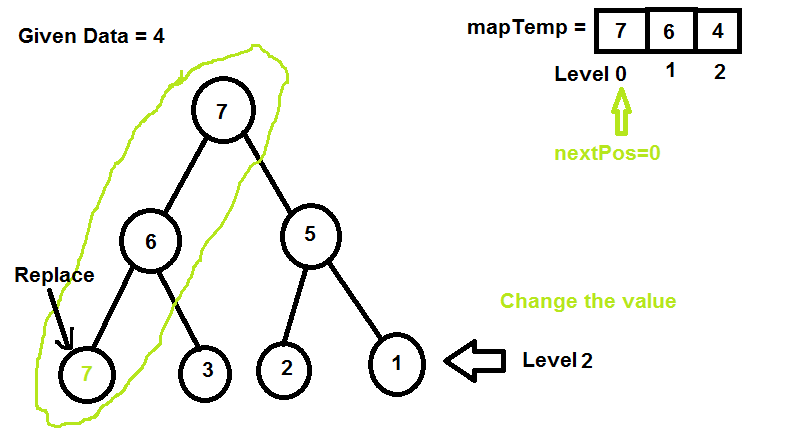
increment the nextpos index and replace the next value
increment the nextpos index and replace the next value
Implementation:
C++ `
// C++ program to Reverse Tree path #include <bits/stdc++.h> using namespace std;
// A Binary Tree Node struct Node { int data; struct Node *left, *right; };
// 'data' is input. We need to reverse path from // root to data. // 'level' is current level. // 'temp' that stores path nodes. // 'nextpos' used to pick next item for reversing. Node* reverseTreePathUtil(Node* root, int data, map<int, int>& temp, int level, int& nextpos) { // return NULL if root NULL if (root == NULL) return NULL;
// Final condition
// if the node is found then
if (data == root->data) {

    // store the value in it's level
    temp[level] = root->data;

    // change the root value with the current
    // next element of the map
    root->data = temp[nextpos];

    // increment in k for the next element
    nextpos++;
    return root;
}

// store the data in particular level
temp[level] = root->data;

// We go to right only when left does not
// contain given data. This way we make sure
// that correct path node is stored in temp[]
Node *left, *right;
left = reverseTreePathUtil(root->left, data, temp,
                              level + 1, nextpos);
if (left == NULL)
    right = reverseTreePathUtil(root->right, data,
                        temp, level + 1, nextpos);

// If current node is part of the path,
// then do reversing.
if (left || right) {
    root->data = temp[nextpos];
    nextpos++;
    return (left ? left : right);
}

// return NULL if not element found
return NULL;
}
// Reverse Tree path void reverseTreePath(Node* root, int data) { // store per level data map<int, int> temp;
// it is for replacing the data
int nextpos = 0;

// reverse tree path
reverseTreePathUtil(root, data, temp, 0, nextpos);
}
// INORDER void inorder(Node* root) { if (root != NULL) { inorder(root->left); cout << root->data << " "; inorder(root->right); } }
// Utility function to create a new tree node Node* newNode(int data) { Node* temp = new Node; temp->data = data; temp->left = temp->right = NULL; return temp; }
// Driver program to test above functions int main() { // Let us create binary tree shown in above diagram Node* root = newNode(7); root->left = newNode(6); root->right = newNode(5); root->left->left = newNode(4); root->left->right = newNode(3); root->right->left = newNode(2); root->right->right = newNode(1);
/*     7
     /    \
    6       5
   / \     / \
  4  3     2  1          */

int data = 4;

// Reverse Tree Path
reverseTreePath(root, data);

// Traverse inorder
inorder(root);
return 0;
}
Java
// Java program to Reverse Tree path import java.util.*; class solution {
// A Binary Tree Node static class Node { int data; Node left, right; };
//class for int values static class INT { int data; };
// 'data' is input. We need to reverse path from // root to data. // 'level' is current level. // 'temp' that stores path nodes. // 'nextpos' used to pick next item for reversing. static Node reverseTreePathUtil(Node root, int data, Map<Integer, Integer> temp, int level, INT nextpos) { // return null if root null if (root == null) return null;
// Final condition
// if the node is found then
if (data == root.data) {

    // store the value in it's level
    temp.put(level,root.data);

    // change the root value with the current
    // next element of the map
    root.data = temp.get(nextpos.data);

    // increment in k for the next element
    nextpos.data++;
    return root;
}

// store the data in particular level
temp.put(level,root.data);

// We go to right only when left does not
// contain given data. This way we make sure
// that correct path node is stored in temp[]
Node left, right=null;
left = reverseTreePathUtil(root.left, data, temp,
                              level + 1, nextpos);
if (left == null)
    right = reverseTreePathUtil(root.right, data,
                        temp, level + 1, nextpos);

// If current node is part of the path,
// then do reversing.
if (left!=null || right!=null) {
    root.data = temp.get(nextpos.data);
    nextpos.data++;
    return (left!=null ? left : right);
}

// return null if not element found
return null;
}
// Reverse Tree path static void reverseTreePath(Node root, int data) { // store per level data Map< Integer, Integer> temp= new HashMap< Integer, Integer>();
// it is for replacing the data
INT nextpos=new INT();
nextpos.data = 0;

// reverse tree path
reverseTreePathUtil(root, data, temp, 0, nextpos);
}
// INORDER static void inorder(Node root) { if (root != null) { inorder(root.left); System.out.print( root.data + " "); inorder(root.right); } }
// Utility function to create a new tree node static Node newNode(int data) { Node temp = new Node(); temp.data = data; temp.left = temp.right = null; return temp; }
// Driver program to test above functions public static void main(String args[]) { // Let us create binary tree shown in above diagram Node root = newNode(7); root.left = newNode(6); root.right = newNode(5); root.left.left = newNode(4); root.left.right = newNode(3); root.right.left = newNode(2); root.right.right = newNode(1);
  /*   7
     /    \
    6       5
   / \     / \
  4  3     2  1         */

int data = 4;

// Reverse Tree Path
reverseTreePath(root, data);

// Traverse inorder
inorder(root);
} } //contributed by Arnab Kundu
Python3
Python3 program to Reverse Tree path
A Binary Tree Node
class Node: def init(self, data): self.data = data self.left = None self.right = None
'data' is input. We need to reverse path from
root to data.
'level' is current level.
'temp' that stores path nodes.
'nextpos' used to pick next item for reversing.
def reverseTreePathUtil(root, data,temp, level, nextpos):
# return None if root None
if (root == None):
    return None, temp, nextpos;

# Final condition
# if the node is found then
if (data == root.data):

    # store the value in it's level
    temp[level] = root.data;

    # change the root value with the current
    # next element of the map
    root.data = temp[nextpos];

    # increment in k for the next element
    nextpos += 1
    return root, temp, nextpos;

# store the data in particular level
temp[level] = root.data;

# We go to right only when left does not
# contain given data. This way we make sure
# that correct path node is stored in temp[]
right = None
left, temp, nextpos = reverseTreePathUtil(root.left, data, temp,
                              level + 1, nextpos);
if (left == None):
    right, temp, nextpos = reverseTreePathUtil(root.right, data,
                        temp, level + 1, nextpos);

# If current node is part of the path,
# then do reversing.
if (left or right):
    root.data = temp[nextpos];
    nextpos += 1
    return (left if left != None else right), temp, nextpos;

# return None if not element found
return None, temp, nextpos;
Reverse Tree path
def reverseTreePath(root, data):
# store per level data
temp = dict()

# it is for replacing the data
nextpos = 0;

# reverse tree path
reverseTreePathUtil(root, data, temp, 0, nextpos);
INORDER
def inorder(root): if (root != None): inorder(root.left); print(root.data, end = ' ') inorder(root.right);
Utility function to create a new tree node
def newNode(data): temp = Node(data) return temp;
Driver code
if name=='main':
# Let us create binary tree shown in above diagram
root = newNode(7);
root.left = newNode(6);
root.right = newNode(5);
root.left.left = newNode(4);
root.left.right = newNode(3);
root.right.left = newNode(2);
root.right.right = newNode(1);

'''     7
     /    \
    6       5
   / \     / \
  4  3     2  1          '''

data = 4;

# Reverse Tree Path
reverseTreePath(root, data);

# Traverse inorder
inorder(root);
This code is contributed by rutvik_56.
C#
// C# program to Reverse Tree path using System; using System.Collections.Generic;
class GFG {
// A Binary Tree Node public class Node { public int data; public Node left, right; }
//class for int values public class INT { public int data; }
// 'data' is input. We need to reverse // path from root to data. // 'level' is current level. // 'temp' that stores path nodes. // 'nextpos' used to pick next item for reversing. public static Node reverseTreePathUtil(Node root, int data, IDictionary<int, int> temp, int level, INT nextpos) { // return null if root null if (root == null) { return null; }
// Final condition
// if the node is found then
if (data == root.data)
{

    // store the value in it's level
    temp[level] = root.data;

    // change the root value with the
    // current next element of the map
    root.data = temp[nextpos.data];

    // increment in k for the next element
    nextpos.data++;
    return root;
}

// store the data in particular level
temp[level] = root.data;

// We go to right only when left does not
// contain given data. This way we make sure
// that correct path node is stored in temp[]
Node left, right = null;
left = reverseTreePathUtil(root.left, data, temp,
                           level + 1, nextpos);
if (left == null)
{
    right = reverseTreePathUtil(root.right, data, temp,
                                level + 1, nextpos);
}

// If current node is part of the path,
// then do reversing.
if (left != null || right != null)
{
    root.data = temp[nextpos.data];
    nextpos.data++;
    return (left != null ? left : right);
}

// return null if not element found
return null;
}
// Reverse Tree path public static void reverseTreePath(Node root, int data) { // store per level data IDictionary<int, int> temp = new Dictionary<int, int>();
// it is for replacing the data
INT nextpos = new INT();
nextpos.data = 0;

// reverse tree path
reverseTreePathUtil(root, data,
                    temp, 0, nextpos);
}
// INORDER public static void inorder(Node root) { if (root != null) { inorder(root.left); Console.Write(root.data + " "); inorder(root.right); } }
// Utility function to create // a new tree node public static Node newNode(int data) { Node temp = new Node(); temp.data = data; temp.left = temp.right = null; return temp; }
// Driver Code public static void Main(string[] args) { // Let us create binary tree // shown in above diagram Node root = newNode(7); root.left = newNode(6); root.right = newNode(5); root.left.left = newNode(4); root.left.right = newNode(3); root.right.left = newNode(2); root.right.right = newNode(1);
/* 7
    / \
    6     5
/ \     / \
4 3     2 1         */

int data = 4;

// Reverse Tree Path
reverseTreePath(root, data);

// Traverse inorder
inorder(root);
} }
// This code is contributed by Shrikant13
JavaScript
`
Complexity Analysis:
- Time Complexity: O(nlogn). Here n is the number of elements in the tree.
- Auxiliary Space: O(n), The extra space is used to store the elements in the map and recursive function call stack which can go upto O(h), where h is the height of the tree.
Another Approach:
Use the concept of printing all the root-to-leaf paths. The idea is to keep a track of the path from the root to that particular node upto which the path is to be reversed and once we get that particular node we simply reverse the data of those nodes.
Here we will not only try to track all the root the leaf paths but also check for the node up to which we need to reverse the path.
Use a vector to store every path.
Once we get the node up to which the path needs to be reversed we use a simple algorithm to reverse the data of the nodes found in the followed path that is store in the vector.
Implementation of the above approach given below:
C++ `
// CPP program for the above approach #include <bits/stdc++.h> using namespace std; #define nl "\n" class Node { public: int data; Node* left; Node* right; Node(int value) { data = value; } };
// Function to print inorder // traversal of the tree void inorder(Node* temp) { if (temp == NULL) return;
inorder(temp->left);
cout << temp->data << " ";
inorder(temp->right);
}
// Utility function to track // root to leaf paths void reverseTreePathUtil(Node* root, vector<Node*> path, int pathLen, int key) { // Check if root is null then return if (root == NULL) return;
// Store the node in path array
path[pathLen] = root;
pathLen++;

// Check if we find the node upto
// which path needs to be
// reversed
if (root->data == key) {

    // Current path array contains
    // the path which needs
    // to be reversed
    int i = 0, j = pathLen - 1;

    // Swap the data of two nodes
    while (i < j) {
        int temp = path[i]->data;
        path[i]->data = path[j]->data;
        path[j]->data = temp;
        i++;
        j--;
    }
}

// Check if the node is a
// leaf node then return
if (!root->left and !root->right)
    return;

// Call utility function for
// left and right subtree
// recursively
reverseTreePathUtil(root->left, path,
                         pathLen, key);
reverseTreePathUtil(root->right, path,
                          pathLen, key);
}
// Function to reverse tree path void reverseTreePath(Node* root, int key) { if (root == NULL) return;
// Initialize a vector to store paths
vector<Node*> path(50, NULL);
reverseTreePathUtil(root, path, 0, key);
}
// Driver Code int main() { Node* root = new Node(7); root->left = new Node(6); root->right = new Node(5); root->left->left = new Node(4); root->left->right = new Node(3); root->right->left = new Node(2); root->right->right = new Node(1);
/*     7
     /    \
    6       5
   / \     / \
  4  3     2  1          */

int key = 4;
reverseTreePath(root, key);
inorder(root);
return 0;
}
Java
// Java program for the above approach import java.util.*; class GFG {
static class Node { int data; Node left; Node right; Node(int value) { this.data = value; } };
// Function to print inorder // traversal of the tree static void inorder(Node temp) { if (temp == null) return;
inorder(temp.left);
System.out.print(temp.data+" ");
inorder(temp.right);
}
// Utility function to track // root to leaf paths static void reverseTreePathUtil(Node root, ArrayList path, int pathLen, int key) {
// Check if root is null then return
if (root == null)
    return;

// Store the node in path array
path.set(pathLen, root);
pathLen++;

// Check if we find the node upto
// which path needs to be
// reversed
if (root.data == key) {

    // Current path array contains
    // the path which needs
    // to be reversed
    int i = 0, j = pathLen - 1;

    // Swap the data of two nodes
    while (i < j)
    {
        int temp = path.get(i).data;
        path.get(i).data = path.get(j).data;
        path.get(j).data = temp;
        i++;
        j--;
    }
}

// Check if the node is a
// leaf node then return
if (root.left == null && root.right == null)
    return;

// Call utility function for
// left and right subtree
// recursively
reverseTreePathUtil(root.left, path,
                         pathLen, key);
reverseTreePathUtil(root.right, path,
                          pathLen, key);
}
// Function to reverse tree path static void reverseTreePath(Node root, int key) { if (root == null) return;
// Initialize a vector to store paths
ArrayList<Node> path = new ArrayList<Node>();
for(int i = 0; i < 50; i++)
{
    path.add(null);
}
reverseTreePathUtil(root, path, 0, key);
}
// Driver Code public static void main(String []args) { Node root = new Node(7); root.left = new Node(6); root.right = new Node(5); root.left.left = new Node(4); root.left.right = new Node(3); root.right.left = new Node(2); root.right.right = new Node(1);
/*     7
     /    \
    6       5
   / \     / \
  4  3     2  1          */

int key = 4;
reverseTreePath(root, key);
inorder(root);
} }
// This code is contributed by pratham76.
Python3
Python program for the above approach
class Node: def init(self, data): self.data = data; self.left = None; self.right = None;
Function to print inorder
traversal of the tree
def inorder(temp): if (temp == None): return;
inorder(temp.left);
print(temp.data, end=" ");
inorder(temp.right);
Utility function to track
root to leaf paths
def reverseTreePathUtil(root, path, pathLen, key):
# Check if root is None then return
if (root == None):
    return;

# Store the Node in path array
path[pathLen] = root;
pathLen+=1;

# Check if we find the Node upto
# which path needs to be
# reversed
if (root.data == key):

    # Current path array contains
    # the path which needs
    # to be reversed
    i = 0;
    j = pathLen - 1;

    # Swap the data of two Nodes
    while (i < j):
        temp = path[i].data;
        path[i].data = path[j].data;
        path[j].data = temp;
        i += 1;
        j -= 1;

# Check if the Node is a
# leaf Node then return
if (root.left == None and root.right == None):
    return;

# Call utility function for
# left and right subtree
# recursively
reverseTreePathUtil(root.left, path, pathLen, key);
reverseTreePathUtil(root.right, path, pathLen, key);
Function to reverse tree path
def reverseTreePath(root, key): if (root == None): return;
# Initialize a vector to store paths
path = [None for i in range(50)];

reverseTreePathUtil(root, path, 0, key);
Driver Code
if name == 'main': root = Node(7); root.left = Node(6); root.right = Node(5); root.left.left = Node(4); root.left.right = Node(3); root.right.left = Node(2); root.right.right = Node(1);
'''
 * 7 / \ 6 5 / \ / \ 4 3 2 1
 '''

key = 4;
reverseTreePath(root, key);
inorder(root);
This code is contributed by umadevi9616
C#
// C# program for the above approach using System; using System.Collections.Generic;
public class GFG {
public class Node { public int data; public Node left; public Node right; public Node(int value) { this.data = value; } };
// Function to print inorder // traversal of the tree static void inorder(Node temp) { if (temp == null) return;
inorder(temp.left);
Console.Write(temp.data+" ");
inorder(temp.right);
}
// Utility function to track // root to leaf paths static void reverseTreePathUtil(Node root, List path, int pathLen, int key) {
// Check if root is null then return
if (root == null)
    return;

// Store the node in path array
path[pathLen]= root;
pathLen++;

// Check if we find the node upto
// which path needs to be
// reversed
if (root.data == key) {

    // Current path array contains
    // the path which needs
    // to be reversed
    int i = 0, j = pathLen - 1;

    // Swap the data of two nodes
    while (i < j)
    {
        int temp = path[i].data;
        path[i].data = path[j].data;
        path[j].data = temp;
        i++;
        j--;
    }
}

// Check if the node is a
// leaf node then return
if (root.left == null && root.right == null)
    return;

// Call utility function for
// left and right subtree
// recursively
reverseTreePathUtil(root.left, path,
                         pathLen, key);
reverseTreePathUtil(root.right, path,
                          pathLen, key);
}
// Function to reverse tree path static void reverseTreePath(Node root, int key) { if (root == null) return;
// Initialize a vector to store paths
List<Node> path = new List<Node>();
for(int i = 0; i < 50; i++)
{
    path.Add(null);
}
reverseTreePathUtil(root, path, 0, key);
}
// Driver Code public static void Main(String []args) { Node root = new Node(7); root.left = new Node(6); root.right = new Node(5); root.left.left = new Node(4); root.left.right = new Node(3); root.right.left = new Node(2); root.right.right = new Node(1);
/*     7
     /    \
    6       5
   / \     / \
  4  3     2  1          */

int key = 4;
reverseTreePath(root, key);
inorder(root);
} }
// This code is contributed by umadevi9616
JavaScript
`
Complexity Analysis:
- Time Complexity: O(N)
- Space Complexity: O(N)