Root to leaf path sum equal to a given number (original) (raw)
Last Updated : 23 Jul, 2025
Given a **binary tree and a sum, return true if the tree has a **root-to-leaf path such that adding up all the values along the path equals the given sum. Return **false if no such path can be found.
**Example:
**Input:
**Output: True
**Explanation: Root to leaf path sum, existing in this tree are:
- 10 -> 8 -> 3 = 21
- 10 -> 8 -> 5 = 23
- 10 -> 2 -> 2 = 14
So it is possible to get **sum = 21
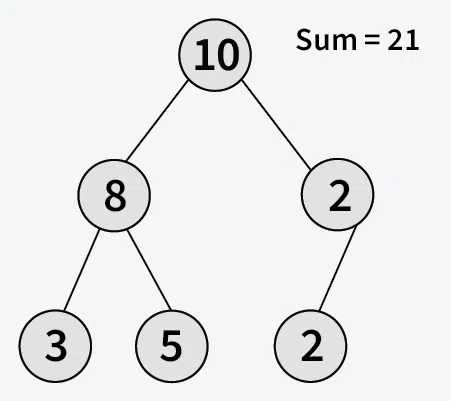

Table of Content
- [Expected Approach - 1] Using Recursion - O(n) Time and O(h) Space
- [Expected Approach - 2] Using Iterative - O(n) Time and O(h) Space
[Expected Approach - 1] Using Recursion - O(n) Time and O(h) Space
The idea is to recursively move to **left and **right subtree and **decrease sum by the value of the current node and if at any point the current node is equal to a **leaf node and remaining sum is equal to **zero then the answer is **true.
Follow the given steps to solve the problem using the above approach:
- Recursively move to the **left and **right subtree and at each call **decrease the sum by the value of the current node.
- If at any level the **current node is a leaf node and the remaining sum is equal to **zero then return true.
Below is the implementation of the above approach:
C++ `
// C++ Program to Check if Root to leaf path // sum equal to a given number
#include <bits/stdc++.h>
using namespace std;
class Node { public: Node *left, *right; int data;
Node(int key) {
    data = key;
    left = nullptr;
    right = nullptr;
}
};
// Given a tree and a sum, return true if there is a path from // the root down to a leaf, such that adding up all the values // along the path equals the given sum. bool hasPathSum(Node* root, int sum) { if (root == NULL) return 0;
int subSum = sum - root->data;

// If we reach a leaf node and sum becomes 0 then return true
if (subSum == 0 && root->left == nullptr && root->right == nullptr)
    return 1;

// Otherwise check both subtrees
bool left = 0, right = 0;

if (root->left)
    left = hasPathSum(root->left, subSum);
if (root->right)
    right = hasPathSum(root->right, subSum);

return left || right;
}
int main() {
int sum = 21;

// Constructed binary tree is
//         10
//       /    \
//      8      2
//     / \    /
//    3   5  2

Node* root = new Node(10);
root->left = new Node(8);
root->right = new Node(2);
root->left->left = new Node(3);
root->left->right = new Node(5);
root->right->left = new Node(2);

if(hasPathSum(root, sum)) {
  cout << "True"<< endl;
}
  else cout << "False";

return 0;
}
C
#include <stdio.h> #include <stdlib.h>
struct Node { int data; struct Node* left; struct Node* right; };
// Function to check if there is a root-to-leaf // path with a given sum int hasPathSum(struct Node* root, int sum) { if (root == NULL) { return sum == 0; }
int subSum = sum - root->data;

// If we reach a leaf node and sum becomes
  // 0 then return true
if (subSum == 0 && root->left == NULL
    && root->right == NULL) {
    return 1;
}

// Otherwise check both subtrees
return hasPathSum(root->left, subSum)
  || hasPathSum(root->right, subSum);
}
struct Node* createNode(int key) { struct Node* node = ( struct Node*)malloc(sizeof(struct Node)); node->data = key; node->left = NULL; node->right = NULL; return node; }
int main() {
// Constructed binary tree is
//         10
//       /    \
//      8      2
//     / \    /
//    3   5  2

int sum = 21;

struct Node* root = createNode(10);
root->left = createNode(8);
root->right = createNode(2);
root->left->left = createNode(3);
root->left->right = createNode(5);
root->right->left = createNode(2);

if (hasPathSum(root, sum)) {
    printf("True\n");
} else {
    printf("False\n");
}

return 0;
}
Java
// Java Program to Check if Root to leaf path // sum equal to a given number
class Node { Node left, right; int data;
Node(int key) {
    data = key;
    left = null;
    right = null;
}
}
class GfG {
// Given a tree and a sum, return true if there is a path from
// the root down to a leaf, such that adding up all the values
// along the path equals the given sum.
static boolean hasPathSum(Node root, int sum) {
    if (root == null) return false;

    int subSum = sum - root.data;

    // If we reach a leaf node and sum becomes 0 then return true
    if (subSum == 0 && root.left == null
        && root.right == null) return true;

    // Otherwise check both subtrees
    boolean left = false, right = false;

    if (root.left != null) left = hasPathSum(root.left, subSum);
    if (root.right != null) right = hasPathSum(root.right, subSum);

    return left || right;
}

public static void main(String[] args) {
    int sum = 21;

    // Constructed binary tree is
    //         10
    //       /    \
    //      8      2
    //     / \    /
    //    3   5  2

    Node root = new Node(10);
    root.left = new Node(8);
    root.right = new Node(2);
    root.left.left = new Node(3);
    root.left.right = new Node(5);
    root.right.left = new Node(2);

    System.out.println(hasPathSum(root, sum));
}
}
Python
Python Program to Check if Root to leaf path
sum equal to a given number
class Node: def init(self, data): self.data = data self.left = None self.right = None
Given a tree and a sum, return true if there is a path from
the root down to a leaf, such that adding up all the values
along the path equals the given sum.
def hasPathSum(root, sum): if root is None: return False
subSum = sum - root.data

# If we reach a leaf node and sum becomes 0 then return true
if subSum == 0 and root.left is None and root.right is None:
    return True

# Otherwise check both subtrees
left = hasPathSum(root.left, subSum) if root.left else False
right = hasPathSum(root.right, subSum) if root.right else False

return left or right
if name == "main": sum = 21
# Constructed binary tree is
#         10
#       /    \
#      8      2
#     / \    /
#    3   5  2

root = Node(10)
root.left = Node(8)
root.right = Node(2)
root.left.left = Node(3)
root.left.right = Node(5)
root.right.left = Node(2)

print(hasPathSum(root, sum))
C#
// C# Program to Check if Root to leaf path // sum equal to a given number
using System;
class Node { public Node left, right; public int data;
public Node(int key) {
    data = key;
    left = null;
    right = null;
}
}
class GfG {
// Given a tree and a sum, return true if there is a path from
// the root down to a leaf, such that adding up all the values
// along the path equals the given sum.
static bool HasPathSum(Node root, int sum) {
    if (root == null) return false;

    int subSum = sum - root.data;

    // If we reach a leaf node and sum becomes 0 then return true
    if (subSum == 0 && root.left == null
        && root.right == null) return true;

    // Otherwise check both subtrees
    bool left = false, right = false;

    if (root.left != null) left = HasPathSum(root.left, subSum);
    if (root.right != null) right = HasPathSum(root.right, subSum);

    return left || right;
}

static void Main(string[] args) {
    int sum = 21;

    // Constructed binary tree is
    //         10
    //       /    \
    //      8      2
    //     / \    /
    //    3   5  2

    Node root = new Node(10);
    root.left = new Node(8);
    root.right = new Node(2);
    root.left.left = new Node(3);
    root.left.right = new Node(5);
    root.right.left = new Node(2);

    Console.WriteLine(HasPathSum(root, sum));
}
}
JavaScript
// JavaScript Program to Check if Root to leaf // path sum equal to a given number
class Node { constructor(data) { this.data = data; this.left = null; this.right = null; } }
// Given a tree and a sum, return true if there is a path from // the root down to a leaf, such that adding up all the values // along the path equals the given sum. function hasPathSum(root, sum) { if (root === null) return false;
const subSum = sum - root.data;

// If we reach a leaf node and sum becomes 0 then return true
if (subSum === 0 && root.left === null
    && root.right === null) return true;

// Otherwise check both subtrees
const left = root.left ? hasPathSum(root.left, subSum) : false;
const right = root.right ? hasPathSum(root.right, subSum) : false;

return left || right;
}
// Constructed binary tree is
// 10
// /
// 8 2
// / \ /
// 3 5 2
const sum = 21; const root = new Node(10); root.left = new Node(8); root.right = new Node(2); root.left.left = new Node(3); root.left.right = new Node(5); root.right.left = new Node(2);
console.log(hasPathSum(root, sum));
`
**Time Complexity: O(n), where **n is the number of nodes.
**Auxiliary Space: O(h), where h is the height of the tree.
[Expected Approach - 2] Using **Iterative - O(n) Time and O(h) Space
In this approach, we use a **stack to perform a preorder traversal of the binary tree. We maintain **two stacks - one to store the **nodes and another to store the **sum of values along the path to that node. Whenever we encounter a **leaf node, we check if the **sum matches the target sum. If it does, we **return true, otherwise, we continue traversing the tree.
Follow the given steps to solve the problem using the above approach:
- Check if the root node is **NULL. If it is, **return false, since there is no path to follow.
- Create **two stacks, one for the nodes and one for the sums. Push the root **node onto the node stack and its data onto the **sum stack. While the node stack is not empty, do the following:
- Pop a node from the node stack and its corresponding sum from the sum stack.
- Check if the node is a **leaf node (i.e., it has no **left or right child). If it is, check if the **sum equals the **target sum. If it does, return true, since we have found a path that adds up to the target sum.
- If the node has a **left child, push it onto the node **stack and push the sum plus the left child’s data onto the sum stack.
- If the node has a **right child, push it onto the node **stack and push the sum plus the right child’s data onto the sum stack.
- If we reach this point, it means we have **exhausted all paths and haven’t found any that add up to the target sum. Return false.
Below is the implementation of the above approach:
C++ `
// C++ Program to Check if Root to leaf path sum // equal to a given number
#include <bits/stdc++.h> using namespace std;
class Node { public: Node *left, *right; int data;
Node(int key) {
    data = key;
    left = nullptr;
    right = nullptr;
}
};
// Check if there's a root-to-leaf path with the given sum bool hasPathSum(Node* root, int targetSum) { if (root == nullptr) return false;
stack<Node*> stk;
stack<int> sums;
stk.push(root);
sums.push(root->data);

while (!stk.empty()) {
    Node* node = stk.top();
      stk.pop();
    int sum = sums.top();
      sums.pop();

    // Check if leaf node and sum matches
    if (node->left == nullptr && node->right == nullptr
        && sum == targetSum)
        return true;

    // Add children to stacks with updated sums
    if (node->left) {
        stk.push(node->left);
        sums.push(sum + node->left->data);
    }
    if (node->right) {
        stk.push(node->right);
        sums.push(sum + node->right->data);
    }
}

return false;
}
int main() {
  // Construct binary tree
  //         10
  //       /  \
  //      8    2
  //     / \   /
  //    3   5 2

Node* root = new Node(10);
root->left = new Node(8);
root->right = new Node(2);
root->left->left = new Node(3);
root->left->right = new Node(5);
root->right->left = new Node(2);

int targetSum = 21;
   if(hasPathSum(root, targetSum)) {
      cout << "True"<< endl;
}
  else cout << "False";

return 0;
}
Java
// Java Program to Check if Root to leaf path // sum equal to a given number
import java.util.Stack;
class Node { Node left, right; int data;
Node(int key) {
    data = key;
    left = null;
    right = null;
}
}
class GfG {
// Check if there's a root-to-leaf path with the given sum
static boolean hasPathSum(Node root, int targetSum) {
    if (root == null) return false;

    Stack<Node> stk = new Stack<>();
    Stack<Integer> sums = new Stack<>();
    stk.push(root);
    sums.push(root.data);

    while (!stk.isEmpty()) {
        Node node = stk.pop();
        int sum = sums.pop();

        // Check if leaf node and sum matches
        if (node.left == null && node.right == null
            && sum == targetSum)
            return true;

        // Add children to stacks with updated sums
        if (node.left != null) {
            stk.push(node.left);
            sums.push(sum + node.left.data);
        }
        if (node.right != null) {
            stk.push(node.right);
            sums.push(sum + node.right.data);
        }
    }

    return false;
}

public static void main(String[] args) {

     // Construct binary tree
    //         10
    //       /  \
    //      8    2
    //     / \   /
    //    3   5 2
    Node root = new Node(10);
    root.left = new Node(8);
    root.right = new Node(2);
    root.left.left = new Node(3);
    root.left.right = new Node(5);
    root.right.left = new Node(2);

    int targetSum = 21;
    System.out.println(hasPathSum(root, targetSum));
}
}
Python
Python Program to Check if Root to leaf path
sum equal to a given number
class Node: def init(self, key): self.data = key self.left = None self.right = None
Check if there's a root-to-leaf path with
the given sum
def hasPathSum(root, targetSum): if root is None: return False
stack = []
sums = []
stack.append(root)
sums.append(root.data)

while stack:
    node = stack.pop()
    sumValue = sums.pop()

    # Check if leaf node and sum matches
    if node.left is None and node.right is None \
    and sumValue == targetSum:
        return True

    # Add children to stacks with updated sums
    if node.left:
        stack.append(node.left)
        sums.append(sumValue + node.left.data)
    if node.right:
        stack.append(node.right)
        sums.append(sumValue + node.right.data)

return False
if name == "main":
# Construct binary tree
#         10
#       /  \
#      8    2
#     / \   /
#    3   5 2

root = Node(10)
root.left = Node(8)
root.right = Node(2)
root.left.left = Node(3)
root.left.right = Node(5)
root.right.left = Node(2)

targetSum = 21

print(hasPathSum(root, targetSum))
C#
// C# Program to Check if Root to leaf path // sum equal to a given number
using System; using System.Collections.Generic;
class Node { public Node left, right; public int data;
public Node(int key) {
    data = key;
    left = null;
    right = null;
}
}
class GfG {
// Check if there's a root-to-leaf path with the given sum
static bool hasPathSum(Node root, int targetSum) {
    if (root == null) return false;

    Stack<Node> stk = new Stack<Node>();
    Stack<int> sums = new Stack<int>();
    stk.Push(root);
    sums.Push(root.data);

    while (stk.Count > 0) {
        Node node = stk.Pop();
        int sum = sums.Pop();

        // Check if leaf node and sum matches
        if (node.left == null && node.right == null
            && sum == targetSum)
            return true;

        // Add children to stacks with updated sums
        if (node.left != null) {
            stk.Push(node.left);
            sums.Push(sum + node.left.data);
        }
        if (node.right != null) {
            stk.Push(node.right);
            sums.Push(sum + node.right.data);
        }
    }

    return false;
}

static void Main(string[] args) {

    // Construct binary tree
    //         10
    //       /  \
    //      8    2
    //     / \   /
    //    3   5 2

    Node root = new Node(10);
    root.left = new Node(8);
    root.right = new Node(2);
    root.left.left = new Node(3);
    root.left.right = new Node(5);
    root.right.left = new Node(2);

    int targetSum = 21;
    Console.WriteLine(hasPathSum(root, targetSum));
}
}
JavaScript
// JavaScript Program to Check if Root to leaf // path sum equal to a given number
class Node { constructor(key) { this.data = key; this.left = null; this.right = null; } }
// Check if there's a root-to-leaf path // with the given sum function hasPathSum(root, targetSum) { if (root === null) return false;
const stack = [];
const sums = [];
stack.push(root);
sums.push(root.data);

while (stack.length > 0) {
    const node = stack.pop();
    const sum = sums.pop();

    // Check if leaf node and sum matches
    if (node.left === null && node.right === null
        && sum === targetSum)
        return true;

    // Add children to stacks with updated sums
    if (node.left) {
        stack.push(node.left);
        sums.push(sum + node.left.data);
    }
    if (node.right) {
        stack.push(node.right);
        sums.push(sum + node.right.data);
    }
}

return false;
}
// Construct binary tree
// 10
// /
// 8 2
// / \ /
// 3 5 2
const root = new Node(10);
root.left = new Node(8);
root.right = new Node(2);
root.left.left = new Node(3);
root.left.right = new Node(5);
root.right.left = new Node(2);
const targetSum = 21; console.log(hasPathSum(root, targetSum));
`
**Time Complexity: O(n) where **n is the number of nodes.
**Auxiliary Space: O(h) where h is the height of the tree.