Roundoff a number to a given number of significant digits (original) (raw)
Last Updated : 16 Feb, 2023
Given a positive number n (n > 1), round-off this number to a given no. of significant digits, d.
Examples:
Input : n = 139.59 d = 4 Output : The number after rounding-off is 139.6 .
The number 139.59 has 5 significant figures and for rounding-off the number to 4 significant figures, 139.59 is converted to 139.6 .
Input : n = 1240 d = 2 Output : The number after rounding-off is 1200 .
What are significant figures?
Each of the digits of a number that are used to express it to the required degree of accuracy, starting from the first non-zero digit, are called as significant figures.
Since there are numbers with large number of digits, for example, \frac{22}{7} = 3.142857143, so in order to limit such numbers to a manageable number of digits, we drop unwanted digits and this process is called rounding off.
Significant digits include all the digits in a number falling in one of the following categories -
- All non-zero digits.
- Zero digits which-
- lie between significant digits.
- lie to the right of decimal point and at the same time to the right of a non-zero digit.
- are specifically indicated to be significant.
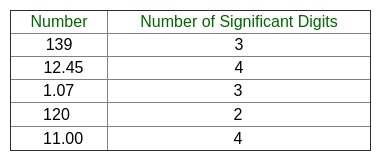
The following table shows numbers and no. of significant digits present in them -
Rules for Rounding-off a Number
To round off a number to n significant figures-
- Discard all digits to the right of nth significant digit.
- If this discarded number is-
- less than half a unit in nthplace, leave the nth digit unchanged.
- greater than half a unit in the nth place, increase the nth digit by unity.
- exactly half a unit in the nth place, increase the nth digit by unity if its odd, otherwise leave it unchanged.
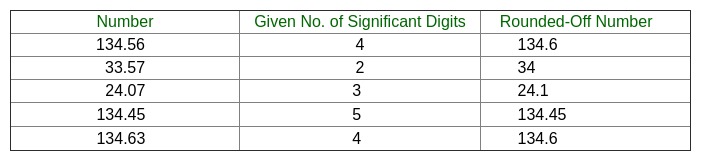
The following table shows rounding-off a number to a given no. of significant digits -
C++ `
// C++ program to round-off a number to given no. of // significant digits #include <bits/stdc++.h> using namespace std;
// Function to round - off the number void Round_off(double N, double n) { int h; double l, a, b, c, d, e, i, j, m, f, g; b = N; c = floor(N);
// Counting the no. of digits to the left of decimal point
// in the given no.
for (i = 0; b >= 1; ++i)
    b = b / 10;

d = n - i;
b = N;
b = b * pow(10, d);
e = b + 0.5;
if ((float)e == (float)ceil(b)) {
    f = (ceil(b));
    h = f - 2;
    if (h % 2 != 0) {
        e = e - 1;
    }
}
j = floor(e);
m = pow(10, d);
j = j / m;
cout << "The number after rounding-off is " << j;
}
// Driver main function int main() { double N, n;
// Number to be rounded - off
N = 139.59;

// No. of Significant digits required in the no.
n = 4;

Round_off(N, n);
return 0;
}
Java
// Java program to round-off a number to given no. of // significant digits
import java.io.; import static java.lang.Math.; public class A {
// Function to round - off the number
static void Round_off(double N, double n)
{
    int h;
    double l, a, b, c, d, e, i, j, m, f, g;
    b = N;
    c = floor(N);

    // Counting the no. of digits to the left of decimal point
    // in the given no.
    for (i = 0; b >= 1; ++i)
        b = b / 10;

    d = n - i;
    b = N;
    b = b * pow(10, d);
    e = b + 0.5;
    if ((float)e == (float)ceil(b)) {
        f = (ceil(b));
        h = (int)(f - 2);
        if (h % 2 != 0) {
            e = e - 1;
        }
    }
    j = floor(e);
    m = pow(10, d);
    j = j / m;
    System.out.println("The number after rounding-off is "
                       + j);
}

// Driver main function
public static void main(String args[])
{
    double N, n;

    // Number to be rounded - off
    N = 139.59;

    // No. of Significant digits required in the no.
    n = 4;

    Round_off(N, n);
}
}
Python3
Python 3 program to round-off a number
to given no. of significant digits
from math import ceil, floor, pow
Function to round - off the number
def Round_off(N, n): b = N c = floor(N)
# Counting the no. of digits
# to the left of decimal point
# in the given no.
i = 0;
while(b >= 1):
    b = b / 10
    i = i + 1

d = n - i
b = N
b = b * pow(10, d)
e = b + 0.5
if (float(e) == float(ceil(b))):
    f = (ceil(b))
    h = f - 2
    if (h % 2 != 0):
        e = e - 1
j = floor(e)
m = pow(10, d)
j = j / m
print("The number after rounding-off is", j)
Driver Code
if name == 'main':
# Number to be rounded - off
N = 139.59

# No. of Significant digits
# required in the no.
n = 4

Round_off(N, n)
This code is contributed by
Surendra_Gangwar
C#
// C# program to round-off a number // to given no. of significant digits using System;
class A {
// Function to round - off the number
static void Round_off(double N, double n)
{
    int h;
    double b, d, e, i, j, m, f;
    b = N;
    // c = Math.Floor(N);

    // Counting the no. of digits to the
    // left of decimal point in the given no.
    for (i = 0; b >= 1; ++i)
        b = b / 10;

    d = n - i;
    b = N;
    b = b * Math.Pow(10, d);
    e = b + 0.5;
    if ((float)e == (float)Math.Ceiling(b)) {
        f = (Math.Ceiling(b));
        h = (int)(f - 2);
        if (h % 2 != 0) {
            e = e - 1;
        }
    }
    j = Math.Floor(e);
    m = Math.Pow(10, d);
    j = j / m;
    Console.WriteLine("The number after " +
                   "rounding-off is " + j);
}

// Driver main function
public static void Main()
{
    double N, n;

    // Number to be rounded - off
    N = 139.59;

    // No. of Significant digits required in the no.
    n = 4;

    Round_off(N, n);
}
}
// This code is contributed by vt_m.
PHP
JavaScript
`
Output:
The number after rounding-off is 139.6
Time complexity: O(logN)
Space complexity: O(1)