Shortest path with exactly k edges in a directed and weighted graph (original) (raw)
Last Updated : 10 Dec, 2025
Given a directed and two vertices ‘u’ and ‘v’ in it, find shortest path from ‘u’ to ‘v’ with exactly k edges on the path.
The graph is given as adjacency matrix representation where value of graph[i][j] indicates the weight of an edge from vertex i to vertex j and a value INF(infinite) indicates no edge from i to j.
For example, consider the following graph. Let source ‘u’ be vertex 0, destination ‘v’ be 3 and k be 2. There are two walks of length 2, the walks are {0, 2, 3} and {0, 1, 3}. The shortest among the two is {0, 2, 3} and weight of path is 3+6 = 9.
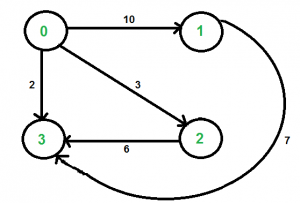
The idea is to browse through all paths of length k from u to v using the approach discussed in the previous post and return weight of the shortest path. A **simple solution is to start from u, go to all adjacent vertices, and recur for adjacent vertices with k as k-1, source as adjacent vertex and destination as v. Following are C++ and Java implementations of this simple solution.
C++ `
// C++ program to find shortest path with exactly k edges #include <bits/stdc++.h> using namespace std;
// Define number of vertices in the graph and infinite value #define V 4 #define INF INT_MAX
// A naive recursive function to count walks from u to v with k edges int shortestPath(int graph[][V], int u, int v, int k) { // Base cases if (k == 0 && u == v) return 0; if (k == 1 && graph[u][v] != INF) return graph[u][v]; if (k <= 0) return INF;
// Initialize result int res = INF;
// Go to all adjacents of u and recur for (int i = 0; i < V; i++) { if (graph[u][i] != INF && u != i && v != i) { int rec_res = shortestPath(graph, i, v, k-1); if (rec_res != INF) res = min(res, graph[u][i] + rec_res); } } return res; }
// driver program to test above function int main() { /* Let us create the graph shown in above diagram*/ int graph[V][V] = { {0, 10, 3, 2}, {INF, 0, INF, 7}, {INF, INF, 0, 6}, {INF, INF, INF, 0} }; int u = 0, v = 3, k = 2; cout << "Weight of the shortest path is " << shortestPath(graph, u, v, k); return 0; }
Java
// Dynamic Programming based Java program to find shortest path // with exactly k edges import java.util.; import java.lang.; import java.io.*;
class ShortestPath { // Define number of vertices in the graph and infinite value static final int V = 4; static final int INF = Integer.MAX_VALUE;
// A naive recursive function to count walks from u to v
// with k edges
int shortestPath(int graph[][], int u, int v, int k)
{
    // Base cases
    if (k == 0 && u == v)             return 0;
    if (k == 1 && graph[u][v] != INF) return graph[u][v];
    if (k <= 0)                       return INF;

    // Initialize result
    int res = INF;

    // Go to all adjacents of u and recur
    for (int i = 0; i < V; i++)
    {
        if (graph[u][i] != INF && u != i && v != i)
        {
            int rec_res = shortestPath(graph, i, v, k-1);
            if (rec_res != INF)
                res = Math.min(res, graph[u][i] + rec_res);
        }
    }
    return res;
}

public static void main (String[] args)
{
    /* Let us create the graph shown in above diagram*/
    int graph[][] = new int[][]{ {0, 10, 3, 2},
                                 {INF, 0, INF, 7},
                                 {INF, INF, 0, 6},
                                 {INF, INF, INF, 0}
                               };
    ShortestPath t = new ShortestPath();
    int u = 0, v = 3, k = 2;
    System.out.println("Weight of the shortest path is "+
                       t.shortestPath(graph, u, v, k));
}
}
Python3
Python3 program to find shortest path
with exactly k edges
Define number of vertices in the graph
and infinite value
A naive recursive function to count
walks from u to v with k edges
def shortestPath(graph, u, v, k): V = 4 INF = 999999999999
# Base cases
if k == 0 and u == v:
    return 0
if k == 1 and graph[u][v] != INF:
    return graph[u][v]
if k <= 0:
    return INF
Initialize result
res = INF Go to all adjacents of u and recur
for i in range(V):
    if graph[u][i] != INF and u != i and v != i:
        rec_res = shortestPath(graph, i, v, k - 1)
        if rec_res != INF:
            res = min(res, graph[u][i] + rec_res)
return res
Driver Code
if name == 'main': INF = 999999999999
# Let us create the graph shown
# in above diagram
graph = [[0, 10, 3, 2],
         [INF, 0, INF, 7],
         [INF, INF, 0, 6],
         [INF, INF, INF, 0]]
u = 0
v = 3
k = 2
print("Weight of the shortest path is",
          shortestPath(graph, u, v, k))
This code is contributed by PranchalK
C#
// Dynamic Programming based C# program to // find shortest pathwith exactly k edges using System;
class GFG {
// Define number of vertices in the // graph and infinite value const int V = 4; const int INF = Int32.MaxValue;
// A naive recursive function to count // walks from u to v with k edges int shortestPath(int[,] graph, int u, int v, int k) { // Base cases if (k == 0 && u == v) return 0; if (k == 1 && graph[u, v] != INF) return graph[u, v]; if (k <= 0) return INF;
// Initialize result
int res = INF;

// Go to all adjacents of u and recur
for (int i = 0; i < V; i++)
{
    if (graph[u, i] != INF && u != i && v != i)
    {
        int rec_res = shortestPath(graph, i, v, k - 1);
        if (rec_res != INF)
            res = Math.Min(res, graph[u, i] + rec_res);
    }
}
return res;
}
// Driver Code public static void Main () { /* Let us create the graph shown in above diagram*/ int[,] graph = new int[,]{{0, 10, 3, 2}, {INF, 0, INF, 7}, {INF, INF, 0, 6}, {INF, INF, INF, 0}}; GFG t = new GFG(); int u = 0, v = 3, k = 2; Console.WriteLine("Weight of the shortest path is "+ t.shortestPath(graph, u, v, k)); } }
// This code is contributed by Akanksha Rai
JavaScript
`
Output
Weight of the shortest path is 9
**Time Complexity: O(V K )
**Space Complexity: O(V)
The worst-case time complexity of the above function is O(Vk) where V is the number of vertices in the given graph. We can simply analyze the time complexity by drawing recursion tree. The worst occurs for a complete graph. In worst case, every internal node of recursion tree would have exactly V children.
We can optimize the above solution using **Dynamic Programming. The idea is to build a 3D table where first dimension is source, second dimension is destination, third dimension is number of edges from source to destination, and the value is the weight of the shortest path having exactly the number of edges, stored in the third dimension, from source to destination. Like other Dynamic Programming problems, we fill the 3D table in bottom-up manner.
C++ `
// Dynamic Programming based C++ program to find shortest path with // exactly k edges #include #include using namespace std;
// Define number of vertices in the graph and infinite value #define V 4 #define INF INT_MAX
// A Dynamic programming based function to find the shortest path from // u to v with exactly k edges. int shortestPath(int graph[][V], int u, int v, int k) { // Table to be filled up using DP. The value sp[i][j][e] will store // weight of the shortest path from i to j with exactly k edges int sp[V][V][k+1];
// Loop for number of edges from 0 to k
for (int e = 0; e <= k; e++)
{
    for (int i = 0; i < V; i++)  // for source
    {
        for (int j = 0; j < V; j++) // for destination
        {
            // initialize value
            sp[i][j][e] = INF;

            // from base cases
            if (e == 0 && i == j)
                sp[i][j][e] = 0;
            if (e == 1 && graph[i][j] != INF)
                sp[i][j][e] = graph[i][j];

            //go to adjacent only when number of edges is more than 1
            if (e > 1)
            {
                for (int a = 0; a < V; a++)
                {
                    // There should be an edge from i to a and a
                    // should not be same as either i or j
                    if (graph[i][a] != INF && i != a &&
                        j!= a && sp[a][j][e-1] != INF)
                      sp[i][j][e] = min(sp[i][j][e], graph[i][a] +
                                                   sp[a][j][e-1]);
                }
            }
       }
    }
}
return sp[u][v][k];
}
// driver program to test above function int main() { /* Let us create the graph shown in above diagram*/ int graph[V][V] = { {0, 10, 3, 2}, {INF, 0, INF, 7}, {INF, INF, 0, 6}, {INF, INF, INF, 0} }; int u = 0, v = 3, k = 2; cout << shortestPath(graph, u, v, k); return 0; }
Java
// Dynamic Programming based Java program to find shortest path with // exactly k edges import java.util.; import java.lang.; import java.io.*;
class ShortestPath { // Define number of vertices in the graph and infinite value static final int V = 4; static final int INF = Integer.MAX_VALUE;
// A Dynamic programming based function to find the shortest path
// from u to v with exactly k edges.
int shortestPath(int graph[][], int u, int v, int k)
{
    // Table to be filled up using DP. The value sp[i][j][e] will
    // store weight of the shortest path from i to j with exactly
    // k edges
    int sp[][][] = new int[V][V][k+1];

    // Loop for number of edges from 0 to k
    for (int e = 0; e <= k; e++)
    {
        for (int i = 0; i < V; i++)  // for source
        {
            for (int j = 0; j < V; j++) // for destination
            {
                // initialize value
                sp[i][j][e] = INF;

                // from base cases
                if (e == 0 && i == j)
                    sp[i][j][e] = 0;
                if (e == 1 && graph[i][j] != INF)
                    sp[i][j][e] = graph[i][j];

                // go to adjacent only when number of edges is
                // more than 1
                if (e > 1)
                {
                    for (int a = 0; a < V; a++)
                    {
                        // There should be an edge from i to a and
                        // a should not be same as either i or j
                        if (graph[i][a] != INF && i != a &&
                                j!= a && sp[a][j][e-1] != INF)
                            sp[i][j][e] = Math.min(sp[i][j][e],
                                      graph[i][a] + sp[a][j][e-1]);
                    }
                }
            }
        }
    }
    return sp[u][v][k];
}

public static void main (String[] args)
{
    /* Let us create the graph shown in above diagram*/
    int graph[][] = new int[][]{ {0, 10, 3, 2},
                                 {INF, 0, INF, 7},
                                 {INF, INF, 0, 6},
                                 {INF, INF, INF, 0}
                               };
    ShortestPath t = new ShortestPath();
    int u = 0, v = 3, k = 2;
    System.out.println("Weight of the shortest path is "+
                       t.shortestPath(graph, u, v, k));
}
} //This code is contributed by Aakash Hasija
Python3
Dynamic Programming based Python3
program to find shortest path with
A Dynamic programming based function
to find the shortest path from u to v
with exactly k edges.
def shortestPath(graph, u, v, k): global V, INF
# Table to be filled up using DP. The
# value sp[i][j][e] will store weight
# of the shortest path from i to j
# with exactly k edges
sp = [[None] * V for i in range(V)]
for i in range(V):
    for j in range(V):
        sp[i][j] = [None] * (k + 1)

# Loop for number of edges from 0 to k
for e in range(k + 1):
    for i in range(V): # for source
        for j in range(V): # for destination

            # initialize value
            sp[i][j][e] = INF

            # from base cases
            if (e == 0 and i == j):
                sp[i][j][e] = 0
            if (e == 1 and graph[i][j] != INF):
                sp[i][j][e] = graph[i][j]

            # go to adjacent only when number
            # of edges is more than 1
            if (e > 1):
                for a in range(V):

                    # There should be an edge from
                    # i to a and a should not be
                    # same as either i or j
                    if (graph[i][a] != INF and i != a and
                         j!= a and sp[a][j][e - 1] != INF):
                        sp[i][j][e] = min(sp[i][j][e], graph[i][a] +
                                          sp[a][j][e - 1])

return sp[u][v][k]
Driver Code
Define number of vertices in
the graph and infinite value
V = 4 INF = 999999999999
Let us create the graph shown
in above diagram
graph = [[0, 10, 3, 2], [INF, 0, INF, 7], [INF, INF, 0, 6], [INF, INF, INF, 0]] u = 0 v = 3 k = 2 print("Weight of the shortest path is", shortestPath(graph, u, v, k))
This code is contributed by PranchalK
C#
// Dynamic Programming based C# program to find // shortest path with exactly k edges using System;
class GFG {
// Define number of vertices in the graph // and infinite value static readonly int V = 4; static readonly int INF = int.MaxValue;
// A Dynamic programming based function to // find the shortest path from u to v // with exactly k edges. int shortestPath(int [,]graph, int u, int v, int k) { // Table to be filled up using DP. The value // sp[i][j][e] will store weight of the shortest // path from i to j with exactly k edges int [,,]sp = new int[V, V, k + 1];
// Loop for number of edges from 0 to k
for (int e = 0; e <= k; e++)
{
    for (int i = 0; i < V; i++) // for source
    {
        for (int j = 0; j < V; j++) // for destination
        {
            // initialize value
            sp[i, j, e] = INF;

            // from base cases
            if (e == 0 && i == j)
                sp[i, j, e] = 0;
            if (e == 1 && graph[i, j] != INF)
                sp[i, j, e] = graph[i, j];

            // go to adjacent only when number of
            // edges is more than 1
            if (e > 1)
            {
                for (int a = 0; a < V; a++)
                {
                    // There should be an edge from i to a and
                    // a should not be same as either i or j
                    if (graph[i, a] != INF && i != a &&
                            j!= a && sp[a, j, e - 1] != INF)
                        sp[i, j, e] = Math.Min(sp[i, j, e],
                                      graph[i, a] + sp[a, j, e - 1]);
                }
            }
        }
    }
}
return sp[u, v, k];
}
// Driver Code public static void Main(String[] args) { /* Let us create the graph shown in above diagram*/ int [,]graph = new int[,]{ {0, 10, 3, 2}, {INF, 0, INF, 7}, {INF, INF, 0, 6}, {INF, INF, INF, 0} }; GFG t = new GFG(); int u = 0, v = 3, k = 2; Console.WriteLine("Weight of the shortest path is "+ t.shortestPath(graph, u, v, k)); } }
// This code is contributed by 29AjayKumar
JavaScript
`
**Time complexity of the above DP-based solution is **O(V 3 K) which is much better than the naive solution.
**Auxiliary Space: **O(V 2 K) as we are required to store DP states.