Sparse Matrix and its representations | Set 1 (Using Arrays and Linked Lists) (original) (raw)
Last Updated : 26 Jul, 2025
A matrix is a two-dimensional data object made of m rows and n columns, therefore having total m x n values. If most of the elements of the matrix have **0 value, then it is called a sparse matrix.
**Why to use Sparse Matrix instead of simple matrix ?
- **Storage: There are lesser non-zero elements than zeros and thus lesser memory can be used to store only those elements.
- **Computing time: Computing time can be saved by logically designing a data structure traversing only non-zero elements..
**Example:
0 0 3 0 4
0 0 5 7 0
0 0 0 0 0
0 2 6 0 0
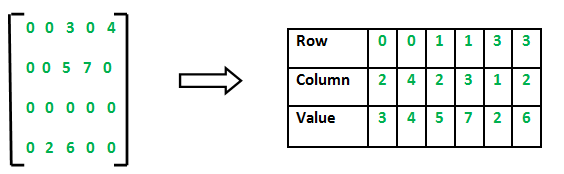
Representing a sparse matrix by a 2D array leads to wastage of lots of memory as zeroes in the matrix are of no use in most of the cases. So, instead of storing zeroes with non-zero elements, we only store non-zero elements. This means storing non-zero elements with **triples- (Row, Column, value).
Sparse Matrix Representations can be done in many ways following are two common representations:
- Array representation
- Linked list representation
**Method 1: Using Arrays:
2D array is used to represent a sparse matrix in which there are three rows named as
- **Row: Index of row, where non-zero element is located
- **Column: Index of column, where non-zero element is located
- **Value: Value of the non zero element located at index - (row,column)
**Implementation:
C++ `
// C++ program for Sparse Matrix Representation // using Array #include using namespace std;
int main() { // Assume 4x5 sparse matrix int sparseMatrix[4][5] = { {0 , 0 , 3 , 0 , 4 }, {0 , 0 , 5 , 7 , 0 }, {0 , 0 , 0 , 0 , 0 }, {0 , 2 , 6 , 0 , 0 } };
int size = 0;
for (int i = 0; i < 4; i++)
    for (int j = 0; j < 5; j++)
        if (sparseMatrix[i][j] != 0)
            size++;

// number of columns in compactMatrix (size) must be
// equal to number of non - zero elements in
// sparseMatrix
int compactMatrix[3][size];

// Making of new matrix
int k = 0;
for (int i = 0; i < 4; i++)
    for (int j = 0; j < 5; j++)
        if (sparseMatrix[i][j] != 0)
        {
            compactMatrix[0][k] = i;
            compactMatrix[1][k] = j;
            compactMatrix[2][k] = sparseMatrix[i][j];
            k++;
        }

for (int i=0; i<3; i++)
{
    for (int j=0; j<size; j++)
        cout <<" "<< compactMatrix[i][j];

    cout <<"\n";
}
return 0;
}
// this code is contributed by shivanisinghss2110
C
// C++ program for Sparse Matrix Representation // using Array #include<stdio.h>
int main() { // Assume 4x5 sparse matrix int sparseMatrix[4][5] = { {0 , 0 , 3 , 0 , 4 }, {0 , 0 , 5 , 7 , 0 }, {0 , 0 , 0 , 0 , 0 }, {0 , 2 , 6 , 0 , 0 } };
int size = 0;
for (int i = 0; i < 4; i++)
    for (int j = 0; j < 5; j++)
        if (sparseMatrix[i][j] != 0)
            size++;

// number of columns in compactMatrix (size) must be
// equal to number of non - zero elements in
// sparseMatrix
int compactMatrix[3][size];

// Making of new matrix
int k = 0;
for (int i = 0; i < 4; i++)
    for (int j = 0; j < 5; j++)
        if (sparseMatrix[i][j] != 0)
        {
            compactMatrix[0][k] = i;
            compactMatrix[1][k] = j;
            compactMatrix[2][k] = sparseMatrix[i][j];
            k++;
        }

for (int i=0; i<3; i++)
{
    for (int j=0; j<size; j++)
        printf("%d ", compactMatrix[i][j]);

    printf("\n");
}
return 0;
}
Java
// Java program for Sparse Matrix Representation // using Array class GFG {
public static void main(String[] args)
{
    int sparseMatrix[][]
            = {
                {0, 0, 3, 0, 4},
                {0, 0, 5, 7, 0},
                {0, 0, 0, 0, 0},
                {0, 2, 6, 0, 0}
            };

    int size = 0;
    for (int i = 0; i < 4; i++)
    {
        for (int j = 0; j < 5; j++)
        {
            if (sparseMatrix[i][j] != 0)
            {
                size++;
            }
        }
    }

    // number of columns in compactMatrix (size) must be
    // equal to number of non - zero elements in
    // sparseMatrix
    int compactMatrix[][] = new int[3][size];

    // Making of new matrix
    int k = 0;
    for (int i = 0; i < 4; i++)
    {
        for (int j = 0; j < 5; j++)
        {
            if (sparseMatrix[i][j] != 0)
            {
                compactMatrix[0][k] = i;
                compactMatrix[1][k] = j;
                compactMatrix[2][k] = sparseMatrix[i][j];
                k++;
            }
        }
    }

    for (int i = 0; i < 3; i++)
    {
        for (int j = 0; j < size; j++)
        {
            System.out.printf("%d ", compactMatrix[i][j]);
        }
        System.out.printf("\n");
    }
}
}
/* This code contributed by PrinciRaj1992 */
Python3
Python program for Sparse Matrix Representation
using arrays
assume a sparse matrix of order 4*5
let assume another matrix compactMatrix
now store the value,row,column of arr1 in sparse matrix compactMatrix
sparseMatrix = [[0,0,3,0,4],[0,0,5,7,0],[0,0,0,0,0],[0,2,6,0,0]]
initialize size as 0
size = 0
for i in range(4): for j in range(5): if (sparseMatrix[i][j] != 0): size += 1
number of columns in compactMatrix(size) should
be equal to number of non-zero elements in sparseMatrix
rows, cols = (3, size) compactMatrix = [[0 for i in range(cols)] for j in range(rows)]
k = 0 for i in range(4): for j in range(5): if (sparseMatrix[i][j] != 0): compactMatrix[0][k] = i compactMatrix[1][k] = j compactMatrix[2][k] = sparseMatrix[i][j] k += 1
for i in compactMatrix: print(i)
This code is contributed by MRINALWALIA
C#
// C# program for Sparse Matrix Representation // using Array
using System;
class Program { static void Main(string[] args) { // Assume 4x5 sparse matrix int[, ] sparseMatrix = new int[4, 5] { { 0, 0, 3, 0, 4 }, { 0, 0, 5, 7, 0 }, { 0, 0, 0, 0, 0 }, { 0, 2, 6, 0, 0 } }; int size = 0; for (int i = 0; i < 4; i++) for (int j = 0; j < 5; j++) if (sparseMatrix[i, j] != 0) size++;
    // number of columns in compactMatrix (size) must be
    // equal to number of non - zero elements in
    // sparseMatrix
    int[, ] compactMatrix = new int[3, size];

    // Making of new matrix
    int k = 0;
    for (int i = 0; i < 4; i++) {
        for (int j = 0; j < 5; j++)
            if (sparseMatrix[i, j] != 0) {
                compactMatrix[0, k] = i;
                compactMatrix[1, k] = j;
                compactMatrix[2, k]
                    = sparseMatrix[i, j];
                k++;
            }
    }

    for (int i = 0; i < 3; i++) {
        for (int j = 0; j < size; j++)
            Console.Write(" " + compactMatrix[i, j]);
        Console.WriteLine();
    }
}
} // This code is contributed by Tapesh(tapeshdua420)
JavaScript
//JS program for Sparse Matrix Representation // using Array
// Assume 4x5 sparse matrix
let sparseMatrix =
[
    [0 , 0 , 3 , 0 , 4 ],
    [0 , 0 , 5 , 7 , 0 ],
    [0 , 0 , 0 , 0 , 0 ],
    [0 , 2 , 6 , 0 , 0 ]
];

let size = 0;
for (let i = 0; i < 4; i++)
    for (let j = 0; j < 5; j++)
        if (sparseMatrix[i][j] != 0)
            size++;

// number of columns in compactMatrix (size) must be
// equal to number of non - zero elements in
// sparseMatrix
let compactMatrix = new Array(3);
for (var i = 0; i < 3; i++)
    compactMatrix[i] = new Array(size);


// Making of new matrix
let k = 0;
for (let i = 0; i < 4; i++)
    for (let j = 0; j < 5; j++)
        if (sparseMatrix[i][j] != 0)
        {
            compactMatrix[0][k] = i;
            compactMatrix[1][k] = j;
            compactMatrix[2][k] = sparseMatrix[i][j];
            k++;
        }

for (let i=0; i<3; i++)
{
    for (let j=0; j<size; j++)
        process.stdout.write(" " + compactMatrix[i][j]);

    console.log()
}
// this code is contributed by phasing17
`
Output
0 0 1 1 3 3 2 4 2 3 1 2 3 4 5 7 2 6
**Time Complexity: O(NM), where N is the number of rows in the sparse matrix, and M is the number of columns in the sparse matrix.
**Auxiliary Space: O(NM), where N is the number of rows in the sparse matrix, and M is the number of columns in the sparse matrix.
**Method 2: Using Linked Lists
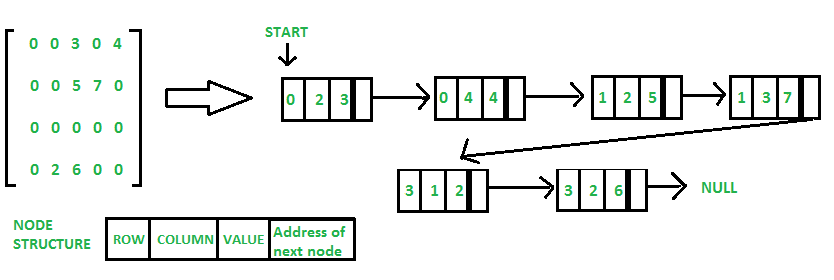
In linked list, each node has four fields. These four fields are defined as:
- **Row: Index of row, where non-zero element is located
- **Column: Index of column, where non-zero element is located
- **Value: Value of the non zero element located at index - (row,column)
- **Next node: Address of the next node
C++ `
// C++ program for sparse matrix representation. // Using Link list #include using namespace std;
// Node class to represent link list class Node { public: int row; int col; int data; Node *next; };
// Function to create new node void create_new_node(Node **p, int row_index, int col_index, int x) { Node *temp = *p; Node *r;
// If link list is empty then
// create first node and assign value.
if (temp == NULL)
{
    temp = new Node();
    temp->row = row_index;
    temp->col = col_index;
    temp->data = x;
    temp->next = NULL;
    *p = temp;
}

// If link list is already created
// then append newly created node
else
{
    while (temp->next != NULL)
        temp = temp->next;

    r = new Node();
    r->row = row_index;
    r->col = col_index;
    r->data = x;
    r->next = NULL;
    temp->next = r;
}
}
// Function prints contents of linked list // starting from start void printList(Node *start) { Node *ptr = start; cout << "row_position:"; while (ptr != NULL) { cout << ptr->row << " "; ptr = ptr->next; } cout << endl; cout << "column_position:";
ptr = start;
while (ptr != NULL)
{
    cout << ptr->col << " ";
    ptr = ptr->next;
}
cout << endl;
cout << "Value:";
ptr = start;

while (ptr != NULL)
{
    cout << ptr->data << " ";
    ptr = ptr->next;
}
}
// Driver Code int main() {
// 4x5 sparse matrix
int sparseMatrix[4][5] = { { 0 , 0 , 3 , 0 , 4 },
                           { 0 , 0 , 5 , 7 , 0 },
                           { 0 , 0 , 0 , 0 , 0 },
                           { 0 , 2 , 6 , 0 , 0 } };

// Creating head/first node of list as NULL
Node *first = NULL;
for(int i = 0; i < 4; i++)
{
    for(int j = 0; j < 5; j++)
    {

        // Pass only those values which
        // are non - zero
        if (sparseMatrix[i][j] != 0)
            create_new_node(&first, i, j,
                            sparseMatrix[i][j]);
    }
}
printList(first);

return 0;
}
// This code is contributed by ronaksuba
C
// C program for Sparse Matrix Representation // using Linked Lists #include<stdio.h> #include<stdlib.h>
// Node to represent sparse matrix struct Node { int value; int row_position; int column_postion; struct Node *next; };
// Function to create new node void create_new_node(struct Node** start, int non_zero_element, int row_index, int column_index ) { struct Node *temp, *r; temp = *start; if (temp == NULL) { // Create new node dynamically temp = (struct Node *) malloc (sizeof(struct Node)); temp->value = non_zero_element; temp->row_position = row_index; temp->column_postion = column_index; temp->next = NULL; *start = temp;
}
else
{
    while (temp->next != NULL)
        temp = temp->next;

    // Create new node dynamically
    r = (struct Node *) malloc (sizeof(struct Node));
    r->value = non_zero_element;
    r->row_position = row_index;
    r->column_postion = column_index;
    r->next = NULL;
    temp->next = r;

}
}
// This function prints contents of linked list // starting from start void PrintList(struct Node* start) { struct Node *temp, *r, *s; temp = r = s = start;
printf("row_position: ");
while(temp != NULL)
{

    printf("%d ", temp->row_position);
    temp = temp->next;
}
printf("\n");

printf("column_postion: ");
while(r != NULL)
{
    printf("%d ", r->column_postion);
    r = r->next;
}
printf("\n");
printf("Value: ");
while(s != NULL)
{
    printf("%d ", s->value);
    s = s->next;
}
printf("\n");
}
// Driver of the program int main() { // Assume 4x5 sparse matrix int sparseMatric[4][5] = { {0 , 0 , 3 , 0 , 4 }, {0 , 0 , 5 , 7 , 0 }, {0 , 0 , 0 , 0 , 0 }, {0 , 2 , 6 , 0 , 0 } };
/* Start with the empty list */
struct Node* start = NULL;

for (int i = 0; i < 4; i++)
    for (int j = 0; j < 5; j++)

        // Pass only those values which are non - zero
        if (sparseMatric[i][j] != 0)
            create_new_node(&start, sparseMatric[i][j], i, j);

PrintList(start);

return 0;
}
Java
// Java program for sparse matrix representation. // Using Link list import java.util.*;
public class SparseMatrix { // Creating head/first node of list as NULL static Node first = null;
// Node class to represent link list
public static class Node {
    int row;
    int col;
    int data;
    Node next;
};

// Driver Code
public static void main(String[] args)
{
    // 4x5 sparse matrix
    int[][] sparseMatrix = { { 0, 0, 3, 0, 4 },
                             { 0, 0, 5, 7, 0 },
                             { 0, 0, 0, 0, 0 },
                             { 0, 2, 6, 0, 0 } };

    for (int i = 0; i < 4; i++) {
        for (int j = 0; j < 5; j++) {
            // Pass only those values which
            // are non - zero
            if (sparseMatrix[i][j] != 0) {
                create_new_node(i, j,
                                sparseMatrix[i][j]);
            }
        }
    }
    printList(first);
}
// Function to create new node
private static void
create_new_node(int row_index, int col_index, int x)
{
    Node temp = first;
    Node r;

    // If link list is empty then
    // create first node and assign value.
    if (temp == null) {
        temp = new Node();
        temp.row = row_index;
        temp.col = col_index;
        temp.data = x;
        temp.next = null;
        first = temp;
    }

    // If link list is already created
    // then append newly created node
    else {
        while (temp.next != null)
            temp = temp.next;

        r = new Node();
        r.row = row_index;
        r.col = col_index;
        r.data = x;
        r.next = null;
        temp.next = r;
    }
}

// Function prints contents of linked list
// starting from start
public static void printList(Node start)
{
    Node ptr = start;
    System.out.print("row_position:");
    while (ptr != null) {
        System.out.print(ptr.row + " ");
        ptr = ptr.next;
    }
    System.out.println("");
    System.out.print("column_position:");

    ptr = start;
    while (ptr != null) {
        System.out.print(ptr.col + " ");
        ptr = ptr.next;
    }
    System.out.println("");
    System.out.print("Value:");
    ptr = start;

    while (ptr != null) {
        System.out.print(ptr.data + " ");
        ptr = ptr.next;
    }
}
}
// This code is contributed by Tapesh (tapeshdua420)
Python3
Python Program for Representation of
Sparse Matrix using Linked List
Node Class to represent Linked List Node
class Node:
# Making the slots for storing row,
# column, value, and address
__slots__ = "row", "col", "data", "next"

# Constructor to initialize the values
def __init__(self, row=0, col=0, data=0, next=None):

    self.row = row
    self.col = col
    self.data = data
    self.next = next
Class to convert Sparse Matrix
into Linked List
class Sparse:
# Initialize Class Variables
def __init__(self):
    self.head = None
    self.temp = None
    self.size = 0

# Function which returns the size
# of the Linked List
def __len__(self):
    return self.size

# Check the Linked List is
# Empty or not
def isempty(self):
    return self.size == 0

# Responsible function to create
# Linked List from Sparse Matrix
def create_new_node(self, row, col, data):

    # Creating New Node
    newNode = Node(row, col, data, None)

    # Check whether the List is
    # empty or not
    if self.isempty():
        self.head = newNode
    else:
        self.temp.next = newNode
    self.temp = newNode

    # Incrementing the size
    self.size += 1

# Function display the contents of
# Linked List
def PrintList(self):
    temp = r = s = self.head
    print("row_position:", end=" ")
    while temp != None:
        print(temp.row, end=" ")
        temp = temp.next
    print()
    print("column_postion:", end=" ")
    while r != None:
        print(r.col, end=" ")
        r = r.next
    print()
    print("Value:", end=" ")
    while s != None:
        print(s.data, end=" ")
        s = s.next
    print()
Driver Code
if name == "main":
# Creating Object
s = Sparse()

# Assuming 4x5 Sparse Matrix
sparseMatric = [[0, 0, 3, 0, 4],
                [0, 0, 5, 7, 0],
                [0, 0, 0, 0, 0],
                [0, 2, 6, 0, 0]]
for i in range(4):
    for j in range(5):

        # Creating Linked List by only those
        # elements which are non-zero
        if sparseMatric[i][j] != 0:
            s.create_new_node(i, j, sparseMatric[i][j])

# Printing the Linked List Representation
# of the sparse matrix
s.PrintList()

# This code is contributed by Naveen Rathore
C#
// C# program for sparse matrix representation. // Using Link list using System;
class Program {
// Creating head/first node of list as NULL
static Node first = null;

// Node class to represent link list
public class Node {
    public int row;
    public int col;
    public int data;
    public Node next;
};

// Driver Code
static void Main(string[] args)
{
    // 4x5 sparse matrix
    int[, ] sparseMatrix = { { 0, 0, 3, 0, 4 },
                             { 0, 0, 5, 7, 0 },
                             { 0, 0, 0, 0, 0 },
                             { 0, 2, 6, 0, 0 } };

    for (int i = 0; i < 4; i++) {
        for (int j = 0; j < 5; j++) {
            // Pass only those values which
            // are non - zero
            if (sparseMatrix[i, j] != 0) {
                create_new_node(i, j,
                                sparseMatrix[i, j]);
            }
        }
    }
    printList(first);
}

// Function to create new node
private static void
create_new_node(int row_index, int col_index, int x)
{
    Node temp = first;
    Node r;

    // If link list is empty then
    // create first node and assign value.
    if (temp == null) {
        temp = new Node();
        temp.row = row_index;
        temp.col = col_index;
        temp.data = x;
        temp.next = null;
        first = temp;
    }

    // If link list is already created
    // then append newly created node
    else

    {
        while (temp.next != null)
            temp = temp.next;

        r = new Node();
        r.row = row_index;
        r.col = col_index;
        r.data = x;
        r.next = null;
        temp.next = r;
    }
}

// Function prints contents of linked list
// starting from start
public static void printList(Node start)
{
    Node ptr = start;
    Console.Write("row_position:");
    while (ptr != null) {
        Console.Write(ptr.row + " ");
        ptr = ptr.next;
    }
    Console.WriteLine("");
    Console.Write("column_position:");
    ptr = start;
    while (ptr != null) {
        Console.Write(ptr.col + " ");
        ptr = ptr.next;
    }
    Console.WriteLine("");
    Console.Write("Value:");
    ptr = start;
    while (ptr != null) {
        Console.Write(ptr.data + " ");
        ptr = ptr.next;
    }
}
}
// This code is contributed by Tapesh (tapeshdua420)
JavaScript
// JS Program for Representation of // Sparse Matrix into Linked List
// Node Class to represent Linked List Node class Node { constructor(row, col, data) { this.row = row; this.col = col; this.data = data; this.next = null; } }
// Class to convert Sparse Matrix // into Linked List class Sparse {
// Initialize Class Variables
constructor()
{
    this.head = null
    this.temp = null
    this.size = 0
}

// Function which returns the size
// of the Linked List
len()
{
    return this.size
}

// Check the Linked List is
// Empty or not
isempty()
{
    return this.size == 0
}

// Responsible function to create
// Linked List from Sparse Matrix
create_new_node(row, col, data)
{
    // Creating New Node
    let newNode = new Node(row, col, data)

    // Check whether the List is
    // empty or not
    if (this.isempty())
        this.head = newNode
    else
        (this.temp).next = newNode
    this.temp = newNode

    // Incrementing the size
    this.size += 1
}

// Function display the contents of
// Linked List
PrintList()
{
    let temp = this.head
    let r = this.head
    let s = this.head

    process.stdout.write("row_position: ")
    while (temp != null)
    {
        process.stdout.write(temp.row + " ")
        temp = temp.next
    }
    console.log()
    process.stdout.write("column_postion: ")
    while (r != null)
    {
        process.stdout.write(r.col + " " )
        r = r.next
    }
    console.log()
    process.stdout.write("Value: ")
    while (s != null)
    {
        process.stdout.write(s.data + " ")
        s = s.next
    }
    console.log()
}
}
// Driver Code
// Creating Object let s = new Sparse()
// Assuming 4x5 Sparse Matrix let sparseMatric = [[0, 0, 3, 0, 4], [0, 0, 5, 7, 0], [0, 0, 0, 0, 0], [0, 2, 6, 0, 0]]
for (var i = 0; i < 4; i++) for (var j = 0; j < 5; j++) // Creating Linked List by only those // elements which are non-zero if (sparseMatric[i][j] != 0) { s.create_new_node(i, j, sparseMatric[i][j]) s.data = sparseMatric[i][j] }
// Printing the Linked List Representation // of the sparse matrix s.PrintList()
`
Output
row_position:0 0 1 1 3 3 column_position:2 4 2 3 1 2 Value:3 4 5 7 2 6
**Time Complexity: O(N*M), where N is the number of rows in the sparse matrix, and M is the number of columns in the sparse matrix.
**Auxiliary Space: O(K), where K is the number of non-zero elements in the array.
**Other representations:
As a **Dictionary where row and column numbers are used as keys and values are matrix entries. This method saves space but sequential access of items is costly.
As a **list of list. The idea is to make a list of rows and every item of list contains values. We can keep list items sorted by column numbers.
Sparse Matrix and its representations | Set 2 (Using List of Lists and Dictionary of keys)