Sparse Table (original) (raw)
Last Updated : 29 Apr, 2025
Sparse table concept is used for fast queries on a set of static data (elements do not change). It does preprocessing so that the queries can be answered efficiently.
**Range Minimum Query Using Sparse Table
You are given an integer array arr of length n and an integer q denoting the number of queries. Each query consists of two indices L and R (0 ≤ L ≤ R < n), and asks for the minimum value in the subarray arr[L…R].
**Example:
**Input: arr[] = [ 7, 2, 3, 0, 5, 10, 3, 12, 18 ]
queries[][] = [ [0, 4], [4, 7], [7, 8] ]
**Output: 0 3 12
**Explanation: For query 1, the subarray spanning indices 0 through 4 contains the values 7, 2, 3, and 0, and the minimum among them is 0. Similarly, the minimum value in range [4, 7] and [7, 8] are 3 and 12 respectively.
**Approach:
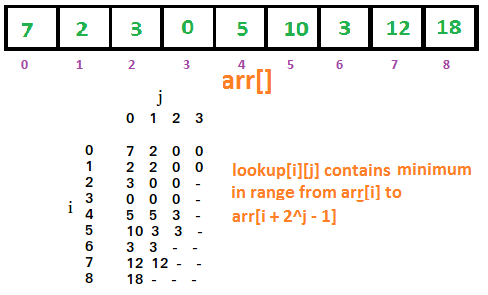
The idea is to precompute the minimum values for all subarrays whose lengths are **powers of two and store them in a table so that any range-minimum query can be answered in constant time. We build a 2D array
lookupwherelookup[i][j]holds the minimum of the subarray starting atiwith length2^j (j varies from to Log n where n is the length of the input array). For example lookup[0][3] contains minimum of range [0, 7] (starting with 0 and of size 23)**How to fill this lookup or sparse table?
The idea is simple, fill in a bottom-up manner using previously computed values. We compute ranges with current power of 2 using values of lower power of two. Each entry for length2^jis derived by combining two overlapping subarrays of length2^(j–1)that were computed in the previous step. For example, to find a minimum of range [0, 7] (Range size is a power of 3), we can use the minimum of following two.
a) Minimum of range [0, 3] (Range size is a power of 2)
b) Minimum of range [4, 7] (Range size is a power of 2)
Based on above example, below is formula,// Minimum of single element subarrays is same // as the only element. lookup[i][0] = arr[i] // If lookup[0][2] <= lookup[4][2], // then lookup[0][3] = lookup[0][2]If lookup[i][j-1] <= lookup[i+2j-1][j-1] lookup[i][j] = lookup[i][j-1] // If lookup[0][2] > lookup[4][2], // then lookup[0][3] = lookup[4][2]**Else** lookup[i][j] = lookup[i+2j-1][j-1]
Follow the below given steps:
- Initialize
lookup[i][0] = arr[i]for every0 ≤ i < n. - For each
jfrom1up to⌊log₂n⌋, and for eachifrom0ton – 2^j:- Compute
lookup[i][j]as the minimum of the two halves:
* the interval beginning atiof length2^(j–1)(lookup[i][j–1])
* the interval beginning ati + 2^(j–1)of length2^(j–1)(lookup[i + 2^(j–1)][j–1])
- Compute
- To answer a query on the range
[L, R]:- Let
k = ⌊log₂(R – L + 1)⌋. - The minimum over
[L, R]ismin(lookup[L][k], lookup[R – 2^k + 1][k]).
- Let
**How do we handle individual queries?
- Find highest power of 2 that is smaller than or equal to count of elements in given range [L, R]. we get
j = floor(log2(R - L + 1))For [2, 10], j = 3- Compute minimum of last 2^j elements with first 2^j elements in range. For [2, 10], we compare lookup[0][3] (minimum from 0 to 7) and lookup[3][3] (minimum from 3 to 10) and return the minimum of two values.
C++ `
#include <bits/stdc++.h> using namespace std;
// Fills lookup array lookup[][] in bottom up manner. vector<vector> buildSparseTable(vector &arr) { int n = arr.size();
// create the 2d table
vector<vector<int>> lookup(n + 1,
            vector<int>(log2(n) + 1));

// Initialize for the intervals with length 1
for (int i = 0; i < n; i++)
    lookup[i][0] = arr[i];

// Compute values from smaller to bigger intervals
for (int j = 1; (1 << j) <= n; j++) {

    // Compute minimum value for all intervals with
    // size 2^j
    for (int i = 0; (i + (1 << j) - 1) < n; i++) {

        if (lookup[i][j - 1] <
            lookup[i + (1 << (j - 1))][j - 1])
            lookup[i][j] = lookup[i][j - 1];
        else
            lookup[i][j] =
            lookup[i + (1 << (j - 1))][j - 1];
    }
}

return lookup;
}
// Returns minimum of arr[L..R] int query(int L, int R, vector<vector> &lookup) {
// Find highest power of 2 that is smaller
// than or equal to count of elements in range
int j = (int)log2(R - L + 1);

// Compute minimum of last 2^j elements with first
// 2^j elements in range.
if (lookup[L][j] <= lookup[R - (1 << j) + 1][j])
    return lookup[L][j];
else
    return lookup[R - (1 << j) + 1][j];
}
vector solveQueries(vector& arr, vector<vector>& queries) { int n = arr.size(); int m = queries.size(); vector result(m);
// Build the sparse table
vector<vector<int>> lookup = buildSparseTable(arr);

// Process each query
for (int i = 0; i < m; i++) {
    int L = queries[i][0];
    int R = queries[i][1];
    result[i] = query(L, R, lookup);
}

return result;
}
int main() { vector arr = { 7, 2, 3, 0, 5, 10, 3, 12, 18 }; vector<vector> queries = { {0, 4}, {4, 7}, {7, 8} }; vector res = solveQueries(arr, queries); for (int i = 0; i < res.size(); i++) { cout << res[i] << " "; } return 0; }
Java
public class GfG {
// Fills lookup array lookup[][] in bottom up manner.
public static int[][] buildSparseTable(int[] arr) {
    int n = arr.length;

    // create the 2d table
    int[][] lookup = new int[n + 1][(int)(Math.log(n) / Math.log(2)) + 1];

    // Initialize for the intervals with length 1
    for (int i = 0; i < n; i++)
        lookup[i][0] = arr[i];

    // Compute values from smaller to bigger intervals
    for (int j = 1; (1 << j) <= n; j++) {

        // Compute minimum value for all intervals with
        // size 2^j
        for (int i = 0; (i + (1 << j) - 1) < n; i++) {

            if (lookup[i][j - 1] <
                lookup[i + (1 << (j - 1))][j - 1])
                lookup[i][j] = lookup[i][j - 1];
            else
                lookup[i][j] =
                lookup[i + (1 << (j - 1))][j - 1];
        }
    }

    return lookup;
}

// Returns minimum of arr[L..R]
public static int query(int L, int R, int[][] lookup) {

    // Find highest power of 2 that is smaller
    // than or equal to count of elements in range
    int j = (int)(Math.log(R - L + 1) / Math.log(2));

    // Compute minimum of last 2^j elements with first
    // 2^j elements in range.
    if (lookup[L][j] <= lookup[R - (1 << j) + 1][j])
        return lookup[L][j];
    else
        return lookup[R - (1 << j) + 1][j];
}

public static int[] solveQueries(int[] arr, int[][] queries) {
    int n = arr.length;
    int m = queries.length;
    int[] result = new int[m];

    // Build the sparse table
    int[][] lookup = buildSparseTable(arr);

    // Process each query
    for (int i = 0; i < m; i++) {
        int L = queries[i][0];
        int R = queries[i][1];
        result[i] = query(L, R, lookup);
    }

    return result;
}

public static void main(String[] args) {
    int[] arr = { 7, 2, 3, 0, 5, 10, 3, 12, 18 };
    int[][] queries = { {0, 4}, {4, 7}, {7, 8} };
    int[] res = solveQueries(arr, queries);
    for (int i = 0; i < res.length; i++) {
        System.out.print(res[i] + " ");
    }
}
}
Python
import math
Fills lookup array lookup[][] in bottom up manner.
def buildSparseTable(arr): n = len(arr)
# create the 2d table
lookup = [[0] * (int(math.log(n, 2)) + 1) for _ in range(n + 1)]

# Initialize for the intervals with length 1
for i in range(n):
    lookup[i][0] = arr[i]

# Compute values from smaller to bigger intervals
for j in range(1, int(math.log(n, 2)) + 1):

    # Compute minimum value for all intervals with
    # size 2^j
    for i in range(0, n - (1 << j) + 1):

        if lookup[i][j - 1] < lookup[i + (1 << (j - 1))][j - 1]:
            lookup[i][j] = lookup[i][j - 1]
        else:
            lookup[i][j] = lookup[i + (1 << (j - 1))][j - 1]

return lookup
Returns minimum of arr[L..R]
def query(L, R, lookup):
# Find highest power of 2 that is smaller
# than or equal to count of elements in range
j = int(math.log(R - L + 1, 2))

# Compute minimum of last 2^j elements with first
# 2^j elements in range.
if lookup[L][j] <= lookup[R - (1 << j) + 1][j]:
    return lookup[L][j]
else:
    return lookup[R - (1 << j) + 1][j]
def solveQueries(arr, queries): n = len(arr) m = len(queries) result = [0] * m
# Build the sparse table
lookup = buildSparseTable(arr)

# Process each query
for i in range(m):
    L = queries[i][0]
    R = queries[i][1]
    result[i] = query(L, R, lookup)

return result
if name == "main": arr = [ 7, 2, 3, 0, 5, 10, 3, 12, 18 ] queries = [ [0, 4], [4, 7], [7, 8] ] res = solveQueries(arr, queries) for x in res: print(x, end=" ")
C#
using System;
public class GfG {
// Fills lookup array lookup[][] in bottom up manner.
public static int[][] buildSparseTable(int[] arr) {
    int n = arr.Length;

    // create the 2d table
    int cols = (int)(Math.Log(n) / Math.Log(2)) + 1;
    int[][] lookup = new int[n + 1][];
    for (int i = 0; i < n + 1; i++)
        lookup[i] = new int[cols];

    // Initialize for the intervals with length 1
    for (int i = 0; i < n; i++)
        lookup[i][0] = arr[i];

    // Compute values from smaller to bigger intervals
    for (int j = 1; (1 << j) <= n; j++) {

        // Compute minimum value for all intervals with
        // size 2^j
        for (int i = 0; (i + (1 << j) - 1) < n; i++) {

            if (lookup[i][j - 1] <
                lookup[i + (1 << (j - 1))][j - 1])
                lookup[i][j] = lookup[i][j - 1];
            else
                lookup[i][j] =
                lookup[i + (1 << (j - 1))][j - 1];
        }
    }

    return lookup;
}

// Returns minimum of arr[L..R]
public static int query(int L, int R, int[][] lookup) {

    // Find highest power of 2 that is smaller
    // than or equal to count of elements in range
    int j = (int)(Math.Log(R - L + 1) / Math.Log(2));

    // Compute minimum of last 2^j elements with first
    // 2^j elements in range.
    if (lookup[L][j] <= lookup[R - (1 << j) + 1][j])
        return lookup[L][j];
    else
        return lookup[R - (1 << j) + 1][j];
}

public static int[] solveQueries(int[] arr, int[][] queries) {
    int n = arr.Length;
    int m = queries.Length;
    int[] result = new int[m];

    // Build the sparse table
    int[][] lookup = buildSparseTable(arr);

    // Process each query
    for (int i = 0; i < m; i++) {
        int L = queries[i][0];
        int R = queries[i][1];
        result[i] = query(L, R, lookup);
    }

    return result;
}

public static void Main(string[] args) {
    int[] arr = { 7, 2, 3, 0, 5, 10, 3, 12, 18 };
    int[][] queries = { new int[]{0, 4}, new int[]{4, 7}, new int[]{7, 8} };
    int[] res = solveQueries(arr, queries);
    for (int i = 0; i < res.Length; i++) {
        Console.Write(res[i] + " ");
    }
}
}
JavaScript
// Fills lookup array lookup[][] in bottom up manner. function buildSparseTable(arr) { const n = arr.length;
// create the 2d table
const cols = Math.floor(Math.log2(n)) + 1;
const lookup = Array.from({ length: n + 1 }, () => Array(cols).fill(0));

// Initialize for the intervals with length 1
for (let i = 0; i < n; i++)
    lookup[i][0] = arr[i];

// Compute values from smaller to bigger intervals
for (let j = 1; (1 << j) <= n; j++) {

    // Compute minimum value for all intervals with
    // size 2^j
    for (let i = 0; (i + (1 << j) - 1) < n; i++) {

        if (lookup[i][j - 1] <
            lookup[i + (1 << (j - 1))][j - 1])
            lookup[i][j] = lookup[i][j - 1];
        else
            lookup[i][j] =
            lookup[i + (1 << (j - 1))][j - 1];
    }
}

return lookup;
}
// Returns minimum of arr[L..R] function query(L, R, lookup) {
// Find highest power of 2 that is smaller
// than or equal to count of elements in range
const j = Math.floor(Math.log2(R - L + 1));

// Compute minimum of last 2^j elements with first
// 2^j elements in range.
if (lookup[L][j] <= lookup[R - (1 << j) + 1][j])
    return lookup[L][j];
else
    return lookup[R - (1 << j) + 1][j];
}
function solveQueries(arr, queries) { const n = arr.length; const m = queries.length; const result = new Array(m);
// Build the sparse table
const lookup = buildSparseTable(arr);

// Process each query
for (let i = 0; i < m; i++) {
    const L = queries[i][0];
    const R = queries[i][1];
    result[i] = query(L, R, lookup);
}

return result;
}
const arr = [ 7, 2, 3, 0, 5, 10, 3, 12, 18 ]; const queries = [ [0, 4], [4, 7], [7, 8] ]; const res = solveQueries(arr, queries); console.log(res.join(' '));
`
**Time Complexity: O(n * log n), sparse table method supports query operation in O(1) time with O(n Log n) preprocessing time.
**Auxiliary Space: O(n * log n)
**Range GCD Query Using Sparse Table
You are given an integer array arr of length n and an integer q denoting the number of queries. Each query consists of two indices L and R (0 ≤ L ≤ R < n), and asks for the greatest common divisor in the subarray arr[L…R].
**Example:
**Input: arr[] = [2, 3, 5, 4, 6, 8]
queries[][] = [ [0, 2], [3, 5], [2, 3] ]
**Output: 1 2 1
**Explanation: For query 1, gcd of elements 2, 3, and 5 is 1 (as all three are primes).
For query 2, gcd of elements 4, 6, and 8 is 2.
For query 3, gcd of elements 5 and 4 is 1 (as 4 and 5 are co-primes).
**Approach:
The idea is to exploit the associativity and idempotence of GCD to answer any range‐GCD query in constant time after preprocessing. Since
**GCD(a, b, c) = GCD(GCD(a, b), c) = GCD(a, GCD(b, c))
and taking GCD of an overlapping element more than once does not change the result (e.g. GCD(a, b, c) = GCD(GCD(a, b), GCD(b, c))), we can build a sparse table over powers of two just like in the range‐minimum query. Any query range [L, R] can then be covered by two overlapping power‐of‐two intervals whose GCDs we combine to get the answer.
**How to handle individual queries?
- Find highest power of 2 that is smaller than or equal to count of elements in given range [L, R]. we get
j = floor(log2(R - L + 1))For [2, 10], j = 3- Compute GCD of last 2^j elements with first 2^j elements in range. For [2, 10], we compute GCD of lookup[0][3] (GCD of 0 to 7) and GCD of lookup[3][3] (GCD of 3 to 10).
Follow the below given steps:
- For every index i, set lookup[i][0] = arr[i].
- For j = 1 to ⌊log₂n⌋, and for each i from 0 to n − 2ʲ:
- lookup[i][j] = GCD( lookup[i][j−1], lookup[i + 2^(j−1)][j−1] )
- To answer a query [L, R]:
- Let k = ⌊log₂(R − L + 1)⌋
- The GCD over [L, R] is GCD( lookup[L][k], lookup[R − 2ᵏ + 1][k] )
Below is given the **implementation:
C++ `
#include <bits/stdc++.h> using namespace std;
// Fills lookup array lookup[][] in bottom up manner. vector<vector> buildSparseTable(vector &arr){ int n = arr.size();
// create the 2d table
vector<vector<int>> lookup(n + 1,
            vector<int>(log2(n) + 1));

// GCD of single element is element itself
for (int i = 0; i < n; i++)
    lookup[i][0] = arr[i];

// Build sparse table
for (int j = 1; j <= log2(n); j++)
    for (int i = 0; i <= n - (1 << j); i++)
        lookup[i][j] = __gcd(lookup[i][j - 1],
        lookup[i + (1 << (j - 1))][j - 1]);

return lookup;
}
// Returns GCD of arr[L..R] int query(int L, int R, vector<vector> & lookup) {
// Find highest power of 2 that is smaller
// than or equal to count of elements
int j = (int)log2(R - L + 1);

// Compute GCD of last 2^j elements with first
// 2^j elements in range.
return __gcd(lookup[L][j], lookup[R - (1 << j) + 1][j]);
}
vector solveQueries(vector& arr, vector<vector>& queries) { int n = arr.size(); int m = queries.size(); vector result(m);
// Build the sparse table
vector<vector<int>> lookup = buildSparseTable(arr);

// Process each query
for (int i = 0; i < m; i++) {
    int L = queries[i][0];
    int R = queries[i][1];
    result[i] = query(L, R, lookup);
}

return result;
}
int main() { vector arr = { 2, 3, 5, 4, 6, 8 }; vector<vector> queries = { {0, 2}, {3, 5}, {2, 3} }; vector res = solveQueries(arr, queries); for (int i = 0; i < res.size(); i++) { cout << res[i] << " "; } return 0; }
Java
public class GfG {
public static int[][] buildSparseTable(int[] arr) {
    int n = arr.length;

    // create the 2d table
    int[][] lookup = new int[n + 1][(int)(Math.log(n) / Math.log(2)) + 1];

    // GCD of single element is element itself
    for (int i = 0; i < n; i++)
        lookup[i][0] = arr[i];

    // Build sparse table
    for (int j = 1; j <= (int)(Math.log(n) / Math.log(2)); j++)
        for (int i = 0; i <= n - (1 << j); i++)
            lookup[i][j] = gcd(lookup[i][j - 1],
                               lookup[i + (1 << (j - 1))][j - 1]);

    return lookup;
}

public static int query(int L, int R, int[][] lookup) {

    // Find highest power of 2 that is smaller
    // than or equal to count of elements
    int j = (int)(Math.log(R - L + 1) / Math.log(2));

    // Compute GCD of last 2^j elements with first
    // 2^j elements in range.
    return gcd(lookup[L][j], lookup[R - (1 << j) + 1][j]);
}

public static int[] solveQueries(int[] arr, int[][] queries) {
    int n = arr.length;
    int m = queries.length;
    int[] result = new int[m];

    // Build the sparse table
    int[][] lookup = buildSparseTable(arr);

    // Process each query
    for (int i = 0; i < m; i++) {
        int L = queries[i][0];
        int R = queries[i][1];
        result[i] = query(L, R, lookup);
    }

    return result;
}

private static int gcd(int a, int b) {
    return b == 0 ? a : gcd(b, a % b);
}

public static void main(String[] args) {
    int[] arr = { 2, 3, 5, 4, 6, 8 };
    int[][] queries = { {0, 2}, {3, 5}, {2, 3} };
    int[] res = solveQueries(arr, queries);
    for (int i = 0; i < res.length; i++) {
        System.out.print(res[i] + " ");
    }
}
}
Python
import math
def buildSparseTable(arr): n = len(arr)
# create the 2d table
lookup = [[0] * (int(math.log2(n)) + 1) for _ in range(n + 1)]

# GCD of single element is element itself
for i in range(n):
    lookup[i][0] = arr[i]

# Build sparse table
for j in range(1, int(math.log2(n)) + 1):
    for i in range(0, n - (1 << j) + 1):
        lookup[i][j] = math.gcd(lookup[i][j - 1],
                                lookup[i + (1 << (j - 1))][j - 1])

return lookup
def query(L, R, lookup):
# Find highest power of 2 that is smaller
# than or equal to count of elements
j = int(math.log2(R - L + 1))

# Compute GCD of last 2^j elements with first
# 2^j elements in range.
return math.gcd(lookup[L][j], lookup[R - (1 << j) + 1][j])
def solveQueries(arr, queries): n = len(arr) m = len(queries) result = [0] * m
# Build the sparse table
lookup = buildSparseTable(arr)

# Process each query
for i in range(m):
    L = queries[i][0]
    R = queries[i][1]
    result[i] = query(L, R, lookup)

return result
if name == "main": arr = [ 2, 3, 5, 4, 6, 8 ] queries = [ [0, 2], [3, 5], [2, 3] ] res = solveQueries(arr, queries) for i in range(len(res)): print(res[i], end=" ")
C#
using System;
public class GfG {
public static int[][] buildSparseTable(int[] arr) {
    int n = arr.Length;

    // create the 2d table
    int[][] lookup = new int[n + 1][];
    for (int i = 0; i <= n; i++)
        lookup[i] = new int[(int)(Math.Log(n) / Math.Log(2)) + 1];

    // GCD of single element is element itself
    for (int i = 0; i < n; i++)
        lookup[i][0] = arr[i];

    // Build sparse table
    for (int j = 1; j <= (int)(Math.Log(n) / Math.Log(2)); j++)
        for (int i = 0; i <= n - (1 << j); i++)
            lookup[i][j] = GCD(lookup[i][j - 1],
                               lookup[i + (1 << (j - 1))][j - 1]);

    return lookup;
}

public static int query(int L, int R, int[][] lookup) {

    // Find highest power of 2 that is smaller
    // than or equal to count of elements
    int j = (int)(Math.Log(R - L + 1) / Math.Log(2));

    // Compute GCD of last 2^j elements with first
    // 2^j elements in range.
    return GCD(lookup[L][j], lookup[R - (1 << j) + 1][j]);
}

public static int[] solveQueries(int[] arr, int[][] queries) {
    int n = arr.Length;
    int m = queries.Length;
    int[] result = new int[m];

    // Build the sparse table
    int[][] lookup = buildSparseTable(arr);

    // Process each query
    for (int i = 0; i < m; i++) {
        int L = queries[i][0];
        int R = queries[i][1];
        result[i] = query(L, R, lookup);
    }

    return result;
}

private static int GCD(int a, int b) {
    return b == 0 ? a : GCD(b, a % b);
}

public static void Main(string[] args) {
    int[] arr = { 2, 3, 5, 4, 6, 8 };
    int[][] queries = new int[][] { new int[]{0, 2},
    new int[]{3, 5}, new int[]{2, 3} };
    int[] res = solveQueries(arr, queries);
    for (int i = 0; i < res.Length; i++) {
        Console.Write(res[i] + " ");
    }
}
}
JavaScript
// Fills lookup array lookup[][] in bottom up manner. function buildSparseTable(arr) { const n = arr.length;
// create the 2d table
const lookup = Array.from({ length: n + 1 },
() => Array(Math.floor(Math.log2(n)) + 1).fill(0));

// GCD of single element is element itself
for (let i = 0; i < n; i++)
    lookup[i][0] = arr[i];

// Build sparse table
for (let j = 1; j <= Math.floor(Math.log2(n)); j++)
    for (let i = 0; i <= n - (1 << j); i++)
        lookup[i][j] = gcd(lookup[i][j - 1],
                           lookup[i + (1 << (j - 1))][j - 1]);

return lookup;
}
// Returns GCD of arr[L..R] function query(L, R, lookup) {
// Find highest power of 2 that is smaller
// than or equal to count of elements
const j = Math.floor(Math.log2(R - L + 1));

// Compute GCD of last 2^j elements with first
// 2^j elements in range.
return gcd(lookup[L][j], lookup[R - (1 << j) + 1][j]);
}
function solveQueries(arr, queries) { const n = arr.length; const m = queries.length; const result = new Array(m);
// Build the sparse table
const lookup = buildSparseTable(arr);

// Process each query
for (let i = 0; i < m; i++) {
    const L = queries[i][0];
    const R = queries[i][1];
    result[i] = query(L, R, lookup);
}

return result;
}
function gcd(a, b) { return b === 0 ? a : gcd(b, a % b); }
const arr = [ 2, 3, 5, 4, 6, 8 ]; const queries = [ [0, 2], [3, 5], [2, 3] ]; const res = solveQueries(arr, queries); console.log(res.join(" "));
`
**Time Complexity: O(n * log n)
**Auxiliary Space: O(n * log n)