Stooge Sort (original) (raw)
Last Updated : 10 Jan, 2023
Stooge Sort is a recursive sorting algorithm. It is not much efficient but interesting sorting algorithm. It generally divides the array into two overlapping parts (2/3 each). After that it performs sorting in first 2/3 part and then it performs sorting in last 2/3 part. And then, sorting is done on first 2/3 part to ensure that the array is sorted.
The key idea is that sorting the overlapping part twice exchanges the elements between the other two sections accordingly.
Approach:
Step 1: If value at index 0 is greater than value at last index, swap them.
Step 2: Recursively,
- Stooge sort the initial 2/3rd of the array.
- Stooge sort the last 2/3rd of the array.
- Stooge sort the initial 2/3rd again to confirm.
NOTE: Always take the ceil of ((2/3)*N) for selecting elements.
Illustration:
Lets consider an example: arr[] = {2, 4, 5, 3, 1}
- Step1: Initially, First and last elements are compared and if last is greater than first then they are swapped.
1 4 5 3 2
- Step2: Now, recursively sort initial 2/3rd of the elements as shown below:
1 4 5 3 2
1 3 4 5 2
- Step3: Then, recursively sort last 2/3rd of the elements, as shown below:
1 3 4 5 2
1 2 3 4 5
- Step4: Again, sort the initial 2/3rd of the elements to confirm final data is sorted.
- Resulted array:
1 2 3 4 5
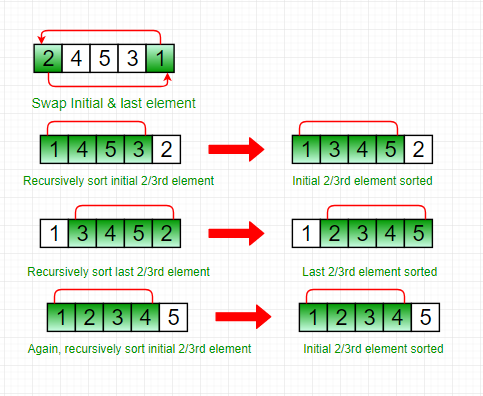
Below is the implementation for the above approach:
C++ `
// C++ code to implement stooge sort #include using namespace std;
// Function to implement stooge sort void stoogesort(int arr[], int l, int h) { if (l >= h) return;
// If first element is smaller than last,
// swap them
if (arr[l] > arr[h])
    swap(arr[l], arr[h]);

// If there are more than 2 elements in
// the array
if (h - l + 1 > 2) {
    int t = (h - l + 1) / 3;

    // Recursively sort first 2/3 elements
    stoogesort(arr, l, h - t);

    // Recursively sort last 2/3 elements
    stoogesort(arr, l + t, h);

    // Recursively sort first 2/3 elements
    // again to confirm
    stoogesort(arr, l, h - t);
}
}
// Driver Code int main() { int arr[] = { 2, 4, 5, 3, 1 }; int n = sizeof(arr) / sizeof(arr[0]);
// Calling Stooge Sort function to sort
// the array
stoogesort(arr, 0, n - 1);

// Display the sorted array
for (int i = 0; i < n; i++)
    cout << arr[i] << " ";

return 0;
}
Java
// Java program to implement stooge sort import java.io.*;
public class stooge { // Function to implement stooge sort static void stoogesort(int arr[], int l, int h) { if (l >= h) return;
    // If first element is smaller
    // than last, swap them
    if (arr[l] > arr[h]) {
        int t = arr[l];
        arr[l] = arr[h];
        arr[h] = t;
    }

    // If there are more than 2 elements in
    // the array
    if (h - l + 1 > 2) {
        int t = (h - l + 1) / 3;

        // Recursively sort first 2/3 elements
        stoogesort(arr, l, h - t);

        // Recursively sort last 2/3 elements
        stoogesort(arr, l + t, h);

        // Recursively sort first 2/3 elements
        // again to confirm
        stoogesort(arr, l, h - t);
    }
}

// Driver Code
public static void main(String args[])
{
    int arr[] = { 2, 4, 5, 3, 1 };
    int n = arr.length;

    stoogesort(arr, 0, n - 1);

    for (int i = 0; i < n; i++)
        System.out.print(arr[i] + " ");
}
} // Code Contributed by Mohit Gupta_OMG <(0_o)>
Python3
Python program to implement stooge sort
def stoogesort(arr, l, h): if l >= h: return
# If first element is smaller
# than last, swap them
if arr[l]>arr[h]:
    t = arr[l]
    arr[l] = arr[h]
    arr[h] = t

# If there are more than 2 elements in
# the array
if h-l + 1 > 2:
    t = (int)((h-l + 1)/3)

    # Recursively sort first 2 / 3 elements
    stoogesort(arr, l, (h-t))

    # Recursively sort last 2 / 3 elements
    stoogesort(arr, l + t, (h))

    # Recursively sort first 2 / 3 elements
    # again to confirm
    stoogesort(arr, l, (h-t))
deriver
arr = [2, 4, 5, 3, 1] n = len(arr)
stoogesort(arr, 0, n-1)
for i in range(0, n): print(arr[i], end = ' ')
Code Contributed by Mohit Gupta_OMG <(0_o)>
C#
// C# program to implement stooge sort using System;
class GFG {
// Function to implement stooge sort
static void stoogesort(int[] arr,
                        int l, int h)
{
    if (l >= h)
        return;

    // If first element is smaller
    // than last, swap them
    if (arr[l] > arr[h]) {
        int t = arr[l];
        arr[l] = arr[h];
        arr[h] = t;
    }

    // If there are more than 2
    // elements in the array
    if (h - l + 1 > 2) {
        int t = (h - l + 1) / 3;

        // Recursively sort first
        // 2/3 elements
        stoogesort(arr, l, h - t);

        // Recursively sort last
        // 2/3 elements
        stoogesort(arr, l + t, h);

        // Recursively sort first
        // 2/3 elements again to
        // confirm
        stoogesort(arr, l, h - t);
    }
}

// Driver Code
public static void Main()
{
    int[] arr = { 2, 4, 5, 3, 1 };
    int n = arr.Length;

    // Calling Stooge Sort function
    // to sort the array
    stoogesort(arr, 0, n - 1);

    // Display the sorted array
    for (int i = 0; i < n; i++)
        Console.Write(arr[i] + " ");
}
}
// This code is contributed by Sam007.
JavaScript
`
The running time complexity of stooge sort can be written as,
T(n) = 3T(2n/3) + ?(1)
Solution of above recurrence is O(n(log3/log1.5)) = O(n2.709), hence it is slower than even bubble sort(n^2).