Matrix Multiplication (original) (raw)
Given two matrices **mat1[][] of size **n × m and **mat2[][] of size **m × q, find their matrix product, where the resulting matrix has dimensions **n × q
**Examples:
**Input: mat1[][] = [[1, 2, 3],
[4, 5, 6]],
mat2[][] = [[7, 8],
[9, 10],
[11, 12]]
**Output: [[58, 64],
[139, 154]]
**Explanation: Matrix mat1[ ][ ] (2×3) is multiplied with Matrix mat2[ ][ ] (3×2) by computing the dot product of a's rows with b's columns. This results in a new matrix of size 2×2 containing the summed products for each position.**Input: mat1[][] = [[17, 4],
[17, 16]],
mat2[][] = [9, 2],
[7, 1]]
**Output: [[181, 38],
[265, 50]]
**Explanation: Matrix mat1[ ][ ] (2×2) is multiplied with Matrix mat2[ ][ ] (2×2) by computing the dot product of a's rows with b's columns. This results in a new matrix of size 2×2 containing the summed products for each position.
Table of Content
- [Approach 1] - Using Nested Loops - O(n * m * q) Time and O(n * q) Space
- [Approach 2] - Using Divide and Conquer - O(n * m * q) Time and O(n * q) Space
- [Approach 3] - Using Strassen's Method
[Approach 1] - Using Nested Loops - O(n * m * q) Time and O(n * q) Space
The main idea is to initializes the result matrix with zeros and fills each cell by computing the dot product of the corresponding row from a and column from . This is done using three nested loops: the outer two iterate over the result matrix cells, and the innermost loop performs the multiplication and addition.
C++ `
#include #include using namespace std;
vector<vector> multiply(vector<vector> &mat1, vector<vector> &mat2) {
int n = mat1.size(), m = mat1[0].size(),
                                q = mat2[0].size();

// Initialize the result matrix with
// dimensions n×q, filled with 0s
vector<vector<int>> res(n, vector<int>(q, 0));

// Loop through each row of mat1
for (int i = 0; i < n; i++) {

    // Loop through each column of mat2
    for (int j = 0; j < q; j++) {

        // Compute the dot product of
        // row mat1[i] and column mat2[][j]
        for (int k = 0; k < m; k++) {
            res[i][j] += mat1[i][k] * mat2[k][j];
        }
    }
}

return res;
}
int main() { vector<vector> mat1 = { {1, 2, 3}, {4, 5, 6} };
vector<vector<int>> mat2 = {
    {7, 8},
    {9, 10},
    {11, 12}
};

vector<vector<int>> res = multiply(mat1, mat2);

// Print the resulting matrix
for (int i = 0; i < res.size(); i++) {
    for (int j = 0; j < res[i].size(); j++) {
        cout << res[i][j] << " ";
    }
    cout << endl;
}

return 0;
}
Java
import java.util.ArrayList; import java.util.Collections;
class GfG {
static ArrayList<ArrayList<Integer>> multiply(
                        int[][] mat1, int[][] mat2) {
    int n = mat1.length;
    int m = mat1[0].length;
    int q = mat2[0].length;

    // Initialize the result matrix with
    // dimensions n×q, filled with 0s
    ArrayList<ArrayList<Integer>> res = new ArrayList<>();
    for (int i = 0; i < n; i++) {
        ArrayList<Integer> row = new ArrayList<>(
                                    Collections.nCopies(q, 0));
        res.add(row);
    }

    // Loop through each row of mat1
    for (int i = 0; i < n; i++) {

        // Loop through each column of mat2
        for (int j = 0; j < q; j++) {

            // Compute the dot product of
            // row mat1[i] and column mat2[][j]
            for (int k = 0; k < m; k++) {
                int val = res.get(i).get(j) +
                                mat1[i][k] *
                                    mat2[k][j];
                res.get(i).set(j, val);
            }
        }
    }

    return res;
}

public static void main(String[] args) {
    int[][] mat1 = {
        {1, 2, 3},
        {4, 5, 6}
    };

    int[][] mat2 = {
        {7, 8},
        {9, 10},
        {11, 12}
    };

    ArrayList<ArrayList<Integer>> res = multiply(mat1, mat2);

    // Print the resulting matrix
    for (ArrayList<Integer> row : res) {
        for (int val : row) {
            System.out.print(val + " ");
        }
        System.out.println();
    }
}
}
Python
def multiply(mat1, mat2): n = len(mat1) m = len(mat1[0]) q = len(mat2[0])
# Initialize the result matrix with
# dimensions n×q, filled with 0s
res = [[0 for _ in range(q)] for _ in range(n)]

# Loop through each row of mat1
for i in range(n):

    # Loop through each column of mat2
    for j in range(q):

        # Compute the dot product of
        # row mat1[i] and column mat2[][j]
        for k in range(m):
            res[i][j] += mat1[i][k] * mat2[k][j]

return res
if name == "main":
mat1 = [[1, 2, 3],[4, 5, 6]]
mat2 = [[7, 8],[9, 10],[11, 12]]

res = multiply(mat1, mat2)

for row in res:
    for val in row:
        print(val, end=" ")
    print()
C#
using System; using System.Collections.Generic;
class GfG {
static List<List<int>> multiply(int[,] mat1, int[,] mat2) {

    // rows in mat1
    int n = mat1.GetLength(0);

    // cols in mat1 = rows in mat2
    int m = mat1.GetLength(1);

    // cols in mat2
    int q = mat2.GetLength(1);

    // Initialize the result matrix with dimensions n×q, filled with 0s
    List<List<int>> res = new List<List<int>>();
    for (int i = 0; i < n; i++) {
        List<int> row = new List<int>(new int[q]);
        res.Add(row);
    }

    // Matrix multiplication
    for (int i = 0; i < n; i++) {
        for (int j = 0; j < q; j++) {
            for (int k = 0; k < m; k++) {
                res[i][j] += mat1[i, k] * mat2[k, j];
            }
        }
    }

    return res;
}

static void Main() {

    int[,] mat1 = {{1, 2, 3},{4, 5, 6}};
    int[,] mat2 = {{7, 8},{9, 10},{11, 12}};

    List<List<int>> res = multiply(mat1, mat2);

    foreach (var row in res) {
        foreach (var val in row) {
            Console.Write(val + " ");
        }
        Console.WriteLine();
    }
}
}
JavaScript
function multiply(mat1, mat2) { let n = mat1.length; let m = mat1[0].length; let q = mat2[0].length;
// Initialize the result matrix with
// dimensions n×q, filled with 0s
let res = Array.from({ length: n }, () => Array(q).fill(0));

// Loop through each row of mat1
for (let i = 0; i < n; i++) {

    // Loop through each column of mat2
    for (let j = 0; j < q; j++) {

        // Compute the dot product of
        // row mat1[i] and column mat2[][j]
        for (let k = 0; k < m; k++) {
            res[i][j] += mat1[i][k] * mat2[k][j];
        }
    }
}

return res;
}
// Driver code
let mat1 = [[1, 2, 3],[4, 5, 6]]; let mat2 = [[7, 8],[9, 10],[11, 12]];
let res = multiply(mat1, mat2); for (let i = 0; i < res.length; i++) { console.log(res[i].join(" ")); }
`
[Approach 2] - Using Divide and Conquer - O(n * m * q) Time and O(n * q) Space
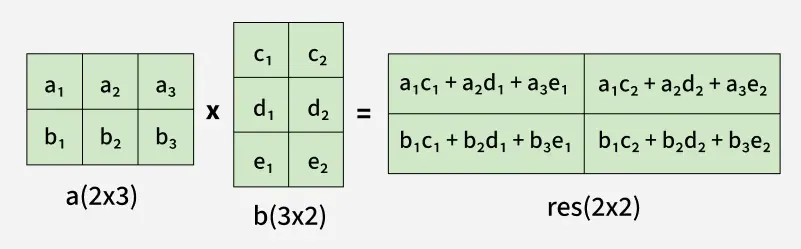
The main idea is to multiply two matrices by following the standard row-by-column multiplication method. For each element in the result matrix, it takes a row from the first matrix and a column from the second matrix, multiplies their corresponding elements, and adds them up to get a single value. This process is repeated for every position in the result matrix.
C++ `
#include #include using namespace std;
// Function to add two matrices of same dimensions r×c vector<vector> add(vector<vector> &mat1, vector<vector> &mat2) { int r = mat1.size(); int c = mat1[0].size();
// Initialize result matrix with dimensions r×c
vector<vector<int>> res(r, vector<int>(c, 0));

// Perform element-wise addition
for (int i = 0; i < r; ++i) {
    for (int j = 0; j < c; ++j) {
        res[i][j] = mat1[i][j] + mat2[i][j];
    }
}

return res;
}
// Function to multiply mat1 (n×m) // with mat2 (m×q) vector<vector> multiply(vector<vector> &mat1, vector<vector> &mat2) { int n = mat1.size(); int m = mat1[0].size(); int q = mat2[0].size();
// Initialize result matrix with dimensions n×q
vector<vector<int>> res(n, vector<int>(q, 0));

// Matrix multiplication logic
for (int i = 0; i < n; ++i) {
    for (int j = 0; j < q; ++j) {
        for (int k = 0; k < m; ++k) {
            res[i][j] += mat1[i][k] * mat2[k][j];
        }
    }
}

return res;
}
int main() { vector<vector> mat1 = { {1, 2, 3}, {4, 5, 6} };
vector<vector<int>> mat2 = {
    {7, 8},
    {9, 10},
    {11, 12}
};

vector<vector<int>> res = multiply(mat1, mat2);

for (auto &row : res) {
    for (int val : row) {
        cout << val << " ";
    }
    cout << endl;
}

return 0;
}
Java
import java.util.ArrayList; import java.util.Collections;
class GfG {
// Function to add two matrices of same dimensions r×c
public static ArrayList<ArrayList<Integer>> add(
        int[][] mat1, int[][] mat2) {


    int r = mat1.length;
    int c = mat1[0].length;

    ArrayList<ArrayList<Integer>> res = new ArrayList<>();
    for (int i = 0; i < r; i++) {
        ArrayList<Integer> row = new ArrayList<>(
                                 Collections.nCopies(c, 0));
        res.add(row);
    }

    for (int i = 0; i < r; i++) {
        for (int j = 0; j < c; j++) {
            res.get(i).set(j, mat1[i][j] + mat2[i][j]);
        }
    }

    return res;
}

// Function to multiply mat1 (n×m) with mat2 (m×q)
public static ArrayList<ArrayList<Integer>> multiply(
        int[][] mat1, int[][] mat2) {

    int n = mat1.length;
    int m = mat1[0].length;
    int q = mat2[0].length;

    ArrayList<ArrayList<Integer>> res = new ArrayList<>();
    for (int i = 0; i < n; i++) {
        ArrayList<Integer> row = new ArrayList<>(
                                 Collections.nCopies(q, 0));
        res.add(row);
    }

    for (int i = 0; i < n; i++) {
        for (int j = 0; j < q; j++) {
            for (int k = 0; k < m; k++) {

                int val = res.get(i).get(j) +
                          mat1[i][k] * mat2[k][j];

                res.get(i).set(j, val);
            }
        }
    }

    return res;
}

public static void main(String[] args) {
    int[][] mat1 = {
        {1, 2, 3},
        {4, 5, 6}
    };

    int[][] mat2 = {
        {7, 8},
        {9, 10},
        {11, 12}
    };

    ArrayList<ArrayList<Integer>> res = multiply(mat1, mat2);

    for (ArrayList<Integer> row : res) {
        for (int val : row) {
            System.out.print(val + " ");
        }
        System.out.println();
    }
}
}
Python
Function to add two matrices of same dimensions r×c
def add(mat1, mat2): r = len(mat1) c = len(mat1[0])
# Initialize result matrix with dimensions r×c
res = [[0] * c for _ in range(r)]

# Perform element-wise addition
for i in range(r):
    for j in range(c):
        res[i][j] = mat1[i][j] + mat2[i][j]

return res
Function to multiply mat1 (n×m) with mat2 (m×q)
def multiply(mat1, mat2): n = len(mat1) m = len(mat1[0]) q = len(mat2[0])
# Initialize result matrix with dimensions n×q
res = [[0] * q for _ in range(n)]

# Matrix multiplication logic
for i in range(n):
    for j in range(q):
        for k in range(m):
            res[i][j] += mat1[i][k] * mat2[k][j]

return res
if name == "main": mat1 = [ [1, 2, 3], [4, 5, 6] ]
mat2 = [
    [7, 8],
    [9, 10],
    [11, 12]
]

res = multiply(mat1, mat2)

for row in res:
    print(" ".join(map(str, row)))
C#
using System; using System.Collections.Generic;
class GfG {
// Function to add two matrices and return result as List<List<int>>
static List<List<int>> Add(int[,] mat1, int[,] mat2) {
    int r = mat1.GetLength(0);
    int c = mat1.GetLength(1);

    List<List<int>> res = new List<List<int>>();

    for (int i = 0; i < r; i++) {
        List<int> row = new List<int>();
        for (int j = 0; j < c; j++) {
            row.Add(mat1[i, j] + mat2[i, j]);
        }
        res.Add(row);
    }

    return res;
}

// Function to multiply mat1 (n×m) with mat2 (m×q)
// and return result as List<List<int>>
static List<List<int>> multiply(int[,] mat1, int[,] mat2) {
    int n = mat1.GetLength(0);
    int m = mat1.GetLength(1);
    int q = mat2.GetLength(1);

    List<List<int>> res = new List<List<int>>();

    for (int i = 0; i < n; i++) {
        List<int> row = new List<int>();
        for (int j = 0; j < q; j++) {
            int sum = 0;
            for (int k = 0; k < m; k++) {
                sum += mat1[i, k] * mat2[k, j];
            }
            row.Add(sum);
        }
        res.Add(row);
    }

    return res;
}

static void Main() {
    int[,] mat1 = {
        {1, 2, 3},
        {4, 5, 6}
    };

    int[,] mat2 = {
        {7, 8},
        {9, 10},
        {11, 12}
    };

    var res = multiply(mat1, mat2);

    foreach (var row in res) {
        foreach (var val in row) {
            Console.Write(val + " ");
        }
        Console.WriteLine();
    }
}
}
JavaScript
// Function to add two matrices of same dimensions r×c function add(mat1, mat2) { let r = mat1.length; let c = mat1[0].length;
// Initialize result matrix with dimensions r×c
let res = Array.from({ length: r }, () => Array(c).fill(0));

// Perform element-wise addition
for (let i = 0; i < r; i++) {
    for (let j = 0; j < c; j++) {
        res[i][j] = mat1[i][j] + mat2[i][j];
    }
}

return res ;
}
// Function to multiply mat1 (n×m) // with mat2 (m×q) function multiply(mat1, mat2) { let n = mat1.length; let m = mat1[0].length; let q = mat2[0].length;
// Initialize result matrix with dimensions n×q
let res = Array.from({ length: n }, () => Array(q).fill(0));

// Matrix multiplication logic
for (let i = 0; i < n; i++) {
    for (let j = 0; j < q; j++) {
        for (let k = 0; k < m; k++) {
            res[i][j] += mat1[i][k] * mat2[k][j];
        }
    }
}

return res;
}
// Driver Code let mat1 = [ [1, 2, 3], [4, 5, 6] ];
let mat2 = [ [7, 8], [9, 10], [11, 12] ];
let res = multiply(mat1, mat2);
for (let row of res) { console.log(row.join(" ")); }
`
[Approach 3] - Using Strassen's Method
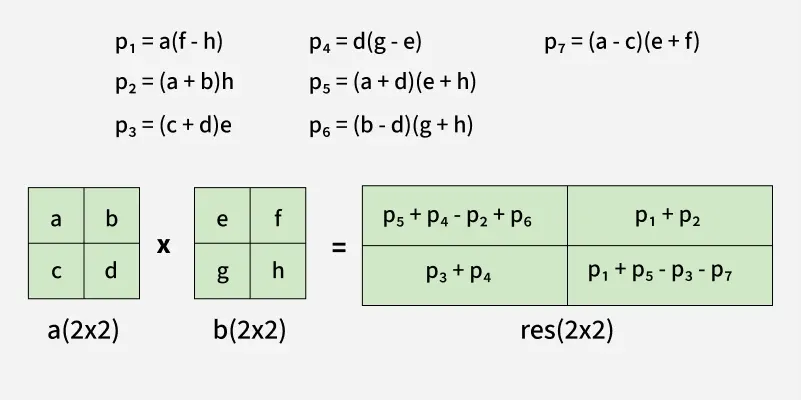
Strassen’s algorithm originally applies to square matrices, but when adapted for multiplying an n*m matrix with an m*q matrix, the matrices are padded to form square matrices of size s*s where s = next power of two _≥ max(n, m, q). The algorithm then performs 7 recursive multiplications on these square blocks.
**Note: Strassen's Method is often not preferred in practice due to its high constant factors, making the naive method faster for typical applications. It performs poorly with sparse matrices, where specialized algorithms work better. The recursive submatrix divisions require extra memory. Additionally, due to limited precision in floating-point arithmetic, Strassen’s algorithm tends to accumulate more errors than the naive approach.
C++ `
#include #include #include using namespace std;
// Return the next power of two greater than or equal to n int nextPowerOfTwo(int n) { return pow(2, ceil(log2(n))); }
// Resize a matrix to newR x newC and // fill extra space with zeros vector<vector> resizeMatrix(vector<vector> &mat, int newR, int newC) {
vector<vector<int>> resized(newR, vector<int>(newC, 0));
for (int i = 0; i < mat.size(); ++i)
    for (int j = 0; j < mat[0].size(); ++j)
        resized[i][j] = mat[i][j];

return resized;
}
// Perform matrix addition or subtraction // of size×size matrices // sign = 1 for addition, -1 for subtraction vector<vector> add(vector<vector> a, vector<vector> b, int size, int sign = 1) { vector<vector> res(size, vector(size)); for (int i = 0; i < size; i++) for (int j = 0; j < size; j++) res[i][j] = a[i][j] + sign * b[i][j]; return res; }
// Recursive implementation of Strassen's // matrix multiplication // Assumes both matrices are size×size // and size is a power of 2 vector<vector> strassen(vector<vector> mat1, vector<vector> mat2) { int n = mat1.size();
// Base case: 1×1 matrix multiplication
vector<vector<int>> res(n, vector<int>(n, 0));
if (n == 1) {
    res[0][0] = mat1[0][0] * mat2[0][0];
    return res;
}

// Split matrices into 4 submatrices
int newSize = n / 2;
vector<vector<int>> a11(newSize, vector<int>(newSize));
vector<vector<int>> a12(newSize, vector<int>(newSize));
vector<vector<int>> a21(newSize, vector<int>(newSize));
vector<vector<int>> a22(newSize, vector<int>(newSize));
vector<vector<int>> b11(newSize, vector<int>(newSize));
vector<vector<int>> b12(newSize, vector<int>(newSize));
vector<vector<int>> b21(newSize, vector<int>(newSize));
vector<vector<int>> b22(newSize, vector<int>(newSize));

// Fill the submatrices
for (int i = 0; i < newSize; i++)
    for (int j = 0; j < newSize; j++) {
        a11[i][j] = mat1[i][j];
        a12[i][j] = mat1[i][j + newSize];
        a21[i][j] = mat1[i + newSize][j];
        a22[i][j] = mat1[i + newSize][j + newSize];
        b11[i][j] = mat2[i][j];
        b12[i][j] = mat2[i][j + newSize];
        b21[i][j] = mat2[i + newSize][j];
        b22[i][j] = mat2[i + newSize][j + newSize];
    }

// Compute the 7 products using Strassen’s formulas
auto m1 = strassen(add(a11, a22, newSize), add(b11, b22, newSize));
auto m2 = strassen(add(a21, a22, newSize), b11);
auto m3 = strassen(a11, add(b12, b22, newSize, -1));
auto m4 = strassen(a22, add(b21, b11, newSize, -1));
auto m5 = strassen(add(a11, a12, newSize), b22);
auto m6 = strassen(add(a21, a11, newSize, -1), add(b11, b12, newSize));
auto m7 = strassen(add(a12, a22, newSize, -1), add(b21, b22, newSize));

// Calculate result quadrants from m1...m7
auto c11 = add(add(m1, m4, newSize), add(m7, m5, newSize, -1), newSize);
auto c12 = add(m3, m5, newSize);
auto c21 = add(m2, m4, newSize);
auto c22 = add(add(m1, m3, newSize), add(m6, m2, newSize, -1), newSize);

// Combine result quadrants into final matrix
for (int i = 0; i < newSize; i++)
    for (int j = 0; j < newSize; j++) {
        res[i][j] = c11[i][j];
        res[i][j + newSize] = c12[i][j];
        res[i + newSize][j] = c21[i][j];
        res[i + newSize][j + newSize] = c22[i][j];
    }

return res;
}
// Multiply mat1 (n×m) and mat2 (m×q) // using Strassen’s method vector<vector> multiply(vector<vector> &mat1, vector<vector> &mat2) { // Compute size of the smallest power of 2 ≥ max(n, m, q) int n = mat1.size(), m = mat1[0].size(), q = mat2[0].size() ; int size = nextPowerOfTwo(max(n, max(m, q)));
// Pad both matrices to size×size with zeros
vector<vector<int>> aPad = resizeMatrix(mat1, size, size);
vector<vector<int>> bPad = resizeMatrix(mat2, size, size);

// Perform Strassen multiplication on padded matrices
vector<vector<int>> cPad = strassen(aPad, bPad);

// Extract the valid n×q result from the padded result
vector<vector<int>> C(n, vector<int>(q));
for (int i = 0; i < n; i++)
    for (int j = 0; j < q; j++)
        C[i][j] = cPad[i][j];

return C ;
}
int main() { vector<vector> mat1 = {{1, 2, 3}, {4, 5, 6}}; vector<vector> mat2 = {{7, 8}, {9, 10}, {11, 12}};
vector<vector<int>> res = multiply(mat1, mat2);

for (auto &row : res) {
    for (int val : row) {
        cout << val << " " ;
    }
    cout << endl;
}

return 0;
}
Java
import java.util.Scanner; import java.lang.Math; import java.util.ArrayList;
public class GfG {
// Return the next power of two greater than or equal to n
static int nextPowerOfTwo(int n) {
    return (int) Math.pow(2, Math.ceil(Math.log(n) / Math.log(2)));
}

// Resize a matrix to newR x newC and
// fill extra space with zeros
static int[][] resizeMatrix(int[][] mat, int newR, int newC) {
    int[][] resized = new int[newR][newC];
    for (int i = 0; i < mat.length; ++i)
        for (int j = 0; j < mat[0].length; ++j)
            resized[i][j] = mat[i][j];
    return resized;
}

// Perform matrix addition or subtraction
// of size×size matrices
// sign = 1 for addition, -1 for subtraction
static int[][] add(int[][] a, int[][] b, int size, int sign) {
    int[][] res = new int[size][size];
    for (int i = 0; i < size; i++)
        for (int j = 0; j < size; j++)
            res[i][j] = a[i][j] + sign * b[i][j];
    return res;
}

static int[][] add(int[][] a, int[][] b, int size) {
    return add(a, b, size, 1);
}

// Recursive implementation of Strassen's
// matrix multiplication
// Assumes both matrices are size×size
// and size is a power of 2
static int[][] strassen(int[][] mat1, int[][] mat2) {
    int n = mat1.length;

    // Base case: 1×1 matrix multiplication
    int[][] res = new int[n][n];
    if (n == 1) {
        res[0][0] = mat1[0][0] * mat2[0][0];
        return res;
    }

    // Split matrices into 4 submatrices
    int newSize = n / 2;
    int[][] a11 = new int[newSize][newSize];
    int[][] a12 = new int[newSize][newSize];
    int[][] a21 = new int[newSize][newSize];
    int[][] a22 = new int[newSize][newSize];
    int[][] b11 = new int[newSize][newSize];
    int[][] b12 = new int[newSize][newSize];
    int[][] b21 = new int[newSize][newSize];
    int[][] b22 = new int[newSize][newSize];

    // Fill the submatrices
    for (int i = 0; i < newSize; i++)
        for (int j = 0; j < newSize; j++) {
            a11[i][j] = mat1[i][j];
            a12[i][j] = mat1[i][j + newSize];
            a21[i][j] = mat1[i + newSize][j];
            a22[i][j] = mat1[i + newSize][j + newSize];
            b11[i][j] = mat2[i][j];
            b12[i][j] = mat2[i][j + newSize];
            b21[i][j] = mat2[i + newSize][j];
            b22[i][j] = mat2[i + newSize][j + newSize];
        }

    // Compute the 7 products using Strassen’s formulas
    int[][] m1 = strassen(add(a11, a22, newSize), add(b11, b22, newSize));
    int[][] m2 = strassen(add(a21, a22, newSize), b11);
    int[][] m3 = strassen(a11, add(b12, b22, newSize, -1));
    int[][] m4 = strassen(a22, add(b21, b11, newSize, -1));
    int[][] m5 = strassen(add(a11, a12, newSize), b22);
    int[][] m6 = strassen(add(a21, a11, newSize, -1), add(b11, b12, newSize));
    int[][] m7 = strassen(add(a12, a22, newSize, -1), add(b21, b22, newSize));

    // Calculate result quadrants from m1...m7
    int[][] c11 = add(add(m1, m4, newSize), add(m7, m5, newSize, -1), newSize);
    int[][] c12 = add(m3, m5, newSize);
    int[][] c21 = add(m2, m4, newSize);
    int[][] c22 = add(add(m1, m3, newSize), add(m6, m2, newSize, -1), newSize);

    // Combine result quadrants into final matrix
    for (int i = 0; i < newSize; i++)
        for (int j = 0; j < newSize; j++) {
            res[i][j] = c11[i][j];
            res[i][j + newSize] = c12[i][j];
            res[i + newSize][j] = c21[i][j];
            res[i + newSize][j + newSize] = c22[i][j];
        }

    return res;
}

// Multiply mat1 (n×m) and mat2 (m×q)
// using Strassen’s method
static ArrayList<ArrayList<Integer>> multiply(int[][] mat1, int[][] mat2) {
    int n = mat1.length, m = mat1[0].length, q = mat2[0].length;
    int size = nextPowerOfTwo(Math.max(n, Math.max(m, q)));

    // Pad both matrices to size×size with zeros
    int[][] aPad = resizeMatrix(mat1, size, size);
    int[][] bPad = resizeMatrix(mat2, size, size);

    // Perform Strassen multiplication on padded matrices
    int[][] cPad = strassen(aPad, bPad);

    // Extract the valid n×q result from the padded result
    ArrayList<ArrayList<Integer>> C = new ArrayList<>();
    for (int i = 0; i < n; i++) {
        ArrayList<Integer> row = new ArrayList<>();
        for (int j = 0; j < q; j++) {
            row.add(cPad[i][j]);
        }
        C.add(row);
    }

    return C;
}

public static void main(String[] args) {
    int[][] mat1 = {{1, 2, 3}, {4, 5, 6}};
    int[][] mat2 = {{7, 8}, {9, 10}, {11, 12}};

    ArrayList<ArrayList<Integer>> res = multiply(mat1, mat2);

    for (ArrayList<Integer> row : res) {
        for (int val : row) {
            System.out.print(val + " ");
        }
        System.out.println();
    }
}
}
Python
import math
Return the next power of two greater than or equal to n
def nextPowerOfTwo(n): return int(math.pow(2, math.ceil(math.log2(n))))
Resize a matrix to newR x newC and
fill extra space with zeros
def resizeMatrix(mat, newR, newC): resized = [[0 for _ in range(newC)] for _ in range(newR)] for i in range(len(mat)): for j in range(len(mat[0])): resized[i][j] = mat[i][j] return resized
Perform matrix addition or subtraction
of size×size matrices
sign = 1 for addition, -1 for subtraction
def add(a, b, size, sign=1): res = [[0 for _ in range(size)] for _ in range(size)] for i in range(size): for j in range(size): res[i][j] = a[i][j] + sign * b[i][j] return res
Recursive implementation of Strassen's
matrix multiplication
Assumes both matrices are size×size
and size is a power of 2
def strassen(mat1, mat2): n = len(mat1)
# Base case: 1×1 matrix multiplication
res = [[0 for _ in range(n)] for _ in range(n)]
if n == 1:
    res[0][0] = mat1[0][0] * mat2[0][0]
    return res

# Split matrices into 4 submatrices
newSize = n // 2
a11 = [[0 for _ in range(newSize)] for _ in range(newSize)]
a12 = [[0 for _ in range(newSize)] for _ in range(newSize)]
a21 = [[0 for _ in range(newSize)] for _ in range(newSize)]
a22 = [[0 for _ in range(newSize)] for _ in range(newSize)]
b11 = [[0 for _ in range(newSize)] for _ in range(newSize)]
b12 = [[0 for _ in range(newSize)] for _ in range(newSize)]
b21 = [[0 for _ in range(newSize)] for _ in range(newSize)]
b22 = [[0 for _ in range(newSize)] for _ in range(newSize)]

# Fill the submatrices
for i in range(newSize):
    for j in range(newSize):
        a11[i][j] = mat1[i][j]
        a12[i][j] = mat1[i][j + newSize]
        a21[i][j] = mat1[i + newSize][j]
        a22[i][j] = mat1[i + newSize][j + newSize]
        b11[i][j] = mat2[i][j]
        b12[i][j] = mat2[i][j + newSize]
        b21[i][j] = mat2[i + newSize][j]
        b22[i][j] = mat2[i + newSize][j + newSize]

# Compute the 7 products using Strassen’s formulas
m1 = strassen(add(a11, a22, newSize), add(b11, b22, newSize))
m2 = strassen(add(a21, a22, newSize), b11)
m3 = strassen(a11, add(b12, b22, newSize, -1))
m4 = strassen(a22, add(b21, b11, newSize, -1))
m5 = strassen(add(a11, a12, newSize), b22)
m6 = strassen(add(a21, a11, newSize, -1), add(b11, b12, newSize))
m7 = strassen(add(a12, a22, newSize, -1), add(b21, b22, newSize))

# Calculate result quadrants from m1...m7
c11 = add(add(m1, m4, newSize), add(m7, m5, newSize, -1), newSize)
c12 = add(m3, m5, newSize)
c21 = add(m2, m4, newSize)
c22 = add(add(m1, m3, newSize), add(m6, m2, newSize, -1), newSize)

# Combine result quadrants into final matrix
for i in range(newSize):
    for j in range(newSize):
        res[i][j] = c11[i][j]
        res[i][j + newSize] = c12[i][j]
        res[i + newSize][j] = c21[i][j]
        res[i + newSize][j + newSize] = c22[i][j]

return res
Multiply mat1 (n×m) and mat2 (m×q)
using Strassen’s method
def multiply(mat1, mat2): # Compute size of the smallest power of 2 ≥ max(n, m, q) n = len(mat1) m = len(mat1[0]) q = len(mat2[0]) size = nextPowerOfTwo(max(n, max(m, q)))
# Pad both matrices to size×size with zeros
aPad = resizeMatrix(mat1, size, size)
bPad = resizeMatrix(mat2, size, size)

# Perform Strassen multiplication on padded matrices
cPad = strassen(aPad, bPad)

# Extract the valid n×q result from the padded result
C = [[0 for _ in range(q)] for _ in range(n)]
for i in range(n):
    for j in range(q):
        C[i][j] = cPad[i][j]

return C
if name == "main": mat1 = [[1, 2, 3], [4, 5, 6]] mat2 = [[7, 8], [9, 10], [11, 12]]
res = multiply(mat1, mat2)

for row in res:
    for val in row:
        print(val, end=" ")
    print()
C#
using System; using System.Collections.Generic;
class GfG {
// Return the next power of 2 ≥ n
static int nextPowerOfTwo(int n) {
    int power = 1;
    while (power < n) power *= 2;
    return power;
}

// Resize a 2D array to newR x newC, padding with 0
static List<List<int>> resizeMatrix(int[,] mat, int newR, int newC) {
    List<List<int>> resized = new List<List<int>>();
    for (int i = 0; i < newR; i++)
    {
        List<int> row = new List<int>();
        for (int j = 0; j < newC; j++)
        {
            if (i < mat.GetLength(0) && j < mat.GetLength(1))
                row.Add(mat[i, j]);
            else
                row.Add(0);
        }
        resized.Add(row);
    }
    return resized;
}

// Add or subtract two matrices
static List<List<int>> add(List<List<int>> a,
            List<List<int>> b, int size, int sign) {
    var res = new List<List<int>>();

    for (int i = 0; i < size; i++) {
        var row = new List<int>();
        for (int j = 0; j < size; j++)
            row.Add(a[i][j] + sign * b[i][j]);
        res.Add(row);
    }
    return res;
}

// Strassen’s matrix multiplication (recursive)
static List<List<int>> strassen(List<List<int>> mat1,
                                List<List<int>> mat2) {
    int n = mat1.Count;

    if (n == 1) {
        return new List<List<int>> {
            new List<int> { mat1[0][0] * mat2[0][0] } };
    }

    int newSize = n / 2;

    List<List<int>> a11 = new List<List<int>>();
    List<List<int>> a12 = new List<List<int>>();
    List<List<int>> a21 = new List<List<int>>();
    List<List<int>> a22 = new List<List<int>>();
    List<List<int>> b11 = new List<List<int>>();
    List<List<int>> b12 = new List<List<int>>();
    List<List<int>> b21 = new List<List<int>>();
    List<List<int>> b22 = new List<List<int>>();

    for (int i = 0; i < newSize; i++) {
        a11.Add(new List<int>());
        a12.Add(new List<int>());
        a21.Add(new List<int>());
        a22.Add(new List<int>());
        b11.Add(new List<int>());
        b12.Add(new List<int>());
        b21.Add(new List<int>());
        b22.Add(new List<int>());

        for (int j = 0; j < newSize; j++) {
            a11[i].Add(mat1[i][j]);
            a12[i].Add(mat1[i][j + newSize]);
            a21[i].Add(mat1[i + newSize][j]);
            a22[i].Add(mat1[i + newSize][j + newSize]);

            b11[i].Add(mat2[i][j]);
            b12[i].Add(mat2[i][j + newSize]);
            b21[i].Add(mat2[i + newSize][j]);
            b22[i].Add(mat2[i + newSize][j + newSize]);
        }
    }

    var m1 = strassen(add(a11, a22, newSize, 1), add(b11, b22, newSize, 1));
    var m2 = strassen(add(a21, a22, newSize, 1), b11);
    var m3 = strassen(a11, add(b12, b22, newSize, -1));
    var m4 = strassen(a22, add(b21, b11, newSize, -1));
    var m5 = strassen(add(a11, a12, newSize, 1), b22);
    var m6 = strassen(add(a21, a11, newSize, -1), add(b11, b12, newSize, 1));
    var m7 = strassen(add(a12, a22, newSize, -1), add(b21, b22, newSize, 1));

    var c11 = add(add(m1, m4, newSize, 1), add(m7, m5, newSize, -1), newSize, 1);
    var c12 = add(m3, m5, newSize, 1);
    var c21 = add(m2, m4, newSize, 1);
    var c22 = add(add(m1, m3, newSize, 1), add(m6, m2, newSize, -1), newSize, 1);

    var res = new List<List<int>>();
    for (int i = 0; i < n; i++)
        res.Add(new List<int>(new int[n]));

    for (int i = 0; i < newSize; i++) {
        for (int j = 0; j < newSize; j++) {
            res[i][j] = c11[i][j];
            res[i][j + newSize] = c12[i][j];
            res[i + newSize][j] = c21[i][j];
            res[i + newSize][j + newSize] = c22[i][j];
        }
    }

    return res;
}

// Multiply two matrices using Strassen’s algorithm
static List<List<int>> multiply(int[,] mat1, int[,] mat2) {
    int n = mat1.GetLength(0);
    int m = mat1.GetLength(1);
    int q = mat2.GetLength(1);

    int size = nextPowerOfTwo(Math.Max(Math.Max(n, m), q));
    var aPad = resizeMatrix(mat1, size, size);
    var bPad = resizeMatrix(mat2, size, size);
    var cPad = strassen(aPad, bPad);

    var result = new List<List<int>>();
    for (int i = 0; i < n; i++)
    {
        var row = new List<int>();
        for (int j = 0; j < q; j++)
            row.Add(cPad[i][j]);
        result.Add(row);
    }
    return result;
}

static void Main() {
    int[,] mat1 = { { 1, 2, 3 }, { 4, 5, 6 } };
    int[,] mat2 = { { 7, 8 }, { 9, 10 }, { 11, 12 } };

    var result = multiply(mat1, mat2);

    foreach (var row in result)
    {
        foreach (var val in row)
            Console.Write(val + " ");
        Console.WriteLine();
    }
}
}
JavaScript
// Return the next power of two greater than or equal to n function nextPowerOfTwo(n) { return Math.pow(2, Math.ceil(Math.log2(n))); }
// Resize a matrix to newR x newC and // fill extra space with zeros function resizeMatrix(mat1, newR, newC) { let resized = Array.from({ length: newR }, (, i) => Array.from({ length: newC }, (, j) => i < mat1.length && j < mat1[0].length ? mat1[i][j] : 0 ) ); return resized; }
// Perform matrix addition or subtraction // of size×size matrices // sign = 1 for addition, -1 for subtraction function add(mat1, mat2, size, sign = 1) { let res = Array.from({ length: size }, () => Array(size).fill(0)); for (let i = 0; i < size; i++) for (let j = 0; j < size; j++) res[i][j] = mat1[i][j] + sign * mat2[i][j]; return res; }
// Recursive implementation of Strassen's // matrix multiplication // Assumes both matrices are size×size // and size is a power of 2 function strassen(mat1, mat2) { const n = mat1.length; const res = Array.from({ length: n }, () => Array(n).fill(0));
// Base case: 1×1 matrix multiplication
if (n === 1) {
    res[0][0] = mat1[0][0] * mat2[0][0];
    return res;
}

// Split matrices into 4 submatrices
const newSize = n / 2;
const a11 = [], a12 = [], a21 = [], a22 = [];
const b11 = [], b12 = [], b21 = [], b22 = [];

// Fill the submatrices
for (let i = 0; i < newSize; i++) {
    a11.push(mat1[i].slice(0, newSize));
    a12.push(mat1[i].slice(newSize));
    a21.push(mat1[i + newSize].slice(0, newSize));
    a22.push(mat1[i + newSize].slice(newSize));
    b11.push(mat2[i].slice(0, newSize));
    b12.push(mat2[i].slice(newSize));
    b21.push(mat2[i + newSize].slice(0, newSize));
    b22.push(mat2[i + newSize].slice(newSize));
}

// Compute the 7 products using Strassen’s formulas
const m1 = strassen(add(a11, a22, newSize), add(b11, b22, newSize));
const m2 = strassen(add(a21, a22, newSize), b11);
const m3 = strassen(a11, add(b12, b22, newSize, -1));
const m4 = strassen(a22, add(b21, b11, newSize, -1));
const m5 = strassen(add(a11, a12, newSize), b22);
const m6 = strassen(add(a21, a11, newSize, -1), add(b11, b12, newSize));
const m7 = strassen(add(a12, a22, newSize, -1), add(b21, b22, newSize));

// Calculate result quadrants from m1...m7
const c11 = add(add(m1, m4, newSize), add(m7, m5, newSize, -1), newSize);
const c12 = add(m3, m5, newSize);
const c21 = add(m2, m4, newSize);
const c22 = add(add(m1, m3, newSize), add(m6, m2, newSize, -1), newSize);

// Combine result quadrants into final matrix
for (let i = 0; i < newSize; i++)
    for (let j = 0; j < newSize; j++) {
        res[i][j] = c11[i][j];
        res[i][j + newSize] = c12[i][j];
        res[i + newSize][j] = c21[i][j];
        res[i + newSize][j + newSize] = c22[i][j];
    }

return res;
}
// Multiply mat1 (n×m) and mat2 (m×q) // using Strassen’s method function multiply(mat1, mat2) { const n = mat1.length, m = mat1[0].length, q = mat2[0].length; const size = nextPowerOfTwo(Math.max(n, m, q));
// Pad both matrices to size×size with zeros
const aPad = resizeMatrix(mat1, size, size);
const bPad = resizeMatrix(mat2, size, size);

// Perform Strassen multiplication on padded matrices
const cPad = strassen(aPad, bPad);

// Extract the valid n×q result from the padded result
const matrixC = [];
for (let i = 0; i < n; i++) {
    matrixC.push([]);
    for (let j = 0; j < q; j++)
        matrixC[i][j] = cPad[i][j];
}

return matrixC;
}
// Driver Code const mat1 = [[1, 2, 3], [4, 5, 6]]; const mat2 = [[7, 8], [9, 10], [11, 12]]; const res = multiply(mat1, mat2); res.forEach(row => console.log(row.join(" ")));
`
**Time Complexity: O(s³) to O(s^log₂7) ≈ O(s^2.807), where s is the next power of two greater than max(n, m, q), due to only 7 recursive multiplications.
**Auxiliary Space: O(s²) because of the padding and the creation of intermediate submatrices during recursion.