Sum of Arithmetic Geometric Sequence (original) (raw)
Last Updated : 7 Aug, 2022
In mathematics, an arithmetico–geometric sequence is the result of the term-by-term multiplication of a geometric progression with the corresponding terms of an arithmetic progression.
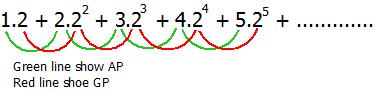
is an arithmetico–geometric sequence.
Given the value of a(First term of AP), n(Number of terms), d(Common Difference), b(First term of GP), r(Common ratio of GP). The task is find the sum of first n term of the AGP.
Examples:
Input : First term of AP, a = 1, Common difference of AP, d = 1, First term of GP, b = 2, Common ratio of GP r = 2, Number of terms, n = 3 Output : 34 Explanation Sum = 12 + 222 + 3*23 = 2 + 8 + 24 = 34
The nth term of an arithmetico–geometric sequence is the product of the n-th term of an arithmetic sequence and the nth term of a geometric one. Arithmetico–geometric sequences arise in various applications, such as the computation of expected values in probability theory. For example Counting Expected Number of Trials until Success.
n-th term of an AGP is denoted by: tn = [a + (n - 1) * d] * (b * rn-1)
Method 1: (Brute Force)
The idea is to find each term of the AGP and find the sum.
Below is the implementation of this approach:
C++ `
// CPP Program to find the sum of first n terms. #include<bits/stdc++.h> using namespace std;
// Return the sum of first n term of AGP
int sumofNterm(int a, int d, int b, int r, int n)
{
// finding the each term of AGP and adding
// it to sum.
int sum = 0;
for (int i = 1; i <= n ; i++)
sum += ((a + (i -1) * d) * (b * pow(r, i - 1)));
return sum;
}
// Driven Program int main() { int a = 1, d = 1, b = 2, r = 2, n = 3; cout << sumofNterm(a, d, b, r, n) << endl; return 0; }
Java
// Java Program to find the sum of first n terms. import java.io.*;
class GFG {
// Return the sum of first n term of AGP
static int sumofNterm(int a, int d, int b, int r, int n)
{
    // finding the each term of AGP and adding
    // it to sum.
    int sum = 0;
    for (int i = 1; i <= n ; i++)
        sum += ((a + (i -1) * d) * (b * Math.pow(r, i - 1)));
    return sum;
}


// Driven Program
public static void main(String args[])
{
    int a = 1, d = 1, b = 2, r = 2, n = 3;
    System.out.println(sumofNterm(a, d, b, r, n));

}
}
// This code is contributed by Nikita Tiwari.
Python3
Python3 code to find the
sum of first n terms.
import math
Return the sum of first
n term of AGP
def sumofNterm( a , d , b , r , n ): # finding the each term # of AGP and adding it to sum. sum = 0 for i in range(1,n+1): sum += ((a + (i -1) * d) * (b * math.pow(r, i - 1))) return int(sum)
Driven Code
a = 1 d = 1 b = 2 r = 2 n = 3 print(sumofNterm(a, d, b, r, n))
This code is contributed by "Sharad_Bhardwaj".
C#
// C# Program to find the sum of first n terms. using System;
class GFG {
// Return the sum of first n term of AGP
static int sumofNterm(int a, int d, int b, int r, int n)
{
    // Finding the each term of AGP
    // and adding it to sum.
    int sum = 0;
    for (int i = 1; i <= n ; i++)
        sum += (int)((a + (i -1) * d) *
                     (b * Math.Pow(r, i - 1)));
    return sum;
}


// Driver Code
public static void Main()
{
    int a = 1, d = 1, b = 2, r = 2, n = 3;
    Console.Write(sumofNterm(a, d, b, r, n));
}
}
// This code is contributed by vt_m.
PHP
JavaScript
`
Output:
34
Time Complexity: O(nlogn) since using a inbuilt pow function inside a loop
Auxiliary Space: O(1) as using constant variables
Method 2: (Using Formula)

Proof,
Series, Sn = ab + (a+d)br + (a+2d)br2 + ..... + (a + (n-1)d)brn-1
Multiplying Sn by r, rSn = abr + (a+d)br2 + (a+2d)br3 + ..... + (a + (n-1)d)brn
Subtract rSn from Sn, (1 - r)Sn = [a + (a + d)r + (a + 2d)r2 + ...... + [a + (n-1)d]rn-1] - [ar + (a + d)r2 + (a + 2d)r3 + ...... + [a + (n-1)d]rn] = b[a + d(r + r2 + r3 + ...... + rn-1) - [a + (n-1)d]rn] (Using sum of geometric series Sn = a(1 - rn-1)/(1-r)) = b[a + dr(1 - rn-1)/(1-r) - [a + (n-1)d]rn]
Below is the implementation of this approach:
CPP `
// CPP Program to find the sum of first n terms. #include<bits/stdc++.h> using namespace std;
// Return the sum of first n term of AGP
int sumofNterm(int a, int d, int b, int r, int n)
{
int ans = 0;
ans += a;
ans += ((d * r * (1 - pow(r, n-1)))/(1-r));
ans -= (a + (n-1)*d)pow(r, n);
return (ansb)/(1-r);
}
// Driven Program int main() { int a = 1, d = 1, b = 2, r = 2, n = 3; cout << sumofNterm(a, d, b, r, n) << endl; return 0; }
Java
// Java Program to find the sum of first n terms.
import java.io.; import java.math.;
class GFG {
// Return the sum of first n term of AGP
static int sumofNterm(int a, int d, int b, int r, int n)
{
    int ans = 0;
    ans += a;
    ans += ((d * r * (1 - (int)(Math.pow(r, n-1))))/(1-r));
    ans -= (a + (n-1)*d)*(int)(Math.pow(r, n));
    return (ans*b)/(1-r);
}


// Driven Program
public static void main(String args[])
{
    int a = 1, d = 1, b = 2, r = 2, n = 3;
    System.out.println(sumofNterm(a, d, b, r, n));

}
}
// This code is contributed by Nikita Tiwari.
Python3
Python3 code to find
the sum of first n terms.
import math
Return the sum of
first n term of AGP
def sumofNterm( a , d , b , r , n ):
ans = 0
ans += a

ans += ((d * r * (1 - math.pow(r, n-1))
                            )/(1-r))

ans -= (a + (n-1)*d)*math.pow(r, n)

return int((ans*b)/(1-r))
Driven Code
a = 1 d = 1 b = 2 r = 2 n = 3 print(sumofNterm(a, d, b, r, n) )
This code is contributed by "Sharad_Bhardwaj".
C#
// C# Program to find the sum of first n terms. using System;
class GFG {
// Return the sum of first n term of AGP
static int sumofNterm(int a, int d, int b, int r, int n)
{
    int ans = 0;
    ans += a;
    ans += ((d * r * (1 - (int)(Math.Pow(r, n-1))))
                                           / (1-r));
    ans -= (a + (n-1) * d) *
            (int)(Math.Pow(r, n));

    return (ans * b) / (1 - r);
}


// Driver Code
public static void Main()
{
    int a = 1, d = 1, b = 2, r = 2, n = 3;
    Console.Write(sumofNterm(a, d, b, r, n));
}
}
// This code is contributed by vt_m.
PHP
JavaScript
`
Output:
34
Time Complexity: O(logn)
Auxiliary Space: O(1)