Tiling Problem (original) (raw)
Given a **2 × n board and tiles of size **2 × 1, find the **total number of ways to completely fill the board using these tiles. Each tile can be placed either horizontally i.e., as a 1 x 2 tile or vertically i.e., as 2 x 1 tile.
Two tiling arrangements are considered different if the placement of at least one tile differs.
**Examples:
**Input: n = 4
**Output: 5
**Explanation: For a 2 x 4 board, there are 5 ways.
**Input: n = 3
**Output: 3
**Explanation: For or a 2 x 3 board, there are 3 ways.
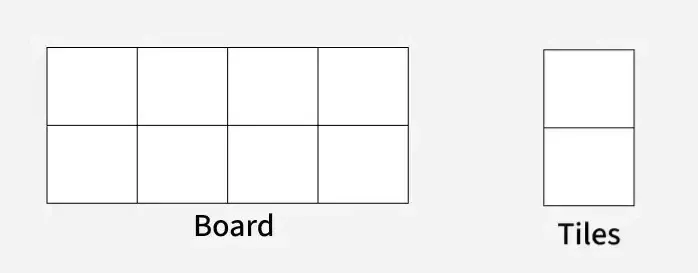
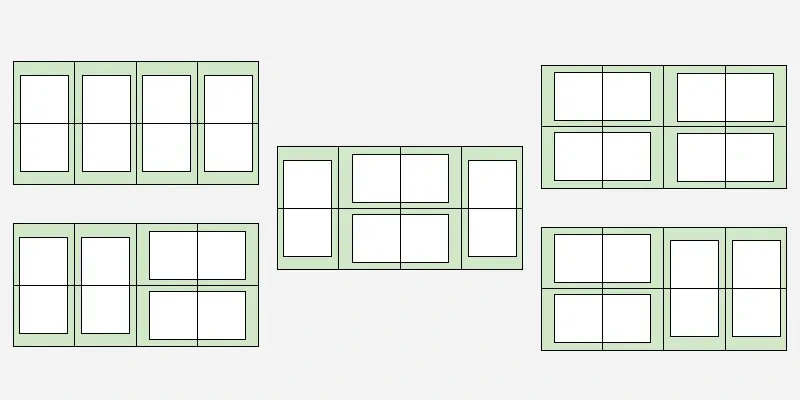
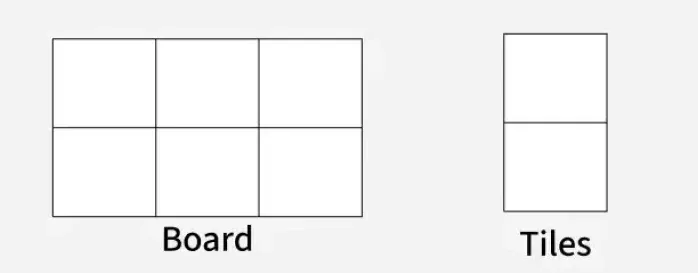
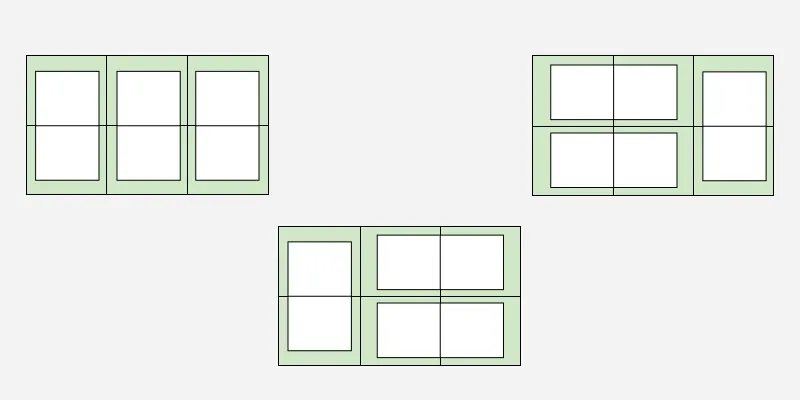
Table of Content
- [Naive Approach] Using Recursion - O(2^n) Time and O(n) Space
- [Better Approach 1] Using Top-Down DP (Memoization) - O(n) Time and O(n) Space
- [Better Approach 2] Using Bottom-Up DP (Tabulation) - O(n) Time and O(n) Space
- [Expected Approach] Using Space Optimized DP - O(n) Time and O(1) Space
[Naive Approach] Using Recursion - O(2^n) Time and O(n) Space
The idea is to use Recursion and breaking the larger problem (size n) into smaller subproblems (sizes n-1 and n-2).
At any point, we have two choices:
- Place one vertical tile (2 × 1): This tile will cover one column of the board, leaving a smaller board of size 2 × (n - 1) to be filled.
- Place two horizontal tiles (1 × 2): These two tiles will cover two columns together, leaving a smaller board of size 2 × (n - 2) to be filled.
So, to find the total number of ways to fill a 2 × n board, we just need to sum the number of ways to fill the smaller boards obtained by these two choices.
C++ `
//Driver Code Starts #include #include using namespace std; //Driver Code Ends
int numberOfWays(int n) {
// Base Case
if (n<0) return 0;
if (n == 0) return 1;

int ans = 0;

// if one tile is placed vertically
ans = numberOfWays(n-1);

// if two tiles are placed horizontly.
ans += numberOfWays(n-2);

return ans;
}
//Driver Code Starts int main() { int n = 4; cout<<numberOfWays(n);
return 0;} //Driver Code Ends
Java
//Driver Code Starts class GFG { //Driver Code Ends
static int numberOfWays(int n) {

    // Base Case
    if (n < 0) return 0;
    if (n == 0) return 1;

    int ans = 0;

    // if one tile is placed vertically
    ans = numberOfWays(n - 1);

    // if two tiles are placed horizontally.
    ans += numberOfWays(n - 2);

    return ans;
}
//Driver Code Starts public static void main(String[] args) { int n = 4; System.out.println(numberOfWays(n)); } }
//Driver Code Ends
Python
def numberOfWays(n):
# Base Case
if n < 0:
    return 0
if n == 0:
    return 1

ans = 0

# if one tile is placed vertically
ans = numberOfWays(n - 1)

# if two tiles are placed horizontally.
ans += numberOfWays(n - 2)

return ans
#Driver Code Starts if name == "main": n = 4 print(numberOfWays(n))
#Driver Code Ends
C#
//Driver Code Starts using System;
class GFG { //Driver Code Ends
static int numberOfWays(int n)
{
    // Base Case
    if (n < 0) return 0;
    if (n == 0) return 1;

    int ans = 0;

    // if one tile is placed vertically
    ans = numberOfWays(n - 1);

    // if two tiles are placed horizontally.
    ans += numberOfWays(n - 2);

    return ans;
}
//Driver Code Starts static void Main() { int n = 4; Console.WriteLine(numberOfWays(n)); } }
//Driver Code Ends
JavaScript
function numberOfWays(n) { // Base Case if (n < 0) return 0; if (n === 0) return 1;
let ans = 0;

// if one tile is placed vertically
ans = numberOfWays(n - 1);

// if two tiles are placed horizontally.
ans += numberOfWays(n - 2);

return ans;
}
//Driver Code //Driver Code Starts let n = 4; console.log(numberOfWays(n));
//Driver Code Ends
`
[Better Approach 1] Using Top-Down DP (Memoization) - O(n) Time and O(n) Space
In the recursive approach, we saw that many subproblems are solved repeatedly, leading to redundant computations.
To handle this, we use Dynamic Programming with Memoization. We create a 1D array dp[] of size n + 1, where each element dp[i] represents the number of ways to completely fill a 2 × i board.
Since there is only one changing parameter (i) in our recursive function, a 1D array is sufficient. Before solving a subproblem, we first check if it has already been computed.
- If yes, we return the stored value from the dp array.
- If not, we compute it recursively and store the result in dp[i] for future use.
C++ `
//Driver Code Starts #include #include using namespace std; //Driver Code Ends
int countRecur(int n, vector &dp) {
// Base Case
if (n<0) return 0;
if (n == 0) return 1;

// If value is memoized
if (dp[n] != -1) return dp[n];

int ans = 0;

// if one tile is placed vertically
ans = countRecur(n-1, dp);

//if two tiles are placed horizontly.
ans += countRecur(n-2, dp);

return dp[n] = ans;
}
int numberOfWays(int n) { vector dp(n+1, -1); return countRecur(n, dp); }
//Driver Code Starts int main() { int n = 4; cout<<numberOfWays(n);
return 0;}
//Driver Code Ends
Java
//Driver Code Starts import java.util.Arrays;
class GFG { //Driver Code Ends
static int countRecur(int n, int[] dp) {

    // Base Case
    if (n < 0) return 0;
    if (n == 0) return 1;

    // If value is memoized
    if (dp[n] != -1) return dp[n];

    int ans = 0;

    // if one tile is placed vertically
    ans = countRecur(n - 1, dp);

    //if two tiles are placed horizontly.
    ans += countRecur(n - 2, dp);

    return dp[n] = ans;
}

static int numberOfWays(int n) {
    int[] dp = new int[n + 1];
    Arrays.fill(dp, -1);
    return countRecur(n, dp);
}
//Driver Code Starts public static void main(String[] args) { int n = 4; System.out.println(numberOfWays(n)); } }
//Driver Code Ends
Python
def countRecur(n, dp):
# Base Case
if n < 0:
    return 0
if n == 0:
    return 1

# If value is memoized
if dp[n] != -1:
    return dp[n]

ans = 0

# if one tile is placed vertically
ans = countRecur(n - 1, dp)

# if two tiles are placed horizontly.
ans += countRecur(n - 2, dp)

dp[n] = ans
return dp[n]
def numberOfWays(n): dp = [-1] * (n + 1) return countRecur(n, dp)
if name == "main": #Driver Code Starts n = 4 print(numberOfWays(n))
#Driver Code Ends
C#
//Driver Code Starts using System;
class GFG { //Driver Code Ends
static int countRecur(int n, int[] dp)
{
    // Base Case
    if (n < 0) return 0;
    if (n == 0) return 1;

    // If value is memoized
    if (dp[n] != -1) return dp[n];

    int ans = 0;

    // if one tile is placed vertically
    ans = countRecur(n - 1, dp);

    //if two tiles are placed horizontly.
    ans += countRecur(n - 2, dp);

    return dp[n] = ans;
}

static int numberOfWays(int n)
{
    int[] dp = new int[n + 1];
    for (int i = 0; i <= n; i++) dp[i] = -1;
    return countRecur(n, dp);
}
//Driver Code Starts static void Main() { int n = 4; Console.WriteLine(numberOfWays(n)); } }
//Driver Code Ends
JavaScript
function countRecur(n, dp) {
// Base Case
if (n < 0) return 0;
if (n === 0) return 1;

// If value is memoized
if (dp[n] !== -1) return dp[n];

let ans = 0;

// if one tile is placed vertically
ans = countRecur(n - 1, dp);

//if two tiles are placed horizontly.
ans += countRecur(n - 2, dp);

return dp[n] = ans;
}
function numberOfWays(n) { const dp = new Array(n + 1).fill(-1); return countRecur(n, dp); }
//Driver Code //Driver Code Starts let n = 4; console.log(numberOfWays(n));
//Driver Code Ends
`
[Better Approach 2] Using Bottom-Up DP (Tabulation) - O(n) Time and O(n) Space
In this approach, instead of using recursion, we build the solution iteratively from bottom to top.
We create a 1D DP array dp[n+1] to store the results of already computed subproblems, since there is only one parameter — n — that changes in the recursive solution.
First, we will solve some smaller problems for which we define the base cases:
- dp[0] = 1 — There is one way to fill a 2×0 board.
- dp[1] = 1 — There is only one way to fill a 2×1 board.
We start from these base cases, and then we have two choices:
- Place one vertical tile, leaving a 2×(i−1) board - dp[i−1]
- Place two horizontal tiles, leaving a 2×(i−2) board - dp[i−2]
After filling the DP table iteratively, dp[n] will give the total number of ways to completely fill the 2×n board
C++ `
//Driver Code Starts #include #include using namespace std; //Driver Code Ends
int numberOfWays(int n) {
if (n == 0 || n == 1) return 1;

// Create a 1D DP array to store results of subproblems
vector<int> dp(n + 1);

// Initialize base cases
dp[0] = 1;
dp[1] = 1;

// Build the solution iteratively (Bottom-Up DP)
for (int i = 2; i <= n; i++) {
    // Two choices:
    dp[i] = dp[i - 1] + dp[i - 2];
}

return dp[n];
}
//Driver Code Starts int main() { int n = 4; cout << numberOfWays(n); return 0; }
//Driver Code Ends
Java
//Driver Code Starts import java.util.Arrays;
public class GFG { //Driver Code Ends
static int numberOfWays(int n) {

    if (n == 0 || n == 1) return 1;

    // Create a 1D DP array to store results of subproblems
    int[] dp = new int[n + 1];

    // Initialize base cases
    dp[0] = 1;
    dp[1] = 1;

    // Build the solution iteratively (Bottom-Up DP)
    for (int i = 2; i <= n; i++) {
        // Two choices:
        dp[i] = dp[i - 1] + dp[i - 2];
    }

    return dp[n];
}
//Driver Code Starts public static void main(String[] args) { int n = 4; System.out.println(numberOfWays(n)); } }
//Driver Code Ends
Python
def numberOfWays(n):
if n == 0 or n == 1:
    return 1

# Create a 1D DP array to store results of subproblems
dp = [0] * (n + 1)

# Initialize base cases
dp[0] = 1
dp[1] = 1

# Build the solution iteratively (Bottom-Up DP)
for i in range(2, n + 1):
    # Two choices:
    dp[i] = dp[i - 1] + dp[i - 2]

return dp[n]
if name == "main": #Driver Code Starts n = 4 print(numberOfWays(n))
#Driver Code Ends
C#
//Driver Code Starts using System;
class GFG { //Driver Code Ends
static int numberOfWays(int n)
{
    if (n == 0 || n == 1)
        return 1;

    // Create a 1D DP array to store results of subproblems
    int[] dp = new int[n + 1];

    // Initialize base cases
    dp[0] = 1;
    dp[1] = 1;

    // Build the solution iteratively (Bottom-Up DP)
    for (int i = 2; i <= n; i++)
    {
        // Two choices:
        dp[i] = dp[i - 1] + dp[i - 2];
    }

    return dp[n];
}
//Driver Code Starts static void Main() { int n = 4; Console.WriteLine(numberOfWays(n)); } }
//Driver Code Ends
JavaScript
function numberOfWays(n) { if (n === 0 || n === 1) return 1;
// Create a 1D DP array to store results of subproblems
let dp = new Array(n + 1);

// Initialize base cases
dp[0] = 1;
dp[1] = 1;

// Build the solution iteratively (Bottom-Up DP)
for (let i = 2; i <= n; i++) {
    // Two choices:
    dp[i] = dp[i - 1] + dp[i - 2];
}

return dp[n];
}
//Driver Code //Driver Code Starts let n = 4; console.log(numberOfWays(n));
//Driver Code Ends
`
[Expected Approach] Using Space Optimized DP - O(n) Time and O(1) Space
In the previous dynamic programming approach, we used a 1D array dp[] to store all computed results up to n. However, if we observe carefully, to calculate the current state dp[i], we only need the last two states — dp[i-1] and dp[i-2].
This means we don’t need to maintain the entire DP array; instead, we can optimize the space by storing only these two values.
We can use two variables, say prev1 and prev2, where:
- prev1 represents the number of ways for dp[i-1]
- prev2 represents the number of ways for dp[i-2]
This way, we iteratively move forward while using only constant space instead of an entire array.
C++ `
//Driver Code Starts #include #include using namespace std; //Driver Code Ends
int numberOfWays(int n) {
// Base cases
if (n == 0 || n == 1) return 1;

int prev2 = 1;
int prev1 = 1;

// Iterate from 2 to n to build the result
for (int i = 2; i <= n; i++) {

    // Current state depends on the sum of previous two states
    int curr = prev1 + prev2;

    // Move the variables one step ahead
    prev2 = prev1;
    prev1 = curr;
}

return prev1;
}
//Driver Code Starts int main() { int n = 4;
cout << numberOfWays(n);

return 0;
}
//Driver Code Ends
Java
//Driver Code Starts import java.util.Arrays;
class GFG { //Driver Code Ends
static int numberOfWays(int n) {

    // Base cases
    if (n == 0 || n == 1) return 1;

    int prev2 = 1;
    int prev1 = 1;

    // Iterate from 2 to n to build the result
    for (int i = 2; i <= n; i++) {

        // Current state depends on the sum of previous two states
        int curr = prev1 + prev2;

        // Move the variables one step ahead
        prev2 = prev1;
        prev1 = curr;
    }

    return prev1;
}
//Driver Code Starts public static void main(String[] args) { int n = 4;
    System.out.println(numberOfWays(n));
}
}
//Driver Code Ends
Python
def numberOfWays(n):
# Base cases
if n == 0 or n == 1:
    return 1

prev2 = 1
prev1 = 1

# Iterate from 2 to n to build the result
for i in range(2, n + 1):

    # Current state depends on the sum of previous two states
    curr = prev1 + prev2

    # Move the variables one step ahead
    prev2 = prev1
    prev1 = curr

return prev1
#Driver Code Starts if name == "main": n = 4
print(numberOfWays(n))#Driver Code Ends
C#
//Driver Code Starts using System;
class GFG { //Driver Code Ends
static int numberOfWays(int n) {

    // Base cases
    if (n == 0 || n == 1)
        return 1;

    int prev2 = 1;
    int prev1 = 1;

    // Iterate from 2 to n to build the result
    for (int i = 2; i <= n; i++) {

        // Current state depends on the sum of previous two states
        int curr = prev1 + prev2;

        // Move the variables one step ahead
        prev2 = prev1;
        prev1 = curr;
    }

    return prev1;
}
//Driver Code Starts public static void Main() { int n = 4;
    Console.WriteLine(numberOfWays(n));
}
}
//Driver Code Ends
JavaScript
function numberOfWays(n) {
// Base cases
if (n === 0 || n === 1)
    return 1;

let prev2 = 1;
let prev1 = 1;

// Iterate from 2 to n to build the result
for (let i = 2; i <= n; i++) {

    // Current state depends on the sum of previous two states
    let curr = prev1 + prev2;

    // Move the variables one step ahead
    prev2 = prev1;
    prev1 = curr;
}

return prev1;
}
// Driver code //Driver Code Starts let n = 4; console.log(numberOfWays(n));
//Driver Code Ends
`