Topological sort using DFS (original) (raw)
Last Updated : 31 Oct, 2025
Given a Directed Acyclic Graph(DAG), find any Topological Sorted order of the graph.
**Topological Sorted order: It is a linear ordering of vertices such that for every directed edge **u -> v, where vertex **u comes before **v in the ordering.
There can be several topological ordering for a graph.
**Example:
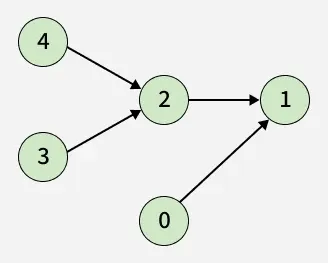
**Input: _adj[][]= [[1], [], [1], [2], [2]]
**Output: [4, 3, 2, 0, 1]
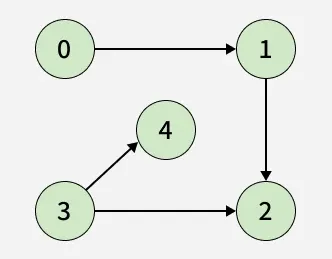
**Explanation: By following that: for an edge u->v, u must come before v, we can obtain several topological orderings and [4, 3, 2, 0, 1] is one of them.**Input: V=5 , adj[][] = [[1], [2], [], [2, 4], []]
**Output: [0, 3, 1, 4, 2]
**Explanation: By following that: for an edge u->v, u must come before v, we can obtain several topological orderings and [0, 3, 1, 4, 2] is one of them.
[Approach]
The idea is to perform a DFS traversal starting from every unvisited vertex (from 0 to n − 1). For each DFS call, we first explore all unvisited neighbors of the current node. Once the recursive calls for all its neighbors are complete, we start pushing these nodes into a stack while backtracking. After all vertices are processed, we pop elements from the stack one by one into a list — this gives a valid topological ordering, as each node is placed before all nodes it points to.
**Illustration of the algorithm:
Below is the implementation of the above algorithm.
C++ `
//Driver Code Starts #include #include #include using namespace std;
//Driver Code Ends
void findTopoSort(int node, vector& vis, vector<vector>& adj, stack& st) { vis[node] = 1; for (int it : adj[node]) { if (!vis[it]) { findTopoSort(it, vis, adj, st); } } // push the node after all its neighbours st.push(node); }
vector topoSort(vector<vector>& adj) { int n = adj.size(); stack st; vector vis(n, 0);
for (int i = 0; i < n; i++) {
    if (!vis[i]) {
        findTopoSort(i, vis, adj, st);
    }
}
vector<int> topo;

// popping elements from stack and
// pushing into the list
while (!st.empty()) {
    topo.push_back(st.top());
    st.pop();
}
return topo;
}
//Driver Code Starts
void addEdge(vector<vector>& adj, int u, int v) { adj[u].push_back(v); }
int main() { int n = 5; vector<vector> adj(n);
// adding edges to adjacency list
addEdge(adj, 0, 1);
addEdge(adj, 2, 1);
addEdge(adj, 3, 2);
addEdge(adj, 4, 2);

vector<int> res = topoSort(adj);
for (int vertex : res)
    cout << vertex << " ";
cout << endl;
}
//Driver Code Ends
Java
//Driver Code Starts import java.util.ArrayList; import java.util.Stack;
class Solution { //Driver Code Ends
static void findTopoSort(int node, int[] vis, ArrayList<ArrayList<Integer>> adj, Stack<Integer> st) {
    vis[node] = 1;
    for (Integer it : adj.get(node)) {
        if (vis[it] == 0) {
            findTopoSort(it, vis, adj, st);
        }
    }
    // Push the node after visiting
    // all its neighbours
    st.push(node);
}

static ArrayList<Integer> topoSort(ArrayList<ArrayList<Integer>> adj) {
    int n = adj.size();
    Stack<Integer> st = new Stack<>();
    int[] vis = new int[n];

    for (int i = 0; i < n; i++) {
        if (vis[i] == 0) {
            findTopoSort(i, vis, adj, st);
        }
    }

    ArrayList<Integer> topo = new ArrayList<>();

    // popping elements from stack and
    // pushing into the list
    while (!st.isEmpty()) {
        topo.add(st.pop());
    }
    return topo;
}
//Driver Code Starts
static void addEdge(ArrayList<ArrayList<Integer>> adj, int u, int v) {
    adj.get(u).add(v);
}

public static void main(String[] args) {
    int n = 5;
    ArrayList<ArrayList<Integer>> adj = new ArrayList<>();

    for (int i = 0; i < n; i++)
        adj.add(new ArrayList<>());


    // adding edges to adjacency list
    addEdge(adj, 0, 1);
    addEdge(adj, 2, 1);
    addEdge(adj, 3, 2);
    addEdge(adj, 4, 2);

    ArrayList<Integer> res = topoSort(adj);

    for (int vertex : res) {
        System.out.print(vertex + " ");
    }
    System.out.println();
}
}
//Driver Code Ends
Python
def findTopoSort(node, vis, adj, stack): vis[node] = 1 for it in adj[node]: if vis[it] == 0: findTopoSort(it, vis, adj, stack)
# push the node after all its neighbours
stack.append(node)
def topoSort(adj): n = len(adj) stack = [] vis = [0] * n
for i in range(n):
    if vis[i] == 0:
        findTopoSort(i, vis, adj, stack)

topo = []

# popping elements from stack and
# pushing into the list
while stack:
    topo.append(stack.pop())

return topo
#Driver Code Starts
def addEdge(adj, u, v): adj[u].append(v)
if name == "main": n = 5 adj = [[] for _ in range(n)]
# adding edges to adjacency list
addEdge(adj, 0, 1)
addEdge(adj, 2, 1)
addEdge(adj, 3, 2)
addEdge(adj, 4, 2)

res = topoSort(adj)
print(*res)
#Driver Code Ends
C#
//Driver Code Starts using System; using System.Collections.Generic;
class GFG { //Driver Code Ends
static void findTopoSort(int node, int[] vis, List<List<int>> adj, Stack<int> st) {
    vis[node] = 1;
    foreach (int it in adj[node]) {
        if (vis[it] == 0) {
            findTopoSort(it, vis, adj, st);
        }
    }

    // push the node after all its neighbours
    st.Push(node);
}

static List<int> topoSort(List<List<int>> adj) {
    int n = adj.Count;
    Stack<int> st = new Stack<int>();
    int[] vis = new int[n];

    for (int i = 0; i < n; i++) {
        if (vis[i] == 0) {
            findTopoSort(i, vis, adj, st);
        }
    }
    List<int> topo = new List<int>();

    // popping elements from stack and
    // pushing into the list
    while (st.Count > 0) {
        topo.Add(st.Pop());
    }
    return topo;
}
//Driver Code Starts
public static void addEdge(List<List<int>> adj, int u, int v) {
    adj[u].Add(v);
}

public static void Main(string[] args) {
    int n = 5;
    List<List<int>> adj = new List<List<int>>();
    for (int i = 0; i < n; i++)
        adj.Add(new List<int>());

    // adding edges to adjacency list
    addEdge(adj, 0, 1);
    addEdge(adj, 2, 1);
    addEdge(adj, 3, 2);
    addEdge(adj, 4, 2);

    List<int> res = topoSort(adj);
    foreach (int vertex in res)
        Console.Write(vertex + " ");
    Console.WriteLine();
}
}
//Driver Code Ends
JavaScript
function findTopoSort(node, vis, adj, stack) { vis[node] = 1; for (let it of adj[node]) { if (vis[it] === 0) { findTopoSort(it, vis, adj, stack); } }
// push the node after all its neighbours
stack.push(node);
}
function topoSort(adj) { let n = adj.length; let stack = []; let vis = new Array(n).fill(0);
for (let i = 0; i < n; i++) {
    if (vis[i] === 0) {
        findTopoSort(i, vis, adj, stack);
    }
}

let topo = [];

// popping elements from stack and
// pushing into the list
while (stack.length > 0) {
    topo.push(stack.pop());
}
return topo;
}
//Driver Code Starts function addEdge(adj, u, v) { adj[u].push(v); }
// Driver code
let n = 5; let adj = Array.from({ length: n }, () => []);
// adding edges to adjacency list addEdge(adj, 0, 1); addEdge(adj, 2, 1); addEdge(adj, 3, 2); addEdge(adj, 4, 2);
let res = topoSort(adj); console.log(res.join(" "));
//Driver Code Ends
`
**Time Complexity: O(V+E). We visited all the nodes, and all the neighbours of each node(i.e., all the edges).
**Auxiliary Space: O(V). For visited array, and for stack to store the topological order.