Number of Spanning Trees in a Graph (original) (raw)
Last Updated : 9 May, 2026
Given a connected **undirected graph with **v vertices and its **adjacency matrix representation, determine the total number of spanning trees that can be formed from the graph.
A **spanning tree is a subgraph that connects all vertices of a graph with exactly v-1 edges and contains no cycles.
**Example:
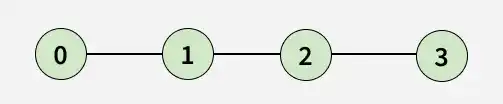
**Input: v = 4 adj[][] = [ [0,1,0,0], [1,0,1,0], [0,1,0,1], [0,0,1,0] ]
**Output: 1
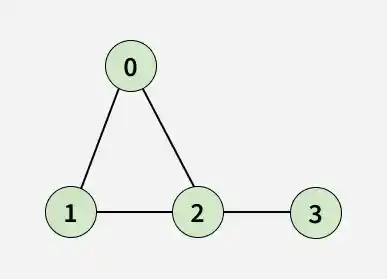
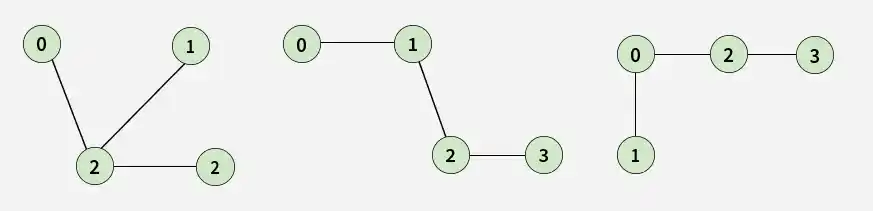
**Explanation: The graph is connected and has exactly v-1 edges, so it is already a tree, hence only one spanning tree exists.**Input: v = 4 adj[][] = [ [0,1,1,0], [1,0,1,0], [1,1,0,1], [0,0,1,0] ]
**Output: 3
**Explanation: The graph has one cycle among nodes 0, 1, and 2, so removing one edge forms a spanning tree. Since the cycle has 3 edges, removing any one gives 3 possible spanning trees.

Using Kirchhoff's Theorem
Kirchhoff’s Theorem works by converting the graph into a matrix form that captures how nodes are connected. This matrix (called the Laplacian matrix) represents the structure of the graph, and its determinant (cofactor) gives the total number of spanning trees.
Consider the following graph,
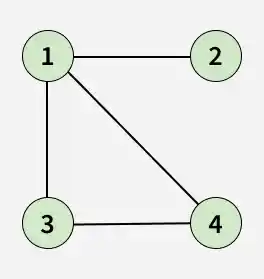
All possible spanning trees are as follows,
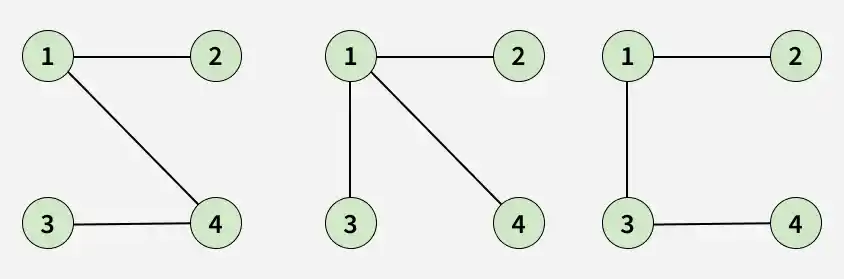
Here are the steps showing how the approach works to find the number of spanning trees in the given graph using Kirchhoff’s Theorem.
- Create the adjacency Matrix for the given graph:
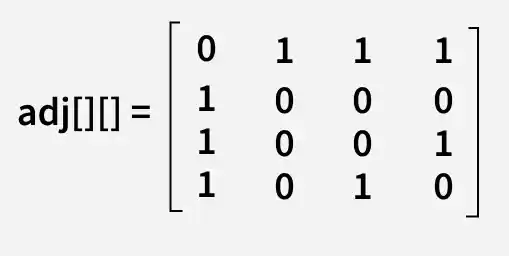
- Convert the adjacency matrix into the Laplacian matrix which is achieved using the following steps.
A Laplacian matrix L, where
- Replace all the diagonal elements with the degree of nodes. For eg. element at (1, 1) position of adjacency matrix will be replaced by the degree of node 1, element, i,e., L[i][i] = degree of node i
- Replace all non-diagonal 1's with -1. L[i][j] = -1 if there is an edge between i and j, L[i][j] remains 0 otherwise
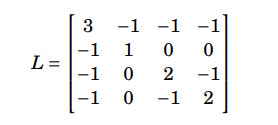
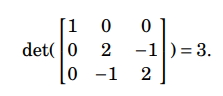
- Remove any one row and one column from the Laplacian matrix. For example, remove the first row and first column. The cofactor value is the same for any row and column removed, so you can choose any.
- Find the determinant (cofactor) of the resulting matrix. This value gives the total number of spanning trees "3". The determinant remains the same regardless of which row and column are removed.
**Cayley’s formula for Complete Graph : Itis a special case of Kirchhoff’s theorem because, in a complete graph of n nodes, the determinant is equal to n^(n-2).
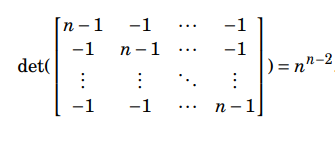
It works here because the Laplacian matrix represents how all nodes in the graph are connected. The determinant expands into all possible edge combinations, and due to its mathematical properties, invalid ones (cycles or disconnected) cancel out. As a result, only valid spanning trees remain, so the determinant directly gives their total count.
C++ `
#include #include #include #include using namespace std;
// Determinant using Gaussian elimination double determinant(vector<vector> mat, int n) { double det = 1.0;
for (int i = 0; i < n; i++) {

    // Find pivot
    int pivot = i;
    for (int j = i + 1; j < n; j++) {
        if (fabs(mat[j][i]) > fabs(mat[pivot][i]))
            pivot = j;
    }

    // If pivot is zero → determinant = 0
    if (fabs(mat[pivot][i]) < 1e-9)
        return 0;

    // Swap rows
    if (i != pivot) {
        swap(mat[i], mat[pivot]);
        det *= -1;
    }

    det *= mat[i][i];

    // Eliminate below
    for (int j = i + 1; j < n; j++) {
        double factor = mat[j][i] / mat[i][i];
        for (int k = i; k < n; k++) {
            mat[j][k] -= factor * mat[i][k];
        }
    }
}

return det;
}
// Number of spanning trees int numOfSpanningTree(vector<vector> &graph, int n) {
// Laplacian matrix
vector<vector<double>> L(n, vector<double>(n, 0));

for (int i = 0; i < n; i++) {
    int degree = 0;

    for (int j = 0; j < n; j++) {
        if (graph[i][j]) {
            degree++;
            if (i != j) L[i][j] = -1;
        }
    }

    L[i][i] = degree;
}

// Minor matrix
vector<vector<double>> minor(n - 1, vector<double>(n - 1));

for (int i = 0; i < n - 1; i++) {
    for (int j = 0; j < n - 1; j++) {
        minor[i][j] = L[i][j];
    }
}

// Determinant
return (int)round(determinant(minor, n - 1));
}
int main() { int v = 4;
vector<vector<int>> graph = {
    {0, 1, 1, 1},
    {1, 0, 1, 1},
    {1, 1, 0, 1},
    {1, 1, 1, 0}
};

cout << numOfSpanningTree(graph, v);

return 0;
}
Java
import java.util.*;
class GfG {
// Determinant using Gaussian elimination
static double determinant(double[][] mat, int n) {
    double det = 1.0;

    for (int i = 0; i < n; i++) {

        // Find pivot
        int pivot = i;
        for (int j = i + 1; j < n; j++) {
            if (Math.abs(mat[j][i]) > Math.abs(mat[pivot][i]))
                pivot = j;
        }

        // If pivot is zero → determinant = 0
        if (Math.abs(mat[pivot][i]) < 1e-9)
            return 0;

        // Swap rows
        if (i != pivot) {
            double[] tempRow = mat[i];
            mat[i] = mat[pivot];
            mat[pivot] = tempRow;
            det *= -1;
        }

        det *= mat[i][i];

        // Eliminate below
        for (int j = i + 1; j < n; j++) {
            double factor = mat[j][i] / mat[i][i];
            for (int k = i; k < n; k++) {
                mat[j][k] -= factor * mat[i][k];
            }
        }
    }

    return det;
}

// Function to compute number of spanning trees
// using adjacency matrix
static int numOfSpanningTree(int[][] graph, int v) {

    // Laplacian matrix
    double[][] L = new double[v][v];

    for (int i = 0; i < v; i++) {
        int degree = 0;

        for (int j = 0; j < v; j++) {
            if (graph[i][j] == 1) {
                degree++;
                if (i != j) L[i][j] = -1;
            }
        }

        L[i][i] = degree;
    }

    // Minor matrix
    double[][] minor = new double[v - 1][v - 1];

    for (int i = 0; i < v - 1; i++) {
        for (int j = 0; j < v - 1; j++) {
            minor[i][j] = L[i][j];
        }
    }

    // Determinant
    return (int)Math.round(determinant(minor, v - 1));
}

public static void main(String[] args) {
    int v = 4;

    int[][] graph = {
        {0, 1, 1, 1},
        {1, 0, 1, 1},
        {1, 1, 0, 1},
        {1, 1, 1, 0}
    };

    System.out.println(numOfSpanningTree(graph, v));
}
}
Python
Determinant using Gaussian elimination
def determinant(mat, n): det = 1.0
for i in range(n):

    # Find pivot
    pivot = i
    for j in range(i + 1, n):
        if abs(mat[j][i]) > abs(mat[pivot][i]):
            pivot = j

    # If pivot is zero → determinant = 0
    if abs(mat[pivot][i]) < 1e-9:
        return 0

    # Swap rows
    if i != pivot:
        mat[i], mat[pivot] = mat[pivot], mat[i]
        det *= -1

    det *= mat[i][i]

    # Eliminate below
    for j in range(i + 1, n):
        factor = mat[j][i] / mat[i][i]
        for k in range(i, n):
            mat[j][k] -= factor * mat[i][k]

return det
Function to compute number of spanning trees
using adjacency matrix
def numOfSpanningTree(graph, v):
# Laplacian matrix
L = [[0.0] * v for _ in range(v)]

for i in range(v):
    degree = 0

    for j in range(v):
        if graph[i][j] == 1:
            degree += 1
            if i != j:
                L[i][j] = -1

    L[i][i] = degree

# Minor matrix
minor = [[0.0] * (v - 1) for _ in range(v - 1)]

for i in range(v - 1):
    for j in range(v - 1):
        minor[i][j] = L[i][j]

# Determinant
return round(determinant(minor, v - 1))
if name == "main": v = 4
graph = [
    [0, 1, 1, 1],
    [1, 0, 1, 1],
    [1, 1, 0, 1],
    [1, 1, 1, 0]
]

print(numOfSpanningTree(graph, v))  # Output: 16
C#
using System;
class GfG {
// Determinant using Gaussian elimination
static double determinant(double[,] mat, int n) {
    double det = 1.0;

    for (int i = 0; i < n; i++) {

        // Find pivot
        int pivot = i;
        for (int j = i + 1; j < n; j++) {
            if (Math.Abs(mat[j, i]) > Math.Abs(mat[pivot, i]))
                pivot = j;
        }

        // If pivot is zero → determinant = 0
        if (Math.Abs(mat[pivot, i]) < 1e-9)
            return 0;

        // Swap rows
        if (i != pivot) {
            for (int k = 0; k < n; k++) {
                double temp = mat[i, k];
                mat[i, k] = mat[pivot, k];
                mat[pivot, k] = temp;
            }
            det *= -1;
        }

        det *= mat[i, i];

        // Eliminate below
        for (int j = i + 1; j < n; j++) {
            double factor = mat[j, i] / mat[i, i];
            for (int k = i; k < n; k++) {
                mat[j, k] -= factor * mat[i, k];
            }
        }
    }

    return det;
}

// Function to compute number of spanning trees
// using adjacency matrix
static int numOfSpanningTree(int[,] graph, int v) {

    // Laplacian matrix
    double[,] L = new double[v, v];

    for (int i = 0; i < v; i++) {
        int degree = 0;

        for (int j = 0; j < v; j++) {
            if (graph[i, j] == 1) {
                degree++;
                if (i != j) L[i, j] = -1;
            }
        }

        L[i, i] = degree;
    }

    // Minor matrix
    double[,] minor = new double[v - 1, v - 1];

    for (int i = 0; i < v - 1; i++) {
        for (int j = 0; j < v - 1; j++) {
            minor[i, j] = L[i, j];
        }
    }

    // Determinant
    return (int)Math.Round(determinant(minor, v - 1));
}

static void Main() {
    int v = 4;

    int[,] graph = {
        {0, 1, 1, 1},
        {1, 0, 1, 1},
        {1, 1, 0, 1},
        {1, 1, 1, 0}
    };

    Console.WriteLine(numOfSpanningTree(graph, v));
}
}
JavaScript
// Determinant using Gaussian elimination function determinant(mat, n) { let det = 1.0;
for (let i = 0; i < n; i++) {

    // Find pivot
    let pivot = i;
    for (let j = i + 1; j < n; j++) {
        if (Math.abs(mat[j][i]) > Math.abs(mat[pivot][i]))
            pivot = j;
    }

    // If pivot is zero → determinant = 0
    if (Math.abs(mat[pivot][i]) < 1e-9)
        return 0;

    // Swap rows
    if (i !== pivot) {
        [mat[i], mat[pivot]] = [mat[pivot], mat[i]];
        det *= -1;
    }

    det *= mat[i][i];

    // Eliminate below
    for (let j = i + 1; j < n; j++) {
        let factor = mat[j][i] / mat[i][i];
        for (let k = i; k < n; k++) {
            mat[j][k] -= factor * mat[i][k];
        }
    }
}

return det;
}
// Function to compute number of spanning trees // using adjacency matrix function numOfSpanningTree(graph, v) {
// Laplacian matrix
let L = Array.from({ length: v }, () => Array(v).fill(0));

for (let i = 0; i < v; i++) {
    let degree = 0;

    for (let j = 0; j < v; j++) {
        if (graph[i][j] === 1) {
            degree++;
            if (i !== j) L[i][j] = -1;
        }
    }

    L[i][i] = degree;
}

// Minor matrix
let minor = Array.from({ length: v - 1 }, () =>
    Array(v - 1).fill(0)
);

for (let i = 0; i < v - 1; i++) {
    for (let j = 0; j < v - 1; j++) {
        minor[i][j] = L[i][j];
    }
}

// Determinant
return Math.round(determinant(minor, v - 1));
}
// Driver code let v = 4;
let graph = [ [0, 1, 1, 1], [1, 0, 1, 1], [1, 1, 0, 1], [1, 1, 1, 0] ];
console.log(numOfSpanningTree(graph, v)); // Output: 16
`
**Time Complexity: O(n^3) due to Gaussian elimination for determinant.
**Auxiliary Space : O(n^2) for storing matrices.