Two Dimensional Binary Indexed Tree or Fenwick Tree (original) (raw)
Last Updated : 30 Nov, 2023
Prerequisite - Fenwick Tree
We know that to answer range sum queries on a 1-D array efficiently, binary indexed tree (or Fenwick Tree) is the best choice (even better than segment tree due to less memory requirements and a little faster than segment tree).
**Can we answer sub-matrix sum queries efficiently using Binary Indexed Tree ?
The answer is **yes. This is possible using a **2D BIT which is nothing but an array of 1D BIT.
**Algorithm:
We consider the below example. Suppose we have to find the sum of all numbers inside the highlighted area:

We assume the origin of the matrix at the bottom - O.Then a 2D BIT exploits the fact that-
Sum under the marked area = Sum(OB) - Sum(OD) - Sum(OA) + Sum(OC)
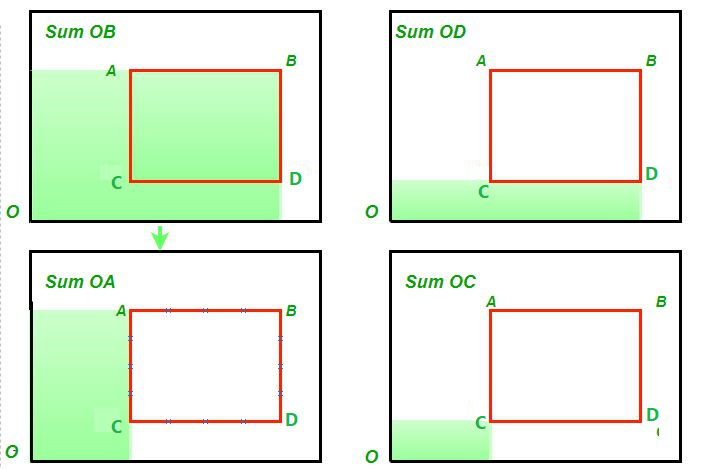
In our program, we use the getSum(x, y) function which finds the sum of the matrix from (0, 0) to (x, y).
Hence the below formula :
Sum under the marked area = Sum(OB) - Sum(OD) - Sum(OA) + Sum(OC)
The above formula gets reduced to,
Query(x1,y1,x2,y2) = getSum(x2, y2) - getSum(x2, y1-1) - getSum(x1-1, y2) + getSum(x1-1, y1-1)
where,
**x1, y1 = x and y coordinates of C
**x2, y2 = x and y coordinates of B
The updateBIT(x, y, val) function updates all the elements under the region – (x, y) to (N, M) where,
**N = maximum X co-ordinate of the whole matrix.
**M = maximum Y co-ordinate of the whole matrix.
The rest procedure is quite similar to that of 1D Binary Indexed Tree.
Below is the C++ implementation of 2D indexed tree
C++ `
/* C++ program to implement 2D Binary Indexed Tree
2D BIT is basically a BIT where each element is another BIT. Updating by adding v on (x, y) means it's effect will be found throughout the rectangle [(x, y), (max_x, max_y)], and query for (x, y) gives you the result of the rectangle [(0, 0), (x, y)], assuming the total rectangle is [(0, 0), (max_x, max_y)]. So when you query and update on this BIT,you have to be careful about how many times you are subtracting a rectangle and adding it. Simple set union formula works here.
So if you want to get the result of a specific rectangle [(x1, y1), (x2, y2)], the following steps are necessary:
Query(x1,y1,x2,y2) = getSum(x2, y2)-getSum(x2, y1-1) - getSum(x1-1, y2)+getSum(x1-1, y1-1)
Here 'Query(x1,y1,x2,y2)' means the sum of elements enclosed in the rectangle with bottom-left corner's co-ordinates (x1, y1) and top-right corner's co-ordinates - (x2, y2)
Constraints -> x1<=x2 and y1<=y2
/\y | | --------(x2,y2) | | | | | | | | | | --------- | (x1,y1) | |___________________________ (0, 0) x-->
In this program we have assumed a square matrix. The program can be easily extended to a rectangular one. */
#include<bits/stdc++.h> using namespace std;
#define N 4 // N-->max_x and max_y
// A structure to hold the queries struct Query { int x1, y1; // x and y co-ordinates of bottom left int x2, y2; // x and y co-ordinates of top right };
// A function to update the 2D BIT void updateBIT(int BIT[][N+1], int x, int y, int val) { for (; x <= N; x += (x & -x)) { // This loop update all the 1D BIT inside the // array of 1D BIT = BIT[x] for (int yy=y; yy <= N; yy += (yy & -yy)) BIT[x][yy] += val; } return; }
// A function to get sum from (0, 0) to (x, y) int getSum(int BIT[][N+1], int x, int y) { int sum = 0;
for(; x > 0; x -= x&-x)
{
    // This loop sum through all the 1D BIT
    // inside the array of 1D BIT = BIT[x]
    for(int yy=y; yy > 0; yy -= yy&-yy)
    {
        sum += BIT[x][yy];
    }
}
return sum;
}
// A function to create an auxiliary matrix // from the given input matrix void constructAux(int mat[][N], int aux[][N+1]) { // Initialise Auxiliary array to 0 for (int i=0; i<=N; i++) for (int j=0; j<=N; j++) aux[i][j] = 0;
// Construct the Auxiliary Matrix
for (int j=1; j<=N; j++)
    for (int i=1; i<=N; i++)
        aux[i][j] = mat[N-j][i-1];

return;
}
// A function to construct a 2D BIT void construct2DBIT(int mat[][N], int BIT[][N+1]) { // Create an auxiliary matrix int aux[N+1][N+1]; constructAux(mat, aux);
// Initialise the BIT to 0
for (int i=1; i<=N; i++)
    for (int j=1; j<=N; j++)
        BIT[i][j] = 0;

for (int j=1; j<=N; j++)
{
    for (int i=1; i<=N; i++)
    {
        // Creating a 2D-BIT using update function
        // everytime we/ encounter a value in the
        // input 2D-array
        int v1 = getSum(BIT, i, j);
        int v2 = getSum(BIT, i, j-1);
        int v3 = getSum(BIT, i-1, j-1);
        int v4 = getSum(BIT, i-1, j);

        // Assigning a value to a particular element
        // of 2D BIT
        updateBIT(BIT, i, j, aux[i][j]-(v1-v2-v4+v3));
    }
}

return;
}
// A function to answer the queries void answerQueries(Query q[], int m, int BIT[][N+1]) { for (int i=0; i<m; i++) { int x1 = q[i].x1 + 1; int y1 = q[i].y1 + 1; int x2 = q[i].x2 + 1; int y2 = q[i].y2 + 1;
    int ans = getSum(BIT, x2, y2)-getSum(BIT, x2, y1-1)-
              getSum(BIT, x1-1, y2)+getSum(BIT, x1-1, y1-1);

    printf ("Query(%d, %d, %d, %d) = %d\n",
            q[i].x1, q[i].y1, q[i].x2, q[i].y2, ans);
}
return;
}
// Driver program int main() { int mat[N][N] = {{1, 2, 3, 4}, {5, 3, 8, 1}, {4, 6, 7, 5}, {2, 4, 8, 9}};
// Create a 2D Binary Indexed Tree
int BIT[N+1][N+1];
construct2DBIT(mat, BIT);

/* Queries of the form - x1, y1, x2, y2
   For example the query- {1, 1, 3, 2} means the sub-matrix-
y
/\
3 | 1 2 3 4 Sub-matrix 2 | 5 3 8 1 {1,1,3,2} ---> 3 8 1 1 | 4 6 7 5 6 7 5 0 | 2 4 8 9 | --|------ 0 1 2 3 ----> x |
Hence sum of the sub-matrix = 3+8+1+6+7+5 = 30

*/

Query q[] = {{1, 1, 3, 2}, {2, 3, 3, 3}, {1, 1, 1, 1}};
int m = sizeof(q)/sizeof(q[0]);

answerQueries(q, m, BIT);

return(0);
}
Java
/* Java program to implement 2D Binary Indexed Tree
2D BIT is basically a BIT where each element is another BIT. Updating by adding v on (x, y) means it's effect will be found throughout the rectangle [(x, y), (max_x, max_y)], and query for (x, y) gives you the result of the rectangle [(0, 0), (x, y)], assuming the total rectangle is [(0, 0), (max_x, max_y)]. So when you query and update on this BIT,you have to be careful about how many times you are subtracting a rectangle and adding it. Simple set union formula works here.
So if you want to get the result of a specific rectangle [(x1, y1), (x2, y2)], the following steps are necessary:
Query(x1,y1,x2,y2) = getSum(x2, y2)-getSum(x2, y1-1) - getSum(x1-1, y2)+getSum(x1-1, y1-1)
Here 'Query(x1,y1,x2,y2)' means the sum of elements enclosed in the rectangle with bottom-left corner's co-ordinates (x1, y1) and top-right corner's co-ordinates - (x2, y2)
Constraints -> x1<=x2 and y1<=y2
/\ y | | --------(x2,y2) | | | | | | | | | | --------- | (x1,y1) | |___________________________ (0, 0) x-->
In this program we have assumed a square matrix. The program can be easily extended to a rectangular one. */ class GFG { static final int N = 4; // N-.max_x and max_y
// A structure to hold the queries static class Query { int x1, y1; // x and y co-ordinates of bottom left int x2, y2; // x and y co-ordinates of top right
    public Query(int x1, int y1, int x2, int y2)
    {
        this.x1 = x1;
        this.y1 = y1;
        this.x2 = x2;
        this.y2 = y2;
    }
};
// A function to update the 2D BIT static void updateBIT(int BIT[][], int x, int y, int val) { for (; x <= N; x += (x & -x)) { // This loop update all the 1D BIT inside the // array of 1D BIT = BIT[x] for (; y <= N; y += (y & -y)) BIT[x][y] += val; } return; }
// A function to get sum from (0, 0) to (x, y) static int getSum(int BIT[][], int x, int y) { int sum = 0;
for(; x > 0; x -= x&-x)
{
    // This loop sum through all the 1D BIT
    // inside the array of 1D BIT = BIT[x]
    for(; y > 0; y -= y&-y)
    {
        sum += BIT[x][y];
    }
}
return sum;
}
// A function to create an auxiliary matrix // from the given input matrix static void constructAux(int mat[][], int aux[][]) { // Initialise Auxiliary array to 0 for (int i = 0; i <= N; i++) for (int j = 0; j <= N; j++) aux[i][j] = 0;
// Construct the Auxiliary Matrix
for (int j = 1; j <= N; j++)
    for (int i = 1; i <= N; i++)
        aux[i][j] = mat[N - j][i - 1];

return;
}
// A function to construct a 2D BIT static void construct2DBIT(int mat[][], int BIT[][]) { // Create an auxiliary matrix int [][]aux = new int[N + 1][N + 1]; constructAux(mat, aux);
// Initialise the BIT to 0
for (int i = 1; i <= N; i++)
    for (int j = 1; j <= N; j++)
        BIT[i][j] = 0;

for (int j = 1; j <= N; j++)
{
    for (int i = 1; i <= N; i++)
    {
        // Creating a 2D-BIT using update function
        // everytime we/ encounter a value in the
        // input 2D-array
        int v1 = getSum(BIT, i, j);
        int v2 = getSum(BIT, i, j - 1);
        int v3 = getSum(BIT, i - 1, j - 1);
        int v4 = getSum(BIT, i - 1, j);

        // Assigning a value to a particular element
        // of 2D BIT
        updateBIT(BIT, i, j, aux[i][j] -
                 (v1 - v2 - v4 + v3));
    }
}
return;
}
// A function to answer the queries static void answerQueries(Query q[], int m, int BIT[][]) { for (int i = 0; i < m; i++) { int x1 = q[i].x1 + 1; int y1 = q[i].y1 + 1; int x2 = q[i].x2 + 1; int y2 = q[i].y2 + 1;
    int ans = getSum(BIT, x2, y2) -
              getSum(BIT, x2, y1 - 1) -
              getSum(BIT, x1 - 1, y2) +
              getSum(BIT, x1 - 1, y1 - 1);

    System.out.printf("Query(%d, %d, %d, %d) = %d\n",
            q[i].x1, q[i].y1, q[i].x2, q[i].y2, ans);
}
return;
}
// Driver Code public static void main(String[] args) { int mat[][] = { {1, 2, 3, 4}, {5, 3, 8, 1}, {4, 6, 7, 5}, {2, 4, 8, 9} };
// Create a 2D Binary Indexed Tree
int [][]BIT = new int[N + 1][N + 1];
construct2DBIT(mat, BIT);

/* Queries of the form - x1, y1, x2, y2
For example the query- {1, 1, 3, 2} means the sub-matrix-
    y
    /\
3 | 1 2 3 4     Sub-matrix
2 | 5 3 8 1     {1,1,3,2} --.     3 8 1
1 | 4 6 7 5                                 6 7 5
0 | 2 4 8 9
    |
--|------ 0 1 2 3 ---. x
    |

    Hence sum of the sub-matrix = 3+8+1+6+7+5 = 30
*/
Query q[] = {new Query(1, 1, 3, 2),
             new Query(2, 3, 3, 3),
             new Query(1, 1, 1, 1)};
int m = q.length;

answerQueries(q, m, BIT);
} }
// This code is contributed by 29AjayKumar
Python3
'''Python3 program to implement 2D Binary Indexed Tree
2D BIT is basically a BIT where each element is another BIT. Updating by adding v on (x, y) means it's effect will be found throughout the rectangle [(x, y), (max_x, max_y)], and query for (x, y) gives you the result of the rectangle [(0, 0), (x, y)], assuming the total rectangle is [(0, 0), (max_x, max_y)]. So when you query and update on this BIT,you have to be careful about how many times you are subtracting a rectangle and adding it. Simple set union formula works here.
So if you want to get the result of a specific rectangle [(x1, y1), (x2, y2)], the following steps are necessary:
Query(x1,y1,x2,y2) = getSum(x2, y2)-getSum(x2, y1-1) - getSum(x1-1, y2)+getSum(x1-1, y1-1)
Here 'Query(x1,y1,x2,y2)' means the sum of elements enclosed in the rectangle with bottom-left corner's co-ordinates (x1, y1) and top-right corner's co-ordinates - (x2, y2)
Constraints -> x1<=x2 and y1<=y2
/\ y | | --------(x2,y2) | | | | | | | | | | --------- | (x1,y1) | |___________________________ (0, 0) x-->
In this program we have assumed a square matrix. The program can be easily extended to a rectangular one. '''
N = 4 # N-.max_x and max_y
A structure to hold the queries
class Query:
def __init__(self, x1,y1,x2,y2):

    self.x1 = x1;
    self.y1 = y1;
    self.x2 = x2;
    self.y2 = y2;
A function to update the 2D BIT
def updateBIT(BIT,x,y,val):
while x <= N:

    # This loop update all the 1D BIT inside the
    # array of 1D BIT = BIT[x]
    while y <= N:
        BIT[x][y] += val;
        y += (y & -y)

    x += (x & -x)

return;
A function to get sum from (0, 0) to (x, y)
def getSum(BIT,x,y):
sum = 0;

while x > 0:
    # This loop sum through all the 1D BIT
    # inside the array of 1D BIT = BIT[x]
    while y > 0:

        sum += BIT[x][y];
        y -= y&-y

    x -= x&-x

return sum;
A function to create an auxiliary matrix
from the given input matrix
def constructAux(mat,aux): # Initialise Auxiliary array to 0 for i in range(N + 1): for j in range(N + 1): aux[i][j] = 0
# Construct the Auxiliary Matrix
for j in range(1, N + 1):
    for i in range(1, N + 1):
        aux[i][j] = mat[N - j][i - 1];

return
A function to construct a 2D BIT
def construct2DBIT(mat,BIT): # Create an auxiliary matrix aux = [None for i in range(N + 1)] for i in range(N + 1) :
    aux[i]= [None for i in range(N + 1)]

constructAux(mat, aux)

# Initialise the BIT to 0
for i in range(1, N + 1):
    for j in range(1, N + 1):
        BIT[i][j] = 0;

for j in range(1, N + 1):

    for i in range(1, N + 1):

        # Creating a 2D-BIT using update function
        # everytime we/ encounter a value in the
        # input 2D-array
        v1 = getSum(BIT, i, j);
        v2 = getSum(BIT, i, j - 1);
        v3 = getSum(BIT, i - 1, j - 1);
        v4 = getSum(BIT, i - 1, j);

        # Assigning a value to a particular element
        # of 2D BIT
        updateBIT(BIT, i, j, aux[i][j] -
                 (v1 - v2 - v4 + v3));


return;
A function to answer the queries
def answerQueries(q,m,BIT):
for i in range(m):

    x1 = q[i].x1 + 1;
    y1 = q[i].y1 + 1;
    x2 = q[i].x2 + 1;
    y2 = q[i].y2 + 1;

    ans = getSum(BIT, x2, y2) - \
              getSum(BIT, x2, y1 - 1) - \
              getSum(BIT, x1 - 1, y2) + \
              getSum(BIT, x1 - 1, y1 - 1);

    print("Query (", q[i].x1, ", ", q[i].y1, ", ", q[i].x2, ", " , q[i].y2, ") = " ,ans, sep = "")

return;
Driver Code
mat= [[1, 2, 3, 4], [5, 3, 8, 1], [4, 6, 7, 5], [2, 4, 8, 9]];
Create a 2D Binary Indexed Tree
BIT = [None for i in range(N + 1)] for i in range(N + 1):
BIT[i]= [None for i in range(N + 1)]
for j in range(N + 1):
        BIT[i][j]=0
construct2DBIT(mat, BIT);
''' Queries of the form - x1, y1, x2, y2 For example the query- {1, 1, 3, 2} means the sub-matrix- y /\ 3 | 1 2 3 4 Sub-matrix 2 | 5 3 8 1 {1,1,3,2} --. 3 8 1 1 | 4 6 7 5 6 7 5 0 | 2 4 8 9 | --|------ 0 1 2 3 ---. x |
    Hence sum of the sub-matrix = 3+8+1+6+7+5 = 30

'''
q = [Query(1, 1, 3, 2), Query(2, 3, 3, 3), Query(1, 1, 1, 1)]; m = len(q)
answerQueries(q, m, BIT);
This code is contributed by phasing17
C#
/* C# program to implement 2D Binary Indexed Tree
2D BIT is basically a BIT where each element is another BIT. Updating by.Adding v on (x, y) means it's effect will be found throughout the rectangle [(x, y), (max_x, max_y)], and query for (x, y) gives you the result of the rectangle [(0, 0), (x, y)], assuming the total rectangle is [(0, 0), (max_x, max_y)]. So when you query and update on this BIT,you have to be careful about how many times you are subtracting a rectangle and.Adding it. Simple set union formula works here.
So if you want to get the result of a specific rectangle [(x1, y1), (x2, y2)], the following steps are necessary:
Query(x1,y1,x2,y2) = getSum(x2, y2)-getSum(x2, y1-1) - getSum(x1-1, y2)+getSum(x1-1, y1-1)
Here 'Query(x1,y1,x2,y2)' means the sum of elements enclosed in the rectangle with bottom-left corner's co-ordinates (x1, y1) and top-right corner's co-ordinates - (x2, y2)
Constraints -> x1<=x2 and y1<=y2
/\ y | | --------(x2,y2) | | | | | | | | | | --------- | (x1,y1) | |___________________________ (0, 0) x-->
In this program we have assumed a square matrix. The program can be easily extended to a rectangular one. */ using System;
class GFG { static readonly int N = 4; // N-.max_x and max_y
// A structure to hold the queries public class Query { public int x1, y1; // x and y co-ordinates of bottom left public int x2, y2; // x and y co-ordinates of top right
    public Query(int x1, int y1, int x2, int y2)
    {
        this.x1 = x1;
        this.y1 = y1;
        this.x2 = x2;
        this.y2 = y2;
    }
};
// A function to update the 2D BIT static void updateBIT(int [,]BIT, int x, int y, int val) { for (; x <= N; x += (x & -x)) { // This loop update all the 1D BIT inside the // array of 1D BIT = BIT[x] for (; y <= N; y += (y & -y)) BIT[x,y] += val; } return; }
// A function to get sum from (0, 0) to (x, y) static int getSum(int [,]BIT, int x, int y) { int sum = 0;
for(; x > 0; x -= x&-x)
{
    // This loop sum through all the 1D BIT
    // inside the array of 1D BIT = BIT[x]
    for(; y > 0; y -= y&-y)
    {
        sum += BIT[x, y];
    }
}
return sum;
}
// A function to create an auxiliary matrix // from the given input matrix static void constructAux(int [,]mat, int [,]aux) { // Initialise Auxiliary array to 0 for (int i = 0; i <= N; i++) for (int j = 0; j <= N; j++) aux[i, j] = 0;
// Construct the Auxiliary Matrix
for (int j = 1; j <= N; j++)
    for (int i = 1; i <= N; i++)
        aux[i, j] = mat[N - j, i - 1];

return;
}
// A function to construct a 2D BIT static void construct2DBIT(int [,]mat, int [,]BIT) { // Create an auxiliary matrix int [,]aux = new int[N + 1, N + 1]; constructAux(mat, aux);
// Initialise the BIT to 0
for (int i = 1; i <= N; i++)
    for (int j = 1; j <= N; j++)
        BIT[i, j] = 0;

for (int j = 1; j <= N; j++)
{
    for (int i = 1; i <= N; i++)
    {
        // Creating a 2D-BIT using update function
        // everytime we/ encounter a value in the
        // input 2D-array
        int v1 = getSum(BIT, i, j);
        int v2 = getSum(BIT, i, j - 1);
        int v3 = getSum(BIT, i - 1, j - 1);
        int v4 = getSum(BIT, i - 1, j);

        // Assigning a value to a particular element
        // of 2D BIT
        updateBIT(BIT, i, j, aux[i,j] -
                (v1 - v2 - v4 + v3));
    }
}
return;
}
// A function to answer the queries static void answerQueries(Query []q, int m, int [,]BIT) { for (int i = 0; i < m; i++) { int x1 = q[i].x1 + 1; int y1 = q[i].y1 + 1; int x2 = q[i].x2 + 1; int y2 = q[i].y2 + 1;
    int ans = getSum(BIT, x2, y2) -
            getSum(BIT, x2, y1 - 1) -
            getSum(BIT, x1 - 1, y2) +
            getSum(BIT, x1 - 1, y1 - 1);

    Console.Write("Query({0}, {1}, {2}, {3}) = {4}\n",
            q[i].x1, q[i].y1, q[i].x2, q[i].y2, ans);
}
return;
}
// Driver Code public static void Main(String[] args) { int [,]mat = { {1, 2, 3, 4}, {5, 3, 8, 1}, {4, 6, 7, 5}, {2, 4, 8, 9} };
// Create a 2D Binary Indexed Tree
int [,]BIT = new int[N + 1,N + 1];
construct2DBIT(mat, BIT);

/* Queries of the form - x1, y1, x2, y2
For example the query- {1, 1, 3, 2} means the sub-matrix-
    y
    /\
3 | 1 2 3 4     Sub-matrix
2 | 5 3 8 1     {1,1,3,2} --.     3 8 1
1 | 4 6 7 5                                 6 7 5
0 | 2 4 8 9
    |
--|------ 0 1 2 3 ---. x
    |

    Hence sum of the sub-matrix = 3+8+1+6+7+5 = 30
*/
Query []q = {new Query(1, 1, 3, 2),
            new Query(2, 3, 3, 3),
            new Query(1, 1, 1, 1)};
int m = q.Length;

answerQueries(q, m, BIT);
} }
// This code is contributed by Rajput-Ji
JavaScript
`
Output
Query(1, 1, 3, 2) = 30 Query(2, 3, 3, 3) = 7 Query(1, 1, 1, 1) = 6
**Time Complexity:
- Both updateBIT(x, y, val) function and getSum(x, y) function takes O(log(N)*log(M)) time.
- Building the 2D BIT takes O(NM log(N)*log(M)).
- Since in each of the queries we are calling getSum(x, y) function so answering all the Q queries takes **O(Q*log(N)*log(M)) time.
- Hence the overall time complexity of the program is **O((NM+Q)*log(N)*log(M)) where,
N = maximum X co-ordinate of the whole matrix.
M = maximum Y co-ordinate of the whole matrix.
Q = Number of queries.
**Auxiliary Space: O(NM) to store the BIT and the auxiliary array