UnionFind Algorithm | (Union By Rank and Find by Optimized Path Compression) (original) (raw)
Last Updated : 14 Dec, 2022
Check whether a given graph contains a cycle or not.
Example:
Input:
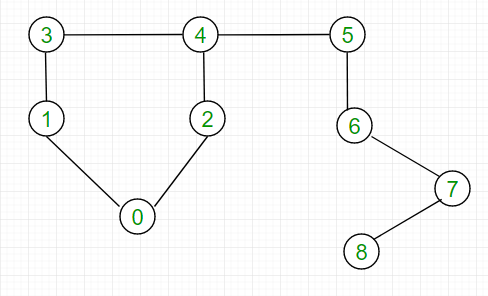
Output: Graph contains Cycle.
Input:
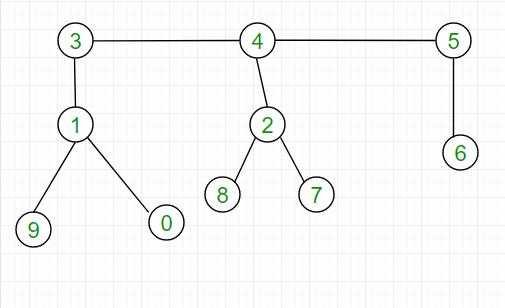
Output: Graph does not contain Cycle.
Prerequisites: Disjoint Set (Or Union-Find), Union By Rank and Path Compression
We have already discussed union-find to detect cycle. Here we discuss find by path compression, where it is slightly modified to work faster than the original method as we are skipping one level each time we are going up the graph. Implementation of find function is iterative, so there is no overhead involved. Time complexity of optimized find function is O(log*(n)), i.e iterated logarithm, which converges to O(1) for repeated calls.
Refer this link for
Proof of log*(n) complexity of Union-Find
Explanation of find function:
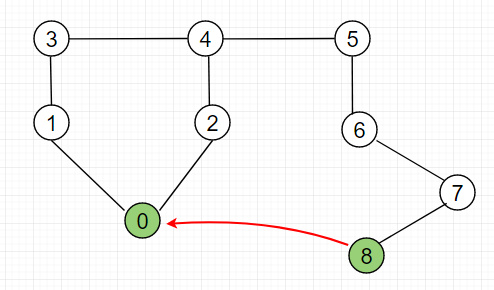
Take Example 1 to understand find function:
(1)call find(8) for first time and mappings will be done like this:
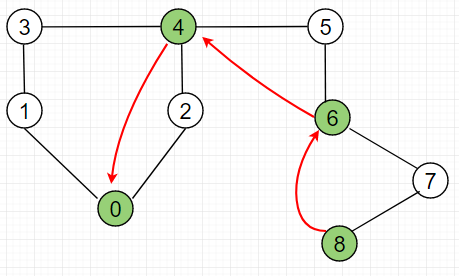
It took 3 mappings for find function to get the root of node 8. Mappings are illustrated below:
From node 8, skipped node 7, Reached node 6.
From node 6, skipped node 5, Reached node 4.
From node 4, skipped node 2, Reached node 0.
(2)call find(8) for second time and mappings will be done like this:
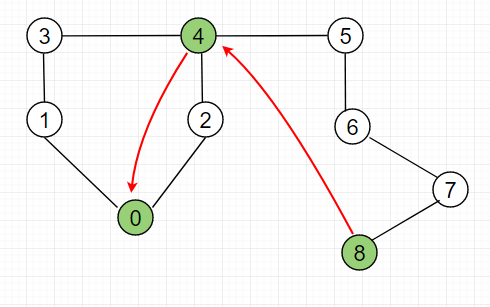
It took 2 mappings to find function to get the root of node 8. Mappings are illustrated below:
From node 8, skipped node 5, node 6, and node 7, Reached node 4.
From node 4, skipped node 2, Reached node 0.
(3)call find(8) for third time and mappings will be done like this:
Finally, we see it took only 1 mapping for find function to get the root of node 8. Mappings are illustrated below:
From node 8, skipped node 5, node 6, node 7, node 4, and node 2, Reached node 0.
That is how it converges path from certain mappings to single mapping.
Explanation of example 1:
Initially array size and Arr look like: Arr[9] = {0, 1, 2, 3, 4, 5, 6, 7, 8} size[9] = {1, 1, 1, 1, 1, 1, 1, 1, 1} Consider the edges in the graph, and add them one by one to the disjoint-union set as follows: Edge 1: 0-1 find(0)=>0, find(1)=>1, both have different root parent Put these in single connected component as currently they doesn't belong to different connected components. Arr[1]=0, size[0]=2; Edge 2: 0-2 find(0)=>0, find(2)=>2, both have different root parent Arr[2]=0, size[0]=3; Edge 3: 1-3 find(1)=>0, find(3)=>3, both have different root parent Arr[3]=0, size[0]=3; Edge 4: 3-4 find(3)=>1, find(4)=>4, both have different root parent Arr[4]=0, size[0]=4; Edge 5: 2-4 find(2)=>0, find(4)=>0, both have same root parent Hence, There is a cycle in graph. We stop further checking for cycle in graph.
Implementation:
C++ `
// CPP program to implement Union-Find with union // by rank and path compression. #include <bits/stdc++.h> using namespace std;
const int MAX_VERTEX = 101;
// Arr to represent parent of index i int Arr[MAX_VERTEX];
// Size to represent the number of nodes // in subgraph rooted at index i int size[MAX_VERTEX];
// set parent of every node to itself and // size of node to one void initialize(int n) { for (int i = 0; i <= n; i++) { Arr[i] = i; size[i] = 1; } }
// Each time we follow a path, find function // compresses it further until the path length // is greater than or equal to 1. int find(int i) { // while we reach a node whose parent is // equal to itself while (Arr[i] != i) { Arr[i] = Arr[Arr[i]]; // Skip one level i = Arr[i]; // Move to the new level } return i; }
// A function that does union of two nodes x and y // where xr is root node of x and yr is root node of y void _union(int xr, int yr) { if (size[xr] < size[yr]) // Make yr parent of xr { Arr[xr] = Arr[yr]; size[yr] += size[xr]; } else // Make xr parent of yr { Arr[yr] = Arr[xr]; size[xr] += size[yr]; } }
// The main function to check whether a given // graph contains cycle or not int isCycle(vector adj[], int V) { // Iterate through all edges of graph, find // nodes connecting them. // If root nodes of both are same, then there is // cycle in graph. for (int i = 0; i < V; i++) { for (int j = 0; j < adj[i].size(); j++) { int x = find(i); // find root of i int y = find(adj[i][j]); // find root of adj[i][j]
        if (x == y)
            return 1; // If same parent
        _union(x, y); // Make them connect
    }
}
return 0;
}
// Driver program to test above functions int main() { int V = 3;
// Initialize the values for array Arr and Size
initialize(V);

/* Let us create following graph
     0
    |  \
    |    \
    1-----2 */

vector<int> adj[V]; // Adjacency list for graph

adj[0].push_back(1);
adj[0].push_back(2);
adj[1].push_back(2);

// call is_cycle to check if it contains cycle
if (isCycle(adj, V))
    cout << "Graph contains Cycle.\n";
else
    cout << "Graph does not contain Cycle.\n";

return 0;
}
Java
// Java program to implement Union-Find with union // by rank and path compression import java.util.*;
class GFG { static int MAX_VERTEX = 101;
// Arr to represent parent of index i static int []Arr = new int[MAX_VERTEX];
// Size to represent the number of nodes // in subgraph rooted at index i static int []size = new int[MAX_VERTEX];
// set parent of every node to itself and // size of node to one static void initialize(int n) { for (int i = 0; i <= n; i++) { Arr[i] = i; size[i] = 1; } }
// Each time we follow a path, find function // compresses it further until the path length // is greater than or equal to 1. static int find(int i) { // while we reach a node whose parent is // equal to itself while (Arr[i] != i) { Arr[i] = Arr[Arr[i]]; // Skip one level i = Arr[i]; // Move to the new level } return i; }
// A function that does union of two nodes x and y // where xr is root node of x and yr is root node of y static void _union(int xr, int yr) { if (size[xr] < size[yr]) // Make yr parent of xr { Arr[xr] = Arr[yr]; size[yr] += size[xr]; } else // Make xr parent of yr { Arr[yr] = Arr[xr]; size[xr] += size[yr]; } }
// The main function to check whether a given // graph contains cycle or not static int isCycle(Vector adj[], int V) { // Iterate through all edges of graph, // find nodes connecting them. // If root nodes of both are same, // then there is cycle in graph. for (int i = 0; i < V; i++) { for (int j = 0; j < adj[i].size(); j++) { int x = find(i); // find root of i
        // find root of adj[i][j]
        int y = find(adj[i].get(j));

        if (x == y)
            return 1; // If same parent
        _union(x, y); // Make them connect
    }
}
return 0;
}
// Driver Code public static void main(String[] args) { int V = 3;
// Initialize the values for array Arr and Size
initialize(V);

/* Let us create following graph
    0
    | \
    | \
    1-----2 */

// Adjacency list for graph
Vector<Integer> []adj = new Vector[V];
for(int i = 0; i < V; i++)
    adj[i] = new Vector<Integer>();

adj[0].add(1);
adj[0].add(2);
adj[1].add(2);

// call is_cycle to check if it contains cycle
if (isCycle(adj, V) == 1)
    System.out.print("Graph contains Cycle.\n");
else
    System.out.print("Graph does not contain Cycle.\n");
}
}
// This code is contributed by PrinciRaj1992
Python3
Python3 program to implement Union-Find
with union by rank and path compression.
set parent of every node to itself
and size of node to one
def initialize(n): global Arr, size for i in range(n + 1): Arr[i] = i size[i] = 1
Each time we follow a path, find
function compresses it further
until the path length is greater
than or equal to 1.
def find(i): global Arr, size
# while we reach a node whose
# parent is equal to itself
while (Arr[i] != i):
    Arr[i] = Arr[Arr[i]] # Skip one level
    i = Arr[i] # Move to the new level
return i
A function that does union of two
nodes x and y where xr is root node
of x and yr is root node of y
def _union(xr, yr): global Arr, size if (size[xr] < size[yr]): # Make yr parent of xr Arr[xr] = Arr[yr] size[yr] += size[xr] else: # Make xr parent of yr Arr[yr] = Arr[xr] size[xr] += size[yr]
The main function to check whether
a given graph contains cycle or not
def isCycle(adj, V): global Arr, size
# Iterate through all edges of graph,
# find nodes connecting them.
# If root nodes of both are same,
# then there is cycle in graph.
for i in range(V):
    for j in range(len(adj[i])):
        x = find(i) # find root of i
        y = find(adj[i][j]) # find root of adj[i][j]

        if (x == y):
            return 1 # If same parent
        _union(x, y) # Make them connect
return 0
Driver Code
MAX_VERTEX = 101
Arr to represent parent of index i
Arr = [None] * MAX_VERTEX
Size to represent the number of nodes
in subgraph rooted at index i
size = [None] * MAX_VERTEX
V = 3
Initialize the values for array
Arr and Size
initialize(V)
Let us create following graph
0
| \
| \
1-----2
Adjacency list for graph
adj = [[] for i in range(V)]
adj[0].append(1) adj[0].append(2) adj[1].append(2)
call is_cycle to check if it
contains cycle
if (isCycle(adj, V)): print("Graph contains Cycle.") else: print("Graph does not contain Cycle.")
This code is contributed by PranchalK
C#
// C# program to implement Union-Find // with union by rank and path compression using System; using System.Collections.Generic;
class GFG { static int MAX_VERTEX = 101;
// Arr to represent parent of index i static int []Arr = new int[MAX_VERTEX];
// Size to represent the number of nodes // in subgraph rooted at index i static int []size = new int[MAX_VERTEX];
// set parent of every node to itself // and size of node to one static void initialize(int n) { for (int i = 0; i <= n; i++) { Arr[i] = i; size[i] = 1; } }
// Each time we follow a path, // find function compresses it further // until the path length is greater than // or equal to 1. static int find(int i) { // while we reach a node whose // parent is equal to itself while (Arr[i] != i) { Arr[i] = Arr[Arr[i]]; // Skip one level i = Arr[i]; // Move to the new level } return i; }
// A function that does union of // two nodes x and y where xr is // root node of x and yr is root node of y static void _union(int xr, int yr) { if (size[xr] < size[yr]) // Make yr parent of xr { Arr[xr] = Arr[yr]; size[yr] += size[xr]; } else // Make xr parent of yr { Arr[yr] = Arr[xr]; size[xr] += size[yr]; } }
// The main function to check whether // a given graph contains cycle or not static int isCycle(List []adj, int V) { // Iterate through all edges of graph, // find nodes connecting them. // If root nodes of both are same, // then there is cycle in graph. for (int i = 0; i < V; i++) { for (int j = 0; j < adj[i].Count; j++) { int x = find(i); // find root of i
        // find root of adj[i][j]
        int y = find(adj[i][j]);

        if (x == y)
            return 1; // If same parent
        _union(x, y); // Make them connect
    }
}
return 0;
}
// Driver Code public static void Main(String[] args) { int V = 3;
// Initialize the values for
// array Arr and Size
initialize(V);

/* Let us create following graph
    0
    | \
    | \
    1-----2 */

// Adjacency list for graph
List<int> []adj = new List<int>[V];
for(int i = 0; i < V; i++)
    adj[i] = new List<int>();

adj[0].Add(1);
adj[0].Add(2);
adj[1].Add(2);

// call is_cycle to check if it contains cycle
if (isCycle(adj, V) == 1)
    Console.Write("Graph contains Cycle.\n");
else
    Console.Write("Graph does not contain Cycle.\n");
}
}
// This code is contributed by Rajput-Ji
JavaScript
`
Output
Graph contains Cycle.
Complexity Analysis:
- Time Complexity(Find) : O(log*(n))
- Time Complexity(union) : O(1)
- Auxiliary Space: O(Max_Vertex)