Vizing’s Theorem (original) (raw)
Last Updated : 13 Apr, 2023
In graph theory, Vizing's theorem states that every simple undirected graph may be edge colored using a number of colors that is at most one larger than the maximum degree 'd' of the graph. In simple meaning this theorem states that the chromatic index of the simple graph can be either 'd' or 'd' +1. The minimum number of colors needed for the edge coloring of the graph is called chromatic index.
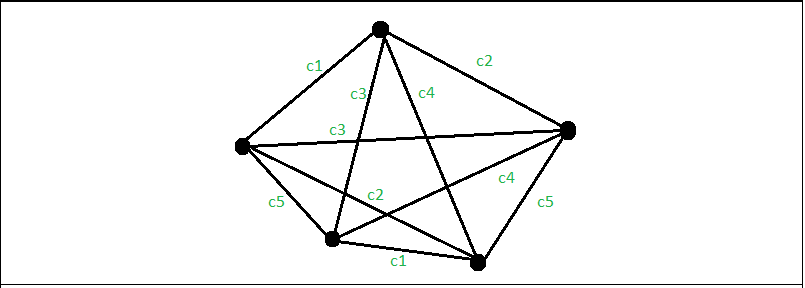
There are 5 vertices in the above graph G. Highest Degree is 4, but we need 5 colors, so that no edge shares the same color with any edge of the adjacent vertices, as you can see in the above graph. Therefore the required number of valid colors for this graph is equal to 5, which is ( 'highest degree' + 1 ).
Note: c1, c2, c3, c4 and c5 in the above diagram implies distinct colors.
Examples :
Input :
v = 3, e = 3
{{ 1, 2, -1 },
{ 2, 3, -1 },
{ 3, 1, -1 }};
Output :
3 colors needs to generate a valid edge coloring :
color between v(1): 1 and v(2): 2 is: color 1
color between v(1): 2 and v(2): 3 is: color 2
color between v(1): 3 and v(2): 1 is: color 3
Algorithm:
- After initializing the number of edges, assign the vertex pair of every edge
- Color the graph edges according to the theorem
- Assign a color and then check its validity
- Check if any two adjacent edges have the same color, then increment the Color, goto flag and try next color
- Repeat till all the edges get it's color according to the theorem
- Once done print the color of all the edges between the vertices
Below is the implementation of the above approach:
C++ `
// C++ program to illustrate // Vizing's Theorem #include using namespace std;
// Function to print the color of the edge void colorEdge(int edges[][3], int e) { int color;
// Assign a color to every edge 'i'.
for (int i = 0; i < e; i++) {
    color = 1;
flag:
    // Assign a color and
    // then check its validity.
    edges[i][2] = color;
    for (int j = 0; j < e; j++) {
        if (j == i)
            continue;

        // If the color of edges
        // is adjacent to edge i
        if ((edges[i][0] == edges[j][0])
            || (edges[i][1] == edges[j][0])
            || (edges[i][0] == edges[j][1])
            || (edges[i][1] == edges[j][1])) {

            // If the color matches
            if (edges[i][2] == edges[j][2]) {

                // Increment the color,
                // denotes the change in color.
                color++;

                // goes back, and assigns
                // the next color.
                goto flag;
            }
        }
    }
}
// Check the maximum color from all the edge colors
int maxColor = -1;
for (int i = 0; i < e; i++) {
    maxColor = max(maxColor, edges[i][2]);
}
cout << maxColor
     << " colors needs to generate a valid edge "
        "coloring:"
     << endl;
for (int i = 0; i < e; i++) {
    cout << "color between v(1): " << edges[i][0]
         << " and v(2): " << edges[i][1]
         << " is: color " << edges[i][2] << endl;
}
}
// Driver Code int main() { // initialize the number // of edges of the graph int e = 5;
// initialize the vertex
// pair of every edge in a graph
int edges[e][3] = { { 1, 2, -1 },
                    { 2, 3, -1 },
                    { 3, 4, -1 },
                    { 4, 1, -1 },
                    { 1, 3, -1 } };

colorEdge(edges, e);
return 0;
}
Java
// Java program to illustrate // Vizing's Theorem import java.util.*;
public class VizingsTheorem {
// Function to find the chromatic index
public void colorEdge(int[][] edges, int e)
{
    // Initialize edge to first edge and
    // color to color 1
    int i = 0, color = 1;

    // Repeat until all edges are done coloring
    while (i < e) {
        // Give the selected edge a color
        edges[i][2] = color;
        boolean flag = false;
        // Iterate through all others edges to check
        for (int j = 0; j < e; j++) {
            // Ignore if same edge
            if (j == i)
                continue;
            // Check if one vertex is similar
            if ((edges[i][0] == edges[j][0])
                || (edges[i][1] == edges[j][0])
                || (edges[i][0] == edges[j][1])
                || (edges[i][1] == edges[j][1])) {
                // Check if color is similar
                if (edges[i][2] == edges[j][2]) {
                    // Increment the color by 1
                    color++;
                    flag = true;
                    break;
                }
            }
        }

        // If same color faced then repeat again
        if (flag == true) {
            continue;
        }

        // Or else proceed to a
        // new vertex with color 1
        color = 1;
        i++;
    }

    // Check the maximum color from all the edge colors
    int maxColor = -1;
    for (i = 0; i < e; i++)
    {
        maxColor = Math.max(maxColor, edges[i][2]);
    }
    System.out.println(
        maxColor
        + " colors needs to generate"
        +" a valid edge coloring:");
    for (i = 0; i < e; i++)
    {
        System.out.println(
            "color between v(1): " + edges[i][0]
            + " and v(2): " + edges[i][1]
            + " is: color " + edges[i][2]);
    }
}

// Driver code
public static void main(String[] args)
{

    // Number of edges
    int e = 5;

    // Edge list
    int[][] edges = new int[e][3];

    // Initialize all edge colors to 0
    for (int i = 0; i < e; i++) {
        edges[i][2] = -1;
    }

    // Edges
    edges[0][0] = 1;
    edges[0][1] = 2;

    edges[1][0] = 2;
    edges[1][1] = 3;

    edges[2][0] = 3;
    edges[2][1] = 4;

    edges[3][0] = 4;
    edges[3][1] = 1;

    edges[4][0] = 1;
    edges[4][1] = 3;

    // Run the function
    VizingsTheorem c = new VizingsTheorem();
    c.colorEdge(edges, e);
}
}
Python3
def colorEdge(edges, e): # Initialize edge to first edge and # color to color 1 i = 0 color = 1 # Repeat until all edges are done coloring while(i < e): # Give the selected edge a color edges[i][2] = color flag = False # Iterate through all others edges to check for j in range(e): # Ignore if same edge if (j == i): continue # Check if one vertex is similar if ((edges[i][0] == edges[j][0])or (edges[i][1] == edges[j][0]) or (edges[i][0] == edges[j][1]) or (edges[i][1] == edges[j][1])): # Check if color is similar if (edges[i][2] == edges[j][2]): # Increment the color by 1 color += 1 flag = True break # If same color faced then repeat again if (flag == True): continue
    # Or else proceed to a new vertex with color 1
    color = 1
    i += 1

# Check the maximum color from all the edge colors
maxColor = -1
for i in range(e):
    maxColor = max(maxColor, edges[i][2])
print(str(maxColor)+" colors needs to generate a valid edge coloring:")
for i in range(e):
    print("color between v(1): "+str(edges[i][0])+" and v(2): "
          + str(edges[i][1])+" is: color "+str(edges[i][2]))
Driver code
if name == "main": # Number of edges e = 5 # Edge list edges = [[0 for _ in range(3)] for _ in range(e)] # Initialize all edge colors to 0 for i in range(e): edges[i][2] = -1 # Edges edges[0][0] = 1 edges[0][1] = 2
edges[1][0] = 2
edges[1][1] = 3

edges[2][0] = 3
edges[2][1] = 4

edges[3][0] = 4
edges[3][1] = 1

edges[4][0] = 1
edges[4][1] = 3

# Run the function
colorEdge(edges, e)
C#
using System;
public class VizingsTheorem { // Function to find the chromatic index public void colorEdge(int[,] edges, int e) { // Initialize edge to first edge and color to color 1 int i = 0, color = 1;
    // Repeat until all edges are done coloring
    while (i < e)
    {
        // Give the selected edge a color
        edges[i, 2] = color;
        bool flag = false;

        // Iterate through all others edges to check
        for (int j = 0; j < e; j++)
        {
            // Ignore if same edge
            if (j == i)
                continue;

            // Check if one vertex is similar
            if ((edges[i, 0] == edges[j, 0])
                || (edges[i, 1] == edges[j, 0])
                || (edges[i, 0] == edges[j, 1])
                || (edges[i, 1] == edges[j, 1]))
            {
                // Check if color is similar
                if (edges[i, 2] == edges[j, 2])
                {
                    // Increment the color by 1
                    color++;
                    flag = true;
                    break;
                }
            }
        }

        // If same color faced then repeat again
        if (flag == true)
            continue;

        // Or else proceed to a new vertex with color 1
        color = 1;
        i++;
    }

    // Check the maximum color from all the edge colors
    int maxColor = -1;
    for (i = 0; i < e; i++)
    {
        maxColor = Math.Max(maxColor, edges[i, 2]);
    }
    Console.WriteLine(maxColor + " colors needs to generate a valid edge coloring:");
    for (i = 0; i < e; i++)
    {
        Console.WriteLine("color between v(1): " + edges[i, 0] + " and v(2): " + edges[i, 1] + " is: color " + edges[i, 2]);
    }
}

// Driver code
public static void Main(string[] args)
{
    // Number of edges
    int e = 5;

    // Edge list
    int[,] edges = new int[e, 3];

    // Initialize all edge colors to 0
    for (int i = 0; i < e; i++)
        edges[i, 2] = -1;

    // Edges
    edges[0, 0] = 1;
    edges[0, 1] = 2;

    edges[1, 0] = 2;
    edges[1, 1] = 3;

    edges[2, 0] = 3;
    edges[2, 1] = 4;

    edges[3, 0] = 4;
    edges[3, 1] = 1;

    edges[4, 0] = 1;
    edges[4, 1] = 3;

    // Run the function
    VizingsTheorem c = new VizingsTheorem();
    c.colorEdge(edges, e);
}
}
JavaScript
`
Output
3 colors needs to generate a valid edge coloring: color between v(1): 1 and v(2): 2 is: color 1 color between v(1): 2 and v(2): 3 is: color 2 color between v(1): 3 and v(2): 4 is: color 1 color between v(1): 4 and v(2): 1 is: color 2 color between v(1): 1 and v(2): 3 is: color 3
Time Complexity: O(e2)
Auxiliary Space: O(1)
As constant extra space is used.