Write a program to Delete a Tree (original) (raw)
Last Updated : 13 Jul, 2023
To delete a tree, we must traverse all the nodes of the tree and delete them one by one. So, which traversal we should use - inorder traversal, preorder traversal, or the postorder traversal? The answer is simple. We should use the postorder traversal because before deleting the parent node, we should delete its child nodes first.
We can delete the tree with other traversals also with extra space complexity but why should we go for the other traversals if we have the postorder one available which does the work without storing anything in the same time complexity.
For the following tree, nodes are deleted in the order - 4, 5, 2, 3, 1.
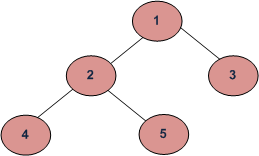
Note : In Java automatic garbage collection happens, so we can simply make root null to delete the tree "root = null";
Implementation:
C++ `
// C++ program to Delete a Tree
#include<bits/stdc++.h> #include using namespace std;
/* A binary tree node has data, pointer to left child and a pointer to right child / class node { public: int data; node left; node* right;
/* Constructor that allocates
a new node with the given data
and NULL left and right pointers. */
node(int data)
{
    this->data = data;
    this->left = NULL;
    this->right = NULL;
}
};
/* This function traverses tree in post order to delete each and every node of the tree / void deleteTree(node node) { if (node == NULL) return;
/* first delete both subtrees */
deleteTree(node->left);
deleteTree(node->right);

/* then delete the node */
cout << "\n Deleting node: " << node->data;
delete node;
}
/* Driver code*/ int main() { node *root = new node(1); root->left = new node(2); root->right = new node(3); root->left->left = new node(4); root->left->right = new node(5);
deleteTree(root);
root = NULL;

cout << "\n Tree deleted ";

return 0;
}
//This code is contributed by rathbhupendra
C
// C program to Delete a Tree #include<stdio.h> #include<stdlib.h>
/* A binary tree node has data, pointer to left child and a pointer to right child / struct node { int data; struct node left; struct node* right; };
/* Helper function that allocates a new node with the given data and NULL left and right pointers. / struct node newNode(int data) { struct node* node = (struct node*) malloc(sizeof(struct node));
node->data = data;
node->left = NULL;
node->right = NULL;
return(node);
}
/* This function traverses tree in post order to to delete each and every node of the tree / void deleteTree(struct node node) { if (node == NULL) return;
/* first delete both subtrees */
deleteTree(node->left);
deleteTree(node->right);

/* then delete the node */
printf("\n Deleting node: %d", node->data);
free(node);
}
/* Driver program to test deleteTree function*/
int main()
{
struct node *root = newNode(1);
root->left = newNode(2);
root->right = newNode(3);
root->left->left = newNode(4);
root->left->right = newNode(5);
deleteTree(root);
root = NULL;

printf("\n Tree deleted ");

return 0;
}
Java
// Java program to delete a tree
// A binary tree node class Node { int data; Node left, right;
Node(int item)
{
    data = item;
    left = right = null;
}
}
class BinaryTree { Node root;
/*  This function traverses tree in post order to
    to delete each and every node of the tree */
void deleteTree(Node node)
{
    // In Java automatic garbage collection
    // happens, so we can simply make root
    // null to delete the tree
    root = null;
}

/* Driver program to test above functions */
public static void main(String[] args)
{
    BinaryTree tree = new BinaryTree();

    tree.root = new Node(1);
    tree.root.left = new Node(2);
    tree.root.right = new Node(3);
    tree.root.left.left = new Node(4);
    tree.root.left.right = new Node(5);

    /* Print all root-to-leaf paths of the input tree */
    tree.deleteTree(tree.root);
    tree.root = null;
    System.out.println("Tree deleted");

}
}
Python3
""" program to Delete a Tree """
Helper function that allocates a new
node with the given data and None
left and right pointers.
class newNode:
# Construct to create a new node
def __init__(self, key):
    self.data = key
    self.left = None
    self.right = None
""" This function traverses tree in post order to to delete each and every node of the tree """ def deleteTree( node) :
if node != None: deleteTree(node.left) deleteTree(node.right) del node
Driver Code
if name == 'main': root = newNode(1) root.left = newNode(2) root.right = newNode(3) root.left.left = newNode(4) root.left.right = newNode(5) deleteTree(root) root = None
print("Tree deleted ")This code is contributed by
Shubham Prashar(shubhamprashar)
C#
using System;
// C# program to delete a tree
// A binary tree node public class Node { public int data; public Node left, right;
public Node(int item)
{
    data = item;
    left = right = null;
}
}
public class BinaryTree { public Node root;
/*  This function traverses tree in post order to
    to delete each and every node of the tree */
public virtual void deleteTree(Node node)
{
    // In Java automatic garbage collection
    // happens, so we can simply make root
    // null to delete the tree
    root = null;
}

/* Driver program to test above functions */
public static void Main(string[] args)
{
    BinaryTree tree = new BinaryTree();

    tree.root = new Node(1);
    tree.root.left = new Node(2);
    tree.root.right = new Node(3);
    tree.root.left.left = new Node(4);
    tree.root.left.right = new Node(5);

    /* Print all root-to-leaf paths of the input tree */
    tree.deleteTree(tree.root);
    tree.root = null;
    Console.WriteLine("Tree deleted");

}
}
// This code is contributed by Shrikant13
JavaScript
`
Time Complexity: O(n)
Space Complexity: If we don't consider size of stack for function calls then O(1) otherwise O(h)
The above deleteTree() function deletes the tree but doesn't change the root to NULL which may cause problems if the user of deleteTree() doesn't change root to NULL and tries to access the values using the root pointer. We can modify the deleteTree() function to take reference to the root node so that this problem doesn't occur. See the following code.
Implementation:
C++ `
// CPP program to Delete a Tree #include <bits/stdc++.h> using namespace std;
/* A binary tree node has data, pointer to left child and a pointer to right child / class node { public: int data; node left; node* right; };
/* Helper function that allocates a new node with the given data and NULL left and right pointers. / node newNode(int data) { node* Node = new node();
Node->data = data;
Node->left = NULL;
Node->right = NULL;
return(Node);
}
/* This function is same as deleteTree() in the previous program / void _deleteTree(node node) { if (node == NULL) return;
/* first delete both subtrees */
_deleteTree(node->left);
_deleteTree(node->right);

/* then delete the node */
cout << "Deleting node: " << node->data << endl;
delete node;
}
/* Deletes a tree and sets the root as NULL / void deleteTree(node* node_ref) { _deleteTree(*node_ref); *node_ref = NULL; }
/* Driver code*/ int main() { node *root = newNode(1); root->left = newNode(2); root->right = newNode(3); root->left->left = newNode(4); root->left->right = newNode(5);
// Note that we pass the address of root here
deleteTree(&root);
cout << "Tree deleted ";
return 0;
}
// This code is contributed by rathbhupendra
C
// C program to Delete a Tree #include<stdio.h> #include<stdlib.h>
/* A binary tree node has data, pointer to left child and a pointer to right child / struct node { int data; struct node left; struct node* right; };
/* Helper function that allocates a new node with the given data and NULL left and right pointers. / struct node newNode(int data) { struct node* node = (struct node*) malloc(sizeof(struct node));
node->data = data;
node->left = NULL;
node->right = NULL;
return(node);
}
/* This function is same as deleteTree() in the previous program / void _deleteTree(struct node node) { if (node == NULL) return;
/* first delete both subtrees */
_deleteTree(node->left);
_deleteTree(node->right);

/* then delete the node */
printf("\n Deleting node: %d", node->data);
free(node);
}
/* Deletes a tree and sets the root as NULL / void deleteTree(struct node* node_ref) { _deleteTree(*node_ref); *node_ref = NULL; }
/* Driver program to test deleteTree function*/ int main() { struct node *root = newNode(1); root->left = newNode(2); root->right = newNode(3); root->left->left = newNode(4); root->left->right = newNode(5);
// Note that we pass the address of root here
deleteTree(&root);
printf("\n Tree deleted ");

getchar();
return 0;
}
Java
// Java program to delete a tree
/* A binary tree node has data, pointer to left child and pointer to right child */ class Node { int data; Node left, right;
Node(int d)
{
    data = d;
    left = right = null;
}
}
class BinaryTree {
static Node root;

/*  This function is same as deleteTree() in the previous program */
void deleteTree(Node node)
{
    // In Java automatic garbage collection
    // happens, so we can simply make root
    // null to delete the tree
    root = null;
}

/* Wrapper function that deletes the tree and
   sets root node as null  */
void deleteTreeRef(Node nodeRef)
{
    deleteTree(nodeRef);
    nodeRef=null;
}

/* Driver program to test deleteTree function */
public static void main(String[] args)
{

    BinaryTree tree = new BinaryTree();

    tree.root = new Node(1);
    tree.root.left = new Node(2);
    tree.root.right = new Node(3);
    tree.root.left.left = new Node(4);
    tree.root.left.right = new Node(5);

    /* Note that we pass root node here */
    tree.deleteTreeRef(root);
    System.out.println("Tree deleted");

}
}
// This code has been contributed by Mayank Jaiswal(mayank_24)
Python3
Python3 program to count all nodes
having k leaves in subtree rooted with them
A binary tree node has data, pointer to
left child and a pointer to right child
Helper function that allocates a new node
with the given data and None left and
right pointers
class newNode: def init(self, data): self.data = data self.left = None self.right = None
''' This function is same as deleteTree() in the previous program ''' def _deleteTree(node): if (node == None): return
# first delete both subtrees
_deleteTree(node.left)
_deleteTree(node.right)

# then delete the node
print("Deleting node: ",
              node.data)
node = None
Deletes a tree and sets the root as NULL
def deleteTree(node_ref): _deleteTree(node_ref[0]) node_ref[0] = None
Driver code
root = [0] root[0] = newNode(1) root[0].left = newNode(2) root[0].right = newNode(3) root[0].left.left = newNode(4) root[0].left.right = newNode(5)
Note that we pass the address
of root here
deleteTree(root) print("Tree deleted ")
This code is contributed by SHUBHAMSINGH10
C#
using System;
// C# program to delete a tree
/* A binary tree node has data, pointer to left child and pointer to right child */ public class Node { public int data; public Node left, right;
public Node(int d)
{
    data = d;
    left = right = null;
}
}
public class BinaryTree {
public static Node root;

/*  This function is same as deleteTree() in the previous program */
public virtual void deleteTree(Node node)
{
    // In Java automatic garbage collection
    // happens, so we can simply make root
    // null to delete the tree
    root = null;
}

/* Wrapper function that deletes the tree and
   sets root node as null  */
public virtual void deleteTreeRef(Node nodeRef)
{
    deleteTree(nodeRef);
    nodeRef = null;
}

/* Driver program to test deleteTree function */
public static void Main(string[] args)
{

    BinaryTree tree = new BinaryTree();

    BinaryTree.root = new Node(1);
    BinaryTree.root.left = new Node(2);
    BinaryTree.root.right = new Node(3);
    BinaryTree.root.left.left = new Node(4);
    BinaryTree.root.left.right = new Node(5);

    /* Note that we pass root node here */
    tree.deleteTreeRef(root);
    Console.WriteLine("Tree deleted");

}
}
// This code is contributed by Shrikant13
JavaScript
`
Output:
Deleting node: 4 Deleting node: 5 Deleting node: 2 Deleting node: 3 Deleting node: 1 Tree deleted
Time Complexity: O(n)
Space Complexity: If we don't consider size of stack for function calls then O(1) otherwise O(n)