Continuous Time and Discrete Time Control Systems (original) (raw)
Last Updated : 11 Mar, 2026
Continuous-time and Discrete-time control systems represent important concepts in Electronic Engineering and support the design and optimization of many electronic systems. Both approaches explain different ways of processing and controlling signals. Knowledge of both concepts helps engineers design effective control strategies for various applications.
- Continuous-time control systems process signals that change continuously with time, where input and output remain continuous functions.
- Mathematical modelling of continuous-time systems generally uses differential equations in the time domain.
- Common applications include robotics, aerospace systems, and industrial automation, where smooth and fast response remains important.
- Discrete-time control systems process signals measured at specific sampling intervals, producing a sequence of discrete values.
- Mathematical representation of discrete-time systems generally uses difference equations and supports digital processing.
- The selection between continuous-time and discrete-time systems depends on the process nature, computational capability, and required performance level.
Continuous Time Control Systems
Continuous-time control systems form an important part of Electronic Engineering and support the regulation of dynamic system behaviour over time. Continuous signal variation allows smooth monitoring and adjustment of system performance. Stable and reliable operation becomes possible through constant control action.
- Control systems regulate process output by continuously adjusting the input signals.
- System variables and signals change smoothly with time, enabling continuous monitoring and response.
- These systems are widely used in industrial plants, electronic equipment, and real-time engineering processes.
- The Proportional-Integral-Derivative (PID) controller is commonly used to improve system stability and dynamic response.
- Understanding this concept helps engineers analyze, design, and enhance processes that operate continuously over time.
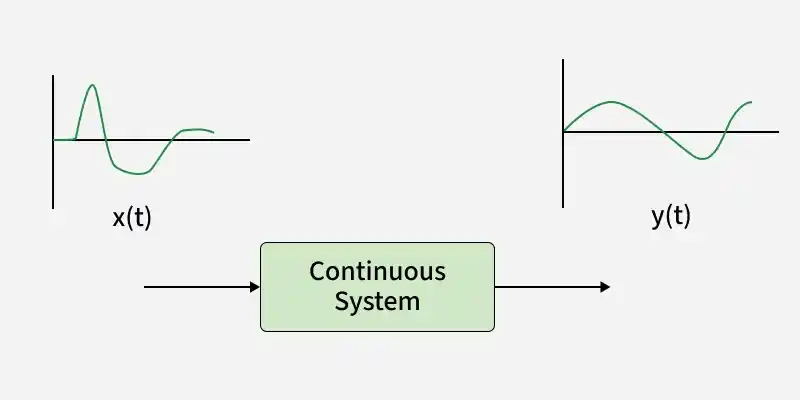
Continuous Time Control Systems
Advantages
- Quick response to variations in input signals due to continuous signal behaviour.
- Easy interaction with analog sensors and actuators, which supports integration with existing analog systems.
- Continuous adjustment capability improves tolerance to disturbances and environmental noise.
- High level of accuracy and precision during control operations.
Disadvantages
- Mathematical analysis often involves differential equations, which increases complexity and analysis time.
- Analog noise can influence signal quality and affect system performance.
- Implementation may become more complex compared with digital or discrete-time systems.
- Additional filtering and noise reduction techniques may be required to improve signal reliability.
Applications
- Aircraft and spacecraft navigation and control systems.
- Power systems, including voltage regulation, frequency regulation, and power factor correction.
- Robotics, where continuous control supports smooth motion and behaviour regulation.
- Industrial process control, such as temperature, pressure, and flow regulation in manufacturing plants.
Discrete Time Control Systems
Discrete-time control plays an important role in Electronic Engineering and supports the design and testing of systems that operate at separate and fixed time intervals. Many modern technologies process information in digital form, which makes such control approaches highly useful in practical engineering applications.
- Signals are observed and processed at predetermined sampling instants rather than varying continuously with time.
- Mathematical modelling commonly uses difference equations to represent system dynamics.
- System analysis involves controller design and stability evaluation to ensure reliable performance.
- These systems are widely used in digital signal processing, robotics, industrial automation, telecommunications, and computer-based control.
- Proper design helps maintain accuracy, stability, and dependable operation in modern electronic systems.
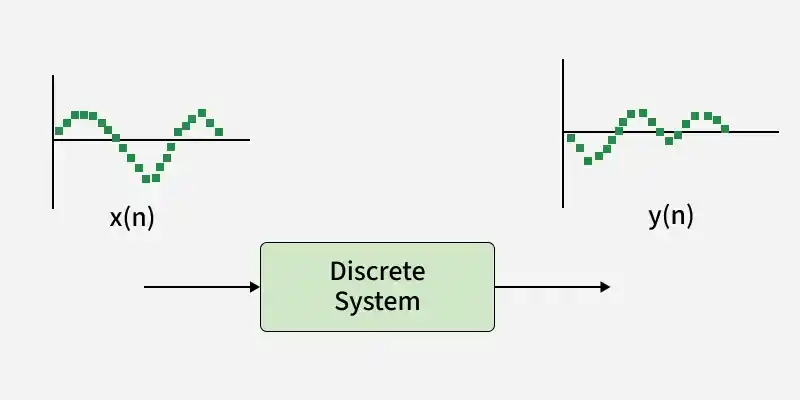
Discrete Time Control Systems
Advantages
- Digital implementation becomes easier due to use of modern processors, software tools, and programmable controllers.
- Analysis and design often rely on difference equations and algebraic methods, which are simpler compared with differential equation methods.
- Sampling-based operation supports efficient handling of measured data, even when measurements arrive at separate time instants.
- Engineers can adjust sampling rate according to available processing capability and required system performance.
Disadvantages
- Aliasing effects may occur during sampling, which can distort high-frequency signal components.
- Digital implementation introduces finite precision limitations due to quantization and rounding operations.
- Sampling process may introduce signal artifacts, which can affect overall system performance.
- System performance can be affected by sampling delays and computational processing time.
Applications
- Flight control and navigation systems use discrete-time control for stable and accurate operation.
- Signal processing applications such as telecommunications, image processing, and audio processing rely on discrete-time techniques.
- Robotics systems use such control methods to achieve accurate motion and coordinated behaviour.
- Digital communication systems apply discrete-time control for channel equalization, modulation/demodulation, and error correction.
Continuous Time vs Discrete Time Control Systems
| Continuous Time | Discrete Time |
|---|---|
| 1. In that control system, time is continuous and flows smoothly. | 1. But in discrete, it is very hard and it is represented by sampled intervals. |
| 2. A signals are represented as continuous functions. | 2. In discrete signals are represented as sequences of values. |
| 3. Control actions are applied continuously in Continuous time control system. | 3. Control actions are applied at discrete time steps. in discrete time |
| 4. Continous Control System bandwidth may be limited. | 4. Discrete Time Control System bandwidth may be limited. |
| 5. Example : aerospace, airline systems. | 5. Example : Digital signal transfer machines, communication Systems . |