Classification of Control Systems (original) (raw)
Last Updated : 13 Mar, 2026
In electronics, control systems are grouped into different types, and each has its unique features and uses. They are Important in electronics engineering for regulating dynamic systems, ensuring stability, accuracy, and top performance in various applications. Understanding their classifications helps to understand their Many functions.
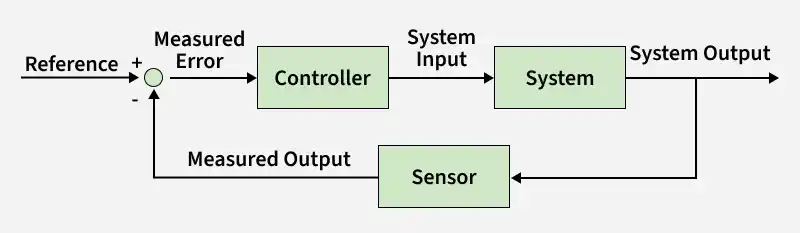
- **Reference Input ®: This is the preferred output or purpose for the machine.
- **Measured Output (Ym): The machine's actual output, compared with the entered reference.
The System works by continuously evaluating the reference input with the measured output to calculate the error. The controller then uses this error to adjust the System and limit the error, creating a feedback loop.
- **Error (e): The distinction between the reference input and the measured output. It represents how far off the system is from the desired aim.
- **Controller: This block takes the mistake as input and approaches it to generate a control signal.
- **Control Signal (u): This is the output of the controller, which is used to govern the system.
- **System: This block represents the procedure or device being managed. It takes the manage sign as an input and produces an output.
- **Output (Y): This is the very last output of the machine after being manipulated by the control sign.
- **Disturbances: These are external factors that may affect the machine’s overall performance. They are accounted for and mitigated by using the controller.
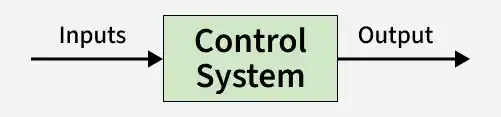
Control System
Types of Control Systems
- Open Loop Control System
- Closed Loop Control System
- Linear Control System
- Non Linear Control Systems
- Time Variant Control System
- Time Invariant Control System
- Continuous-time and Discrete-time Control Systems
- Feedback Control System
- Feedforward Control System
- Digital Control System
Open-Loop Control Systems
Open-loop manage systems, also called non-feedback systems, function with out thinking about the machine's output. In this setup, the controller sends commands to the system, and the device responds without any feedback mechanism. While open-loop structures are simple and value-effective, they lack the potential to adapt the changes or disturbances inside the System, making them less suitable for Applications requiring precision and reliability.
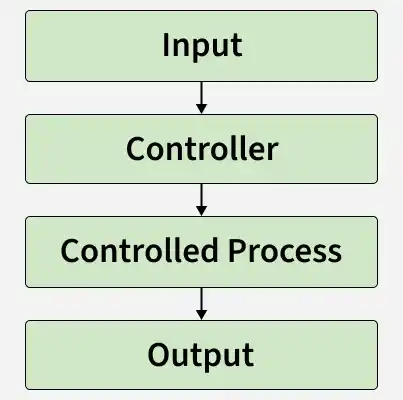
Open-Loop Control System
Features
- Direct courting among input and output.
- No remarks mechanism.
- Simple and price-powerful.
Applications
- **Toaster: In a toaster, an open-loop manage machine is employed to alter the toasting time. The user units a specific time for toasting, and the system operates without comments to attain the favored stage of toasting.
- **Washing Machine: In a bathing gadget, open-loop manage is used to decide the duration of each wash cycle. The consumer selects a wash program, and the system runs via predefined sequences without adjusting based at the real nation of the clothes or water situations.
- **Traffic Signal Control: Traffic signal structures often use open-loop manage to adjust the timing of sign lighting. The timings are set based on ancient visitors patterns and trendy time-of-day considerations, with out actual-time comments from site visitors situations.
- **Electric Oven: Open-loop control is applied in electric ovens where the consumer sets a particular temperature and cooking time. The oven operates based totally on these settings without continuously tracking the temperature inner or adjusting the heating factors.
- **Automated Assembly Lines: Open-loop manage is utilized in certain levels of automatic manufacturing procedures. For example, in a conveyor belt system wherein items flow from one station to every other at a predetermined velocity, without adjusting for variations in the production line.
Advantages
- **Simplicity: Open-loop systems are less difficult and less complicated to design and enforce in comparison to closed-loop structures.
- **Cost-Effectiveness: They are commonly much less highly-priced, making them fee-powerful for sure applications.
- **Predictability: Open-loop systems are predictable and stable while the procedure dynamics are properly understood.
- **Speed: These systems can operate at excessive speeds, as they do not need to system feedback data before making control selections.
- **Less Sensitivity to Disturbances: Open-loop systems are less touchy to external disturbances, which may be a bonus in packages wherein disturbances are predictable.
Disadvantages
- **Lack of Flexibility: They are rigid and do now not adapt to changes or disturbances within the procedure.
- **No Error Correction: Open-loop structures can't correct errors or deviations from the preferred output due to changes inside the device.
- **Sensitivity to Parameter Variations: They are touchy to changes inside the parameters of the procedure or the environment.
- **Limited Accuracy: The accuracy of open-loop systems is restricted, particularly in dynamic or unpredictable methods.
- **Inability to Compensate for Disturbances: They can't atone for surprising disturbances within the system, leading to potential deviations from the favored output.
Closed-Loop Control Systems
Closed-loop manipulate structures, often known as feedback control structures, incorporate Feedback mechanisms to regulate the machine's output. The controller continuously monitors the output and adjusts its input based totally on the feedback received. This closed-loop configuration enhances system stability, accuracy, and the capacity to counteract disturbances. Common examples include temperature control systems, speed regulators, and voltage regulators, all of which rely on the ability to counteract disturbances.
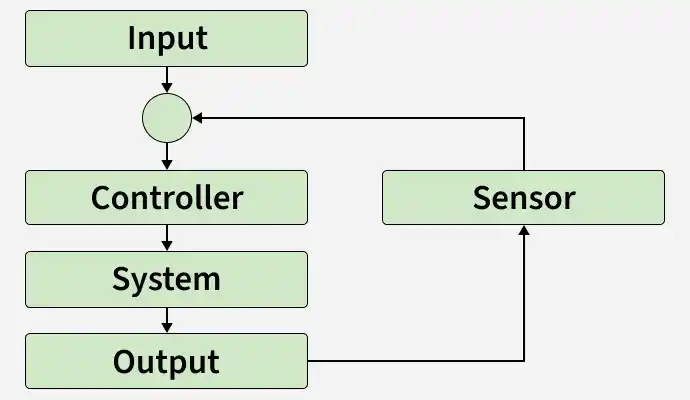
Closed-Loop Control System
Features
- Incorporates a comments mechanism.
- Continuous monitoring and adjustment of the output.
- Enhanced balance and precision.
Applications
- **Thermostat in a Heating System: A closed-loop manipulate machine is used in a thermostat to maintain a steady temperature. Sensors degree the modern temperature, and the heating gadget adjusts its output to maintain the preferred temperature.
- **Autopilot in Aircraft: Closed-loop control is carried out in aircraft autopilot structures. Sensors come across deviations from the favored flight path, and the manage device adjusts the control surfaces to convey the plane back on path.
- **Robotics and Automated Manufacturing: Closed-loop manage is important in robotics for specific moves and in automatic manufacturing to ensure accuracy in meeting tactics. Sensors offer remarks on the location and status of robotic components, permitting actual-time changes.
- **Water Level Control in Tanks: Closed-loop manage is hired in structures that modify water ranges in tanks. Sensors monitor the water degree, and the control system adjusts the influx or outflow to preserve a steady degree.
- **Speed Control in Vehicles: Closed-loop manage is used in vehicle pace law. In cruise manipulate structures, as an example, sensors screen the contemporary pace, and the manage gadget adjusts the throttle to maintain the set velocity.
Advantages
- **Precision and Accuracy: Closed-loop systems offer unique control and may preserve a desired output with excessive accuracy.
- **Adaptability: They can adapt to modifications and disturbances inside the device, making them appropriate for dynamic and unpredictable environments.
- **Error Correction: Closed-loop structures can accurate errors or deviations from the preferred output by means of constantly adjusting the manipulate enter primarily based on feedback.
- **Reduced Sensitivity to Parameter Variations: They are less sensitive to adjustments in gadget parameters, because the comments loop allows the device to regulate for versions.
- **Improved Stability: Closed-loop systems have a tendency to be greater stable in comparison to open-loop structures, mainly inside the face of external disturbances.
Disadvantages
- **Complexity: Closed-loop structures are often greater complicated to design and put into effect than open-loop systems, requiring extra sensors, controllers, and remarks mechanisms.
- **Cost: The complexity of closed-loop systems can result in higher expenses, both in phrases of preliminary setup and protection.
- **Potential for Instability: In sure situations, closed-loop systems can experience instability if no longer nicely designed, leading to oscillations or erratic behavior.
- **Sensor Reliability: The reliability of closed-loop structures depends heavily on the accuracy and reliability of the sensors providing remarks. Sensor failures can effect system overall performance.
- **Tuning Challenges: Designing and tuning a closed-loop manipulate system for most effective overall performance can be challenging, requiring understanding and careful consideration of device dynamics.
Linear Control Systems
Linear control systems exhibit a linear relationship between the input and output variables. The principle of superposition holds, meaning that the machine's reaction to a sum of multiple inputs is equal to the sum of the individual responses. Linear manage structures are mathematically tractable, facilitating analysis and design. They discover substantial utility in various digital gadgets and systems.
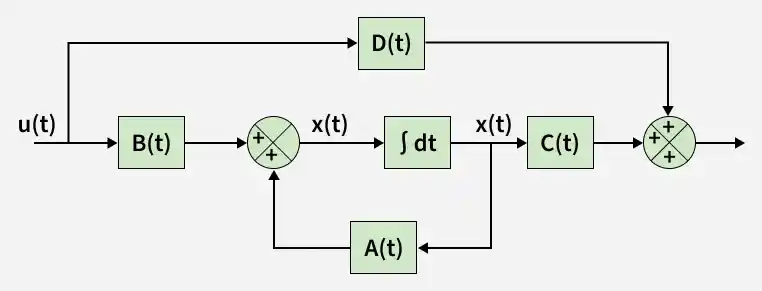
Linear Control System
Features
- Exhibits a linear courting between input and output.
- Principle of superposition holds.
- Mathematically tractable.
Applications
- **Temperature Control in HVAC Systems: Linear manipulate systems are hired in heating, air flow, and air conditioning (HVAC) structures to regulate temperature. The enter (favored temperature) is linearly associated with the control output (heating or cooling intensity).
- **Speed Control in Electric Motors: Linear manipulate is used to alter the velocity of electric motors. By adjusting the enter sign (voltage or present day), the system can manipulate the motor speed linearly.
- **Position Control in Robotics: Linear control is applied in robotics to control the location of robotic fingers or gadgets. The enter corresponds to the desired function, and the manage system adjusts the actuators to attain the specified region.
- **Voltage Regulation in Power Systems: Linear manage structures play a role in voltage law in strength structures. They adjust the voltage levels to maintain stability and meet the demand, making sure a linear courting between manage input and output.
- **Aircraft Altitude Control: Linear control is used inside the altitude manage structures of aircraft. The enter is the preferred altitude, and the control device adjusts the plane's manage surfaces to obtain and maintain the desired altitude.
Advantages
- **Mathematical Simplicity: Linear structures are mathematically nicely-behaved, making evaluation and design rather honest the use of linear algebra and calculus.
- **Superposition Principle: The superposition principle allows engineers to investigate the machine's reaction to man or woman components of the input one at a time, facilitating gadget information and design.
- **Predictable Behavior: Linear structures showcase predictable behavior, and their response to inputs may be without problems expected and modeled appropriately within their linear range.
- **Ease of Design: Designing controllers for linear systems is often less complicated compared to non-linear systems, making it less complicated to put in force and tune manipulate strategies.
- **Well-Established Theory: Linear manipulate concept is nicely-hooked up and widely taught, imparting a stable foundation for engineers running with linear systems.
Disadvantages
- **Limited Applicability to Nonlinear Systems: Linear manage structures are not suitable for structures with inherently nonlinear behavior. In some packages, nonlinearities may additionally cause inaccuracies in the manipulate system's performance.
- **Sensitivity to Parameter Variations: Linear structures can be touchy to versions in machine parameters, and adjustments in these parameters may also affect the device's stability and performance.
- **Difficulty in Representing Certain Systems: Some bodily systems are inherently nonlinear, and trying to model them as linear structures can also bring about inaccuracies or a loss of essential machine traits.
- **Not Ideal for Large Signal Variations: Linear control systems may not carry out well while handling massive sign variations or when the system operates out of doors its linear variety.
- **Assumes Time-Invariance: Linear control theory assumes that device parameters are time-invariant. In instances wherein parameters change over the years, linear models may end up faulty.
Non Linear Control Systems
Nonlinear manipulate systems, in comparison, contain nonlinear relationships between enter and output. The behavior of these systems is extra complicated and frequently nonlinear equations govern their dynamics. Nonlinear manage systems are encountered in programs in which linear approximations are insufficient, along with enormously dynamic systems, chaotic systems, and people with massive nonlinearity.
Non Linear Control System
Features
- Involves nonlinear relationships between enter and output.
- Applicable to complex and dynamic systems.
- May require advanced mathematical equipment for analysis.
Applications
- **Chaos Theory: Manages systems with inherently unpredictable and chaotic behavior, supplying manage in uncertain environments.
- **Biological Systems: Controls organic techniques accurately, considering the elaborate and nonlinear nature of biological structures, which include enzymatic reactions and genetic regulatory networks.
- **Aerospace Maneuvering: Guides aircraft thru dynamic and complex maneuvers by using adapting to nonlinear aerodynamic forces, ensuring stability in various flight situations.
- **Robotics with Flexible Structures: Navigates robots with deformable structures efficaciously, addressing the nonlinear dynamics associated with bendy robot additives.
- **Chemical Process Control: Regulates nonlinear chemical reactions in industrial strategies, considering variations in reactant concentrations and temperatures.
Advantages
- **Applicability to Complex Systems: Well-desirable for systems with complicated and nonlinear dynamics, imparting a extra accurate illustration of actual-global conduct.
- **Accurate Modeling: Precisely captures nonlinear relationships, imparting a extra devoted depiction of the system's behavior.
- **Robustness: Demonstrates resilience by means of efficaciously managing versions and disturbances in the dynamic conduct of the device.
- **Adaptability: Adjusts to modifications in machine dynamics, making sure effective manage in dynamic and evolving environments.
- **Wide Range of System Responses: Accommodates various and complex behaviors, taking into consideration powerful manage throughout a extensive spectrum of eventualities.
Disadvantages
- **Mathematical Complexity: Involves problematic mathematical modeling and evaluation because of the nonlinear nature of the systems, demanding advanced mathematical equipment.
- **Limited Analytical Tools: Offers fewer analytical equipment in comparison to linear structures, making evaluation and layout extra tough.
- **Challenging Controller Design: Requires complicated controller layout because of the complexity of nonlinear systems, frequently relying on advanced control strategies.
- **Less Intuitive: System behaviors may be much less intuitive as compared to linear systems, traumatic a deeper understanding of nonlinear dynamics.
- **Potential for Unpredictability: Some nonlinear systems might also showcase inherent unpredictability, adding a layer of uncertainty to the control system because of the complicated and nonlinear nature of their behaviors.
Time-Invariant and Time-Varying Control Systems
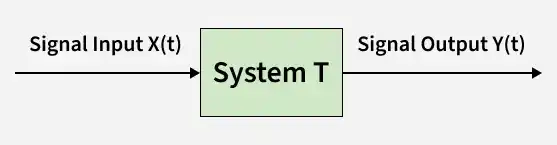
Time-invariant manage systems hold steady characteristics over the years. The parameters governing the machine's conduct continue to be unchanged. Conversely, time-varying manipulate structures experience versions of their parameters over time. Time-various systems are commonplace in packages in which the device's dynamics exchange due to external factors, making adaptability a essential requirement.
Non Linear Control System
Features
- Time-invariant structures preserve regular traits.
- Time-varying structures experience parameter variations over time.
Applications
- **Temperature Control in HVAC Systems: Time-Invariant: Maintains a steady temperature with unchanging parameters.
- **Volume Control in Audio Systems: Time-Invariant: Adjusts audio volume with regular manage parameters.
- **Pressure Control in Hydraulic Systems: Time-Invariant: Maintains solid stress with out parameter variations.
- **Aircraft Flight Control: Time-Varying: Adapts manage parameters in the course of specific flight stages for finest overall performance.
- **Autonomous Vehicles: Time-Varying: Adjusts control techniques based on converting avenue situations and using scenarios.
Advantages of Time-Invariant and Time-Varying Control Systems
**Adaptability
- Time-Varying: Well-appropriate for structures with dynamic or converting traits.
- Time-Invariant: Stable systems may additionally favor time-invariant manage for simplicity.
**Optimization under Varying Conditions
- Time-Varying: Can optimize overall performance below various situations.
- Time-Invariant: Consistent conduct over the years enhances predictability.
**Flexibility
- Time-Varying: Allows for bendy manage techniques in response to converting dynamics.
- Time-Invariant: Implementation is simple with constant parameters.
**Effective in Dynamic Environments
- Time-Varying: Excels in programs with dynamic and evolving conditions.
- Time-Invariant: System balance is less complicated to maintain.
**Accommodates Varied Behaviors
- Time-Varying: Accommodates a extensive range of device behaviors and responses.
- Time-Invariant: Well-suited for packages with strong and unchanging dynamics.
Disadvantages
**Increased Complexity
- Time-Varying: Analysis and layout are extra complex because of changing parameters.
- Time-Invariant: Less adaptable to structures with dynamic parameter adjustments.
**Potential Stability Challenges
- Time-Varying: Time variations might also introduce stability challenges.
- Time-Invariant: May now not optimize overall performance in dynamic environments.
**Challenging Controller Design
- Time-Varying: Requires complicated controller design due to changing dynamics.
- Time-Invariant: Ineffective for methods where parameters vary.
**Possibility of Suboptimal Performance
- Time-Varying: Performance may additionally vary and be suboptimal beneath certain conditions.
- Time-Invariant: Less effective in controlling structures with dynamic traits.
**Demanding Implementation
- Time-Varying: Implementing and tuning time-varying systems can be tough.
- Time-Invariant: Struggles with applications wherein parameters vary notably.
Continuous-Time and Discrete-Time Control Systems
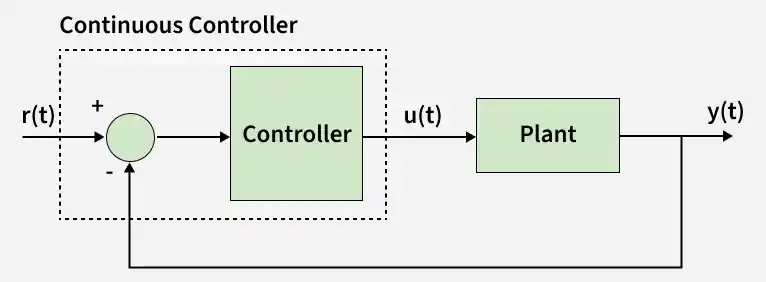
Control systems are also categorized based totally on the nature of time – whether or not time is continuous or discrete. Continuous-time control structures deal with that change constantly with respect to time, even as discrete-time control structures perform on change which might be sampled at discrete time intervals.
In digital control systems, the discrete-time domain is common, offering advantages in terms of accuracy, ease of implementation, and computational efficiency.
Continuous Time Control System
Features
- Continuous-time systems operate on alerts that adjust constantly.
- Discrete-time structures function on sampled signals at discrete intervals.
Applications of Continuous-Time and Discrete-Time Control Systems
**Temperature Control in HVAC Systems
- Continuous-Time: Analog thermostat structures for unique, actual-time temperature regulation.
- Discrete-Time: Digital thermostats sampling and adjusting temperature periodically.
**Motor Speed Control in Industrial Processes
- Continuous-Time: Analog control for non-stop pace adjustments in production.
- Discrete-Time: Digital manage for periodic speed updates in equipment.
**Water Level Regulation in Tanks
- Continuous-Time: Analog structures for non-stop tracking and adjustment.
- Discrete-Time: Digital systems periodically sampling and controlling water ranges.
**Robotics Positioning
- Continuous-Time: Analog manipulate for easy and continuous robotic arm actions.
- Discrete-Time: Digital control for unique positioning at discrete periods.
**Biomedical Systems for Drug Infusion
- Continuous-Time: Analog structures for continuous drug infusion in medical devices.
- Discrete-Time: Digital manipulate for periodic adjustments in drug delivery.
Advantages of Continuous-Time and Discrete-Time Control Systems
**Accurate Modeling
- Continuous-Time: Models bodily tactics appropriately with easy transitions.
- Discrete-Time: Avoids quantization errors related to non-stop processing.
**Real-Time Responsiveness
- Continuous-Time: Responds to indicators in real-time, critical for positive packages.
- Discrete-Time: Less vulnerable to noise, processing occurs at discrete periods.
**Analog and Digital Integration
- Continuous-Time: Well-perfect for programs requiring analog sign processing.
- Discrete-Time: Easier integration with virtual devices the usage of digital hardware.
**Noise Immunity
- Continuous-Time: Sensitive to noise because of continuous processing.
- Discrete-Time: Less at risk of noise, processing happens at discrete durations.
**Flexibility in Sampling Rate
- Continuous-Time: Smooth transitions may also seize rapid modifications effectively.
- Discrete-Time: Provides flexibility in adjusting the sampling fee for particular applications.
Disadvantages of Continuous-Time and Discrete-Time Control Systems
**Noise Sensitivity
- Continuous-Time: Sensitive to noise and disturbances because of non-stop processing.
- Discrete-Time: May now not seize fast modifications inside the system as effectively.
**Hardware Requirements
- Continuous-Time: Implementation may additionally require specialized hardware for precision.
- Discrete-Time: Sampling fee constraints and digital processing requirements.
**Limited Capture of Rapid Changes
- Continuous-Time: May seize speedy modifications efficiently with clean transitions.
- Discrete-Time: May no longer capture speedy modifications as efficiently due to discrete processing.
**Quantization
- Continuous-Time: Avoids quantization errors associated with discrete processing.
- Discrete-Time: Introduces quantization mistakes in signal processing.
Feedback Control Systems
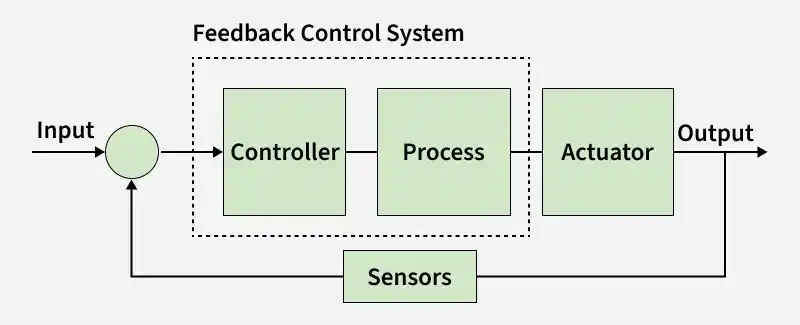
Feedback control systems, as stated earlier, involve a Feedback loop that continuously Monitors and adjusts the device's output. This approach enhances the stability, accuracy, and the systems's capability to reject disturbances. Feedback control structures are widely used in electronics engineering for applications starting from automated temperature manage in electronic gadgets to the stabilization of plane.
Feedback Control Systems
Features
- Utilizes remarks loops for non-stop monitoring.
- Adjusts the system based totally on measured output.
Applications
- **Temperature Regulation in HVAC Systems: Feedback manipulate systems modify heating or cooling inputs based totally on temperature sensors, keeping a desired room temperature.
- **Aircraft Flight Control: Feedback structures continuously display and regulate control surfaces to stabilize and steer the aircraft during flight.
- **Industrial Process Control: Used in production tactics to adjust variables including stress, drift, and temperature, making sure constant and preferred outputs.
- **Robotics and Automated Systems: Feedback manipulate is hired in robotics to enable particular moves and responses, permitting robots to conform to converting conditions.
- **Power Grid Voltage Control: Feedback manipulate structures regulate voltage degrees in electricity grids, adjusting electricity technology to preserve strong and preferred voltage situations.
Advantages
- **Continuous Monitoring: Provides actual-time information about the gadget's overall performance.
- **Stability: Enhances system stability by way of adjusting inputs primarily based on feedback.
- **Error Correction: Automatically corrects errors between favored and actual outputs.
- **Adaptability: Adjusts to adjustments in the machine or external disturbances.
- **Improved Precision: Enables precise manipulate through continuously refining machine responses.
Disadvantages
- **Complexity: Design and implementation may be complicated, especially for complex systems.
- **Sensitivity to Lag: Delays in remarks may cause instability or suboptimal overall performance.
- **Tuning Challenges: Requires careful tuning of parameters for top-quality performance.
- **Potential for Oscillations: Incorrect tuning may cause oscillations within the device.
- **Dependency on Sensors: Relies on accurate sensors for dependable feedback, which may additionally add to expenses.
Feedforward Control Systems
Feedforward control systems count on disturbances and adjust's System's input to counteract those disturbances. Unlike Feed-back Control systems, feedforward structures do no longer rely upon measuring the output and adjusting based totally on Feedbacks. They find Applications in situations in which the disturbance can be accurately predicted and proactively addressed.
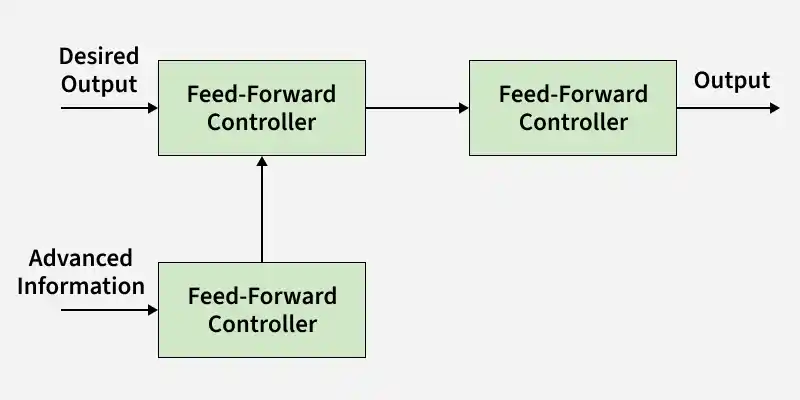
Feedforward Control System
Features
- Anticipates disturbances and adjusts inputs proactively.
- Does no longer depend on measured output Feedbacks.
Applications
- **Chemical Process Industries: Ensures consistent manufacturing exceptional in chemical plant life by means of expecting and countering disturbances.
- **Automotive Engine Control: Optimizes engine performance in automobiles by means of adjusting gas injection based totally on factors like acceleration and incline.
- **Temperature Control in HVAC Systems: Maintains favored indoor temperature by using looking forward to external adjustments and adjusting heating or cooling inputs.
- **Aerospace Engineering: Ensures solid flight and response to pilot commands through the use of feedforward manipulate to assume modifications in aerodynamic situations.
- **Precision Robotics: Enables solid and unique movements in robotics for applications like production or surgical operation by means of expecting and compensating for disturbances.
Advantages
- **Disturbance Rejection: Proactively minimizes the impact of anticipated disturbances on the system.
- **Faster Response: Acts earlier than changes affect the output, ensuing in quicker reaction times.
- **Reduced Dependency on Feedback: Operates independently of output comments, fending off capability instability problems.
- **Improved Stability: Enhances overall machine balance by using addressing disturbances earlier.
- **Precision in Control: Allows for specific manage by means of thinking about expected adjustments and disturbances.
Disadvantages
- **Complexity: Designing and enforcing powerful feedforward systems may be complex.
- **Difficulty in Disturbance Prediction: Accurate prediction of all disturbances is difficult.
- **Sensitivity to Model Inaccuracies: Performance is affected if the version used for feedforward control does not appropriately represent the gadget.
- **Limited in Handling Unforeseen Changes: Cannot take care of disturbances or changes that had been now not predicted for the duration of the design.
- **Potential for Overcompensation: Overcompensation may additionally occur if disturbances aren't appropriately anticipated, leading to suboptimal performance.
Digital Control Systems
Digital manipulate structures contain using virtual computers or processors to manage algorithms. These systems offer precise manipulate, ease of implementation, and the capability to address complex algorithms. Digital manipulate structures are customary in modern electronics engineering, locating packages in robotics, commercial automation, and utilized in various advanced control applications.
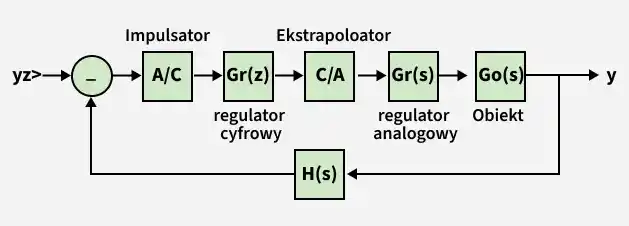
Digital Control System
Features
- Uses digital computer systems or processors.
- Implements control algorithms digitally.
Applications
- **Automotive Engine Control: Digital manage systems optimize engine overall performance by way of exactly adjusting gas injection, ignition timing, and other parameters primarily based on digital sensor readings.
- **Industrial Automation: Used in manufacturing procedures to manipulate variables such as temperature, pressure, and waft with high precision, improving the performance and nice of production.
- **Aircraft Flight Control: Digital manipulate systems in aviation alter control surfaces and manage flight parameters, ensuring strong and responsive plane overall performance.
- **Robotics and Motion Control: Applied in robotics for particular manipulate of movements and tasks, permitting robots to execute complicated operations in manufacturing, healthcare, and other industries.
- **Digital Audio Processing: Utilized in audio structures for responsibilities like equalization, filtering, and sign processing, supplying superb sound reproduction in programs starting from song manufacturing to telecommunications.
Advantages
- **Precision: Provides specific manipulate by processing signals in discrete steps.
- **Flexibility: Easily reprogrammable for distinctive control techniques and applications.
- **Integration with Digital Devices: Seamlessly integrates with other digital structures and devices.
- **Ease of Implementation: Digital hardware additives are extensively available and smooth to enforce.
- **Robustness: Resilient to noise and disturbances due to digital signal processing abilities.
Disadvantages
- **Sampling Limitations: The discrete nature of virtual systems introduces limitations, specifically in taking pictures rapid changes.
- **Computational Load: Complex algorithms and excessive sampling quotes may additionally impose computational hundreds.
- **Analog-to-Digital Conversion: Requires accurate analog-to-digital conversion for interfacing with analog sensors and actuators.
- **Potential for Quantization Errors: The finite decision of virtual indicators may also result in quantization mistakes.
- **Initial Cost: Implementation may also have higher preliminary costs because of virtual hardware requirements.