OpenLoop Control System vs ClosedLoop Control System (original) (raw)
Open-Loop Control System vs Closed-Loop Control System
Last Updated : 12 Mar, 2026
A control system is a system in which the behavior of the system is described using differential equations. It regulates and manages the operation of devices and processes through control loops. Control systems are mainly classified into Open-Loop Control Systems and Closed-Loop Control Systems.
Open-Loop Control System
A system operates without feedback, so the output is not compared with the desired input. Such systems remain simple in design and economical to implement. Error correction and automatic adjustment are not possible; performance optimization cannot be achieved. Maintenance and operation are generally easy.
**Advantages
- Design and implementation remain simple and easy.
- Requires low cost and minimal maintenance.
- Provides fast system operation.
- Suitable for applications where high accuracy is not required.
- Easy to operate and understand due to its simple structure.
**Disadvantages
- Provides low accuracy and precision in system output.
- Performance can be affected by external disturbances and parameter variations.
- Not suitable for applications that require a high level of accuracy and precision.
- Errors cannot be corrected automatically because feedback is not present.
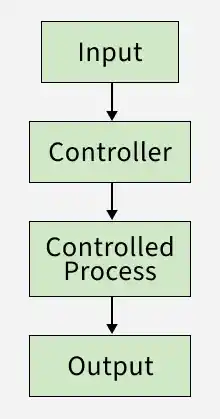
Open-Loop Control System
Closed-Loop Control System
A system is used in applications where feedback and error correction are required. The output is continuously compared with the desired input, and automatic adjustments reduce errors. The design is more complex and the cost is higher compared to open-loop systems. However, performance optimization and higher accuracy can be achieved. Maintenance and system management are relatively more difficult.
**Advantages of Closed-Loop Control System:
- Provides high accuracy and precise system output.
- Reduces the effect of external disturbances and parameter variations.
- Suitable for applications that require a high level of accuracy and control.
- Automatically corrects errors through the feedback mechanism.
- Improves overall system performance and stability.
**Disadvantages of Closed-Loop Control System:
- Design and implementation are more complex.
- Requires higher cost and regular maintenance.
- Operates at a slower speed compared to open-loop systems.
- Feedback components increase overall system complexity.
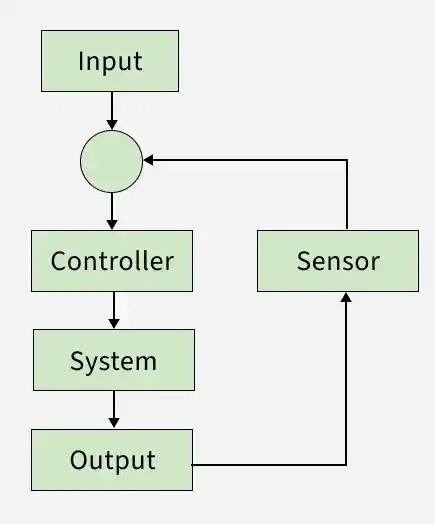
Closed-Loop Control System.
**Similarities between Open-Loop Control System and Closed-Loop Control System:
- Both systems are developed to produce a desired output or achieve a particular objective.
- Each system uses devices such as sensors and actuators for measurement and control of system variables.
- Both operate using control actions to regulate the performance of the system.
- Mathematical models or control algorithms are often used to analyze and design both systems.
- Applications of both systems appear in areas like industrial processes, robotics, and automation.
**Open-Loop Control System vs Closed-Loop Control System:
| S.No. | Open-Loop Control System | Closed-Loop Control System |
|---|---|---|
| 1. | Easy to design and build. | Design and construction are more complex. |
| 2. | Performance depends on proper calibration. | Performance improves due to feedback. |
| 3. | Generally more stable. | Comparatively less stable. |
| 4. | Optimization for desired output can not be performed. | Optimization can be done very easily. |
| 5. | Feedback mechanism is not present. | Feedback mechanism is present. |
| 6. | Requires less maintenance. | Maintenance is difficult. |
| 7. | Less reliable in changing conditions. | More reliable due to automatic correction. |
| 8. | Operates comparatively slower. | Operates faster and responds quickly. |
| 9. | Installation is simple and economical. | Installation is complex and expensive. |