Difference between Sensor and Actuator (original) (raw)
Last Updated : 12 Jul, 2025
Sensor and actuators are basic elements in numerous electrical and mechanical structures. On the same note, sensors are tasked with the responsibility of identifying changes within an environment while actuators are tasked with the responsibility of performing certain actions in response to these detections. It is important for anyone who is employed in certain professions, to have clear distinctions between these two, should work within robotics, automation, as well as control systems.
**Sensor
Sensor is a device used for the conversion of physical events or characteristics into the electrical signals. This is a hardware device that takes the input from environment and gives to the system by converting it. For example, a thermometer takes the temperature as physical characteristic and then converts it into electrical signals for the system.
Types of Sensors
- **Temperature Sensors: Take temperatures.
- **Light Sensors: Light intensity sensors: It has the function of detecting the intensity of the light.
- Pressure Sensors: To use it to measure pressure in gases or liquids.
- **Motion Sensors: Recognize motion in an established region.
Advantages of Sensors
- Offer timely and accurate information as this is a critical requirement by the high release frequency.
- Support automation and management of systems.
- Improve safety by maintaining check on important parameters.
Disadvantages of Sensors
- Sometimes can be costly particularly the high precision sensors.
- It can sometimes need some adjustments and can also probably require maintenance in the long run.
- Interference from the environment is easy in this process.

**Actuator
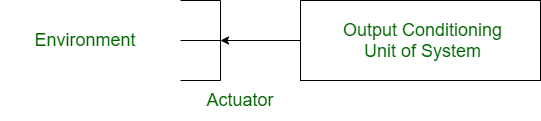
Actuator is a device that converts the electrical signals into the physical events or characteristics. It takes the input from the system and gives output to the environment. For example, motors and heaters are some of the commonly used actuators.
Types of Actuators
- **Linear Actuators: Utilize a linear motion to convert energy, Kinetic/pendulum.
- **Rotary Actuators: This will affect the creation of rotational motion.
- **Hydraulic Actuators: How does fluid power gives motion.
- **Pneumatic Actuators: Function with use of compressed air.
Advantages of Actuators
- Assist in providing a fine level of control of mechanical installations.
- They should enable automation and therefore minimize the need for intervention of human participants.
- Available in a range of variations and suitability in multiple operations ranging from everyday uses to industrial use.
Disadvantages of Actuators
- May consume much power in its operation particularly when used in places that involve much power such as in large industries.
- May be large and costly to both install and maintain.
- As a disadvantage there is a circumstance that, with time the component is liable to mechanical wear and tear.
**Difference between Sensor and Actuator
| SENSOR | ACTUATOR |
|---|---|
| It converts physical characteristics into electrical signals. | It converts electrical signals into physical characteristics. |
| It takes input from environment. | It takes input from output conditioning unit of system. |
| It gives output to input conditioning unit of system. | It gives output to environment. |
| Sensor generated electrical signals. | Actuator generates heat or motion. |
| It is placed at input port of the system. | It is placed at output port of the system. |
| It is used to measure the physical quantity. | It is used to measure the continuous and discrete process parameters. |
| It gives information to the system about environment. | It accepts command to perform a function. |
| Example: Photo-voltaic cell which converts light energy into electrical energy. | Example: Stepper motor where electrical energy drives the motor. |
Conclusion
Sensors and actuators are critical components of contemporary technologies and function in harmonious ways. Actuators act in response to information received from sensors and do specific tasks based on detected information from the environment. It is necessary to emphasize that the difference between these two elements has to be defined properly for the proper development of the control system with the subsequent focus on its efficiency.