Application of Derivative Maxima and Minima (original) (raw)
Last Updated : 12 Jan, 2026
Derivatives have many applications, like finding rate of change, approximation, maxima/minima and tangent. In this section, we focus on their use in finding maxima and minima.
If
f(x)is a continuous function, then for every continuous function on a closed interval has a maximum and a minimum value.
**Let f be a real-valued function and let a be an interior point in the domain of f. Then
- **Local Maximum: A point **a is called a point of local maxima if there is an h > 0 such that f(a) ≥ f(x), for all x in (a – h, a + h), x ≠ a The value f(a) is called the local maximum value of f.
- **Local Minimum: A point a is called a point of local minima if there is an h > 0 such that f(a) ≤ f(x), for all x in (a – h, a + h) The value f(a) is called the local minimum value of f.
Let f be a function defined on an open interval I. Suppose c ∈ I be any point. If f has a local maxima or a local minima at x = c, then either f'(c) = 0 or f is not differentiable at c.
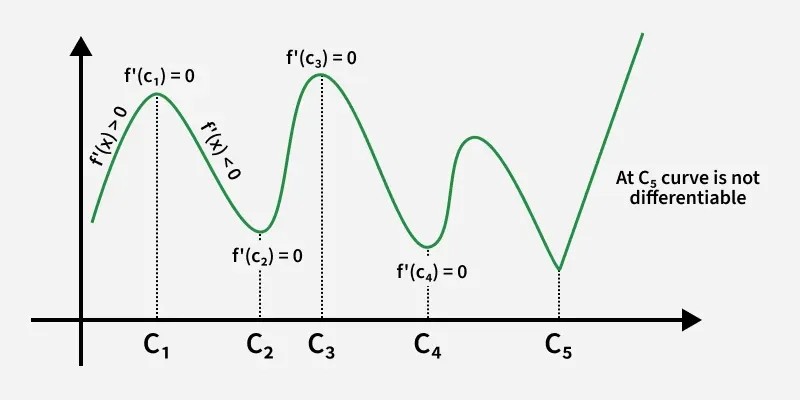
In the above diagram C3 is global maxima and C4local minima.
**First derivative test
To find local maxima and minima, we first find the critical points of the function, where the first derivative f′(x) equals zero or is undefined. We then check how the sign of the first derivative changes around these points:
- If {f}'(x) changes it's sign from positive to negative then the point c at which it happens is l**ocal maxima.
- If {f}'(x) changes it's sign from negative to positive then the point c at which it happens is **local minima.
- If {f}'(x) does not change it's sign as x increases through c then the point is point of inflection.
**Example:
f(x)=x^3−3x^2+2:
1. First derivative: f'(x) = 3x^2 - 6x
2. Critical points: Set f'(x) = 0→ x = 0 and x = 2
3. Test intervals:
- For x < 0 (positive slope), f′(x) > 0
- For 0 < x < 2 (negative slope), f′(x) < 0
- For x > 2 (positive slope), f′(x) > 0
Local maximum at x=0 (slope changes from positive to negative)
Local minimum at x=2 (slope changes from negative to positive)
**Second derivative test
The second derivative test can help determine the concavity of the function at critical points, which further allows us to classify the nature of those points:
1. Find values of x for which {f}'(x) = 0, these points are called critical points.
2. Find {f}''(x) and put the values of x which was found above, if
- {f}''(x)>0then the point is minima
- {f}''(x)<0 then the point is maxima
- {f}''(x)=0 then we can not say anything,
now we have to use first derivative to check whether the point is point of inflection, local minima or local maxima.
**Example:
f(x) = x^3 - 3x^2 + 2
1. First derivative: f' (x) = 3x^2 - 6x
2. Second derivative: f'' (x) = 6x - 6
3. Critical points: x = 0, x = 2
- At x = 0, f′′ (0) = −6 → local maximum (since f′′ (x) < 0)
- At x = 2, f′′ (2) = 6 → local minimum (since f′′ (x) > 0)
**Stationary Point
A point on which the tangent to the graph is horizontal is known as a stationary point, i.e the point at which
\frac{dx}{dy} = 0
Stationary points are candidates for local maxima, minima, or points of inflection.
**Example:
For f(x) = x^2 - 4x + 3:
- First derivative: f'(x) = 2x - 4
- Find stationary point: Set f′(x) = 0 → x = 2
- Function value at stationary point: f(2) = −1
Stationary point at (2 , −1), where the tangent is horizontal.
**Finding Maximum and Minimum Values in a Closed Interval:
To find the maximum and minimum values of a function on a closed interval [a , b], follow these steps:
- **Find critical points: Solve f′(x) = 0 to find critical points within the interval [a , b].
- **Evaluate the function at the endpoints: Find f(a) and f(b).
- **Compare the function values: The maximum and minimum values will either occur at one of the critical points or at the endpoints of the interval.
**Example:
For f(x) = x^2 - 4x + 3 on the interval [0,3]:
- First derivative: f'(x) = 2x - 4
- Critical point: f'(x) = 0 \Rightarrow x = 2
- Evaluate at endpoints and critical point: f(0) = 3, f(2) = −1, f(3) = 0
So, Maximum value: 3 at x = 0
Minimum value: −1 at x= 2
Steps to find Maximum and Minimum
Let's say you have a function f(x) and you want to find the maximum and minimum on the interval [a, b]. You would:
- Compute the derivative f′ (x).
- Find the critical points by solving f ′(x) = 0.
- Use the second derivative test or first derivative test to classify these points as maxima, minima, or points of inflection.
- Evaluate f(x) at the critical points and the end points a and b.
- Compare the values to find the maximum and minimum.
Practice problems
- Find the first derivative of the function f(x) = 3x^2 - 5x + 4
2)For f(x) = x^3 - 6x^2 + 9x, find the local maxima and minima using the first derivative test.
Determine the maximum and minimum values of f(x) = x^2 - 6x + 5 on the interval [1 , 4]
Use the first derivative test to determine the nature of the critical points for f(x) = 2x^3 - 9x^2 + 12x.
Classify the critical points of f(x) = x^4 - 4x^2 using the second derivative test.
Find the stationary points of f(x) = x^3 - 4x + 1 and classify them.