Boolean Algebraic Theorems (original) (raw)
Last Updated : 21 Feb, 2026
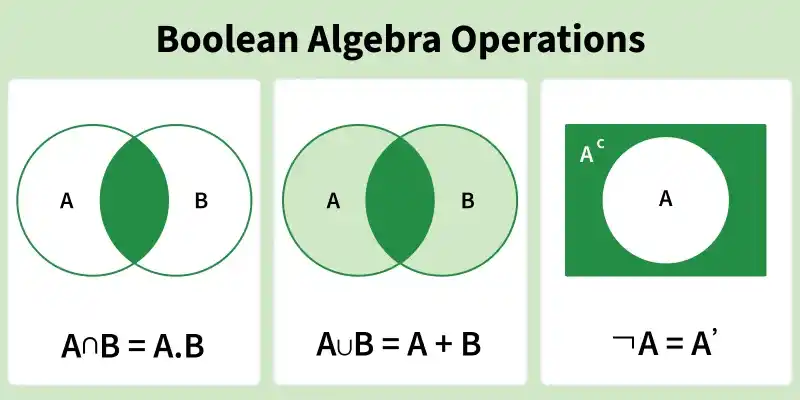
A Boolean algebraic theorem is a proven rule or identity in Boolean algebra that helps simplify logical expressions made using 0 and 1. It shows how Boolean expressions behave when we use operations like:
- AND ( · )
- OR ( + )
- NOT ( ′ )
Fundamental Theorems of Boolean Algebra
Identity Law
In the Boolean Algebra, we have identity elements for both AND(.) and OR(+) operations. The identity law state that in boolean algebra we have such variables that on operating with AND and OR operation we get the same result, i.e.
- A + 0 = A
- A . 1 = A
Commutative Law
Binary variables in Boolean Algebra follow the commutative law. This law states that operating boolean variables A and B is similar to operating boolean variables B and A. That is,
- A . B = B . A
- A + B = B + A
Associative Law
Associative law state that the order of performing Boolean operator is illogical as their result is always the same. This can be understood as,
- ( A . B ) . C = A . ( B . C )
- ( A + B ) + C = A + ( B + C)
Distributive Law
Boolean Variables also follow the distributive law and the expression for Distributive law is given as:
- A . ( B + C) = (A . B) + (A . C)
Inversion Law
Inversion law is the unique law of Boolean algebra this law states that, the complement of the complement of any number is the number itself.
- (A’)’ = A
Advanced Boolean Theorems
1. De Morgan's Theorem
De Morgan's Theorems provide a way to express conjunctions and disjunctions purely in terms of each other via negation.
- \overline{A . B} = \overline {A} + \overline {B}
- \overline{A + B} = \overline {A} . \overline {B}
2. Transposition Theorem
The Transposition Theorem is used to infer a logical implication from another implication.
A \rightarrow B is equivalent to \overline B \rightarrow \overline A
3. Redundancy Theorem
The Redundancy Theorem shows how redundant terms in Boolean expressions can be eliminated without changing the expression's truth value.
- A + A . B = A
- A . (A + B) = A
4. Duality Theorem
The Duality Theorem states that every Boolean algebraic expression remains valid if the operators and identity elements are swapped (AND ↔ OR, 0 ↔ 1).
If an expression F is valid, then its dual FD is also valid, where FD is obtained by replacing all + with . , . with +, 0 with 1, and 1 with 0.
5. Complementary Theorem
The Complementary Theorem deals with the behavior of Boolean expressions involving variables and their complements.
- A . \overline A = 0
- A + \overline A = 1
Applications of Boolean Algebra
- **Digital Circuit Design: Boolean algebra is used to simplify logic circuits in digital electronics. By applying Boolean theorems, complex logic expressions can be minimized, resulting in more efficient circuit designs.
- **Computer Programming: In programming, Boolean algebra is used for conditional statements and controlling the flow of programs. Logical operations are fundamental in algorithms and data structures.
- **Network Security: Boolean logic is applied in designing and analyzing security protocols, such as encryption algorithms and access control mechanisms.
- **Database Query Optimization: Boolean algebra is used in query optimization in databases to efficiently retrieve and manipulate data.