Hasse Diagrams (original) (raw)
Last Updated : 19 Aug, 2025
A Hasse diagram is a graphical representation of the relation of elements of a partially ordered set (**poset) with an implied upward orientation.
- Each element of the poset is shown as a **point.
- If _p < _q and there is no element _r such that _p < _r, then _p and _q are joined by a line, with _p placed **below _q.
- Redundant connections are omitted (e.g., if _A < _B and _B < _C, the direct link _A < _C is skipped).
- Items higher in the diagram represent **greater elements.
**Necessary Condition: To draw a Hasse diagram, the provided set must be a poset.
A **poset A is a pair (B, ≤), where B is a set and ≤ is a partial order on B that satisfies:
- **Reflexivity → p **≤ p ∀ p 𝜖 B
- **Anti-symmetric → p **≤ q and q **≤ p if p = q
- **Transitivity → if p **≤ q and q **≤ r, then p **≤ r
Steps to Draw a Hasse Diagram
- **List the elements and their relationships: Write down all the elements in the set and figure out how they are related (like "smaller than," "divides," etc.).
- **Draw all elements as dots: Each element is represented by a dot. Start with smaller elements at the bottom and bigger ones at the top.
- **Connect related dots: Draw lines between the dots if one element is directly related to another (like
a < bora divides b). - **Remove unnecessary connections: If a relationship can be figured out through other connections, skip it. For example, if
a < bandb < c, there is no need to draw a line fromatoc.
Examples of Hasse Diagram
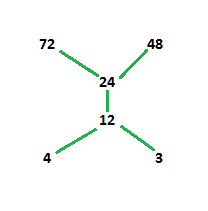
**Example 1: Draw a Hasse diagram for ({3, 4, 12, 24, 48, 72}, /). Find the Maximal, Minimal, Greatest, and Least element.
**Solution:
According to above given question first, we have to find the poset for the divisibility.
Let the set is A.
A={(3 \prec 12), (3 \prec24), (3 \prec 48), (3 \prec 72), (4 \prec 12), (4 \prec 24), (4 \prec 48), (4 \prec 72), (12 \prec 24), (12 \prec 48), (12 \prec72), (24 \prec 48), (24 \prec 72)}
So, now the Hasse diagram will be:
In above diagram,
- 3 and 4 are at same level because they are not related to each other and they are smaller than other elements in the set.
- The next succeeding element for 3 and 4 is 12 i.e, 12 is divisible by both 3 and 4.
- Then 24 is divisible by 3, 4 and 12. Hence, it is placed above 12.
- 24 divides both 48 and 72 but 48 does not divide 72. Hence 48 and 72 are not joined.
We can see transitivity in our diagram as the level is increasing.
Maximal elements are 48 and 72 since they are succeeding all the elements.
Minimal elements are 3 and 4 since they are preceding all the elements.
Greatest element does not exist since there is no any one element that succeeds all the elements.
Least element does not exist since there is no any one element that precedes all the elements.
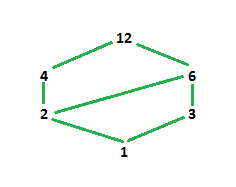
**Example 2: Draw a Hasse diagram for (D12, /). Find the Maximal, Minimal, Greatest, and Least element.
**Solution:
Here, D12 means set of positive integers divisors of 12.
So, D12 = {1, 2, 3, 4, 6, 12}
poset A = {(1 \prec 2), (1 \prec 3), (1 \prec 4), (1 \prec 6), (1 \prec 12), (2 \prec 4), (2 \prec 6), (2 \prec 12), (3 \prec 6), (3 \prec 12), (4 \prec 12), (6 \prec12)}
So, now the Hasse diagram will be-
In above diagram,
- 1 is the only element that divides all other elements and smallest. Hence, it is placed at the bottom.
- Then the elements in our set are 2 and 3 which do not divide each other hence they are placed at same level separately but divisible by 1 (both joined by 1).
- 4 is divisible by 1 and 2 while 6 is divisible by 1, 2 and 3 hence, 4 is joined by 2 and 6 is joined by 2 and 3.
- 12 is divisible by all the elements hence, joined by 4 and 6 not by all elements because we have already joined 4 and 6 with smaller elements accordingly.
Maximal and Greatest element is 12 and Minimal and Least element is 1.
**Example 3: Consider the poset ((P, ≤)) where (P = {1, 2, 3, 4, 6, 12}) and the relation (≤) is divisibility.
**Solution:
Elements: 1, 2, 3, 4, 6, 12
Order Relations: 1 divides all, 2 divides 4 and 6, 3 divides 6, 4 divides 12, 6 divides 12.
12
/ \
6 4
| \ |
3 2
\ /
1
**Example 4: Consider the poset ((P, ≤)) where (P = {a, b, c, d}) and the relation ≤ is defined as (a ≤ b), (a ≤ c), (b ≤ d), (c ≤ d).
**Solution :
Consider the poset ((P, ≤)) where (P = {a, b, c, d}) and the relation (≤) is defined as (a ≤ b), (a ≤ c), (b ≤ d), (c ≤ d). Elements: a, b, c, d Order Relations: (a ≤ b), (a ≤ c), (b ≤ d), (c ≤ d).
Consider the poset ((P, ≤)) where (P = {a, b, c, d}) and the relation (≤) is defined as (a ≤ b), (a ≤ c), (b ≤ d), (c ≤ d). Elements: a, b, c, d Order Relations: (a ≤ b), (a ≤ c), (b ≤ d), (c ≤ d).
d
/ \
b c
\ /
a
**Properties of Hasse Diagram
- Maximal element is an element of a POSET that is not less than any other element of the POSET. Or we can say that it is an element that is not related to any other element. Top elements of the Hasse Diagram.
- Example- In the diagram above, we can say that 4,2,3,6,1 are related to 12 (ordered by division, e.g., (4,/) ), but 12 is not related to any other. (As a Hasse Diagram is upward directional).
- A minimal element is an element of a POSET that is not greater than any other element of the POSET. Or we can say that no other element is related to this element. Bottom elements of the Hasse Diagram.
- Example- In the diagram above, we can say that 1 is related to 2,3,4,6,12 (ordered by division, e.g., (4,/) ), but no element is related to 1. (As a Hasse Diagram is upward directional).
- The greatest element (if it exists) is the element succeeding all other elements.
- The least element is the element that precedes all other elements.
**Note:
- **The greatest and Least elements in a Hasse diagram are only one.
- **An element can be both maximal and minimal
Example:
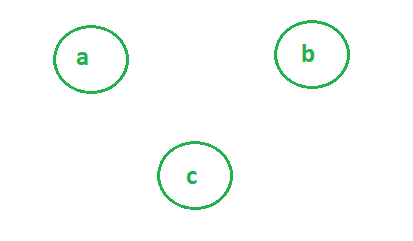
Here, a, b, and c are maximal as well as minimal.
Practice Problems on Hasse Diagram
Problem 1: Given the set (P = {1, 2, 4, 8}) with (≤) being divisibility, draw the Hasse diagram.
Problem 2: Given the set (P = {a, b, c, d, e}) with the relations (a ≤ b), (a ≤ c), (b ≤ d), (c ≤ d), (d ≤ e), draw the Hasse diagram.
Problem 3: Given the set (P = {1, 3, 9, 27}) with (≤ ) being divisibility, draw the Hasse diagram.
Problem 4: Given the set (P = {2, 5, 10, 20}) with (≤) being divisibility, draw the Hasse diagram
Problem 5: Given the set (P = {a, b, c, d, e}) with the relations (a ≤ c), (b ≤ c), (c ≤ d), (d ≤ e), draw the Hasse diagram.
Problem 6: Given the set (P = {x, y, z, w}) with the relations (x ≤ y), (y ≤ z), (z ≤ w), draw the Hasse diagram.
Problem 7: Given the set (P = {m, n, o, p, q}) with the relations (m ≤ n), (m ≤ o), (n ≤ p), (o ≤ p), (p ≤ q), draw the Hasse diagram.
Problem 8: Given the set (P = {4, 8, 16, 32}) with (≤) being divisibility, draw the Hasse diagram.
Problem 9: Given the set (P = {r, s, t, u, v}) with the relations (r ≤ s), (s ≤ t), (t ≤ u), (u ≤ v), draw the Hasse diagram.
Problem 10: Given the set (P = {1, 2, 5, 10}) with (≤ ) being divisibility, draw the Hasse diagram.