Partial Derivatives in Engineering Mathematics (original) (raw)
Last Updated : 13 May, 2026
In multivariable calculus, a partial derivative of a function measures the rate of change of the function with respect to one of its variables, while all other variables are held constant. Partial derivatives are essential in studying functions of several variables and have wide applications in physics, engineering, economics, statistics, and machine learning.
A partial derivative of a function of several variables is its derivative with respect to one of those variables, with all other variables held constant. For a function f(x,y), the partial derivative with respect to x, denoted as ∂f/∂x, measures the rate at which f changes as x changes, while y remains fixed.
Notation and Calculation
The most common notation for partial derivatives includes ∂f/∂x and fx for the partial derivative of f with respect to x.
To calculate a partial derivative:
- Identify the variable with respect to which you are differentiating.
- Treat all other variables as constants.
- Differentiate the function with respect to the chosen variable using the rules of differentiation.
Example:
For the function f(x, y) = x2y+3xy2:
The partial derivative with respect to x is:
∂f/∂x = 2xy+3y2
The partial derivative with respect to y is:
∂f/∂y = x2 + 6xy
Properties of Partial Derivatives
Higher-Order Partial Derivatives
Partial derivatives of a given function of higher order are obtained when the function is differentiated successively with respect to one or more variables. If there are two independent variables, say x and y, in a function, f(x,y), then the second order partial derivatives are:
- ∂2f/∂x2 : The second partial derivative with respect to x.
- ∂2f/∂y2 : The second partial derivative with respect to y.
- ∂2f/∂x∂y or ∂2f/∂y∂x: The mixed partial derivatives.
**Example: For f(x,y)=sin(xy), the second-order partial derivatives are:
- ∂2f/∂x2 = −y2sin(xy)
- ∂2f/∂y2 = −x2sin(xy)
- ∂2f/∂x∂y or ∂2f/∂y∂x = cos(xy)−xysin(xy)
Computing Partial Derivatives
Computing partial derivatives involves systematic application of differentiation rules:
- **Identify the variable of interest: Determine which variable you are differentiating with respect to.
- **Apply differentiation rules: Use standard rules (product, chain, quotient) while treating all other variables as constants.
- **Check for higher-order derivatives: If needed, differentiate again to obtain higher-order derivatives.
**Example: For the function f(x,y,z)=exy ⋅z3 :
- ∂f/∂x = y⋅exy⋅z3
- ∂f/∂y = x.exy ⋅z3
- ∂f/∂z = 3z2 .exy
Partial Derivatives Examples
Some examples of multivariable functions or functions of several variables are:
1. f(x, y) = x2 + y
2. f(x, y, z) = x - 3y + 4z
To understand this better, let us compare with single-variable functions.
- For a single-variable function, say f(x) = x2, we can plot it on a 2D graph as:
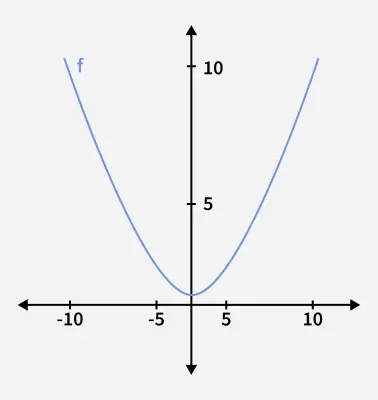
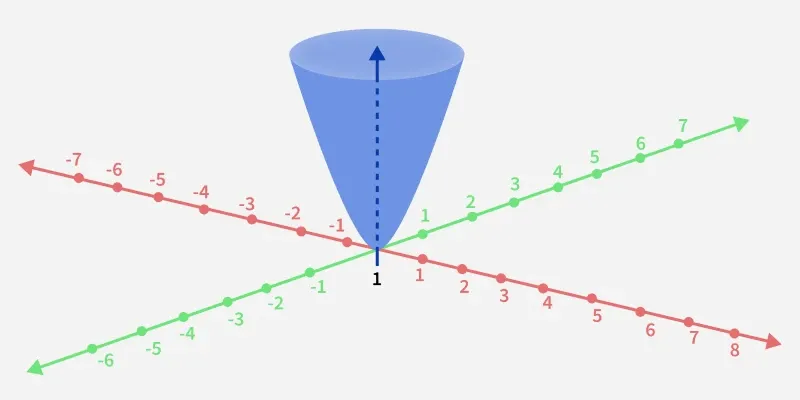
- Functions of two variables like f(x,y) = x2 + y2, we need a 3D graph for visualization, we plot it on the 3-D plane as:
**Geometrical Interpretation of Partial Derivative
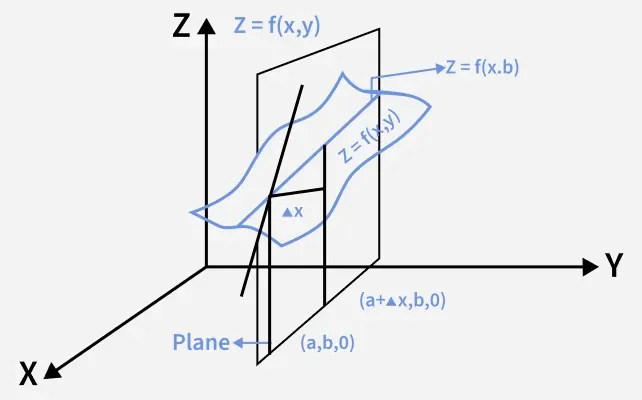
- For single-variable functions, the derivative represents the slope of the tangent at a point.
- For multivariable functions, the partial derivative represents the slope of the tangent to the curve formed by intersecting the surface z = f(x,y) with a plane (e.g., y = b****).**
Consider z = f(x, y) on the 3D plane and pass a plane y = b.
- This gives the curve z = f(x, b).
- For two points P and R on this curve, the slope of the secant is:
m = \frac{\Delta z}{\Delta x} = \frac{f(x+\Delta x, b) - f(x, b)}{\Delta x}
**Taking the limit as Δx → 0:
\frac{\partial z}{\partial x} = \lim_{\Delta y \to 0} \frac{f(x+\Delta x,b) - f(x, b)}{\Delta x}
Calculation of Partial Derivatives of a Function
Steps to calculate partial derivative of a given function :
- Consider z = f(x, y).
- Compute partial derivative with respect to 'x' i.e. \frac{\partial z}{\partial x} by considering 'y' as constant and differentiate the function with respect to 'x'.
- Compute partial derivative with respect to 'y' i.e. \frac{\partial z}{\partial y} by considering 'x' as constant and differentiate the function with respect to 'y'.
**Example: z = x2 + y2 + 3xy
Here, for the given function, we calculate the two partial derivatives as follows :
**Case 1: Differentiating with respect to 'x' by treating 'y' as constant i.e. \frac{\partial z }{\partial x}
z = x2 + y2 + 3xy
∂z/∂x = 2x + 0 + 3y
∂z/∂x = 2x + 3y
**Case 2: Differentiating with respect to 'y' by treating 'x' as constant i.e. \frac{\partial z }{\partial y}
z = x2 + y2 + 3xy
∂z/∂y = 0 + 2y + 3x
∂z/∂y = 2y + 3x
Second-Order Partial Derivatives
Similar to the computation of second-order derivatives for functions of single variables, we can compute the same for functions of several variables.
For an example we consider the same function z = x2 + y2 + 3xy.
**Case 1: We differentiate \frac{\partial z}{\partial x} again with respect to 'x'
∂z/∂x = 2x + 3y
∂2z/∂x2 = 2
**Case 2: We differentiate \frac{\partial z}{\partial y} again with respect to 'y'
∂z/∂y = 2y + 3x
∂2z/∂y2 = 2
**Case 3: We differentiate \frac{\partial z}{\partial x} again with respect to 'y'
∂z/∂x = 2x + 3y
∂2z/∂x∂y = 3
**Case 4: We differentiate \frac{\partial z}{\partial y} again with respect to 'x'
∂z/∂y = 2y + 3x
∂2z/∂y∂x = 3
Applications of Partial Derivatives in Engineering
Partial derivatives are widely used in various engineering disciplines to solve problems involving multiple variables:
- **Heat Transfer: Describing the change in temperature distribution over time and space.
- **Fluid Dynamics: Analyzing velocity fields and pressure distributions in fluid flows.
- **Structural Analysis: Determining stress and strain in materials under load.
Solved Examples
**Basic partial differentiation: Given f(x,y) = x2y + 3xy2, find ∂f/∂x and ∂f/∂y.
**Solution:
∂f/∂x = 2xy + 3y2 (treat y as a constant)
∂f/∂y = x2 + 6xy (treat x as a constant)
**Higher-order partial derivatives: For f(x,y) = x3y2 + 2xy, find ∂²f/∂x², ∂²f/∂y², and ∂²f/∂x∂y.
**Solution:
∂f/∂x = 3x2y2 + 2y
∂²f/∂x² = 6xy2
∂f/∂y = 2x3y + 2x
∂²f/∂y² = 2x3
∂f/∂x = x3y2 + 2y
∂²f/∂x∂y = 6xy2 + 2
**Chain rule for partial derivatives: If z = f(x,y) where x = r cos θ and y = r sin θ, express ∂z/∂r and ∂z/∂θ in terms of ∂z/∂x and ∂z/∂y.
**Solution:
∂z/∂r = (∂z/∂x)(∂x/∂r) + (∂z/∂y)(∂y/∂r)
= (∂z/∂x)(cos θ) + (∂z/∂y)(sin θ)
∂z/∂θ = (∂z/∂x)(∂x/∂θ) + (∂z/∂y)(∂y/∂θ)
= (∂z/∂x)(-r sin θ) + (∂z/∂y)(r cos θ)
**Implicit differentiation: Given x2 + y2 + z2 = 1, find ∂z/∂x and ∂z/∂y.
**Solution:
Differentiate with respect to x:
2x + 2y(∂y/∂x) + 2z(∂z/∂x) = 0
∂z/∂x = -x/z
Differentiate with respect to y:
2y + 2x(∂x/∂y) + 2z(∂z/∂y) = 0
∂z/∂y = -y/z
Gradient:
Find the gradient of f(x,y,z) =. 2x2 y+ yz3 - 3xz
Solution:
∇f = (∂f/∂x, ∂f/∂y, ∂f/∂z)
= (4xy - 3z, 2x2 + z3, 3yz2 - 3x)
**Directional derivative: For f(x, y) = x2 + 2xy + y2, find the directional derivative at (1, 2) in the direction of u = (3/5, 4/5).
**Solution:
∇f = (2x + 2y, 2x + 2y)
At (1,2): ∇f = (6, 6)
Directional derivative = ∇f · u
= (6, 6) · (3/5, 4/5)
= (6 * 3/5) + (6 * 4/5)
= 18/5 + 24/5
= 42/5 = 8.4
**Partial differential equation: Verify that u(x, t) = e(-at) sin(x) is a solution to the heat equation ∂u/∂t = k(∂²u/∂x²).
**Solution:
∂u/∂t = -ae(-at) sin(x)
∂u/∂x = e(-at)cos(x)
∂²u/∂x² = -e(-at) sin(x)
Substituting into the heat equation:
-ae(-at) sin(x) = k(-e(-at)sin(x))
This is true if a = k, verifying the solution.
**Laplacian: Find the Laplacian of f(x,y,z) = x2y + yz2 + xz.
**Solution:
∇²f = ∂²f/∂x² + ∂²f/∂y² + ∂²f/∂z²
∂²f/∂x² = 2y
∂²f/∂y² = 0
∂²f/∂z² = 2y
∇²f = 2y + 0 + 2y = 4y
Unsolved Question on Partial Derivatives
**Question 1: Find df/dx and df/dy for f(x, y) = x2y3 + 4xy + ey
**Question 2: Find the Laplacian ∇2g for g(x, y, z) = x2y + eyz+z3
**Question 3: Given the implicit relation x2y + y3 + z3 = 6 treating z as a function z(x, y) find ∂z/∂x and ∂z/∂y.
**Question 4: Compute the directional derivative of f at the point (1,−1,2) in the direction of the vector v = (2, −1, 2).