Group in Maths: Group Theory (original) (raw)
Last Updated : 4 Jun, 2026
A group is a basic concept from abstract algebra. It describes a set of elements together with an operation that combines any two elements to form another element in the same set, following certain rules.
A group is a set(G) equipped with a single binary operation( * ) that satisfies the following four properties:
**1. Closure: For every pair of elements a and b in G, the result of the operation a * b is also in G.
a ∗ b ∈ G ,∀ a, b ∈ G
**2. Associativity: For every three elements a, b, and c in G, the equation (a * b) * c = a * (b * c) holds.
(a ∗ b) ∗ c = a ∗ (b ∗ c) ,∀ a, b, c ∈ G
**3. Identity Element: There exists an element e in G (called the identity element) such that the given equation holds.
e ∗ a =a ∗ e = a , ∃ e ∈ G such that ∀ a ∈ G
**4. Inverses: For every in G, there exists an element a−1 in G (called the inverse of a ) such that
a ∗ a−1 = a−1 ∗ a = e , ∀ a ∈ G, ∃ a-1 ∈ G
Examples of Group
Some of the important examples of groups are discussed below:
**Integers under Addition (Z, +)
- Set: Z, the set of all integers {…, −3, −2, −1, 0, 1, 2, 3,…}.
- Operation: Addition (+).
- Identity Element: 0 (since n + 0 = n for any integer n).
- Inverse Element: For any integer n, the inverse is −n (since n + (−n) = 0).
**Non-Zero Real Numbers under Multiplication (R, ⋅)
- Set: R, the set of all non-zero real numbers.
- Operation: Multiplication (⋅).
- Identity Element: 1 (since n ⋅ 1 = n for any non-zero real number n).
- Inverse Element: For any non-zero real number n, the inverse is 1/n (since n * 1/n = n).
**Cyclic Group Z n
- Set: The set of integers (modulo n), {0, 1, 2, …, n−1}.
- Operation: Addition modulo n.
- Identity Element: 0 (since (a+0) mod n = a for any integer a).
- Inverse Element: For any integer a, the inverse is n−a (since (a+ (n−a)) mod n = 0 , only when a ≠ 0)
Algebraic Structure
An algebraic structure is a set of elements equipped with one or more operations that combine elements of the set in a specific way.
A non-empty set S is called an algebraic structure with a binary operation (∗) if it follows the closure axiom.
**Closure Axiom: For a, b in S, if (a*b) belongs to S, then S is closed for operation *.
Let's consider an example for better understanding.
- S = {1,- 1} is an algebraic structure under multiplication.
- Set of Integers; Z = {...,−3,−2,−1,0,1,2,3,...} with addition as well as multiplication.
- Set of non-zero real numbers (R, ∗) with multiplication.
Other algebraic structures related to groups are:
- Abelian Group
- Semi Group
- Monoid
Abelian Group or Commutative group
For a non-empty set S, (S, *) is called a Abelian group if it follows the following axiom:
- Closure: (a*b) belongs to S for all a, b ∈ S.
- Associativity: a*(b*c) = (a*b)*c where a ,b ,c belongs to S.
- Identity Element: There exists e ∈ S such that a*e = e*a = a where a ∈ S
- Inverses: For a ∈ S there exists a -1 ∈ S such that a*a -1 = a -1 *a = e
- Commutative: a*b = b*a for all a, b ∈ S
For finding a set that lies in which category one must always check axioms one by one starting from closure property and so on.
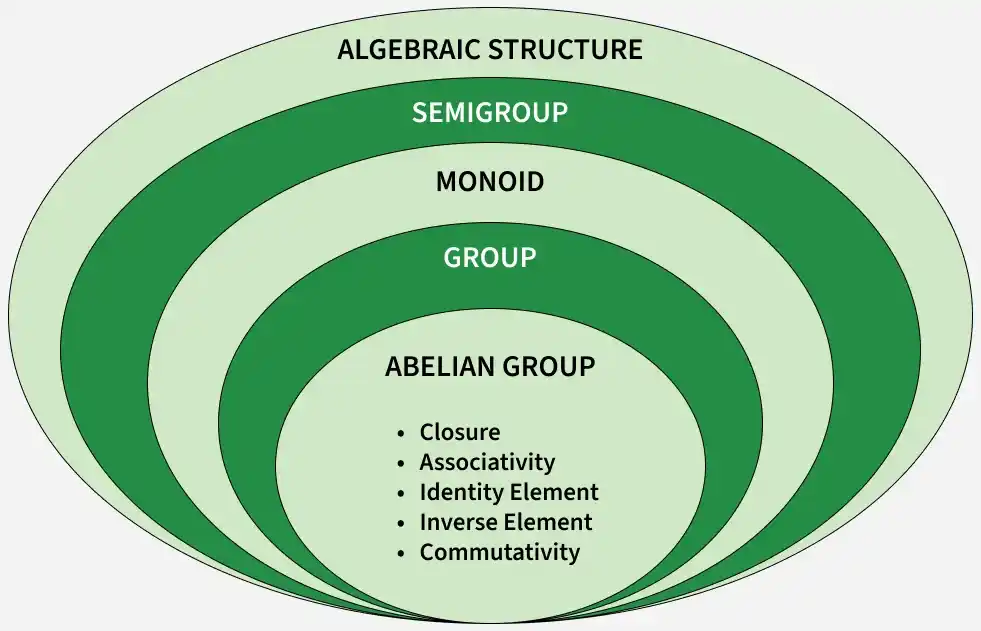
Every Abelian group is a group, monoid, semigroup, and algebraic structure.
Semi Group
A non-empty set S, (S,*) is called a semigroup if it follows the following axiom:
- Closure: (a*b) belongs to S for all a, b ∈ S.
- Associativity: a*(b*c) = (a*b)*c where a, b ,c∈ S.
A semi-group is always an algebraic structure.
**Example: (Set of integers, +), and (Matrix ,*) are examples of semigroup.
Monoid
A non-empty set S, (S,*) is called a monoid if it follows the following axiom:
- Closure: (a*b) belongs to S for all a, b ∈ S.
- Associativity: a*(b*c) = (a*b)*c ? a, b, c ∈ S.
- Identity Element: There exists e ∈ S such that a*e = e*a = a , a ∈ S
A monoid is always a semi-group and algebraic structure.
**Examples of Various Algebraic Structures
(Set of integers, *) is Monoid as 1 is an integer which is also an identity element. (Set of natural numbers, +) is not Monoid as there doesn’t exist any identity element. But this is Semigroup. But (Set of whole numbers, +) is Monoid with 0 as identity element.
Here is a Table with different nonempty set and operation:
| Set, Operation | Algebraic Structure | Semi Group | Monoid | Group | Abelian Group |
|---|---|---|---|---|---|
| N, + | Y | Y | - | - | - |
| N, - | - | - | - | - | - |
| N, × | Y | Y | Y | - | - |
| N, ÷ | - | - | - | - | - |
| Z, + | Y | Y | Y | Y | Y |
| Z, - | Y | - | - | - | - |
| Z, × | Y | Y | Y | - | - |
| Z, ÷ | - | - | - | - | - |
| R, + | Y | Y | Y | Y | Y |
| R, - | Y | - | - | - | - |
| R, × | Y | Y | Y | - | - |
| R, ÷ | - | - | - | - | - |
| E, + | Y | Y | Y | Y | Y |
| E, × | Y | Y | - | - | - |
| O, + | - | - | - | - | - |
| O, × | Y | Y | Y | - | - |
| M, + | Y | Y | Y | Y | Y |
| M, × | Y | Y | Y | - | - |
Where,
- N: Set of Natural Number
- Z: Set of Integer
- R: Set of Real Number
- E: Set of Even Number
- O: Set of Odd Number
- M: Set of Matrix
- +, -, ×, ÷ are the operations
| Structure | Must Satisfy Properties |
|---|---|
| Algebraic Structure | Closure |
| Semi Group | Closure, Associative |
| Monoid | Closure, Associative, Identity |
| Group | Closure, Associative, Identity, Inverse |
| Abelian Group | Closure, Associative, Identity, Inverse, Commutative |
Solved Examples
**Problem 1: Prove that in a group G, if (ab)² = a²b² for all a, b ∈ G, then G is abelian.
Given: (ab)² = a²b² for all a, b ∈ G
Expand (ab)²: ab.ab = a²b²
Multiply both sides by a⁻¹ on the left: a⁻¹(abab) = a⁻¹(a²b²)
Simplify: bab = ab²
Multiply both sides by b⁻¹ on the right: (bab)b⁻¹ = (ab²)b⁻¹
Simplify: ba = ab
Therefore, G is abelian.
**Problem 2: Let G be a group of order 15. Prove that G is cyclic.
By Lagrange's theorem, the possible orders of elements in G are 1, 3, 5, and 15.
If there exists an element of order 15, then G is cyclic.
If not, then G has elements of order 3 and 5 (since it can't be all identity elements).
Let a be an element of order 3 and b be an element of order 5.
Consider the subgroup H = <a, b>. Its order must divide 15.
|H| ≠ 3 or 5 because it contains elements of both orders.
|H| ≠ 1 because it's not just the identity.
Therefore, |H| = 15, which means H = G.
By the fundamental theorem of finite abelian groups, G ≅ Z₃ ⊕ Z₅ ≅ Z₁₅.
Thus, G is cyclic.
**Problem 3: Let G be a group and H be a subgroup of G. Prove that if [G:H] = 2, then H is normal in G.
[G:H] = 2 means there are only two cosets of H in G.
These cosets are H itself and some aH where a ∉ H.
For any g ∈ G, gH must equal either H or aH.
If gH = H, then g ∈ H, so gHg⁻¹ = H.
If gH = aH, then g = ah for some h ∈ H.
In this case, gHg⁻¹ = ahH(ah)⁻¹ = aHa⁻¹
But aHa⁻¹ must be either H or aH.
If aHa⁻¹ = aH, then Ha⁻¹ = H, which means a ∈ H, contradicting our choice of a.
Therefore, aHa⁻¹ = H.
Thus, for all g ∈ G, gHg⁻¹ = H, so H is normal in G.
**Problem 4: Let G be a group and let a, b ∈ G. Prove that if ab = ba, then (ab)ⁿ = aⁿbⁿ for all n ∈ Z.
We'll use induction on n.
Base case: For n = 0, (ab)⁰ = e = a⁰b⁰
For n = 1, (ab)¹ = ab = a¹b¹
Inductive hypothesis: Assume (ab)ᵏ = aᵏbᵏ for some k ≥ 1
Inductive step: Consider (ab)ᵏ⁺¹
(ab)ᵏ⁺¹ = (ab)ᵏ(ab) = (aᵏbᵏ)(ab) = aᵏ(bᵏa)b = aᵏ(abᵏ)b = aᵏ⁺¹bᵏ⁺¹
By induction, (ab)ⁿ = aⁿbⁿ for all n ≥ 0
For negative integers, note that (ab)⁻ⁿ = ((ab)ⁿ)⁻¹ = (aⁿbⁿ)⁻¹ = b⁻ⁿa⁻ⁿ = a⁻ⁿb⁻ⁿ
Therefore, (ab)ⁿ = aⁿbⁿ for all n ∈ Z.
**Problem 5: Let G be a group of order pq, where p and q are distinct primes. Prove that G is cyclic if and only if gcd(p-1, q-1) = 1.
First, prove that if G is cyclic, then gcd(p-1, q-1) = 1:
If G is cyclic, it has an element of order pq.
By the structure theorem of cyclic groups, G ≅ Zₚq
The number of elements of order pq in Zₚq is φ(pq) = (p-1)(q-1)
This number must equal the number of generators of G, which is φ(pq)
For this to be true, we must have gcd(p-1, q-1) = 1
Now, prove that if gcd(p-1, q-1) = 1, then G is cyclic:
By Sylow's theorems, G has a unique subgroup P of order p and a unique subgroup Q of order q
Let a generate P and b generate Q
Consider the order of ab:
(ab)ᵖq = aᵖqbᵖq = (aᵖ)q(bq)ᵖ = e
So the order of ab divides pq
If ord(ab) = p or q, then ab ∈ P or ab ∈ Q, which is impossible
Therefore, ord(ab) = pq, and G is cyclic
Thus, G is cyclic if and only if gcd(p-1, q-1) = 1.
Practice Problems
1. Let G be a group of order pq, where p and q are distinct primes. Prove that G is abelian.
2. Prove that if G is a group of order p², where p is prime, then G is abelian if and only if it has p + 1 subgroups of order p.
3. Let G be a finite group and H be a proper subgroup of G. Prove that the union of all conjugates of H cannot be equal to G.
4. Let G be a group and N be a normal subgroup of G. If G/N is cyclic and N is cyclic, prove that G is abelian.
5. Prove that in any group G, the set of elements of finite order form a subgroup of G.
**Answer Key
1. Abelian
2. True
3. False
4. True
5. True