Change of Voice (original) (raw)
Last Updated : 3 Mar, 2026
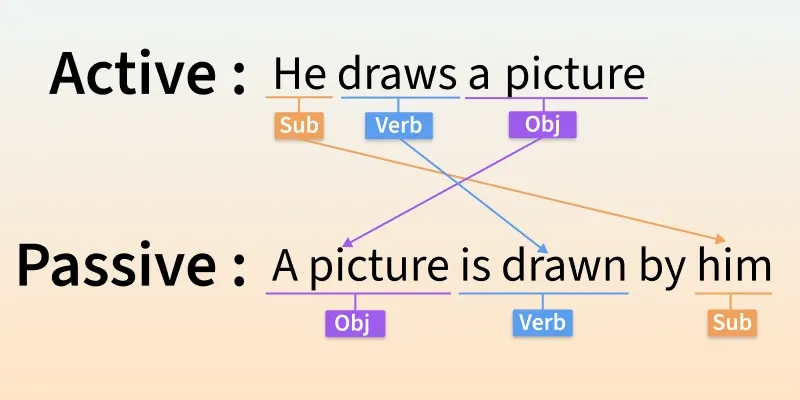
The forms of verbs that show the "**subject doing an action" or " **an action done on the subject" are called voice. Change of voice means converting a sentence from the **Active to the **Passive Voice or vice versa, without changing the original meaning.
Types of Voice
There are two voices in the English language, and they are as follows:
**1. Active Voice: In active voice, the verb expresses the subject's action upon the object.
**General Formula: subject + verb + object
**Example: The chef cooks the meal.
**2. Passive Voice: In passive voice, the verb expresses the object being acted upon.
**General Formula: object + helping verb(according to tense) + V3 + by + subject
**Example: T_he meal is cooked by the chef.
**Change of voice means changing an active sentence into passive, or a passive sentence into active. Let's discuss them in detail below:
1. Changing Active Voice to Passive Voice
**Step 1: Identify the **object of the active sentence; it becomes the **subject in the passive sentence.
Step 2: Use the appropriate form of the verb “to be” (is, am, are, was, were, will be, etc.),** according to the tense of the active verb.
**Step 3: Use the **past participle of the main verb.
**Step 4: Optionally add the original subject preceded by **“by.”
**Step 5: Adjust the sentence for proper grammar and meaning.
**Example:
- Active: The boy kicks the ball.
- **Passive: The ball is kicked by the boy.
**2. Changing Passive Voice to Active Voice
**Step 1: Identify the **doer (agent) in the passive sentence, usually after **“by.” It becomes the subject in the active sentence.
**Step 2: Use the correct verb tense in active form.
**Step 3: Remove the form of **“to be” used in passive voice.
**Step 4: Rearrange the sentence for clarity.
**Example:
- **Passive: The cake was baked by her.
- **Active: She baked the cake.
**Converting Rules
Given below are a few basic rules to follow while converting from active to passive voice and vice versa:
| Tense | **Active Structure + Example | **Passive Structure + Example |
|---|---|---|
| Present Simple | Subject + V1 (s/es) + Object__She writes a report._ | Object + is/am/are + V3 + by + Subject _A report is written by her. |
| Past Simple | Subject + V2 + Object _We built a house. | Object + was/were + V3 + by + Subject _A house was built by us. |
| Future Simple | Subject + shall/will + V1 + Object _She will write the letter. | Object + shall/will + be + V3 + by + Subject _The letter will be written by her. |
| Present Continuous | Subject + is/am/are + V1 + ing + Object__They are painting the wall._ | Object + is/am/are + being + V3 + by + Subject__The wall is being painted by them._ |
| Past Continuous | Subject + was/were + V1 + ing + Object__She was reading a book._ | Object + was/were + being + V3 + by + Subject__The book was being read by her._ |
| Future Continuous | Subject + shall/will + be + V1 + ing + Object__They will be painting the room_ | Object + will + be + being + V3 + by + Subject (Rarely used) _The room will be being painted by them. |
| Present Perfect | Subject + has/have + V3 + Object__He has completed the task._ | Object + has/have + been + V3 + by + Subject__The task has been completed by him._ |
| Past Perfect | Subject + had + V3 + Object__They had finished the work._ | Object + had + been + V3 + by + Subject__The work had been finished by them._ |
| Future Perfect | Subject + shall/will + have + V3 + Object__He will have completed the job._ | Object + shall/will + have + been + V3 + by + Subject__The job will have been completed by him._ |
| Present Perfect Continuous | Subject + has/have + been + V1 + ing + Object__She has been writing a report._ | Object + has/have + been + being + V3 + by + Subject (Rarely used)_A report has been being written by her. |
| Past Perfect Continuous | Subject + had + been + V1 + ing + Object__They had been cleaning the hall._ | Object + had + been + being + V3 + by + Subject (Rarely used)_The hall had been being cleaned by them. |
| Future Perfect Continuous | Subject + will + have + been + V1 + ing + Object__We will have been delivering goods_. | Object + will + have + been + being + V3 + by + Subject (Rarely used)_Goods will have been being delivered by us. |
Active to Passive Voice
Below are some conversions from active to passive voice:
- **Active Voice: She reads a book.
- **Passive Voice: A book is read by her.
- **Active Voice: They built the house.
- **Passive Voice: The house was built by them.
- **Active Voice: He will complete the report.
- **Passive Voice: The report will be completed by him.
- **Active Voice: The chef is cooking the meal.
- **Passive Voice: The meal is being cooked by the chef.
- **Active Voice: The students have finished the assignment.
- **Passive Voice: The assignment has been finished by the students.
Passive to Active Voice
Below are some conversions from passive to active voice:
- **Passive Voice: The proposal is approved by the manager.
- **Active Voice: The manager approves the proposal.
- **Passive Voice: The plants are watered by the gardener.
- **Active Voice: The gardener waters the plants.
- **Passive Voice: A new product will be launched by the company.
- **Active Voice: The company will launch a new product.
- **Passive Voice: A beautiful poem was written by her.
- **Active Voice: She wrote a beautiful poem.
- **Passive Voice: The road is being repaired by them.
- **Active Voice: They are repairing the road.
Tips and Tricks
- Find the **object first — it becomes the new subject in passive.
- Use the correct **“to be” form **past participle in passive.
- Include **“by” + doer only if necessary.
- **Intransitive verbs (no object) can’t be passive.
- Keep the **tense same when changing voice.
- The passive form of perfect continuous tenses always uses **“being” before the past participle.
- These passive forms are **rarely used in everyday English because they sound complicated.
Also Check:
➣ Change of Voice Solved Question- Refer Here!
➣ Test your knowledge- Quiz!