SubjectVerb Agreement Rules (original) (raw)
Subject-Verb Agreement Rules
Last Updated : 23 Feb, 2026
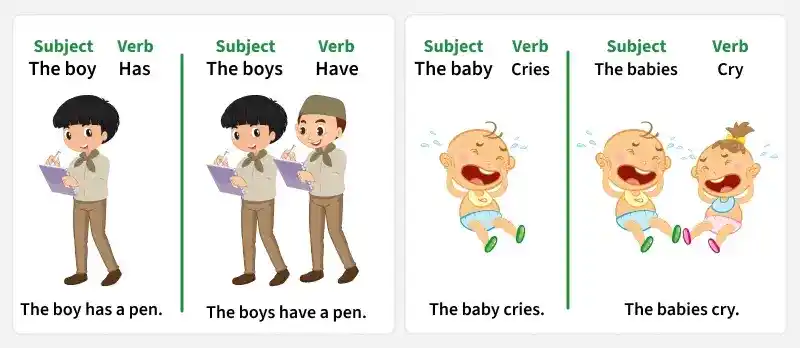
Subject–Verb Agreement means that the verb in a sentence must match the subject in number and person. If the subject is singular, the verb should be singular. If the subject is plural, the verb should be plural.
**Example:
- _The boy runs fast. (Singular subject + singular verb)
- _The boys run fast. (Plural subject + plural verb)
Singular and Plural Verb Form
| **Singular Subject | **Singular Verbs | **Plural Subject | **Plural Verbs |
|---|---|---|---|
| I | am/ was/ have/ go/ read | We | are/ were/have/go/read |
| You | are/ were /have /go/read | You | are/ were/have/go/read |
| He/ She/ It | is/was /has/goes/ reads | They | are/ were/have/go/read |
**Rule 1:
A singular subject takes a singular verb, and a plural subject takes a plural verb. The subject of a sentence can be a noun, pronoun, or noun phrase. When the subject is a pronoun, the verb form depends on the person and number of the pronoun.
**Example:
- _Rachel spends her free time listening to music. (Singular subject with singular verb)
- _Blaine and Kurt play the piano. (Plural subject with plural verb)
- _She likes to have a dessert after every meal. (Third person singular pronoun with singular subject)
**Rule 2:
When using the ‘be’ form of verbs, there is an exception. In this case, the verb is used according to the number and person of the subject. The following table to see how it works with different pronouns.
| **Person | **Pronoun | **Verb | **Example |
|---|---|---|---|
| First person singular | I | am | I am confident. |
| First person plural | We | are | We are confident. |
| Second person singular/plural | You | are | You are confident. |
| Third person singular | He | is | He is confident. |
| She | is | She is confident. | |
| It | is | It is amazing. | |
| Third person plural | They | are | They are confident. |
Moreover, the rule holds true when the word is employed with other nouns and noun phrases. When verbs in the 'be' form are used as the main verb or supporting verb, the same holds true for simple past, present continuous, and past continuous tenses. For clarification, consider the following instances.
**Example:
- _The girls are waiting for you.
- _Santana is a singer.
- _We were happy with the review of our first movie.
- _Michael Jackson’s songs are still enjoyed by millions.
- _I was reading the latest book by Rudyard Kipling.
**Note: If the word **“each” or **“every” is used before two singular nouns joined by “and,” the verb remains singular because the subjects are considered separately.
(e.g. Every boy and every girl was given a bar of chocolate, a biscuit, and two bananas).
**Rule 3:
The subject determines whether we use “have” or “has.”
- “Has” is used with third-person singular subjects (he, she, it, or singular names).
- “Have” is used with I, you, we, they, and all plural subjects.
This rule applies when “have/has” is used as a main verb and also as a helping verb in the present perfect and present perfect continuous tenses.
**Example:
- _I have a younger brother.
- _You have taken the wrong cut.
- _Swetha has a pet dog.
- _William Shakespeare has written around 37 plays.
- _Finn has been waiting to talk to you about the test results
**Rule 4:
When two or more subjects are joined by the conjunction “and,” they take a plural verb because they refer to more than one person or thing.
**Example:
- _Krish and Radha are on their way to the airport.
- _Caren, Sheela and Akash have completed their assessments.
**Rule 5:
When two singular nouns are joined by the conjunction “or,” the verb is usually singular because only one of them is being referred to.
**Example:
- _Celery or spring onion works fine.
- _Your mom or dad has to be here in an hour.
Note: If the subjects joined by “or” are different in number (one singular and one plural), the verb agrees with the subject that is closer to the verb.
(e.g. The teacher or the students are coming.).
Rule 6:
Sentences with pronouns such as anybody, anyone, no one, somebody, someone, everybody, everyone, nothing and nobody are treated as singular subjects and will therefore use a singular verb.
**Example:
- _Nobody has understood anything.
- _Everyone was happy with the outcome.
- _Nothing fits me well.
- _No one finds the movie interesting.
Rule 7:
For sentences using ‘either..or’ and ‘neither..nor’, the verb should agree with the noun or pronoun that comes just before it.
**Example:
- _Neither Ricky nor Gina is here yet.
- _Either the teacher or the students have to take an initiative to keep the classroom clean.
- _Neither the children nor their parents are aware of the consequences.
Rule 8:
Some nouns look plural but are actually treated as singular, while some are always treated as plural.
- Singular in meaning (take singular verb): News, Mathematics, Physics, Economics, etc.
- Plural in meaning (take plural verb): Police, Scissors, Trousers, Glasses, etc.
**Example:
- _The news of demonetisation shocks the entire nation. (Singular verb)
- _The police have been looking for the culprits. (Plural verb)
Rule 9:
In negative sentences in the simple present tense, we use “do” or “does” with not. The helping verb must agree with the subject.
- “Do” is used with plural subjects and with I, you, we, they.
- “Does” is used with third-person singular subjects (he, she, it, or singular nouns).
**Example:
- _The children do not like working out trigonometry problems.
- _My father does not work at the bank anymore.
Rule 10:
In interrogative sentences, helping verbs such as “do,” “does,” “did,” “is,” “are,” “was,” “were,” “has,” and “have” are used at the beginning of the sentence. The helping verb must agree with the subject in number and person.
**Example:
- _Do _you read thriller novels?
- _Doesn’t she know you already?
- _Is Tina happy with the new house?
- _Were _you looking for me?
- _Has Sharon submitted her final project yet?
Rule 11:
When you have sentences that begin with ‘here’, ‘there’, ‘this’, ‘that’, ‘those’, ‘these’, etc., always remember that the subject follows the verb. So, the verb must agree with the real subject that follows it.
**Example:
- Here _is your book.
- There _lies your shirt.
- That _was _a great movie.
- There _have been many changes in the timetable.
Rule 12:
Abstract nouns and uncountable nouns are considered as singular subjects, so make sure you use a singular verb along with it.
**Example:
- _Honesty is the best policy.
- _Love makes people do crazy things.
- _Good friendship keeps your mind and body healthy.
Rule 13:
When the subject refers to a period of time, distance or a sum of money, use a singular verb.
**Example:
- _1267 kilometres is too long for us to travel in half a day.
- _10 years is not considered optimum to go on the water slide.
- Don’t you think _1000 rupees is a little too much for a portrait?
Rule 14:
The next rule is based on the use ofcollective nounsas subjects. Remember that when you have a collective noun as the subject of the sentence, the verb can be singular or plural based on the sentence and the context.
**Example:
- _My family is settled in Australia.
- All _groups of participants have arrived.
Rule 15:
In sentences that have adjectives such as ‘all’, ‘a lot of’, ‘lots of’ or ‘some’ are used along with nouns to form a phrase that acts as the subject of the sentence, the verb is used according to the noun just before it.
**Example:
- _All of my dresses have become tight.
- _A lot of food is left out.
- _Some of the books are torn and damaged.
Rule 16:
When a sentence begins with ‘each’ or ‘every’ as the subject, it is considered singular and so the verb has to be singular too.
**Example:
- _Each student has been asked to provide a consent letter.
- _Every teacher, parent and student is expected to work together.
Rule 17:
When you are using a sentence to express a wish or a sentence expressing a request, verbs are used a little differently from other sentences.
**Example:
- _I wish I were a bird.
- If _you were here, I would not be sad.
- We request that _everyone make their choices now.
**Subject-Verb Agreement Rules Chart
| ****1. If the SUBJECT is singular, add 's' to the verb.**Eg., The horse walks down the street. | ****2. If the SUBJECT is plural, don't add 's' to the verb.**Eg., The horses walk down the street. |
|---|---|
| ****3. If the SUBJECT is I or You, do not add 's' to the verb.**Eg., I ride the bicycle.You ride the bicycle. | ****4. Linking Verbs:**Singular Subject: was, has, is, does, amPlural Subject: were, have, are, do |
**Solved Questions on Subject Verb Agreement
**Direction: Choose the correct form of the verb that agrees with the subject.
**1. The amenities of the farmhouse ____ quite impressive. (is/are)
**2. Man and woman _____ complementary to each other. (is/are)
**3. The leader as well as his supporters _____ to the same tribe. (belong/belongs)
**4. The students accompanied by their professor _____ went on a trip. (has/have)
**5. A large sum of money _____ stolen. (was/were)
**6. A lot of buildings _____ collapsed in the storm. (has/have)
**7. The government ____ criticised by the High Court for their actions. (was/were)
**8. Many people _____ tried hard to climb the treacherous mountain range. (have/has)
**9. All the tourists ____ excited to visit the museum. (was/were)
**10. Somebody ____ waiting at the restaurant for you. (is/are)
**11. The carpenter, along with his helper ____, expected to come soon. (is/are)
**12. Neither Danny nor Emily ____ went to work. (has/have)
**Answers:
**1. The amenities of the farmhouse **are quite impressive.
**2. Man and woman **are complementary to each other.
**3. The leader as well as his supporters **belongs to the same tribe.
**4. The students accompanied by their professor **have gone on a trip.
**5. A large sum of money **was stolen.
**6. A lot of buildings **have collapsed in the storm.
**7. The government **was criticized by the High Court for its actions.
**8. Many people **have tried hard to climb the treacherous mountain range.
**9. All the tourists **were excited to visit the museum.
**10. Somebody **is waiting at the restaurant for you.
**11. The carpenter, along with his helper **is, expected to come soon.
**12. Neither Danny nor Emily **has gone to work.