5 Phases of Hacking (original) (raw)
Last Updated : 10 Mar, 2026
Ethical hacking follows a structured process to identify vulnerabilities in systems, networks, and applications before malicious attackers exploit them. This methodology helps security professionals simulate real-world attacks in a controlled and authorized environment to strengthen cybersecurity defenses.
- Helps identify security weaknesses before attackers can exploit them
- Simulates real-world cyberattacks in a controlled and legal environment
- Assists organizations in improving their security infrastructure
- Reduces the risk of data breaches and cyber threats
Phases of Hacking
The hacking process typically follows five structured phases, which are explained below.
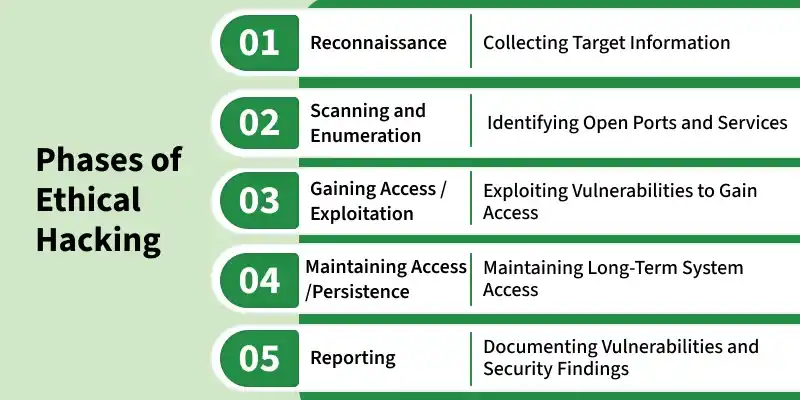
1. Reconnaissance (Footprinting Phase)
Reconnaissance is the first phase of ethical hacking where security professionals gather information about the target system or organization. The goal of this phase is to understand the target environment and identify potential entry points for security testing.
- Collects information such as domain names, IP addresses, and DNS records
- Identifies technologies, servers, and network infrastructure used by the target
- Uses publicly available sources like websites, search engines, and social media
- Helps ethical hackers understand the system before performing further security testing
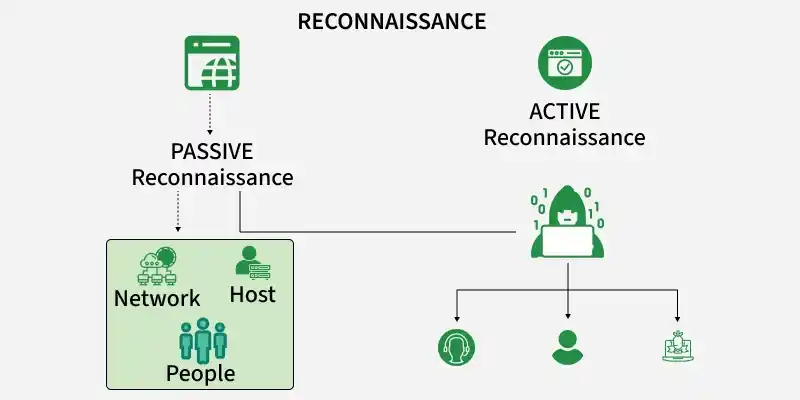
Types of Reconnaissance
**1. Passive Reconnaissance
Passive reconnaissance involves collecting information without directly interacting with the target system. This method is difficult to detect because the hacker relies on publicly available sources.
**Examples:
- Searching company information on Google
- Checking employee profiles on LinkedIn
- Reviewing public DNS records
- Using WHOIS lookup services
**2. Active Reconnaissance
Active reconnaissance involves direct interaction with the target system to gather information. This may include scanning networks or querying servers.
**Examples:
- Ping sweeps to detect active hosts
- DNS queries to identify servers
- Network scanning to detect services
Tools Used in Reconnaissance
Several tools help gather information during this phase:
- **WHOIS: Retrieves domain registration details.
- **Maltego: Visualizes relationships between domains, IPs, and organizations.
- **theHarvester: Collects email addresses and domain information.
- **Recon-ng: A powerful reconnaissance framework.
- **Google Dorking: Uses advanced Google search operators to find sensitive data.
Real-Life Example
Suppose a company hires an ethical hacker to test its security. The hacker first collects information about the company’s domain, hosting servers, and public infrastructure using WHOIS and DNS lookup tools. They may also analyze employee profiles on LinkedIn to identify potential targets for phishing attacks.
2. Scanning
Scanning is the second phase of ethical hacking where the gathered information is analyzed to identify potential vulnerabilities in the target system. In this phase, ethical hackers examine the system to discover open ports, running services, and possible security weaknesses.
- Identifies open ports and active services on the target system
- Detects operating systems and software versions running on the network
- Finds vulnerabilities and misconfigurations that attackers could exploit
- Helps determine possible entry points for further security testing
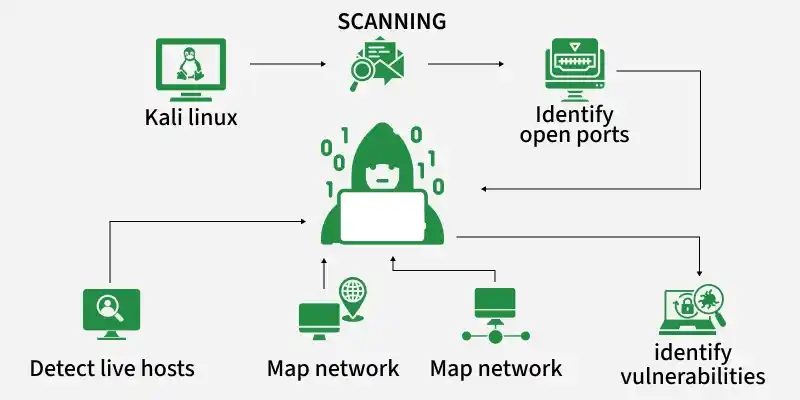
Types of Scanning
- **1. Port Scanning: Port scanning identifies open ports and services running on a system.
- **2. Vulnerability Scanning: This scanning detects known vulnerabilities in operating systems, applications, and network services.
- **3. Network Mapping: Network mapping identifies devices connected to the network and how they communicate with each other.
Tools Used in Scanning
- **Nmap: A powerful network scanning tool used to identify open ports and services.
- **Nikto: Web server vulnerability scanner.
- **OpenVAS: Vulnerability scanning framework.
- **Nessus: Popular vulnerability assessment tool.
- **Netdiscover: Used to identify active devices in a network.
Real-Life Example
An ethical hacker scans a company's web server using Nmap and discovers that ports 80 (HTTP) and 443 (HTTPS) are open. The scan also reveals that the server is running an outdated version of Apache that contains known security vulnerabilities.
3. Gaining Access
In this phase, the ethical hacker attempts to exploit the vulnerabilities discovered during scanning. The goal is to determine whether these vulnerabilities can actually be used to gain unauthorized access to the system. This phase simulates real-world cyberattacks in a controlled environment.
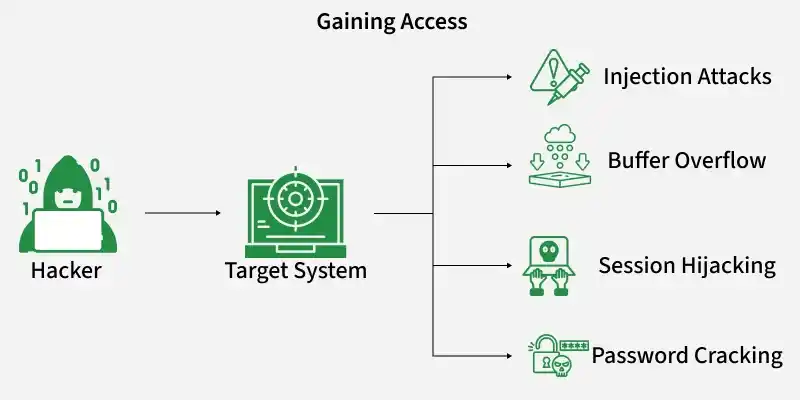
Common Exploitation Techniques
- **SQL Injection: Exploiting database vulnerabilities.
- **Cross-Site Scripting (XSS): Injecting malicious scripts into web applications.
- **Password Cracking: Breaking weak passwords.
- **Buffer Overflow Attacks: Exploiting memory vulnerabilities.
- **Exploiting outdated software vulnerabilities.
Tools Used in Exploitation
- **Metasploit Framework: One of the most popular exploitation frameworks.
- **SQLmap: Automates SQL injection attacks.
- **Burp Suite: Web application security testing tool.
- **Hydra: Password cracking tool.
- **BeEF (Browser Exploitation Framework): Exploits browser vulnerabilities.
Real-Life Example
If the scanning phase reveals a SQL Injection vulnerability in a login form, the ethical hacker may use SQLmap to test whether the vulnerability can be exploited. If successful, the attacker could potentially access sensitive data stored in the database.
4. Maintaining Access
Maintaining Access is the phase where the ethical hacker evaluates how long an attacker could remain inside a compromised system. The goal is to assess the potential impact of the attack and understand the level of control an attacker could achieve.
- Tests whether privileges can be escalated to administrator or root level
- Checks if the attacker can move laterally across other systems in the network
- Identifies access to sensitive data or confidential information
- Evaluates how long unauthorized access can be maintained in the system
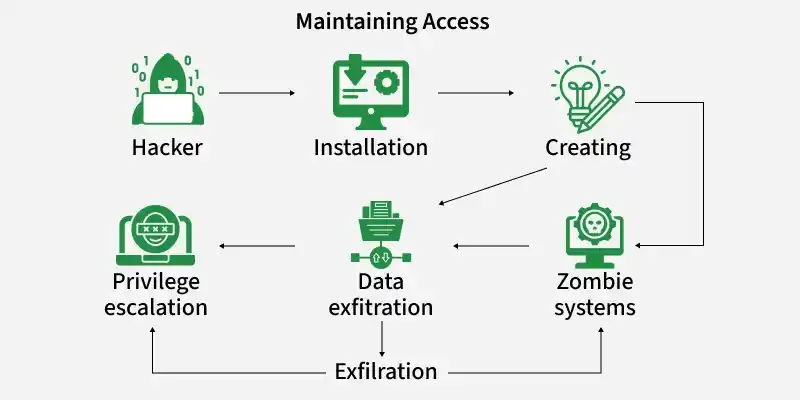
Activities Performed in Maintaining Access
- **Privilege Escalation: Gaining higher-level permissions such as administrator or root access.
- **Lateral Movement: Moving from one compromised system to another within the network.
- **Persistence: Maintaining long-term access to the system.
- **Data Exfiltration: Accessing sensitive data.
Tools Used in Post-Exploitation
- **Meterpreter (Metasploit): Provides advanced control over compromised systems.
- **Mimikatz: Extracts credentials from memory.
- **Empire: Post-exploitation framework.
- **PowerSploit: PowerShell-based exploitation tools.
Real-Life Example
After gaining access to a server, the ethical hacker attempts to escalate privileges using tools like Mimikatz to retrieve credentials. This helps determine whether attackers could gain full administrative control over the system.
5. Covering Tracks
Covering Tracks is the phase where an attacker attempts to hide their activities after gaining unauthorized access to a system. The goal is to remove or modify evidence of the attack so that security teams cannot easily detect or investigate the intrusion.
- Deletes or modifies system logs to hide traces of the attack
- Hides malicious files, processes, or backdoors from security tools
- Alters file timestamps to confuse forensic investigations
- Helps attackers remain undetected and maintain stealth within the system
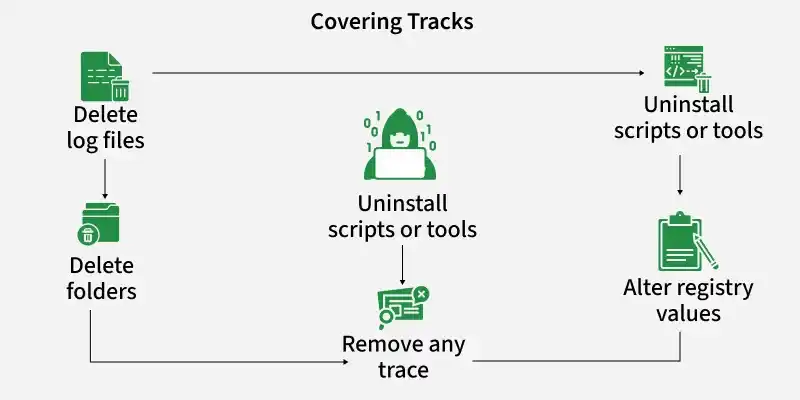
Activities Performed in This Phase
- **Log Deletion: Attackers remove or modify system logs to hide traces of their activities.
- **File and Process Hiding: Malicious files or processes are hidden to avoid detection by security tools.
- **Timestamp Manipulation: Changing file timestamps to make it difficult to track when the attack happened.
- **Backdoor Concealment: Hiding backdoors or persistent access mechanisms to maintain undetected access.
Tools Used in Covering Tracks
- **Rootkits: Used to hide processes, files, and system activities.
- **Metasploit (Clearev module): Used to clear Windows event logs.
- **Timestomp: Alters file timestamps to hide attack timelines.
- **Log Cleaner Scripts: Custom scripts used to delete or modify log entries.
Real-Life Example
After successfully gaining access to a company server, an attacker deletes system logs and modifies file timestamps to hide evidence of the intrusion. They may also install a rootkit to conceal malicious processes and maintain access without being detected by the system administrators.
- Once this step is completed, it means the ethical hacker has successfully gained access to the system or network, exploited vulnerabilities, and exited without detection.
After completing all five phases, the ethical hacker prepares a comprehensive report detailing all discovered vulnerabilities and provides recommendations to fix them, helping the organization improve its overall security posture.