Block Cipher modes of Operation (original) (raw)
Last Updated : 30 May, 2026
Block ciphers are encryption algorithms that process data in fixed-size blocks and produce ciphertext blocks of the same size. Since real-world data is often larger than a single block, modes of operation are used to define how multiple blocks are securely encrypted and decrypted, making block ciphers suitable for different security and performance requirements.
- Processes data in fixed-size blocks (e.g., 128 bits).
- Uses modes of operation to handle data larger than a single block.
- Common modes include ECB, CBC, CFB, OFB and CTR.
**Here are a few common modes:
**Electronic Code Book (ECB)
The electronic codebook is the easiest block cipher mode of functioning. It is easier because of the direct encryption of each block of input plaintext and output is in the form of blocks of encrypted ciphertext. Generally, if a message is larger than _b bits in size, it can be broken down into a bunch of blocks and the procedure is repeated.
**The procedure of ECB is illustrated below:

Electronic Code Book
**Advantages
- Parallel encryption of blocks of bits is possible, thus it is a faster way of encryption.
- Simple way of the block cipher.
**Disadvantages
- Prone to cryptanalysis since there is a direct relationship between plaintext and ciphertext.
- Identical plaintext blocks produce identical ciphertext blocks, which can reveal patterns.
**Cipher Block Chaining
Cipher block chaining or CBC is an advancement made on ECB since ECB compromises some security requirements. In CBC, the previous cipher block is given as input to the next encryption algorithm after XOR with the original plaintext block. In a nutshell here, a cipher block is produced by encrypting an XOR output of the previous cipher block and present plaintext block.
**The process is illustrated here:

Cipher Block Chaining
**Advantages
- CBC works well for input greater than b bits.
- CBC is a good authentication mechanism.
- Better resistive nature towards cryptanalysis than ECB.
- More secure than ECB as it hides patterns.
**Disadvantages
- Requires the previous ciphertext block for encryption and decryption, making parallel processing difficult.
**Cipher Feedback Mode (CFB)
In this mode the cipher is given as feedback to the next block of encryption with some new specifications: first, an initial vector IV is used for first encryption and output bits are divided as a set of s and b-s bits. The left-hand side s bits are selected along with plaintext bits to which an XOR operation is applied. The result is given as input to a shift register having b-s bits to lhs, s bits to rhs and the process continues. The encryption and decryption process for the same is shown below, both of them use encryption algorithms.
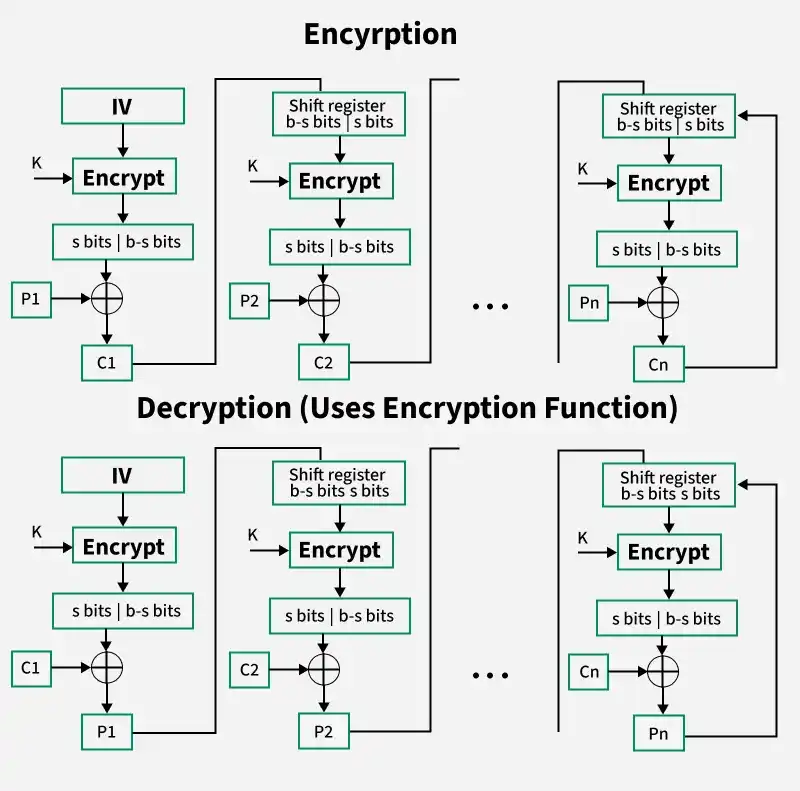
CFB
**Advantages
- Since, there is some data loss due to the use of shift register, thus it is difficult for applying cryptanalysis.
- Can handle data streams of any size.
**Disadvantages
- The drawbacks of CFB are the same as those of CBC mode. Both block losses and concurrent encryption of several blocks are not supported by the encryption. Decryption, however, is parallelizable and loss-tolerant.
- Slightly more complex and can propagate errors.
**Output Feedback Mode
The output feedback mode follows nearly the same process as the Cipher Feedback mode except that it sends the encrypted output as feedback instead of the actual cipher which is XOR output. In this output feedback mode, all bits of the block are sent instead of sending selected s bits. The Output Feedback mode of block cipher holds great resistance towards bit transmission errors. It also decreases the dependency or relationship of the cipher on the plaintext.
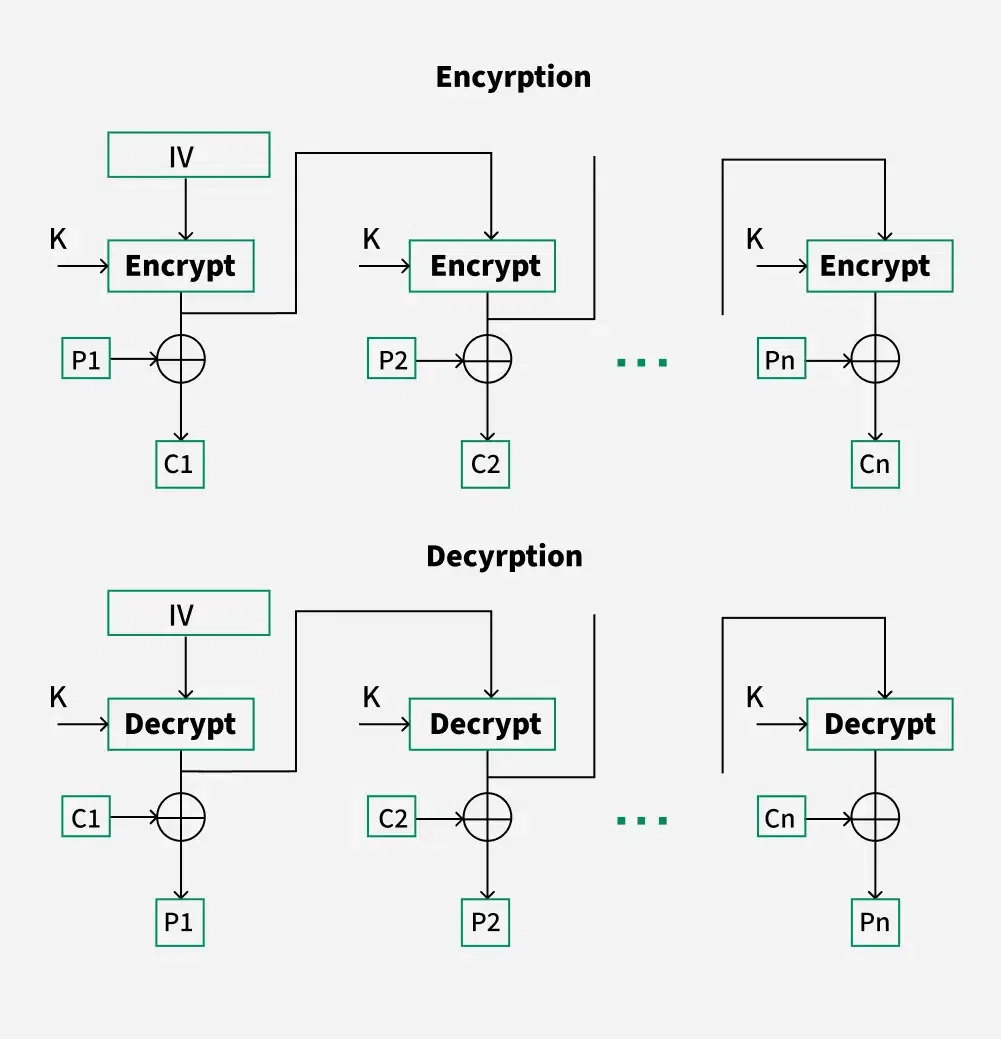
Output Feedback Mode
**Advantages
- In the case of CFB, a single bit error in a block is propagated to all subsequent blocks. This problem is solved by OFB as it is free from bit errors in the plaintext block. Thus errors in transmission don't propagate.
**Disadvantages
- The drawback of OFB is that, because to its operational modes, it is more susceptible to a message stream modification attack than CFB.
- If the keystream is reused, security is compromised.
**Counter Mode
The Counter Mode or CTR is a simple counter-based block cipher implementation. Every time a counter-initiated value is encrypted and given as input to XOR with plaintext which results in ciphertext block. The CTR mode is independent of feedback use and thus can be implemented in parallel.
**Its simple implementation is shown below:
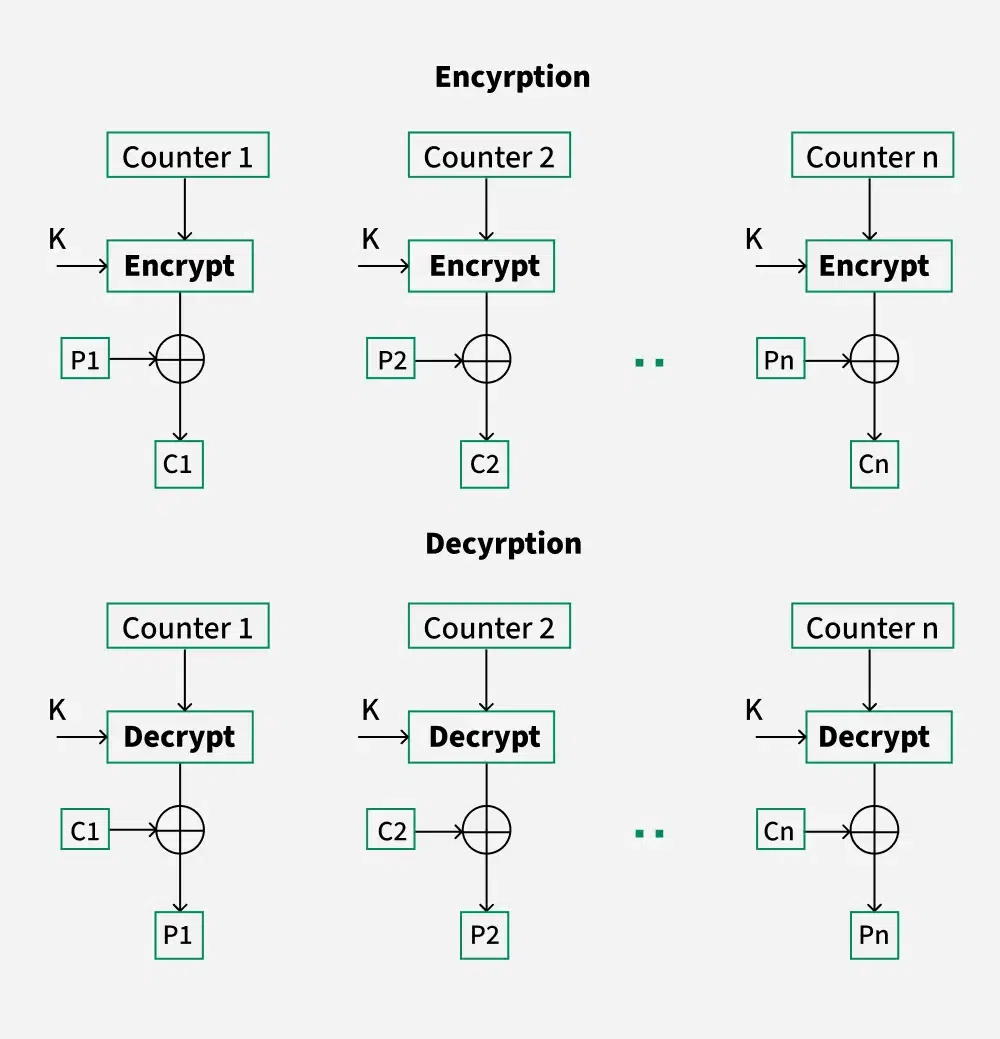
Counter Mode
**Advantages
- Since there is a different counter value for each block, the direct plaintext and ciphertext relationship is avoided. This means that the same plain text can map to different ciphertext.
- Parallel execution of encryption is possible as outputs from previous stages are not chained as in the case of CBC.
**Disadvantages
- The fact that CTR mode requires a synchronous counter at both the transmitter and the receiver is a severe drawback. The recovery of plaintext is inaccurate when synchronization is lost.
Applications of Block Ciphers
- **Data Encryption: Block Ciphers are widely used for the encryption of private and sensitive data such as passwords, credit card details and other information that is transmitted or stored for a communication. This encryption process converts a plain data into non-readable and complex form. Encrypted data can be decrypted only by the authorized person with the private keys.
- **File and Disk Encryption: Block Ciphers are used for encryption of entire files and disks in order to protect their contents and restrict from unauthorized users. The disk encryption software such as BitLocker, TrueCrypt uses block cipher to encrypt data and make it secure.
- **Virtual Private Networks (VPN): Virtual Private Networks use block cipher for the encryption of data that is being transmitted between the two communicating devices over the internet. This process makes sure that data is not accessed by unauthorized person when it is being transmitted to another user.
- **Secure Sockets Layer (SSL) and Transport Layer Security (TLS): SSL and TLS protocols use block ciphers for encryption of data that is transmitted between web browsers and servers over the internet. This encryption process provides security to confidential data such as login credentials, card information etc.
- **Digital Signatures: Block ciphers are used in the digital signature algorithms, to provide authenticity and integrity to the digital documents. This encryption process generates the unique signature for each document that is used for verifying the authenticity and detecting if any malicious activity is detected.
Initialization Vector (IV)
Initialization Vector (IV) is an important concept in cryptography, especially when using block cipher modes of operation. It is a random or unique value used in combination with a secret key to initialize the encryption process. It ensures that the same plaintext encrypted multiple times will produce different ciphertexts, enhancing security by preventing patterns from emerging.
Importance of IV
- **Initialization Vector (IV) is a non-secret, unique value used to ensure that encrypting the same plaintext with the same key results in different ciphertexts.
- IVs are essential for maintaining the security and integrity of encryption processes, especially in block cipher modes like CBC, CFB, OFB and CTR.
- Proper generation and management of IVs ensures they are unique and unpredictable and are vital to preventing cryptographic vulnerabilities.
- IVs should be transmitted or stored alongside the ciphertext to enable successful decryption, but they must never be reused with the same key.
Other Modes of Operation
- GCM (Galois/Counter Mode)
- CCM (Counter with CBC-MAC)
- XTS (XEX Tweakable Block Cipher with Ciphertext Stealing)
- EAX Mode
- OCB (Offset Codebook Mode)
- PCBC (Propagating Cipher Block Chaining)
- LRW (Liskov, Rivest, Wagner) Mode