Proof of Work (PoW) in Blockchain (original) (raw)
Last Updated : 1 Jun, 2026
Proof of Work is one of the earliest and most widely known consensus mechanisms used in blockchain technology. It enables decentralized networks to validate transactions and maintain agreement among participants without relying on a central authority.
- The concept behind PoW was originally developed to limit spam and abusive network activity.
- Cryptocurrencies like Litecoin and Bitcoin are currently using PoW.
- Ethereum was using PoW mechanism, but now shifted to Proof of Stake(PoS).
- **Principle: A solution should be difficult to find but easy to verify.
Proof of Work is Used in Blockchain
In decentralized systems, there is no central organization responsible for approving transactions. Therefore, blockchain networks need a reliable method to ensure that every participant follows the same rules. Proof of Work serves this purpose by:
- Validating blockchain transactions.
- Preventing fraudulent modifications to data.
- Enabling agreement between untrusted network participants.
- Securing the blockchain against malicious attacks.
- Controlling the creation of new blocks.
Working of PoW
The Proof of Work process involves transaction validation, block creation and mathematical problem solving.
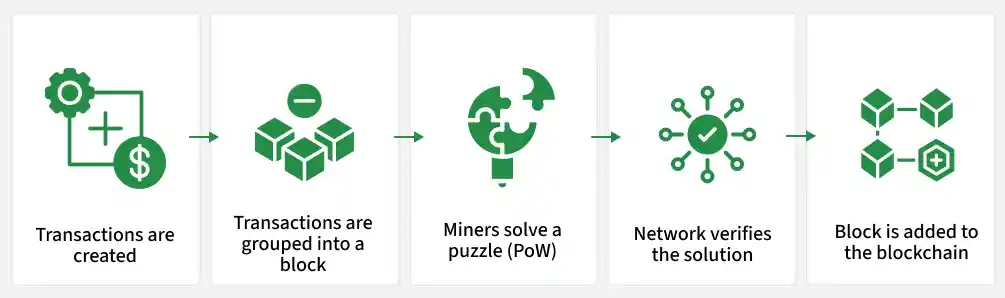
Working
1. Transaction Collection
Users initiate cryptocurrency transactions across the blockchain network. These pending transactions are collected and grouped into a candidate block by miners.
2. Block Verification
Before a block can be added, miners verify that the included transactions are legitimate according to network rules. This stage ensures that invalid transfers, duplicate spending attempts or malformed transactions are rejected.
3. Solving the Mathematical Puzzle
After verification, miners begin solving a computational puzzle. The puzzle usually requires finding a specific value that produces a hash meeting predefined network conditions. Miners repeatedly test different inputs until a valid result is discovered.
4. Block Broadcasting
When a miner finds the correct solution, the newly created block is broadcast to the network. Other nodes quickly verify the solution. If accepted, the block becomes part of the blockchain ledger.
5. Reward Distribution
The successful miner receives a mining reward, which commonly includes:
- Newly created cryptocurrency coins.
- Transaction fees included in the block.
Mining in Proof of Work
Mining is the operational process behind Proof of Work. Miners are specialized participants that use computing hardware to perform the calculations required to solve blockchain puzzles. Because solving the puzzle requires significant computational effort, dishonest behavior becomes expensive and impractical. In PoW systems, mining serves two important roles:
- Securing the network.
- Creating and validating new blocks.
Energy and Time Consumption in Mining
The most resource-intensive part of Proof of Work is not transaction verification but puzzle solving. Mining also requires time.
- For example, Bitcoin is designed to produce approximately one block every 10 minutes.
- If blocks begin appearing too quickly due to increased mining power, the network adjusts the mining difficulty to maintain a relatively stable block generation rate.
- This process consumes: Electricity, Computing power, Specialized hardware resources, Operational costs.
Bitcoin Proof of Work System
Bitcoin uses a Proof of Work model based on the Hashcash algorithm. In simplified terms, miners must solve a problem similar to the following:
- Given some block data A, find a value x such that the hash of A + x is smaller than a required target value.
- The target value defines how difficult mining will be.
- A lower target increases mining difficulty because fewer hash outputs satisfy the requirement.
- To find a valid solution, miners repeatedly modify a changing number called a nonce and compute new hashes until the correct output is produced.
- The miner who successfully discovers the valid nonce broadcasts the block to the network and receives the mining reward.
- Bitcoin periodically adjusts mining difficulty after a fixed number of blocks to maintain its intended block creation schedule.
Mining Rewards in PoW Networks
Proof of Work networks reward miners for securing the blockchain.
- In Bitcoin, the reward mechanism includes newly issued bitcoins along with transaction fees.
- An important characteristic of Bitcoin’s reward model is halving.
- Approximately every four years, the block reward is reduced by half. This gradual reduction limits new coin creation and contributes to Bitcoin’s fixed supply model.
- Over time, block rewards decrease while transaction fees become increasingly important for miner incentives
Common Cryptographic Protocols Used in PoW
Different blockchain projects implement Proof of Work using different hashing algorithms.
- These algorithms vary in computational requirements, hardware compatibility and mining behavior.
- Common examples include: SHA-256 - Used by Bitcoin, Scrypt - Used by Litecoin, SHA-3, Scrypt-N, Scrypt-Jane.
Challenges With Proof of Work
- **51% Attack Risk: If a single entity gains control of more than 50% of the network’s computational power, it can potentially influence transaction validation and blockchain operations.
- **High Energy Consumption: Proof of Work requires massive computing activity. Large-scale mining operations consume substantial amounts of electricity to solve cryptographic puzzles.
- **Time-Intensive Processing: Finding a valid solution is computationally demanding. Miners may test millions or billions of nonce combinations before producing an acceptable result.
- **Expensive Hardware Requirements: Competitive mining often demands powerful and specialized equipment. The cost of purchasing, maintaining and upgrading mining hardware can create high entry barriers for individual participants.
- **Resource Consumption: Proof of Work relies heavily on computing infrastructure, electricity, physical space and cooling systems. Maintaining these resources can significantly increase operational expenses for miners and mining facilities.