Introduction to Ethical Hacking (original) (raw)
Last Updated : 28 Feb, 2026
Ethical hacking is the authorized practice of testing systems, networks, and applications to identify and fix security weaknesses before malicious attackers exploit them. Ethical hackers use real hacking techniques with permission to strengthen cybersecurity and protect digital assets.
- Legal and professional security testing
- Ethical hackers simulate real-world cyberattacks
- Helps identify vulnerabilities and weak points
- Strengthens an organization’s overall security posture
- Supports compliance with cybersecurity standards
- Builds resilience against modern cyber threats
Key aspects of Ethical Hacking
These aspects ensure that ethical hacking remains structured, legal, and focused on improving cybersecurity.
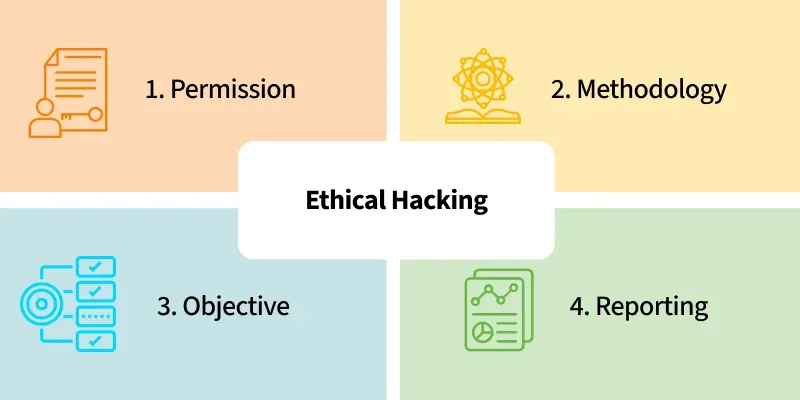
- **Permission-Based: This permission becomes necessary to differentiate their job from criminal hacking jobs
- **Methodology: Ethical hackers perform these steps using a variety of tools and techniques, similar to criminal hackers. It includes scanning for vulnerabilities testing to break in, and accessing control measures available.
- **Objective: The main goal is to find the holes before hostile attackers can penetrate them. This includes discovering system, application, and network vulnerabilities that an attacker could exploit.
- **Reporting: Ethical hackers report back to the organization with the results of the tests.
Importance of Ethical Hacking
Ethical hacking contributes significantly to contemporary cybersecurity, ethical hackers are able to identify and address vulnerabilities before they are exploited by simulating the strategies and tactics utilized by cybercriminals. This proactive methodology serves to:
- **Enhance Security: Identify and address flaws to stop data breaches and cyberattacks.
- **Compliance: Meet security standards set by the industry and regulatory requirements.
- **Management of risk: Assess and reduce potential threats to the assets of the organization
- **Occurrence Reaction: Enhance the company's capacity to respond to security incidents and recover from them.
Types of Ethical Hacking
Depending on the focus of the security testing, ethical hacking can be broken down into a number of different categories:
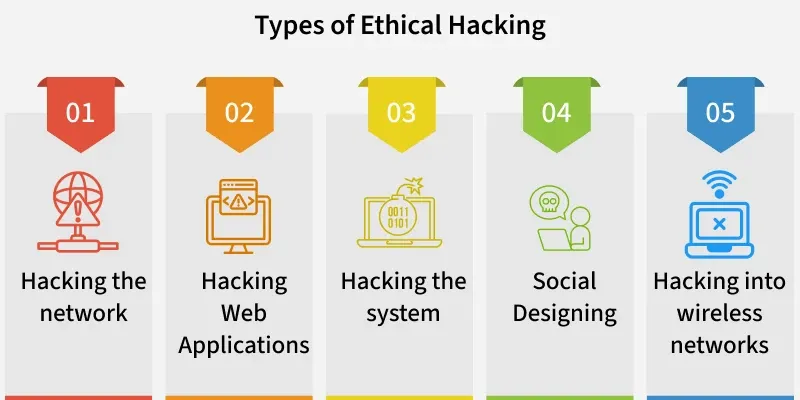
1. Network Hacking
- Identify vulnerabilities in network protocols, open ports, and running services by analyzing traffic and configurations.
- Detect misconfigured routers, switches, firewalls, and other networking devices that may expose the infrastructure.
- Secure the overall network communication system to prevent unauthorized access and data interception.
2. Web Application Hacking
- Discover vulnerabilities such as SQL Injection, XSS, and authentication flaws in web applications.
- Analyze session management, APIs, and input validation to prevent data manipulation and breaches.
- Protect websites and online services from exploitation through secure coding and testing practices.
3. System Hacking
- Identify operating system vulnerabilities, weak passwords, and privilege escalation risks.
- Examine installed software, patch levels, and system configurations for security gaps.
- Secure servers and endpoints to prevent unauthorized system-level access.
- Manipulate individuals through phishing, impersonation, or deception techniques to test security awareness.
- Evaluate how employees respond to suspicious communication or confidential data requests.
- Strengthen the human layer of security by identifying behavioral vulnerabilities.
5. Wireless Network Hacking
- Test wireless encryption protocols such as WPA2/WPA3 for potential weaknesses.
- Identify rogue access points and unauthorized devices connected to the network.
- Secure wireless communication channels to prevent interception and unauthorized access.
Types of Ethical Hackers
Ethical hacking is to scan vulnerabilities and to find potential threats on a computer or network. An ethical hacker finds the weak points or loopholes in a computer, web application or network and reports them to the organization. These are various types of hackers:
1. White Hat Hackers
- The white hat hackers are the ethical security professionals authorized to test systems for vulnerabilities. They are work under legal agreements with the organization.
- White hat hackers receive target information from the organization, perform penetration testing, vulnerability scanning, and security assessments, and then report their findings to help strengthen defenses before malicious attacks occur.
- A white hat hacker typically holds a bachelor’s degree in Computer Science, Information Technology, or Cybersecurity, possesses knowledge of networking, operating systems, programming, and security tools, and often earns certifications such as CEH, CISSP, or OSCP.
**Example: A cybersecurity student is hired by a bank to test its online banking app for vulnerabilities.
- They run authorized penetration tests.
- Find a flaw where account balances could be altered.
- Report it privately to the bank, which fixes it before criminals can exploit it.
2. Black Hat Hackers
- They act without the organization’s permission, making their activities illegal.
- Black hat hackers illegally break into websites, systems, or admin panels by exploiting security vulnerabilities.
- They aim to gain personal financial benefits or power, with no regard for the harm caused.
- They can alter system functions, delete data, or disrupt services, causing significant financial and operational losses.
- Such actions are criminal offenses, punishable by fines, imprisonment, and permanent reputational damage.
**Example: A hacker secretly breaks into an e-commerce site’s database.
- Steals customer credit card numbers and personal details.
- Sells this data on the dark web for profit.
- Causes financial loss and damages the company’s reputation.
3. Grey Hat Hackers
- Sometimes access data and violate laws without permission.
- Do not have the same malicious intent as Black Hat hackers; often act for the common good.
- Grey hat hackers are trying to help by finding security flaws, their unauthorized actions can still cause problems such as disrupting services, exposing sensitive data, or creating vulnerabilities that others might exploit.
- Unauthorized access can disrupt operations and cause financial losses.
- Risk of accidentally causing damage while identifying vulnerabilities.
**Example: Imagine a college student finds a flaw in the university’s online portal. Instead of reporting it privately to the IT department, they post the flaw on social media to prove their skills. They did not steal grades or data, but their public disclosure could let malicious hackers exploit it
4. Blue Hat hackers
- They are called beginner hackers with limited skills, often using pre-made tools.
- They motivated mainly by revenge against someone who angered or challenged them.
- Blue hat hakcers mainly focus on personal payback rather than learning or professional growth.
**Example: A gamer loses an online match and feels embarrassed because the opponent teased them in the game chat. Out of anger, they download a simple DDoS (Distributed Denial of Service) tool from the internet and use it to temporarily crash the opponent’s game server or internet connection.
5. Green Hat hackers
- They care about hacking and Beginner hackers who are still learning but are passionate about improving their skills.
- Eager to learn from experienced hackers, often asking questions and studying techniques.
- Motivated by curiosity and growth, aiming to become skilled, professional hackers in the future.
**Example: A beginner joins an online hacking community, asks questions about penetration testing, and practices legally on test websites to improve their skills
6. Red Hat Hackers
- They Known as “eagle-eyed hackers,” they aim to stop black hat hackers, similar to white hats.
- Use aggressive tactics against malicious hackers, often going beyond standard ethical hacking methods.
- Attack black hat systems so severely that the hacker may need to replace their entire setup.
**Example: A black hat hacker tries to hack into a company’s database to steal customer details.
A red hat hacker detects the attack, hacks back into the black hat’s computer, and floods it with malware that destroys their files and operating system. This forces the attacker to buy a new computer before they can attempt hacking again.
Phases of Ethical Hacking
Ethical hacking follows a structured and legal methodology designed to identify vulnerabilities before malicious attackers can exploit them. Each phase builds upon the previous one, ensuring a systematic security assessment process.
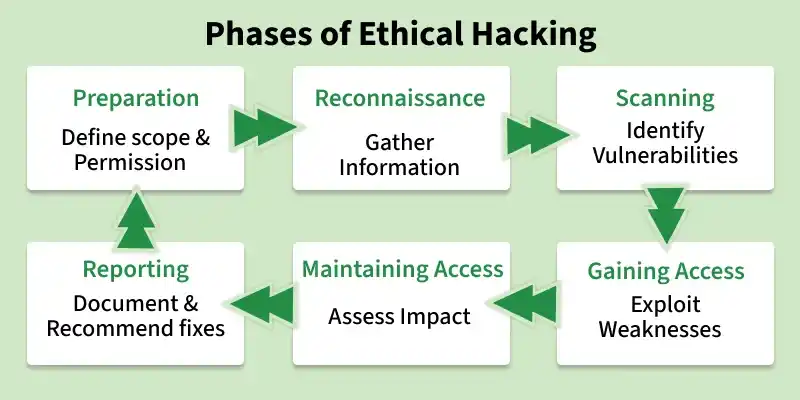
1. Preparation and Planning
This is the first and most important phase.
- Define the scope of testing (what is allowed and what is not).
- Obtain written permission from the organization.
- Identify objectives, target systems, and testing boundaries.
- **Note: Without authorization, hacking is illegal.
2. Reconnaissance (Information Gathering)
In this phase, the ethical hacker gathers as much information as possible about the target.
- Collect IP addresses, domain details, and network structure.
- Identify operating systems and technologies in use.
- Use both passive and active information-gathering techniques.
**Goal: Understand the target before attacking it.
3. Scanning
Now the gathered information is analyzed to find weaknesses.
- Identify open ports and running services.
- Detect vulnerabilities and misconfigurations.
- Perform network mapping and vulnerability scanning.
**Goal: Find possible entry points.
4. Gaining Access (Exploitation)
Here, the ethical hacker attempts to exploit identified vulnerabilities.
- Perform password attacks or exploit software flaws.
- Test web application vulnerabilities like SQL Injection or XSS.
- Simulate real-world attack techniques safely.
**Goal: Determine how deep an attacker could penetrate.
5. Maintaining Access (Post-Exploitation)
This phase evaluates the impact of a successful attack.
- Test privilege escalation possibilities.
- Assess lateral movement within the network.
- Determine how long access could be maintained.
**Goal: Understand the potential damage.
6. Reporting and Analysis
This is the final and most critical phase in ethical hacking.
- Document all discovered vulnerabilities.
- Explain risk levels and business impact.
- Provide clear remediation steps and security recommendations.
**Goal: Help the organization improve security.
Benefits of Ethical Hacking
Ethical hacking has advantages that go beyond just enhancing security, They consist of:
- **Preventing Data Breach: Organizations can avoid costly data breaches by identifying vulnerabilities before attackers do.
- **Protecting Private Information: safeguards vital data from misuse and unauthorized access.
- **Enhancing the System's Resilience: It makes applications and systems stronger and more resistant to attacks.
- **Developing Trust: Demonstrates a commitment to data security and improves the company's reputation.
Skills Required to Become An Ethical Hacker
To become a successful ethical hacker, you need strong technical knowledge and practical skills. Below are the fundamental hard skills required:
1. Networking Knowledge
- Understand network protocols like TCP/IP, DNS, HTTP, and FTP.
- Know how routers, switches, and firewalls operate.
- Analyze network traffic to detect vulnerabilities and suspicious activity.
2. Operating Systems Proficiency
- Be highly comfortable with Linux (especially for security tools).
- Understand Windows and macOS system architecture and security mechanisms.
- Identify OS-level vulnerabilities and misconfigurations.
3. Programming and Scripting
- Learn programming languages like Python, C++, or Java.
- Use scripting languages like Bash or PowerShell for automation.
- Analyze source code to detect security flaws and logic errors.
4. Database Management
- Understand SQL queries and database structure.
- Identify vulnerabilities such as SQL Injection.
- Secure database configurations and manage access controls.
5. Cryptography
- Understand encryption and hashing algorithms.
- Learn how data is protected during transmission and storage.
- Evaluate weaknesses in cryptographic implementations.
6. Web Application Security
- Understand how websites and APIs function.
- Identify common vulnerabilities like XSS, SQLi, and CSRF.
- Analyze HTTP requests and responses for weaknesses.
7. Mastery of Security Tools
- Use tools like Nmap for scanning and Wireshark for traffic analysis.
- Understand exploitation tools like Metasploit.
- Perform vulnerability scanning and penetration testing effectively.
8. Cloud Security
- Understand security principles in AWS, Azure, or Google Cloud.
- Identify misconfigurations in cloud storage and services.
- Secure cloud-based applications and infrastructure.