Intrusion Prevention System (IPS) (original) (raw)
Last Updated : 28 Apr, 2026
An Intrusion Prevention System (IPS) actively monitors network and system traffic to detect and block malicious activity in real time. It extends traditional IDS capabilities by not only identifying threats but also automatically preventing attacks before they cause damage.
- Monitors network and host activities continuously
- Uses signatures, behavior and anomaly analysis
- Prevents intrusions through automated responses
- Enhances security visibility and reduces attack impact
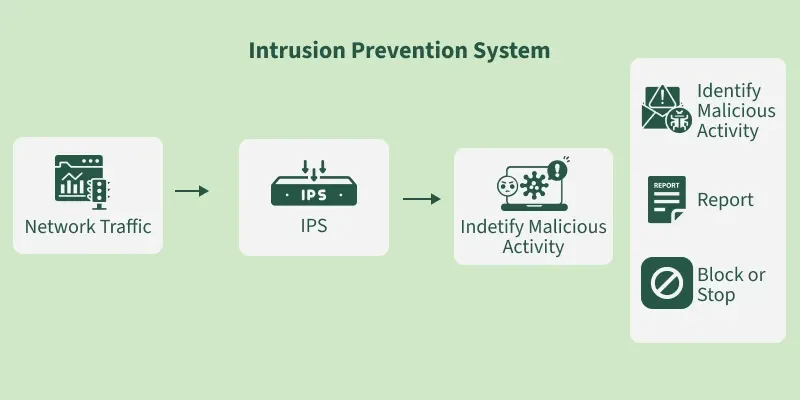
Intrusion Prevention System (IPS)
IPS Working Mechanism
An IPS works by analyzing network traffic in real-time and comparing it against known attack patterns and signatures. When the system detects suspicious traffic, it blocks it from entering the network.
1. Inline Deployment
An IPS is typically deployed in-line, meaning it is placed directly in the path of network traffic between internal networks and external sources (such as the internet). This placement enables the IPS to inspect every packet that flows through, allowing it to block any malicious activity before it can do harm.
- **Positioning: The IPS can be placed behind a firewall or directly between the internal network and external traffic sources.
2. Traffic Preprocessing
Before deep inspection begins, the IPS preprocesses incoming traffic to ensure it's correctly interpreted:
- **Traffic Normalization: It standardizes traffic formats to prevent attackers from using encoding tricks to evade detection.
- **Packet Reassembly: The IPS reassembles fragmented packets to ensure no data is missed and malicious content isn't hidden in fragments.
3. Layered Packet Inspection
An IPS performs deep packet inspection (DPI) to understand both the structure and intent behind the network traffic. This analysis occurs at multiple layers of the OSI model:
- **Network Layer: Checks packet origins and destinations.
- **Transport Layer: Examines the reliability and integrity of the connections.
- **Application Layer: Inspects the type of data being transmitted (e.g., login credentials, file transfers).
4. Detection Mechanisms
The IPS uses various detection mechanisms to identify threats:
- **Signature-Based Detection: Compares traffic against known attack patterns or signatures (like fingerprints of known malware or exploits).
- **Anomaly-Based Detection: Flags any behavior that deviates from normal network activity, such as sudden spikes in traffic or unusual request patterns.
- **Behavior-Based Detection: Monitors and tracks actions over time, identifying suspicious patterns like repeated failed login attempts or unauthorized access attempts.
- **Policy-Based Detection: Enforces custom rules defined by administrators (e.g., blocking traffic from specific countries or blocking certain file types).
5. Automated Response Actions
Once a threat is detected, the IPS can immediately take action to mitigate it:
- **Drop Malicious Packets: Discards harmful traffic before it reaches its target.
- **Block Source IP: Prevents further connections from the attacker’s IP address.
- **Terminate Sessions: Ends suspicious or unauthorized sessions.
- **Trigger Alerts/Logs: Generates alerts or logs for the administrator to review.
- **Update Firewall Rules: Automatically adjusts firewall settings to block traffic from malicious sources.
6. Tuning and Maintenance
An IPS requires regular updates and fine-tuning to stay effective:
- **Update Signatures: Regular updates are needed to add new attack signatures and detection patterns.
- **Reduce False Positives: Fine-tuning helps minimize alerts for non-malicious traffic, ensuring the system only triggers legitimate threats.
- **Optimize Performance: Adjust settings to ensure the IPS can handle high traffic loads without performance degradation.
Types of IPS
IPS systems can be classified into the following types based on their monitoring focus and deployment:
1. Network-Based Intrusion Prevention System (NIPS)
- Monitors and analyzes network traffic for suspicious activity. It is typically placed at the network perimeter.
- Protects the entire network from external threats by inspecting inbound and outbound traffic.
2. Host-Based Intrusion Prevention System (HIPS)
- Runs on individual devices (hosts) within the network and monitors the traffic flowing in and out of those specific devices.
- Provides protection for individual systems and their processes, useful for securing critical machines.
3. Wireless Intrusion Prevention System (WIPS)
- Monitors wireless network traffic to detect and block suspicious activity targeting wireless protocols.
- Protects against wireless-specific attacks such as rogue access points or unauthorized wireless devices.
4. Network Behavior Analysis (NBA)
- Monitors network traffic patterns to identify anomalies that could signify a threat, such as Distributed Denial of Service (DDoS) attacks or malware outbreaks.
- Detects abnormal traffic flows and network behaviors that could indicate a potential attack.
Importance of an IPS
An IPS is an essential tool for network security. Here are some reasons why:
- Protection Against Known and Unknown Threats: An IPS can block known threats and also detect and block unknown threats that haven't been seen before.
- Real-Time Protection: An IPS can detect and block malicious traffic in real-time, preventing attacks from doing any damage.
- Compliance Requirements: Many industries have regulations that require the use of an IPS to protect sensitive information and prevent data breaches.
- Cost-Effective: An IPS is a cost-effective way to protect your network compared to the cost of dealing with the aftermath of a security breach.
- Increased Network Visibility: An IPS provides increased network visibility, allowing you to see what's happening on your network and identify potential security risks.
Comparison of Intrusion Prevention System Technologies
Each IPS type is designed to monitor different parts of an IT environment, providing specialized protection based on where threats occur. Understanding these differences helps in selecting the right combination of technologies for a stronger security posture.
- Coverage varies from entire networks to individual hosts and wireless environments
- Detection approaches include signature-based, anomaly-based and behavior-based analysis
- Some IPS types are better suited for identifying large-scale attacks like DDoS, while others focus on endpoint-level threats
- Using multiple IPS technologies together helps reduce security gaps and improve overall defense
IPS vs. IDS
The main distinction between an Intrusion Prevention System (IPS) and an Intrusion Detection System (IDS) lies in their functionality
IDS (Intrusion Detection System)
- **Detection Only: An IDS is a passive system that detects potential intrusions and generates alerts.
- **Function: It does not block or prevent attacks but informs administrators so they can take action.
IPS (Intrusion Prevention System)
- **Detection and Prevention: An IPS is an active system that detects threats and prevents them by blocking malicious traffic in real-time.
- **Function: It can take automatic actions like dropping packets, blocking IP addresses and resetting connections.