RSA Full Form (original) (raw)
Last Updated : 8 May, 2025
The RSA algorithm, one of the most widely used asymmetric encryption techniques, was invented in 1977 by three researchers: **Ron Rivest, Adi Shamir, and Leonard Adleman, who were professors at the **Massachusetts Institute of Technology (MIT). The algorithm was groundbreaking because it introduced the concept of public-key cryptography, which is the foundation of modern secure communication on the internet.
The name of the algorithm stands for the names of the researchers i.e.
- **R- Rivest
- **S- Shamir
- **A- Adleman
Before RSA, cryptographic systems relied on symmetric encryption methods, where the sender and receiver needed to share a secret key. The challenge with symmetric encryption was the safe distribution of the key, especially over unsecured channels, which made it vulnerable to interception and compromise.
The RSA algorithm solved this issue by introducing the concept of **public and private keys. The public key, as the name suggests, is shared with anyone who wants to send an encrypted message, while the private key remains confidential and is used to decrypt the message. The algorithm is based on the mathematical problem of factoring large prime numbers, which is computationally hard, making it secure even with large data sizes.
What is RSA?
RSA ) is a widely used asymmetric cryptographic algorithm that secures data by utilizing two keys: a **public key for encryption and a **private key for decryption. Developed in 1977 by Ron Rivest, Adi Shamir, and Leonard Adleman, RSA relies on the mathematical difficulty of factoring large composite numbers to ensure its security. The public key is shared with anyone who wants to send an encrypted message, while the private key, known only to the owner, is used to decrypt the message. Here are a few features of RSA:
- **Asymmetric Encryption: Utilizes two keys – a public key for encryption and a private key for decryption.
- **Public and Private Key Pair: The public key is widely distributed, while the private key is kept secret.
- **Secure Key Generation: Based on the difficulty of factoring large prime numbers, making it highly secure..
- **Non-repudiation: Provides proof that the sender cannot deny sending the message, especially when used with digital signatures.
Working of RSA
RSAs' working is based upon two keys:
- **Public key: It comprises two numbers, in which one number is the result of the product of two large prime numbers. This key is provided to all the users.
- **Private key: It is derived from the two prime numbers involved in public key and it always remains private.
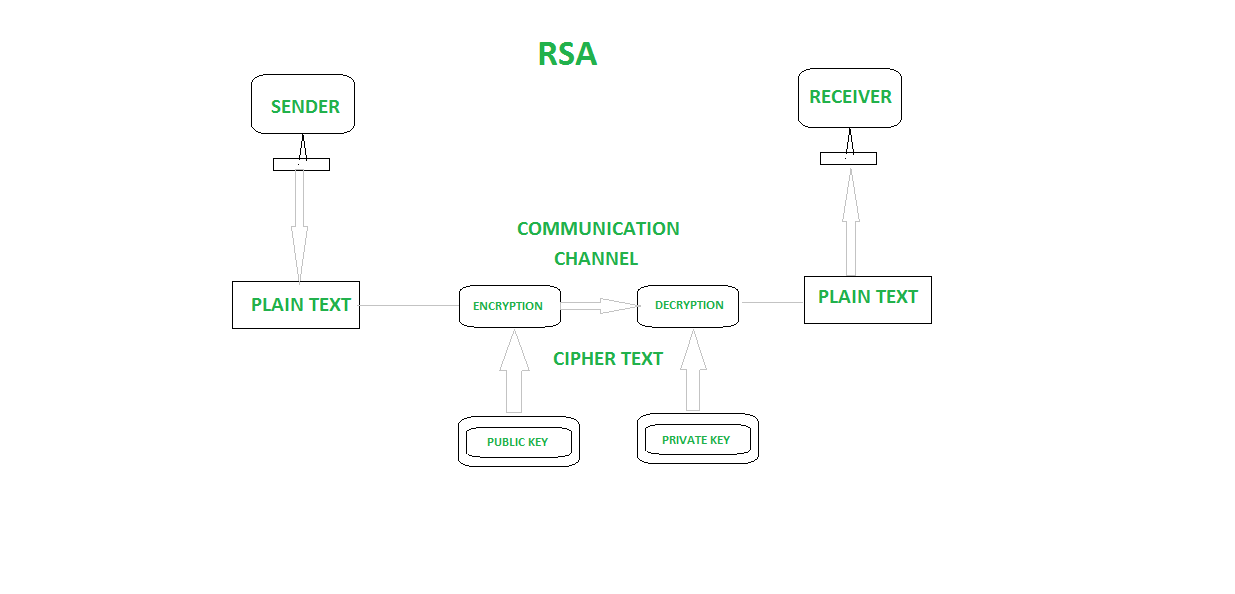
Here’s a stepwise breakdown of how RSA encryption works, as shown in the image:
Step 1: Sender Prepares the Plaintext
- The sender begins with **plaintext, which is the original, unencrypted message that needs to be sent securely. This could be anything from a simple text message to more complex data such as a file.
Step 2: Encryption Using the Public Key
- The sender uses the **recipient’s public key to encrypt the plaintext. RSA encryption relies on asymmetric cryptography, which means two different keys are used: a **public key for encryption and a **private key for decryption.
- The **public key is widely distributed and is used by anyone who wants to send a secure message to the recipient. Since it's only used for encryption, it does not need to be kept secret.
- The encryption process converts the plaintext into **cipher text, a scrambled, unreadable format that ensures confidentiality during transmission.
Step 3: Communication Channel
- The **cipher text is then sent through a **communication channel. This channel could be any form of network or medium, such as the internet, that carries the encrypted data from the sender to the receiver.
- Even if the data is intercepted during transmission, it remains unreadable because it is encrypted.
Step 4: Decryption Using the Private Key
- Upon receiving the cipher text, the **receiver uses their **private key to decrypt the message. The private key is kept confidential and secure by the recipient, and only they have access to it.
- The decryption process reverses the encryption, converting the cipher text back into **plaintext, which is the original message that the sender wanted to communicate.
Step 5: Receive and Read the Plaintext
- After decryption, the **receiver now has the original **plaintext message that was securely transmitted. They can now read or use the data as intended.
Key Points:
- **Public Key: Used for encryption. It’s shared with anyone who wants to send a secure message to the recipient.
- **Private Key: Used for decryption. It’s kept secret by the recipient and ensures that only they can decrypt the message.
Applications of RSA
RSA (Rivest-Shamir-Adleman) is widely used in various applications due to its security features. From being an important component of secure communication to being part of complex blockchain systems and cryptocurrencies, RSA is integral part of security. Here are some common use cases for the RSA algorithm:
1. **Secure Communication (SSL/TLS)
RSA is extensively used in SSL/TLS protocols to establish secure communication between web browsers and servers. In these protocols, RSA is used during the handshake phase to securely exchange symmetric keys between a client (e.g., a web browser) and a server. Once the symmetric key is exchanged using RSA encryption, it is then used to encrypt the data exchanged between the two parties, ensuring that sensitive data such as login credentials, personal information, and credit card numbers are transmitted securely without being intercepted.
2. **Digital Signatures
RSA is used to create digital signatures, which verify the authenticity and integrity of digital messages or documents. By signing a message with a private key, The signature serves as proof of the sender’s identity and guarantees that the message has not been altered. The recipient can use the sender's public key to verify the signature, ensuring that the message was indeed sent by the claimed sender and that it has not been tampered with during transmission.
3. **Email Encryption (PGP and S/MIME)
RSA is used in email encryption systems like **PGP (Pretty Good Privacy) and S/MIME (Secure/Multipurpose Internet Mail Extensions) to secure email content. In both systems, RSA is used for the encryption of the email content and attachments. The sender uses the recipient’s public key to encrypt the email, and the recipient uses their private key to decrypt it. Additionally, RSA is used to sign the email, ensuring its authenticity and protecting the email from tampering.
4. **Data Encryption for Cloud Storage
Many cloud storage services use RSA to secure files stored in the cloud. The public key encrypts files before they are uploaded to the cloud, and the private key is used to decrypt them. The encrypted data is then uploaded to the cloud, and only the recipient, who has the corresponding private key, can decrypt the data. This ensures that only authorized users can access the encrypted files, even if the cloud service itself is compromised.
5. **Virtual Private Networks (VPNs)
RSA plays a key role in the establishment of secure VPN connections. It is used during the key exchange process to securely exchange symmetric keys for encrypting the data transmitted over the VPN.
6. **Cryptocurrency and Blockchain
In blockchain networks, RSA is often employed for securing transactions. It ensures that transactions are authorized by the holder of the private key and not tampered with, adding a layer of security to cryptocurrencies. RSA is used to generate keys for users to sign transactions digitally, providing proof of ownership and authorization. When a user wants to make a transaction, they use their RSA private key to sign the transaction, and the transaction is verified by others using the user’s public key. This ensures that the transaction is valid and authorized by the rightful owner of the cryptocurrency, preventing fraud and unauthorized spending.
Limitations of RSA
RSA encryption is widely used for secure data transmission, but it has some inherent limitations. These limitations can impact its efficiency and suitability in certain applications. Here are some key limitations of RSA:
1. **Slower Performance
RSA is computationally intensive, especially for large key sizes. As the key size increases, the encryption and decryption processes become slower. This can be a significant disadvantage when handling large volumes of data or in real-time systems where performance is crucial.
2. **Key Size and Security
RSA’s security is heavily dependent on the size of the key used. A small key size (e.g., 512-bit or 1024-bit) can be vulnerable to brute-force attacks. As a result, larger key sizes (e.g., 2048-bit or 4096-bit) are recommended to ensure stronger security, but these key sizes further slow down encryption and decryption processes.
3. **Vulnerability to Quantum Computing
One of the biggest concerns with RSA is its vulnerability to **quantum computing. Quantum computers, when fully developed, are capable of solving the mathematical problems that RSA is based on (factorizing large numbers) in polynomial time, making RSA encryption breakable.
4. **Key Management
RSA requires secure management of both public and private keys. If the private key is compromised, an attacker can decrypt any messages encrypted with the associated public key.
Managing and distributing RSA keys, particularly the private key, can be challenging, especially in large systems with multiple users or devices.
5. **Message Length Restrictions
RSA is a block cipher, and it can only encrypt data that fits within a specified block size. For instance, a 2048-bit RSA key can only encrypt messages up to 256 bytes in length (including padding).
Conclusion
The RSA algorithm, invented by **Ron Rivest, Adi Shamir, and Leonard Adleman in 1977, has become a cornerstone of modern cryptography. It revolutionized the concept of secure communications by introducing the idea of public-key cryptography, a system that allowed the encryption and decryption of data using two separate keys, **one public and one private. This innovation solved the problem of key distribution, which was a major challenge in symmetric encryption systems. RSA's use of large prime numbers and its reliance on the computational difficulty of factoring large numbers ensures robust encryption, making it highly secure for various applications such as digital signatures, secure communications, and data encryption.