What is an Attack Surface? (original) (raw)
Last Updated : 12 Dec, 2025
An attack surface is the total set of all possible points where a hacker could enter, exploit, or interact with your system. Think of it as every “crack” in your digital, physical, and human environment that attackers could use to break in.
Why It Matters
- Bigger systems = larger attack surfaces
- More entry points = more ways to attack
- Most breaches begin with exposed attack surfaces

The attack surface increases in size: a small blog may have a tiny surface (simply a website), but a global corporation with cloud servers, IoT devices, and thousands of employees has a big one like:
- Websites and web applications (e.g., login sites).
- Servers and databases (e.g., cloud servers hosted on AWS).
- Devices (e.g., laptops, IoT devices such as smart thermostats).
- Networks (e.g., Wi-Fi or VPNs).
- People (e.g., employees clicking on phishing emails).
**For example: In the 2023 MOVEit incident, attackers used a software vulnerability (one component of the digital attack surface) to steal information from 2,000+ organizations, impacting 60 million individuals. An insecure file transfer tool was the "open window" they crawled through.
**Note: A 2023 study by Gartner found that 80% of data breaches start with an exploited attack surface, like an unsecured API or weak password.
Attack Surface Analysis
- Identifies all possible entry points an attacker could target across digital, physical, and social surfaces.
- Maps how these entry points connect and interact within the system.
- Helps security teams understand where the system is exposed and why those areas are risky.
- Prioritizes vulnerabilities based on impact, likelihood, and exploitability.
- Reveals unnecessary or forgotten assets (shadow IT, old APIs, unused ports).
- Guides teams on how to reduce and harden exposed areas before attackers exploit them.
- Supports proactive decision-making by showing which weaknesses matter most and require immediate action.
- Forms the foundation for continuous security monitoring and better attack surface management.
Types of Attack Surfaces
Not all attack surfaces are the same. Each has unique risks. Here are the three main types:
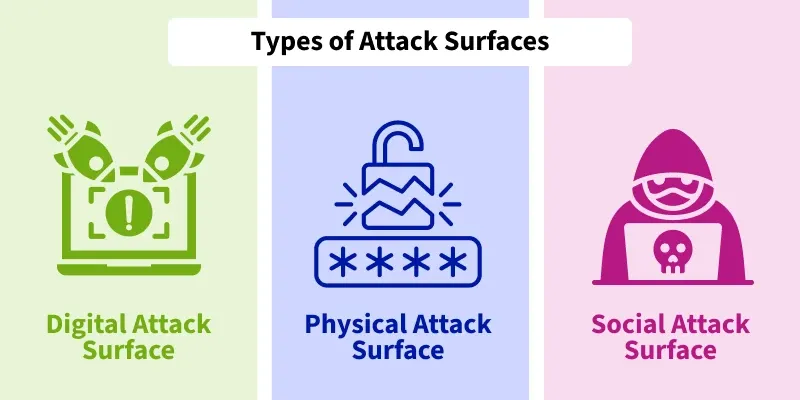
1. Digital Attack Surface
The internet based components hackers target, like websites, cloud services, or software. It's the largest component of most attack surfaces because of worldwide use of the internet.
- **Websites and APIs: Login screens or APIs (such as a payment gateway API).
- **Cloud Services: AWS, Azure, or Google Cloud servers.
- **Software: Apps, operating systems (such as Windows, Linux).
- **Email Systems: Phishing emails to staff.
- **Example: The 2022 Twitter API breach leaked 200M+ user records from an open API, illustrating how digital attack surfaces can result in behemoth breaches.
2. Physical Attack Surface
Physical attack surfaces are devices or areas hackers can physically touch, such as laptops, USB drives, or server rooms.
- **Laptops and Phones: Gaining access to a device with poor passwords.
- **USB Ports: Inserting malicious USB drives.
- **Office Spaces: Gaining access to a server room.
- **Example: In 2019, a hacker breached an unencrypted laptop belonging to a Chicago hospital and revealed 6,000 patients' information, noting physical attack surface risks.3. Social Attack Surface
**Note: The 2017 Target breach began with a stolen HVAC vendor’s access, compromising 40M credit cards.
Human vulnerabilities manipulated by scam, not technology.
- **Phishing Emails: Impostor emails pretending to be from your boss.
- **Social Engineering: Hackers calling employees, pretending to be IT support to obtain passwords.
- **Insider Threats: Angry employees exposing information.
- **Example: A Microsoft 365 credential phishing attack affected 6,000+ accounts in 2020, showing how social attack surfaces facilitate breaches.
**Note: The Colonial Pipeline attack (2021) combined a digital attack surface (weak VPN) and social attack surface (lack of training), costing $4.4M. This shows how attackers exploit multiple surfaces simultaneously, emphasizing the need for good attack surface management.
**How to Secure from social attack surface
- Training employees through simulated phishing
- Enforce two-factor authentication (2FA) (e.g., Google Authenticator).
- Restrict access to data through Role-Based Access Control (RBAC).
Attack Surface vs. Attack Vector
The attack surface is the vulnerable areas (the “what”), while the attack vector is the attack technique (the “how”).
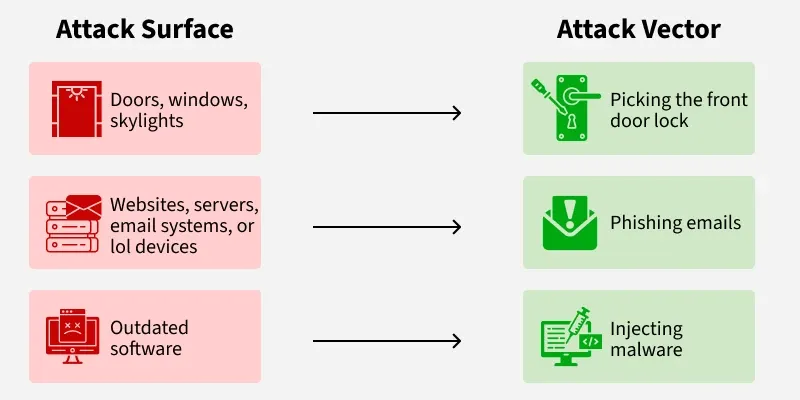
| **Attack Surface | **Attack Vector |
|---|---|
| What can be attacked | How it is attacked |
| All entry points | Techniques used |
| Doors, windows, vents | Lock-picking, breaking glass |
| Websites, APIs, devices | Phishing, SQLi, malware |
| Reduce by removing exposure | Prevent by blocking techniques |
| The size of exposure or risk zone | The specific attack path or tool |
| Reduce by removing unused services and hardening systems | Prevent by blocking techniques and attacker tactics |
| Patch systems, close unused ports, disable services | Firewalls, IDS/IPS, strong passwords, user training |
What is Attack Surface Management?
It's the process of finding, monitoring, and reducing your attack surface so that it becomes harder for hackers to find ways in.
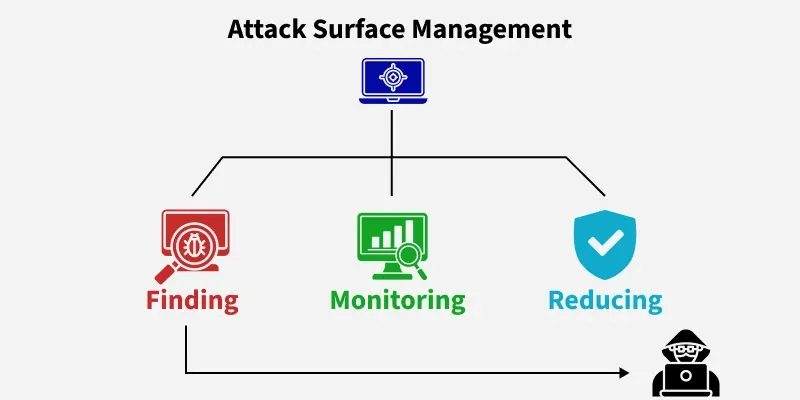
**Core Components of AS
- **Discovery: Graph all of your attack surface vulnerabilities, like forgotten passwords, shadow IT, or new IoT devices added recently. Tools such as Shodan find vulnerabilities with open endpoints.
- **Assessment: Scan for CVSS-scored vulnerabilities (9.8 is high risk). Search for open ports, poor passwords, or out-of-date software.
- **Mitigation: Remediate by patching, installing unused apps, or enabling firewalls. Disable port 3389 (RDP) if not needed.
- **Monitoring: Monitor for changes on a real-time basis (e.g., new API in your application) with real-time alerting with Splunk or Datadog.
**Tools for Attack Surface Management
- **Tenable: Finds vulnerabilities and suggests remediation (e.g., found an open database in a retail company).
- **Rapid7: Monitors cloud and network threats, good for hybrid environments.
- **Censys: Explores internet-facing assets, finds rogue servers.
- **Burp Suite: Examines web applications for vulnerability to SQL injection.
Manage Digital Attack Surfaces
Protecting your digital attack surface is like locking up the internet-facing parts of your apps, servers, and networks. Here's how to do it in simple steps:
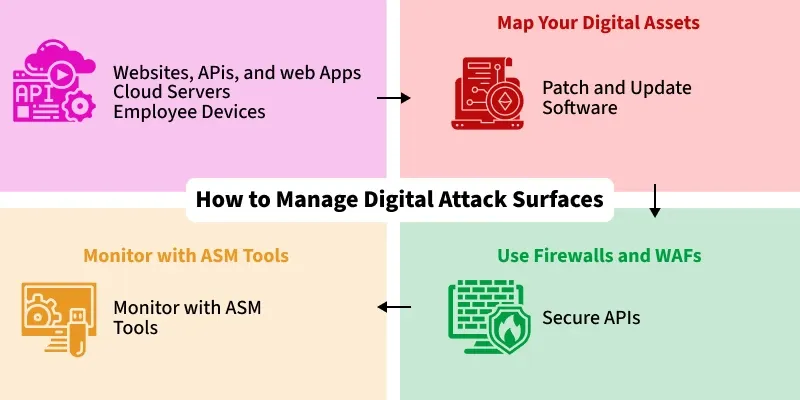
1. Map Your Digital Assets
Take up everything in your digital attack surface:
- Websites, APIs, and web apps.
- Cloud servers (e.g., AWS, Azure).
- Employee devices (e.g., laptops, phones).
- Use tools like Censys or Shodan to scan for exposed assets.
2. Patch and Update Software
Hackers love outdated software—it’s like an open window. Regularly update:
- Operating systems (e.g., Windows, Linux).
- Apps and plugins (e.g., WordPress plugins).
- Example: In the 2020 Equifax breach, 147M records were exposed due to an unpatched Apache Struts bug, which the attackers exploited, costing $1.4B.
3. Use Firewalls and WAFs
A **Web Application Firewall (WAF) blocking the suspicious traffic. Use:
- **Cloudflare for WAF and DDoS protection.
- **AWS WAF for cloud based application.
4. Secure APIs
APIs are common digital attack surface targets. Protect them with:
- Use API keys or OAuth 2.0.
- Also enable rate limiting to avoid abuse.
- **Example: The 2022 Twitter API leak showed how API security was vulnerable to an audience of a million users.
5. Monitor with ASM Tools
Use attack surface management tools like:
- **Tenable: Scans for vulnerabilities.
- **Rapid7: Monitors cloud and network risks.
- **Splunk: Detection of anomalous activity (e.g., 1000 attempts to log on by one IP).
How to Manage Physical Attack Surfaces
Your physical attack surface includes devices and locations that hackers can touch physically. Locking it down is the same as locking down your home's doors and windows. Here's how to do it:
1. Lock Down Devices
Lock down laptops, phones, and IoT devices:
- Use strong passwords or biometrics.
- Enable full-disk encryption (e.g., BitLocker on Windows).
- **Example: An unencrypted stolen laptop can spill company data.
2. Secure Physical Access
Limit who can access server rooms or offices:
- Use keycard entry or biometric locks.
- Install CCTV cameras over entry points.
- **Example: The Target breach in 2017 started with a stolen HVAC vendor's physical access.
3. Disable Unused Ports
Attackers can plug malicious USB drives into available ports:
- Disable USB ports on corporate computers using Group Policy (Windows).
- Use physical port locks on mission-critical systems.
- **Example: There was a 2020 factory breach when an employee plugged in a malicious USB drive.
4. Train Employees
Employees are part of the **physical attack surface:
- Teach them to lock devices when unattended.
- Warn against leaving sensitive documents on desks.
- **Example: A 2019 hospital breach occurred when a nurse left a laptop unlocked.
5. Monitor Physical Security
Use tools like:
- HID Global for keycard systems.
- Verkada for cloud CCTV.
- Regular audits (e.g., checking server room logs) cut off suspicious activity.