What is Secure Software Development Life Cycle (SSDLC) (original) (raw)
Last Updated : 28 Apr, 2026
Secure Software Development Life Cycle is a structured approach to software development that integrates security practices into every phase of the development process.
- It involves planning, designing, coding, testing, deploying and maintaining software while consistently addressing security concerns at each step.
- Crucial to identify and fix security issues early, reducing the risk of cyber threats. By integrating security measures throughout the development process,
- Aims to create safer and more trustworthy software applications. It is an essential practice in the ever-changing landscape of cybersecurity.
Key Principles of SSDLC
The key principles of Secure Software Development Life Cycle define the core practices that guide the development of secure applications. These principles help teams integrate security effectively at every stage of the development process.
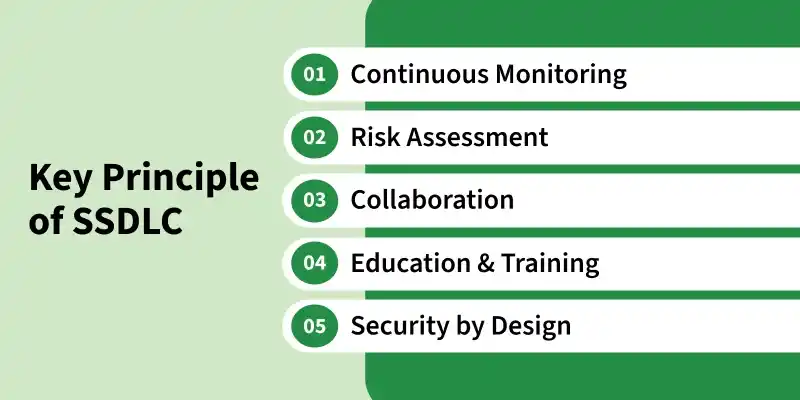
Key Principle Of SSDLC
- **Security by Design: This principle highlights the need to think about security right from the start of creating software. It means including security requirements in the initial planning and design stages of development.
- **Continuous Monitoring: Continuous monitoring ensures that potential threats and vulnerabilities are identified and addressed throughout the entire lifecycle.
- **Risk Assessment: Risk assessment involves identifying and evaluating potential security threats early. It helps prioritize vulnerabilities and take timely actions to minimize risks.
- **Education and Training: Developers and team members must be well-trained in security practices. Proper education ensures they have the knowledge and skills to handle security challenges effectively.
- **Collaboration: Effective security requires teamwork. Collaboration between development, operations and security teams ensures better communication, shared responsibility and stronger overall protection
Phases of SSDLC
Phases of Secure Software Development Life Cycle (SDLC) refer to the different stages involved in building secure software. These phases guide the step-by-step process from the initial planning to the ongoing maintenance of the software.
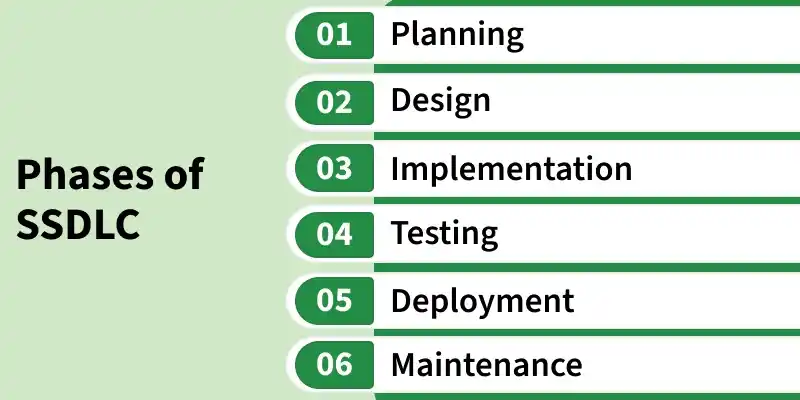
Phases Of SSDLC
- **Planning: In the planning stage, the main focus is on figuring out the security requirements for the software. This includes identifying possible risks and creating a plan for how to make the software secure from the beginning.
- **Design: During the design phase, the plan for security is put into action. This involves making decisions about how to build security features into the software. The goal is to ensure that the design can handle potential security problems.
- **Implementation: In the implementation phase, developers start building the software using secure coding practices. This means writing code in a way that reduces the chances of security problems. Code reviews are done to catch and fix any security issues.
- **Testing: Testing is all about checking how secure the software is. Different tests are done, like trying to break into the software to find vulnerabilities, scanning the code for potential problems and making sure the software can handle different security threats.
- **Deployment: Deployment is when the software is released. Here, the focus is on making sure the release process is secure, taking precautions to avoid any security issues during this stage.
- **Maintenance: Maintenance is an ongoing process where the software is continuously looked after. This involves keeping an eye on security and regularly updating the software to deal with new threats, making sure it stays secure over time.
Examples of a Secure SDLC
NIST Secure Software Development Framework (SSDF)
- The National Institute of Standards and Technology (NIST), which also maintains the National Vulnerability Database (NVD), developed the Secure Software Development Framework to help organizations build more secure software.
- The SSDF provides guidelines, best practices and standardized processes that support the implementation of a secure SDLC. It focuses on reducing vulnerabilities and improving overall software security throughout the development lifecycle.
MS Security Development Lifecycle (MS SDL)
Microsoft introduced MS SDL (Security Development Lifecycle) to integrate security into every phase of software development.
- Ensures secure coding practices and supports compliance requirements.
- Reduces vulnerabilities and minimizes late-stage fixing costs and delays.
SDLC Process vs SSDLC Process
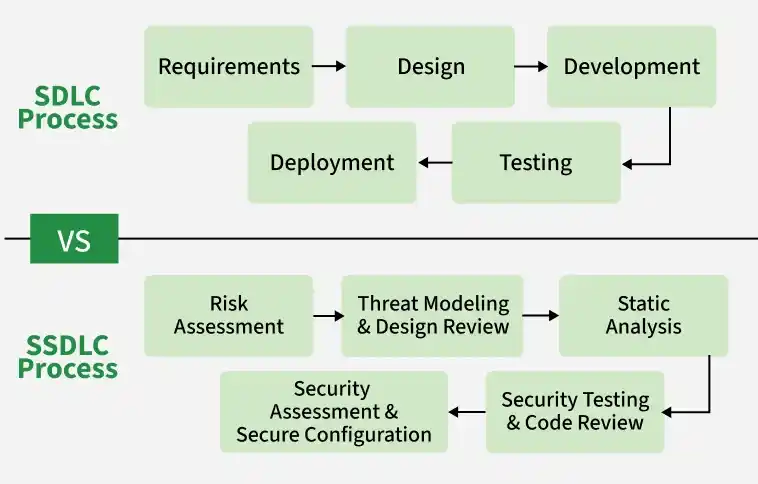
SDLC VS SSDLC
| Aspect | Software Development Life Cycle (SDLC) | Secure Software Development Life Cycle (SSDLC) |
|---|---|---|
| Focus | Primarily on delivering functional software. | Emphasizes security considerations throughout the process. |
| Objective | Meeting business requirements and functionality. | Integrating security measures to protect against vulnerabilities. |
| Phases | Typically includes phases like planning, analysis, design, implementation, testing, deployment and maintenance. | Incorporates security-related phases, such as threat modeling, secure coding and continuous monitoring. |
| Security Considerations | Security is addressed mainly during the testing phase. | Security is considered at every stage, from design to deployment. |
| Testing | Security testing is often a separate phase. | Security testing is integrated into each phase of development. |
| Documentation | Documentation focuses on functionality and features. | Comprehensive documentation on security measures, threat models and risk assessments. |
| Development Speed | Emphasizes timely delivery of software features. | May involve slightly longer development cycles due to added security considerations. |
| Adaptability | Generally more adaptable to changes in business requirements. | May require more effort to incorporate changes due to the stringent security focus. |
The Benefits of Secure Software Development Life Cycle
- **Early Vulnerability Detection: Identifies and fixes security issues early, reducing risks after deployment.
- **Cost Efficiency: Resolving issues during development is cheaper than handling post-release breaches.
- **Enhanced Security & Data Protection: Safeguards sensitive data from unauthorized access and cyber threats.
- **Regulatory Compliance: Helps meet industry security standards and legal requirements.
- **Improved Reliability & Trust: Builds secure, dependable software, increasing user confidence.
- **Reduced Downtime: Prevents security incidents, ensuring better system availability.
- **Long-Term Sustainability: Adapts to evolving threats, extending software lifespan.
- **Competitive Advantage: Strengthens reputation and attracts security-conscious users.
Key Security Challenges in Secure Software Development Life Cycle
Despite its advantages, implementing Secure Software Development Life Cycle comes with several challenges that can impact software security if not addressed properly.
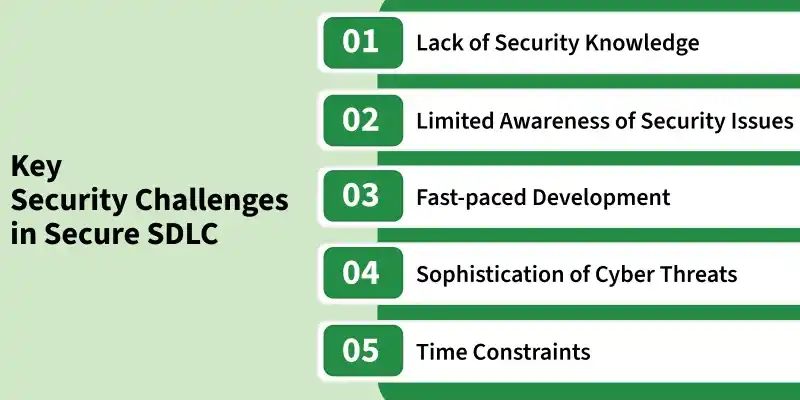
Key Security Challenges In Security Challenges In Secure SDLC
- **Lack of Security Expertise: Limited knowledge of secure coding and best practices can lead to vulnerabilities.
- **Fast-Paced Development: Tight deadlines often reduce the focus on security implementation.
- **Evolving Cyber Threats: Increasingly sophisticated attacks make it harder to predict and prevent risks.
- **Low Security Awareness: Teams may overlook critical security issues due to insufficient awareness.
- **Time Constraints: Pressure to release quickly can result in skipped security checks and testing.
DevOps and Security Integration in SSDLC
Integrating DevOps and security ensures that security is embedded throughout the Secure Software Development Life Cycle (SSDLC). It combines development, operations and security practices to deliver software that is both fast and secure.
- **Early Security Integration: Identify and fix vulnerabilities from the initial stages.
- **Automated Security Testing: Continuously test for security issues during development.
- **Continuous Monitoring: Track and respond to threats in real time.
- **Collaboration: Align development, operations and security teams.
Automation in Secure Software Development Life Cycle
Automation in Secure Software Development Life Cycle (SSDLC) involves using tools and processes to streamline and strengthen security across all development stages. It ensures consistent and proactive security without relying heavily on manual efforts.
- **Automated Security Testing: Perform continuous vulnerability scans and code analysis.
- **Consistent Security Implementation: Apply security controls uniformly across all phases.
- **Continuous Monitoring: Detect and respond to threats in real time.