Version Control Systems (original) (raw)
Last Updated : 11 May, 2026
A Version Control System (VCS) is a tool used in software development and collaborative projects to track and manage changes to source code.
- Tracks and records changes to the codebase, maintaining a structured project history.
- Allows multiple developers to collaborate on the same project without overwriting each other's work.
- Developers access and update a central repository, where project files are stored.
- Enables teams to share updates and revert to earlier versions of the project when needed.
Components of Version Control Systems
Version Control Systems work using a few core concepts that help teams manage code changes and collaborate efficiently.
- **Repository: A central location that stores all project files along with their complete change history and metadata like author and commit message.
- **Revision: A specific saved version of a file or project, identified using a unique ID such as a hash or number.
- **Branch: A separate copy of the codebase used to develop features or fix bugs without affecting the main code.
- **Merging: The process of combining changes from one branch into another, which may sometimes require resolving conflicts.
- **Commit: A snapshot of changes made to the codebase at a specific time, used to track and manage project history.
Types of Version Control Systems
There are three main types of Version Control Systems:
1. Local Version Control Systems (Local VCS)
A Local Version Control System (LVCS) stores all project versions on a single computer and is mainly used by one user without remote collaboration.
**Characteristics:
- No internet or server dependency.
- Useful for individual projects.
- Limited to single-user environments.
2. Centralized Version Control Systems
In a Centralized Version Control System, all the files and their version history are stored in a single central server. Developers connect to this server to access or modify files.
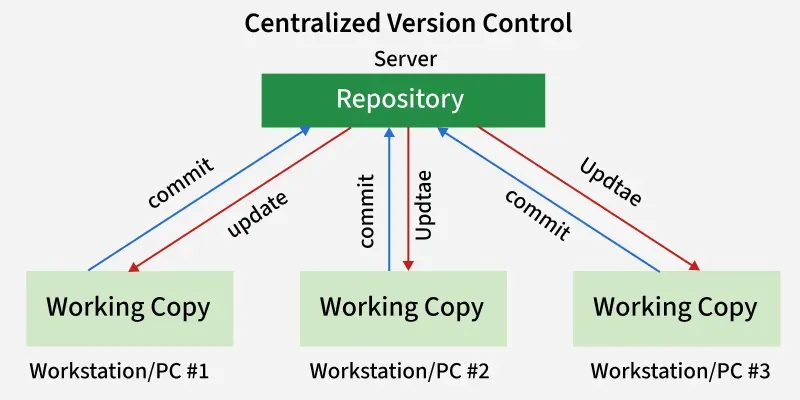
- **Update/Checkout: A developer retrieves the latest version of the files from the central server.
- **Make Changes: The developer works on the files.
- ****Commit:**The developer saves (commits) the changes directly back to the central server, making them immediately available to everyone else.
**Pros:
- Enables collaboration among multiple developers through a central repository.
- Provides visibility into project activities and changes.
- Allows fine-grained access control for administrators.
**Cons:
- Has a single point of failure because everything depends on the central repository.
- If the server goes down, developers cannot collaborate or commit changes.
3. Distributed Version Control Systems
A Distributed Version Control System allows each developer to have a local repository along with a working copy of the project. Changes made in the local repository are not automatically visible to others.
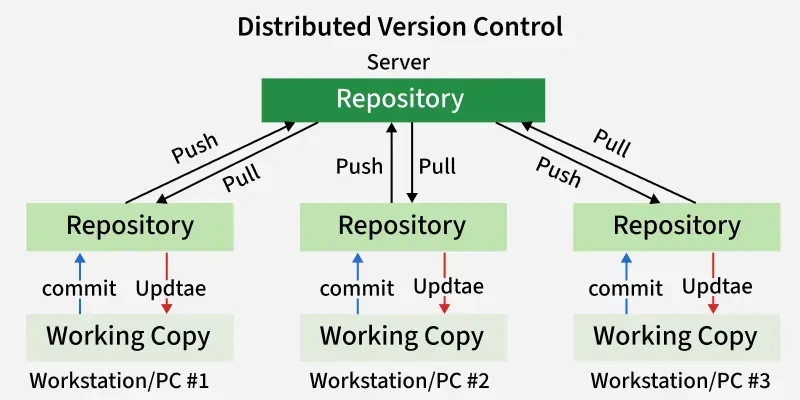
- **Commit: Saves changes to the local repository, visible only to the developer.
- **Push: Uploads committed changes to the central/shared repository so others can access them.
- **Pull: Downloads changes from the central repository to the local repository.
**Note: DVCS uses a two-step process (commit -> push) to share changes with other developers.
Popular Version Control Systems
Below are five most widely used free VCS tools, perfect for individuals and teams. Each of these version control systems serves different needs, and the choice depends on the project size, team collaboration style and workflow preferences.
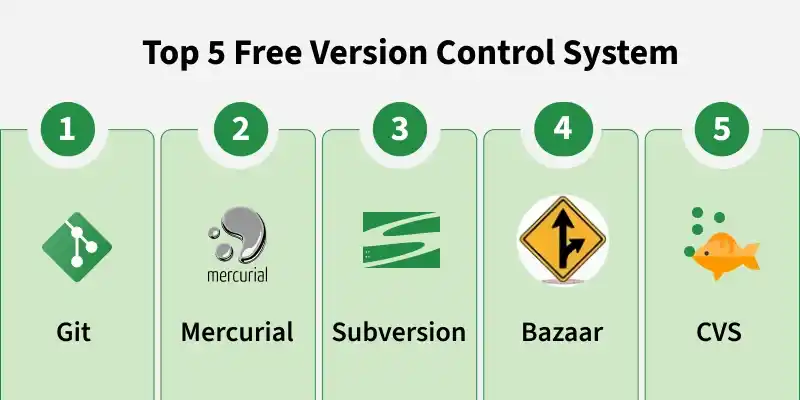
1. Git
Git is a widely used Distributed Version Control System developed by Linus Torvalds in 2005 for managing the Linux kernel. It supports decentralized workflows and is used by platforms like GitHub, GitLab, and Bitbucket.
- Lightweight, fast, and efficient.
- Simple and non-destructive branching and merging.
- Provides powerful commands like git clone, git pull, and git push.
2. Subversion (SVN)
Subversion is a popular centralized version control system. While it is not as commonly used in open-source projects today, SVN is still widely used by many organizations and enterprises for its simplicity and centralized structure.
- Single central repository.
- Supports branching and tagging but it is less flexible compared to Git.
- Versioning of files and directories.
3. Mercurial
Mercurial is a distributed version control system similar to Git but with a simpler interface. It is well-suited for both small and large projects and is used in various open-source and enterprise projects.
- Simple, fast and scalable.
- Supports branching and merging.
- Includes tools for managing project history and changes.
4. CVS (Concurrent Versions System)
CVS is an early centralized version control system widely used in the late 1990s and early 2000s. It influenced modern VCS tools and laid the foundation for systems like Subversion.
- Centralized repository architecture.
- Tracks changes to individual files over time.
- Allows multiple developers to work on the same codebase.
- Basic support for branching and tagging, though more limited than modern alternatives.
5. Bazaar
Bazaar is a distributed version control system developed by Canonical (creators of Ubuntu). It supports both centralized and distributed workflows and was used in projects like Ubuntu and Launchpad.
- Supports centralized and distributed version control models.
- Beginner-friendly and easy to learn.
- Uses human-readable commands like bzr commit and bzr push.
- Cross-platform support (Linux, Windows, macOS).