GraphQL vs REST (original) (raw)
Last Updated : 11 Mar, 2026
GraphQL and REST are two widely used approaches for building APIs that enable communication between clients and servers. Both help applications request and exchange data, but they differ in how data is structured and retrieved.
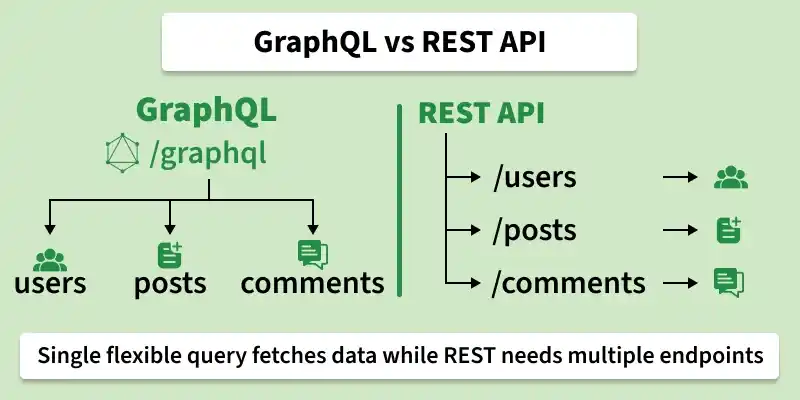
- REST follows a resource-based architecture and typically uses multiple endpoints for different resources.
- GraphQL provides a single endpoint where clients can request exactly the data they need.
- GraphQL helps reduce over-fetching and under-fetching, which can occur in traditional REST APIs.
GraphQL
GraphQL is an open-source query language for APIs and a server-side runtime used to execute queries against a defined schema. It allows clients to request specific data in a single request, making data fetching more efficient.
- Developed by Facebook and later open-sourced in 2015.
- Uses a single endpoint to handle queries and mutations.
- Clients can request only the required fields, reducing unnecessary data transfer.
Features
GraphQL provides several powerful features that make API data fetching more efficient and flexible. These features allow clients to request precise data and interact with APIs through a well-defined schema.
**1. Single Endpoint
GraphQL APIs typically expose a single endpoint through which clients interact with the server. This endpoint handles all types of operations.
- Queries, mutations, and subscriptions are executed through the same endpoint.
- Reduces the need to manage multiple API routes.
**2. Strongly Typed Schema
GraphQL uses a strongly typed schema to define the structure of available data and relationships. This schema acts as a contract between client and server.
- Ensures predictable and well-defined data responses.
- Helps developers validate queries before execution.
**3. Flexible Queries
GraphQL allows clients to define exactly what data they need in a request. This provides more control over the response structure.
- Clients request only the required fields from the server.
- Reduces unnecessary data transfer.
**4. Nested Data Fetching
GraphQL enables fetching related or nested data within a single query. This helps retrieve complex data structures efficiently.
- Multiple related resources can be requested in one query.
- Reduces the need for multiple API calls.
**5. Real-Time Updates
GraphQL supports real-time communication through subscriptions. These allow clients to receive updates whenever data changes.
- Often implemented using technologies like WebSockets.
- Useful for live features such as notifications or chats.
Advantages
GraphQL offers several benefits that improve API efficiency and flexibility. It allows developers to retrieve precise data and design APIs better suited for modern applications.
**1. Prevents Over-fetching and Under-fetching
GraphQL allows clients to request only the specific fields they need in a query. This ensures the server returns precise data instead of unnecessary or incomplete information.
- Clients receive only the required fields in the response.
- Reduces unnecessary data transfer between client and server.
- Improves performance by delivering precise responses.
**2. Efficient Data Retrieval
GraphQL enables fetching multiple related resources in a single query. This helps reduce the number of requests required to gather data from the server.
- Combines multiple data requirements into one request.
- Retrieves related or nested data efficiently.
- Reduces network calls and improves overall performance.
**3. Better for Complex Applications
GraphQL is well suited for applications with complex data relationships. It provides flexibility for modern frontend frameworks and mobile apps.
- Handles nested and interconnected data easily.
- Works well for applications with multiple data sources.
**4. Strong Developer Experience
GraphQL provides tools such as schema introspection and documentation. These features make it easier for developers to understand and use APIs.
- Allows developers to explore API capabilities easily.
- Improves development workflow with better tooling support.
Limitations
Although GraphQL offers flexibility and efficient data fetching, it also introduces certain challenges. These limitations should be considered when choosing GraphQL for API development.
**1. Higher Complexity
GraphQL implementations can be more complex compared to traditional REST APIs. Designing schemas and managing resolvers requires additional setup and planning.
- Requires proper schema design and resolver logic.
- Backend implementation can become complex for large systems.
**2. Caching Difficulties
Caching responses in GraphQL is more challenging compared to REST APIs. Traditional HTTP caching methods are not always directly applicable.
- Single endpoint makes standard caching strategies harder.
- Often requires custom caching solutions at the application level.
**3. Overhead for Simple APIs
GraphQL may introduce unnecessary complexity for simple applications. For basic CRUD APIs, REST can often be simpler to implement.
- Adds extra setup compared to straightforward REST endpoints.
- Not always ideal for small or simple services.
- May increase development effort without significant benefit.
**4. Learning Curve
Developers need to understand GraphQL concepts before implementing it effectively. Schema design and query structure require some learning.
- Requires knowledge of schema definitions and resolvers.
- Developers must learn GraphQL query syntax.
- Initial adoption may take time for teams unfamiliar with it.
REST
REST (Representational State Transfer) is an architectural style used to design networked applications using standard HTTP methods. It organizes APIs around resources that are accessed through multiple endpoints.
- Uses multiple endpoints, each representing a resource.
- Works with standard HTTP methods like GET, POST, PUT, DELETE.
- Widely used and supported with a large ecosystem of tools and frameworks.
Features
REST provides a structured way to design APIs by organizing data around resources and using standard HTTP methods. It follows simple architectural principles that make APIs easy to build and maintain.
**1. Resource-Based Architecture
REST APIs organize data as resources that are accessed through unique endpoints. Each resource represents an entity such as users, products, or orders.
- Every resource has its own endpoint (e.g., /users, /orders).
- Clients interact with resources through these endpoints.
**2. Stateless Communication
REST follows a stateless communication model where each request is independent. The server does not store client state between requests.
- Each request contains all the required information.
- Improves scalability and reliability of APIs.
**3. HTTP Standard Methods
REST APIs rely on standard HTTP methods to perform operations on resources. These methods define how data should be retrieved or modified.
- GET retrieves data, POST creates new resources.
- PUT/PATCH update resources and DELETE removes them.
**4. Simple and Scalable
REST APIs are simple to design and widely adopted in web development. Their architecture makes them suitable for scalable systems.
- Easy to implement and understand.
- Works well for applications of different sizes.
**5. Caching Support
REST APIs can use built-in HTTP caching mechanisms to improve performance. Caching helps reduce repeated requests to the server.
- Supports caching through HTTP headers.
- Improves response time and reduces server load.
Advantages
REST is widely used because of its simplicity and strong ecosystem support. Its architecture makes it suitable for building scalable and reliable APIs.
- **Simple Implementation: REST APIs are easy to design, understand, and widely adopted in web development.
- **Strong Ecosystem: Supported by many tools, frameworks, and libraries across different programming languages.
- **HTTP Caching: Improves performance using built-in HTTP caching mechanisms.
- **Flexible for Many Systems: Works well with microservices, distributed systems, and various types of applications.
Limitations
Although REST is simple and widely used, it has certain limitations when dealing with complex or dynamic data requirements. These issues can affect efficiency and scalability in modern applications.
- **Over-fetching and Under-fetching: APIs may return more or less data than required because responses are predefined.
- **Multiple Requests Needed: Complex or related data often requires several API calls to different endpoints.
- **Multiple Endpoints: Managing many endpoints for different resources can increase API complexity.
- **Versioning Issues: Changes in API structure often require creating new versions such as /v1 or /v2.
Differences Between GraphQL and REST API
Here are some key differences between GraphQL and REST APIs based on how they handle endpoints, data fetching, and real-time communication.
| GraphQL | REST API |
|---|---|
| GraphQL uses single endpoint for every operation. | REST API uses multiple endpoints for different operations |
| In GraphQL client defines what data is required. | REST API fetches data using pre-defined rules. |
| GraphQL reduces over-fetching and under-fetching. | Over-fetching and under-fetching are the common issues with Rest API. |
| GraphQL supports real-time updates with subscriptions | REST API relies on polling for real-time data |
| GraphQL is a growing technology with various tools and libraries. | REST APIs are well established ecosystem with multiple libraries and tools. |
When to Use GraphQL vs REST
Choosing between GraphQL and REST depends on the application's data requirements, complexity, and performance needs. Both approaches are useful in different scenarios depending on how APIs are designed and consumed.
- Use GraphQL when applications require flexible and dynamic data fetching.
- Use GraphQL when frontend clients need different data structures from the same API.
- Use GraphQL when the application involves complex relationships between data.
- Use REST when building simple APIs with predictable resource structures.
- Use REST when quick implementation and HTTP caching support are important.